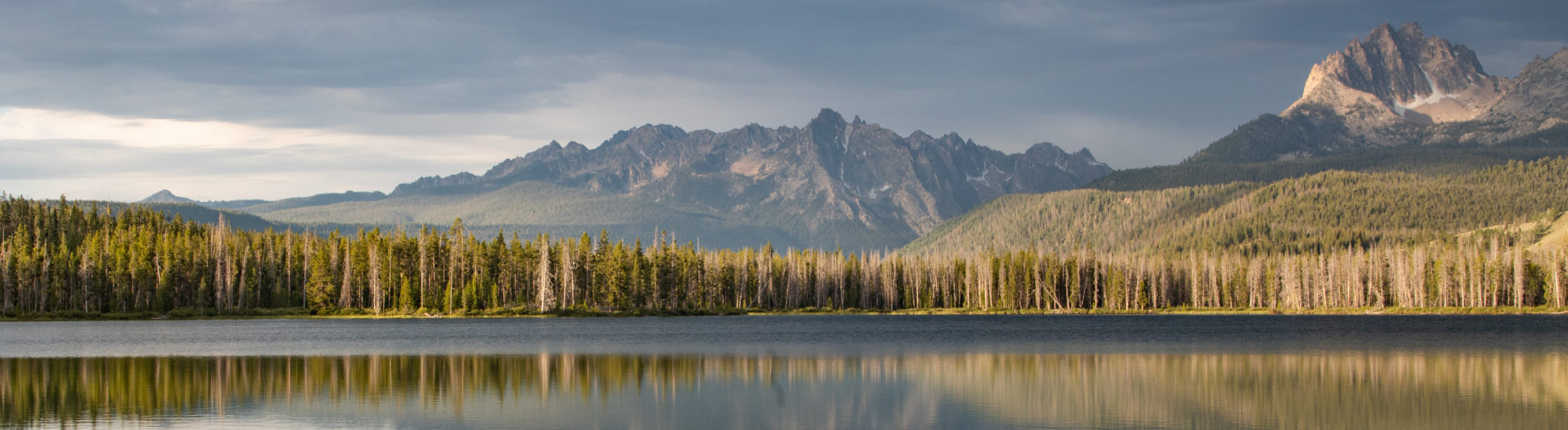
We make it out of Twin Falls before the winds come. We make it past Reno before the rains and we make it over Donner Summit before the snows. The weather forecast is for up to 50 inches of snow in some parts of Montana!
Driving in the dark over the Sunol grade was a bit harrowing but we decide to push on through instead of spending the night in Sacramento. To top off the evening, we arrive to find a block party on the next street and cars are parked on both sides of our typically quiet street. Takes some maneuvering to get into the driveway- seriously?
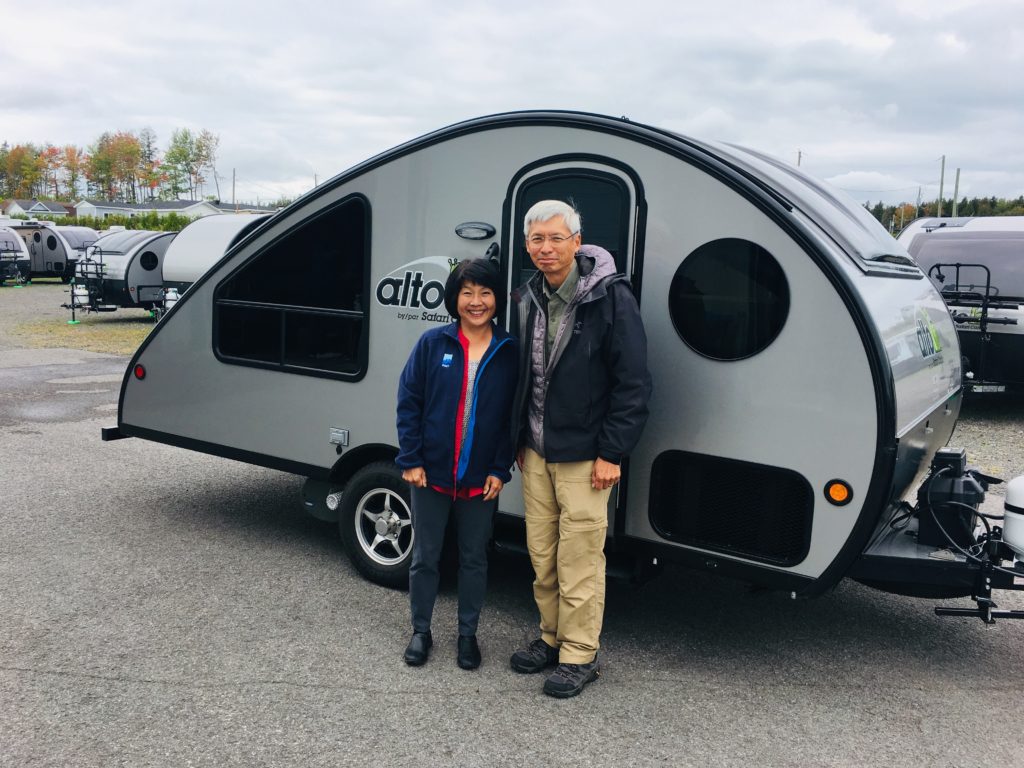
Here we are, car is unloaded and Alto is in the driveway awaiting a bath. It all feels like a dream.
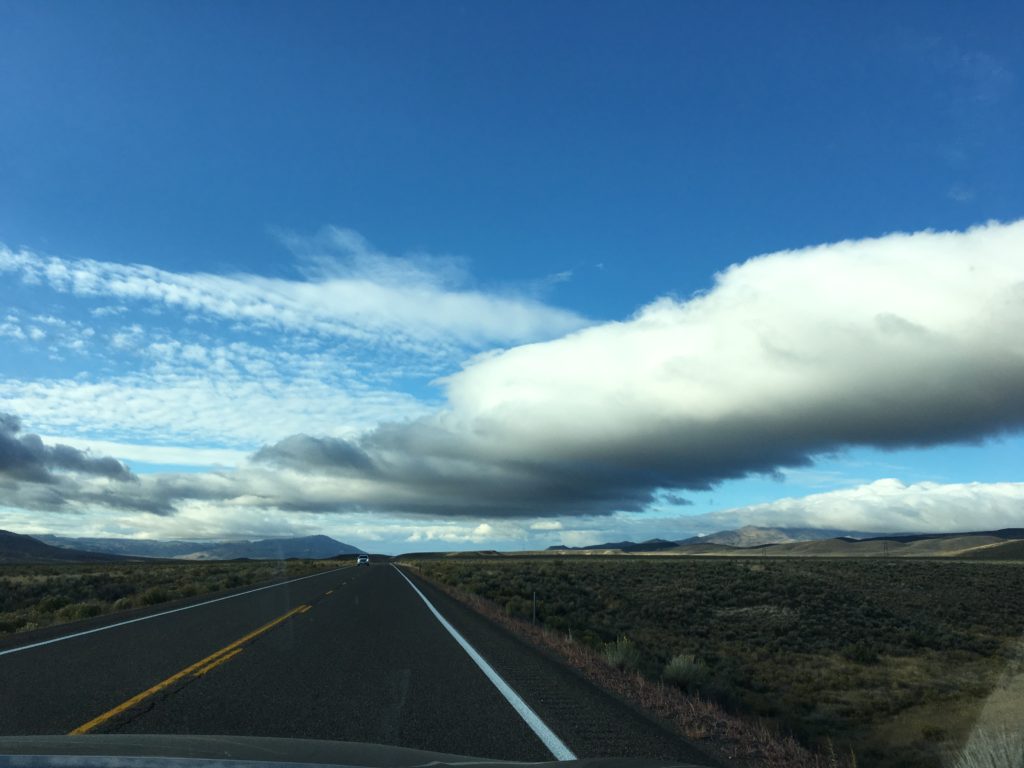
Spaceship cloud in the Nevada desert Coming in for a landing
Even the best laid plans get foiled and you can’t argue with mother nature. We need to move on or risk getting cut off at Donner Pass by snow and cold temperatures in the Sierras this weekend. We leave Livingston early and pass through Billings and Bozeman. I find Bozeman to be a lovely city surrounded by snow dusted mountains and full of fishable rivers and creeks. I hear that winters are brutal with below zero temperatures and mounds of snow.
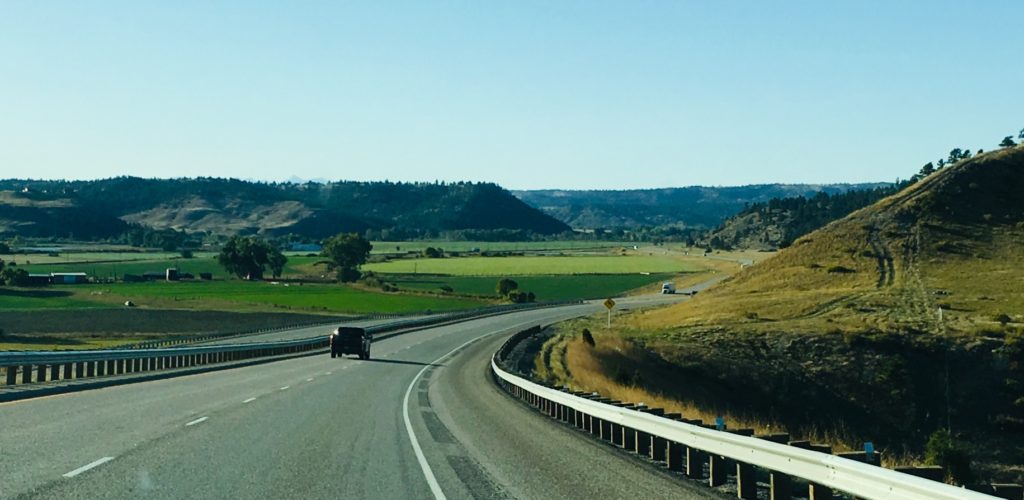
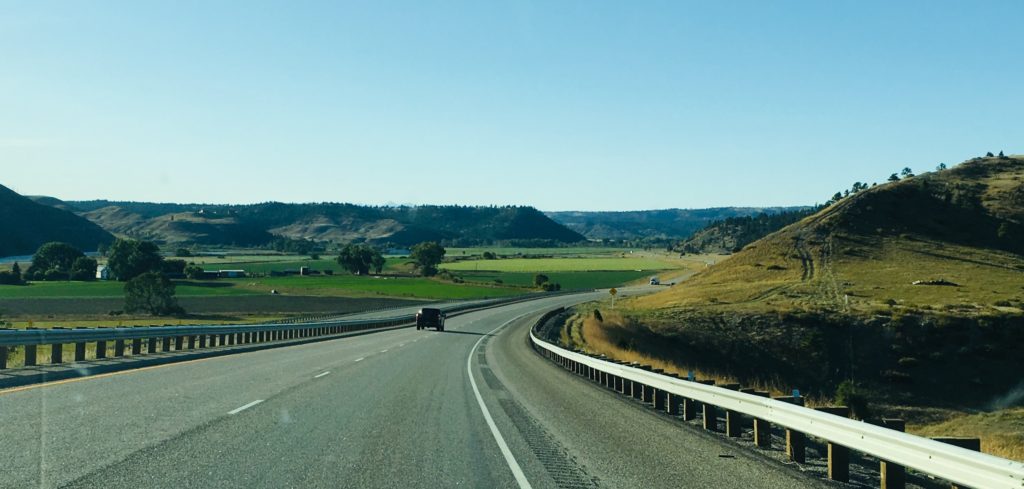
The buttes of Montana
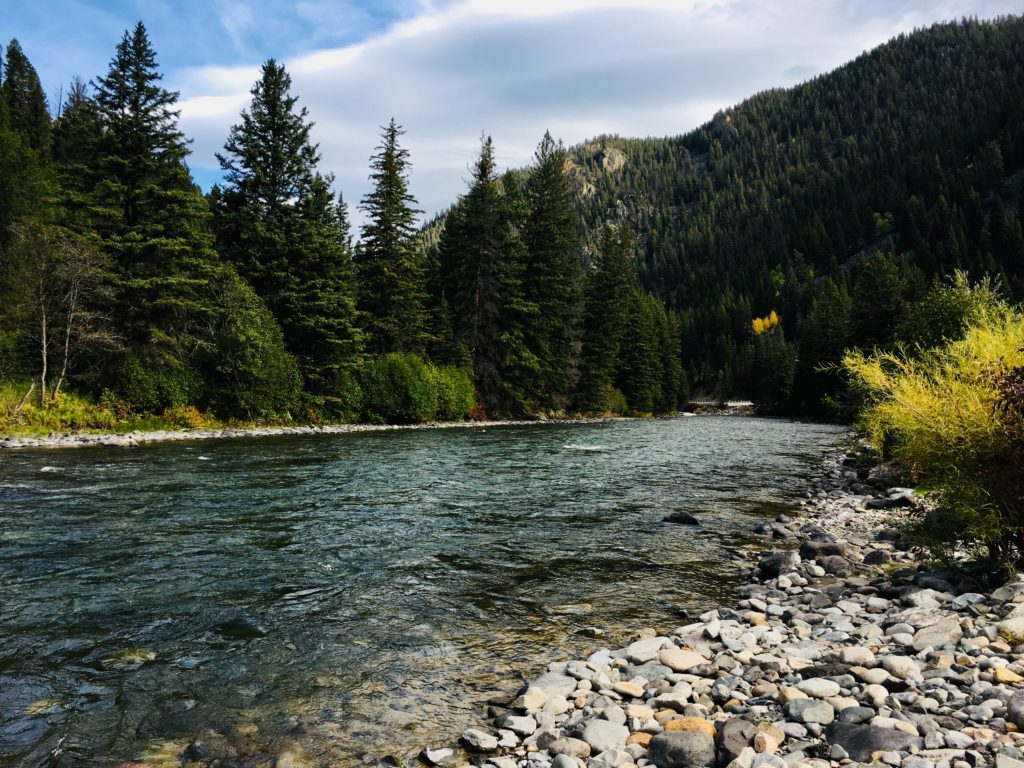
We do stop at least once to fish on the Gallatin, a gorgeous meandering river. The last time I was here, it was muddy from rain. Today it is clear, and the surrounding foliage is rust colored. My casting is just as rusty but it feels good to be out there.
The Gallatin River outside West Yellowstone
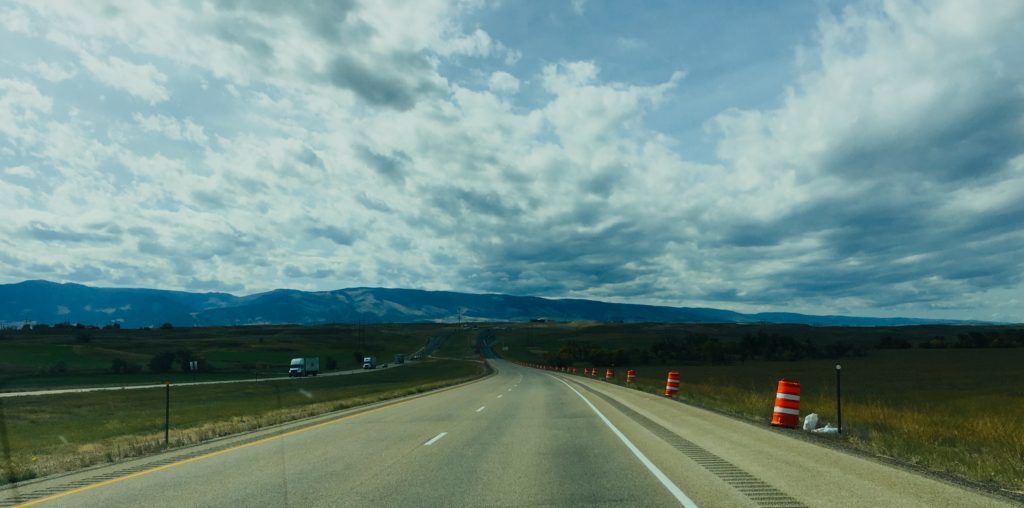
I have always loved the clouds in Montana and today is no exception.
Clouds look like an ice shelf
The town of West Yellowstone is empty and the quietness is such a contrast to the crowds we have seen in August. It is obvious that the season is ending and winter is knocking at the door.
The winds pick up to around 22-24 mph as we pass Island City and Idaho Falls. I monitor wind speeds on the Weather Channel in real time an relay them to Ray. After a while we start guessing and find we are pretty accurate – it helps to pass the time!
Surprisingly, the Alto does really well with its weight distribution sway bars and we hardly notice any difference in towing but the trees swaying in the breeze are a bit disconcerting. We breathe a sigh of relief when we reach Pocatello where the air is much calmer.
Winds creating clouds of dust
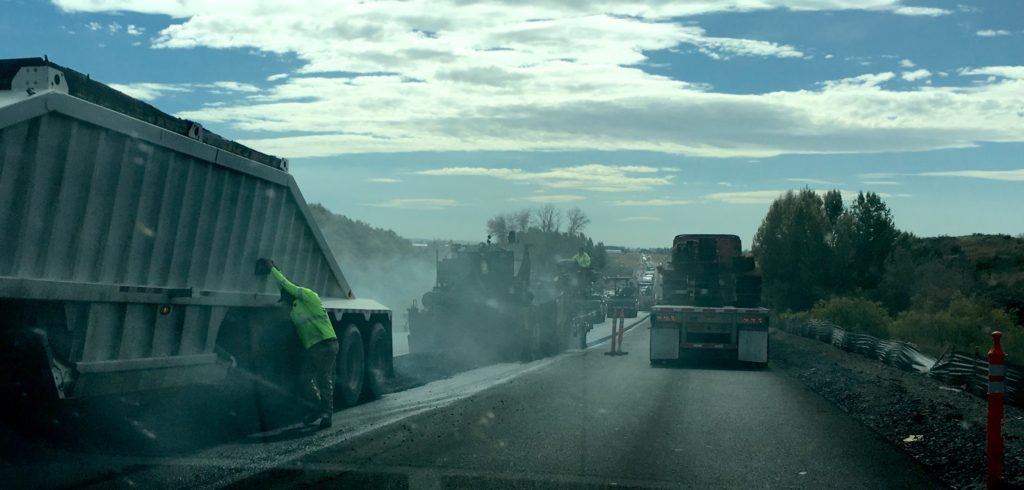
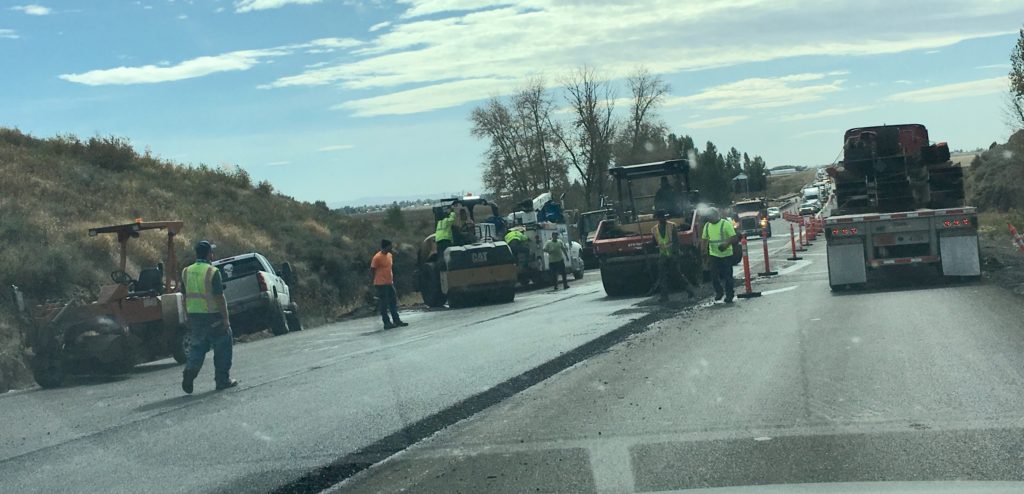
The road construction never ends and this one is the messiest.
Tonight we reach Twin Falls/Jerome and the KOA is small with many large trees. I prepare sausages we bought in Wisconsin-Octoberfest brats. I have to say, the best brats are in Wisconsin just like the best pizza is in Illinois.
I am excited to see an Alto drive in late at night and hope to meet them tomorrow.
Today is a driving day as we leave Rapid City and head toward Billings Montana. We leave early after my run, to avoid forecasted winds along the way. No opportunity to visit Custer State Park, Mount Rushmore or Spearfish Canyon this trip and we promise ourselves we will come back.
Our hope is to be able to get in some fishing time either on the Madison River or Henry’s Fork, and then to head out before nighttime freezing temperatures arrive in a few days. The biggest challenge is to get over Donner Pass and the Sierras since it is expected to snow this weekend. Even if we headed home today, we wouldn’t have enough time to get through. So now our plan is to possibly stay put in Salt Lake City or West Wendover for a few days until the weather improves next week.
Today Ray finally relinquished the wheel and I drive the interstate, giving me a whole hearted appreciation for how well this Alto responds to being towed. I am unable to feel her at all, however our car struggles a bit going up the steep grades and it is somewhat unnerving to see cars zooming by on your left. I feel a bit like an old granny in the slow lane. It takes all my concentration to remember that there are two lengths of us when changing lanes, and that curves take a bigger arc to turn- It takes me back to being a high school student driver, but is also empowering to tow on my own. I today actually believe I could take her out myself and get from point A to B. We’ll see as the week progresses, don’t want to get overconfident!
The Alto is a conversation starter and we meet several fellow Altoistes on the road with plans to stay in touch. There are so few Altos that seeing one on the road is always a thrill. In addition to the couple in Quebec City, we meet a lovely couple from Iowa at a rest stop; we always leave with lots of tip. We stay in touch with others on Facebook, most of whom we have never met.
We love Montana and it feels like we have returned to familiar territory. We spend the night at Osen’s Campground in Livingston. The host has a southern accent, and both sounds like and resembles my friend Alyce from home. Her name is also Linda and she also reminds me of my late boss Lynda.
Not much else to share today aside from the fact that Ray and I are approaching 3 weeks together 24/7 and we are still talking to each other; it is a record!
With eyes on the weather, we look to tomorrow and the possibility of fishing.
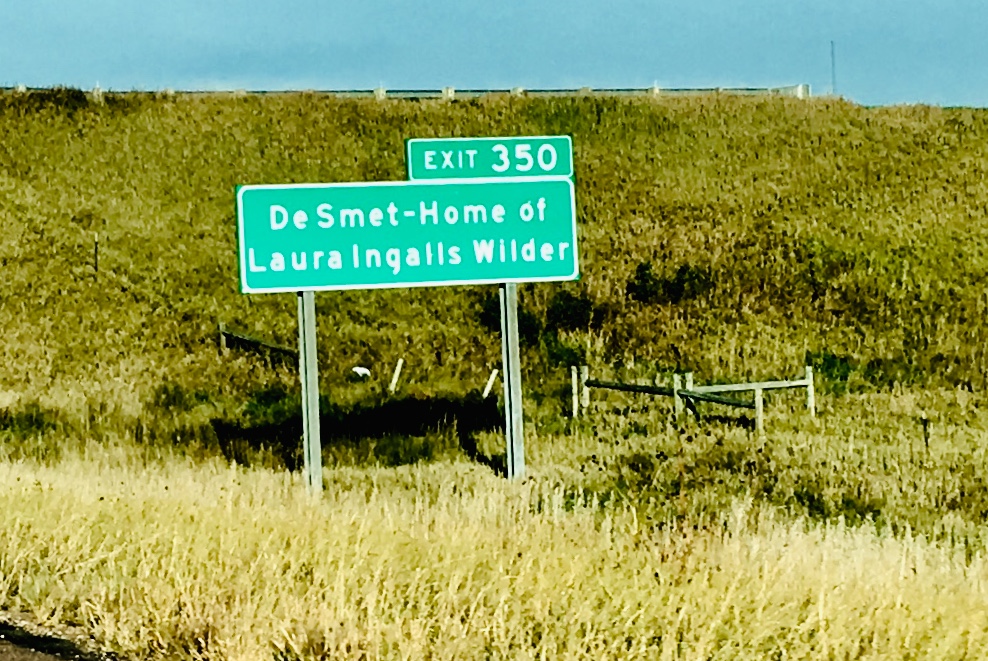
We, or I should say Ray, is worried about winds across South Dakota and so we leave early this morning while it is calm. I am excited to see a sign announcing the town of Desmet, home of Laura Ingalls Wilder, whose family was the first resident, and who later returned to raise her own family. I loved her books and spent many hours reading them to our kids. Seeing the long stretches of prairie made her stories come real.
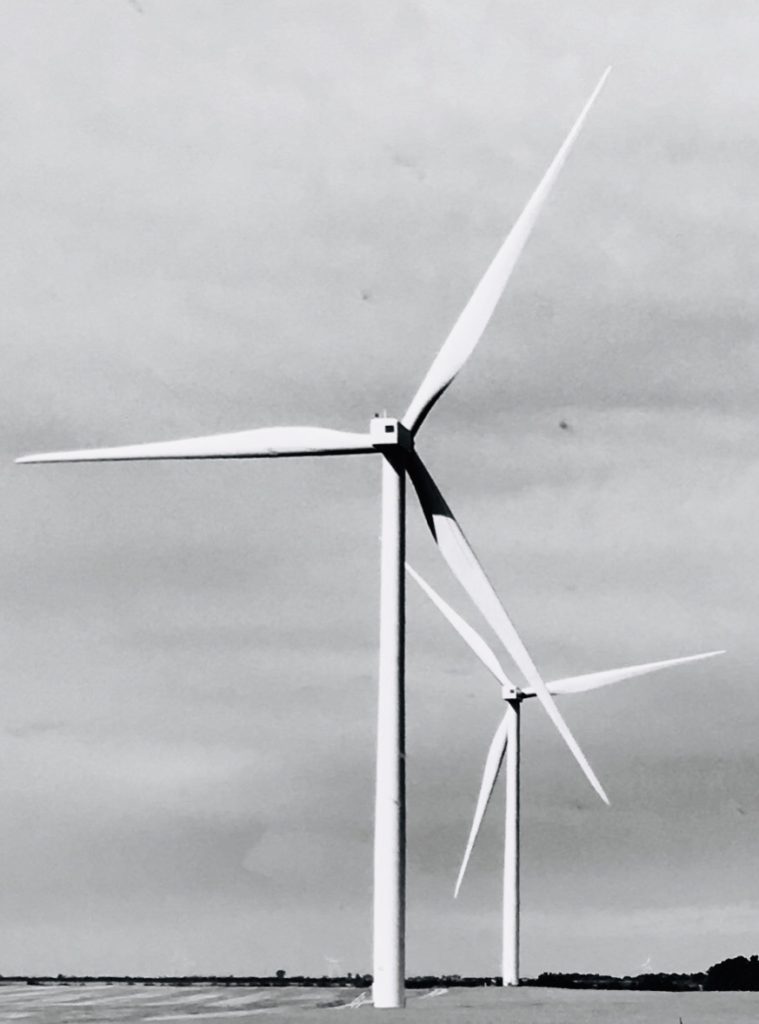
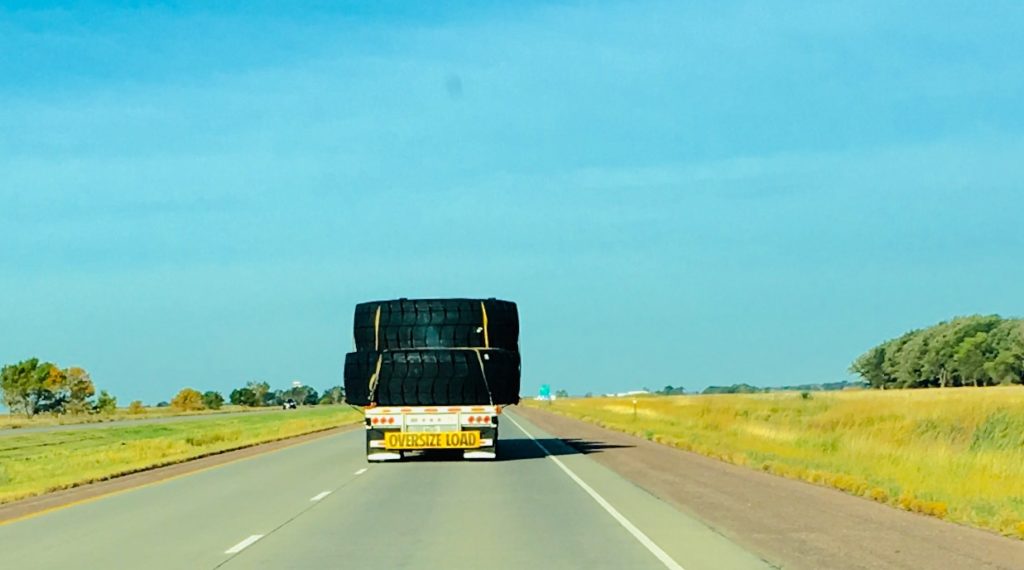
Wind turbines on the prairie. Fields of soybeans. SunflowersGigantic tires, not sure what they are for.
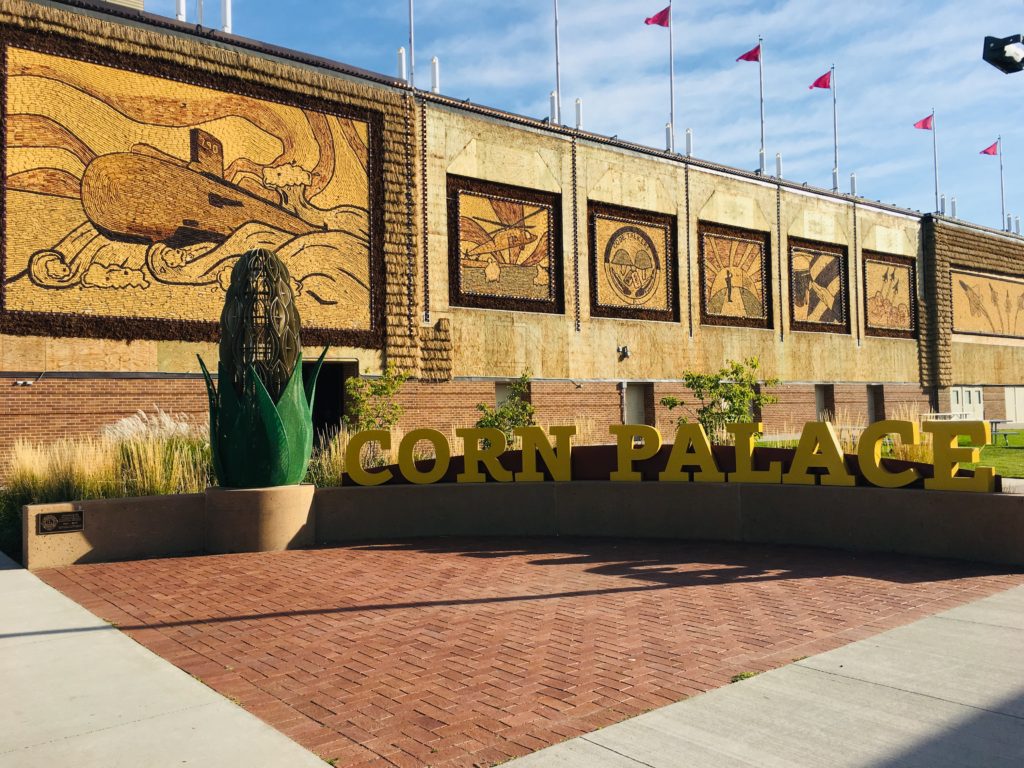
It is all about corn today as we drive across the plains. The town of Mitchell is famous for the “world’s only corn palace” which historically was made to celebrate its prosperity and to be an agricultural showplace of the world.
The Palace is redecorated each year with naturally colored corn, other grains and native grasses – 13 different colors or shades of corn (red, brown, black, blue, white, orange, calico, yellow and even green). A different theme is chosen each year, and murals are designed to reflect that. Ear by ear the corn is nailed to the Corn Palace to create the scenes. The decorating process usually starts in late May with the removal of the rye and dock. The corn murals are stripped at the end of August and the new ones are completed by the first of October. It is quite a unique place!
Murals made with corn.
As we drive, I find some interesting corn facts: 40% of US corn is used for ethanol, 36% for feed, 20% for exports and the remainder for other processing like corn syrup. Dry millers produce flakes, grit, meal etc and wet millers for ethanol, syrup, oil etc.
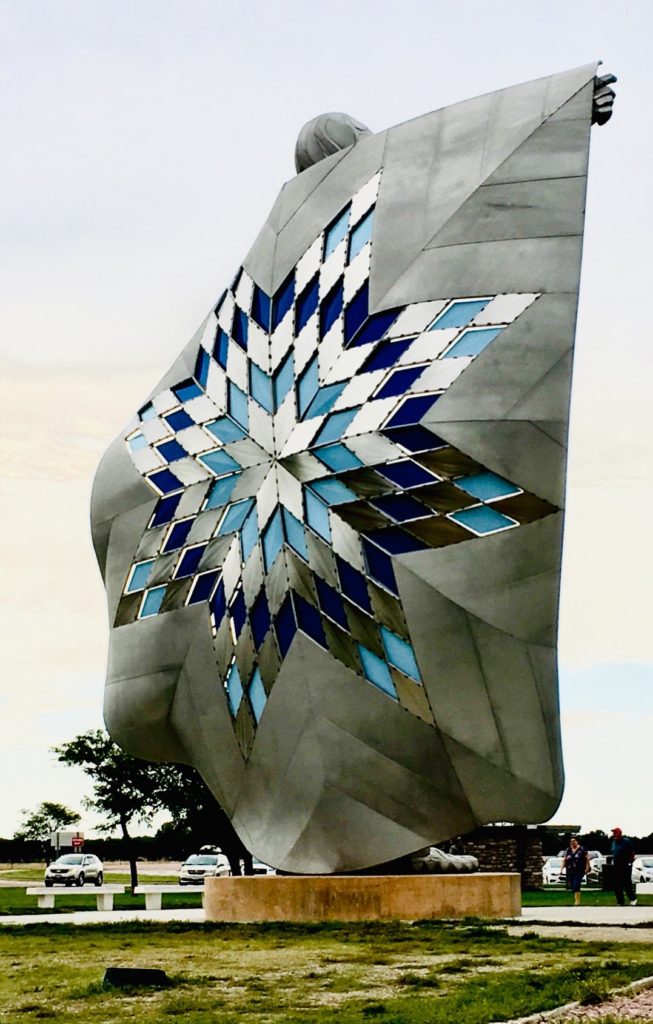
The Chamberlain rest stop has a gorgeous overlook of the Missouri River. At the beginning of the path is a 50 ft sculpture “Dignity” which represents the courage, perseverence, wisdom of Lakota and Dakota cultures.
Made from 128 4 ft diamond shapes, perforated to allow wind to blow through.
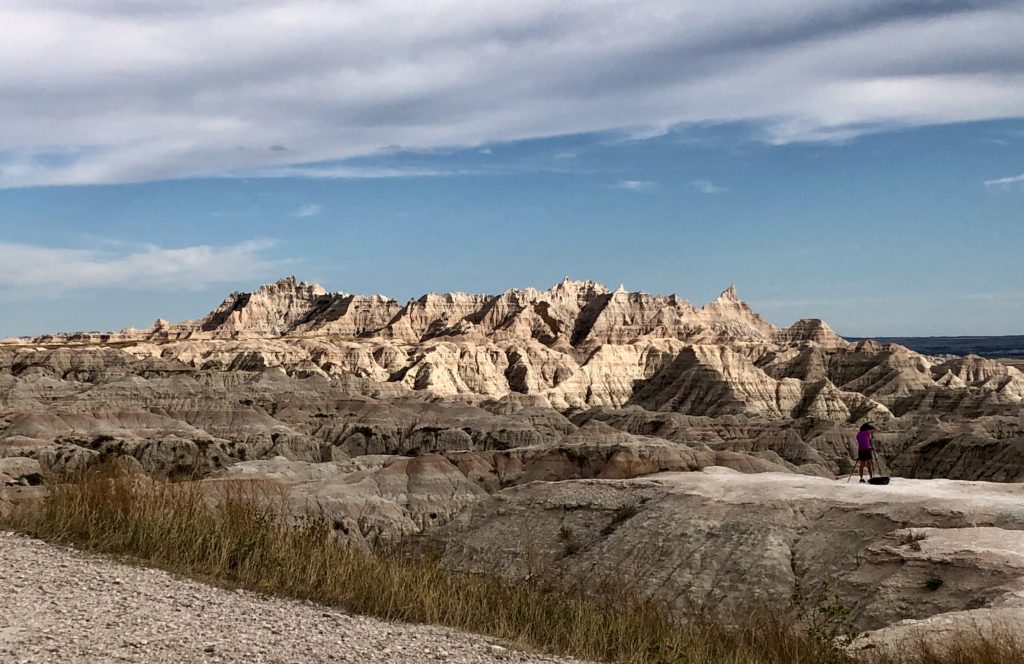
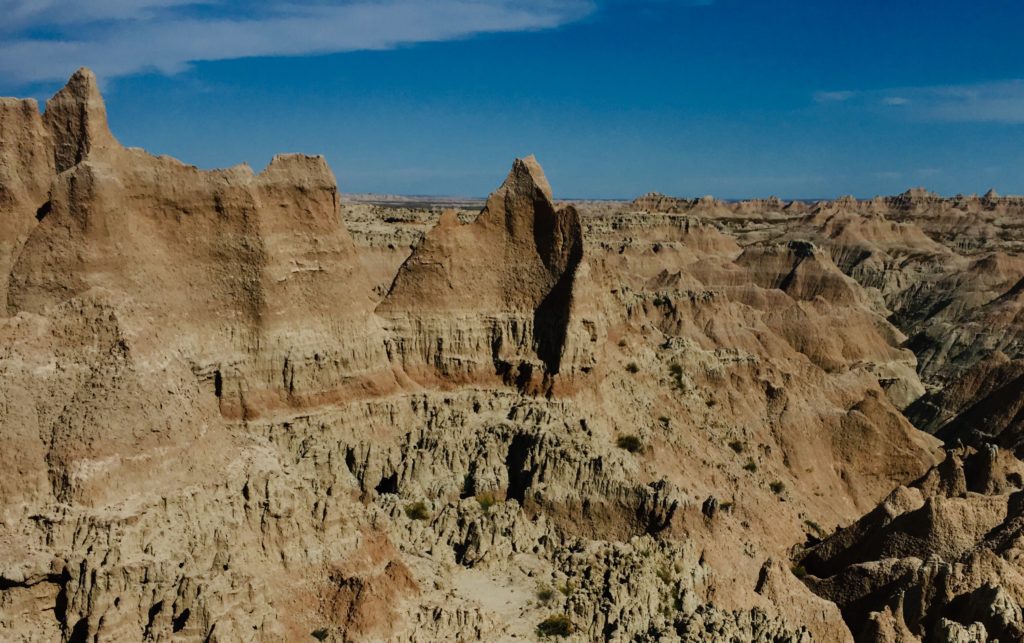
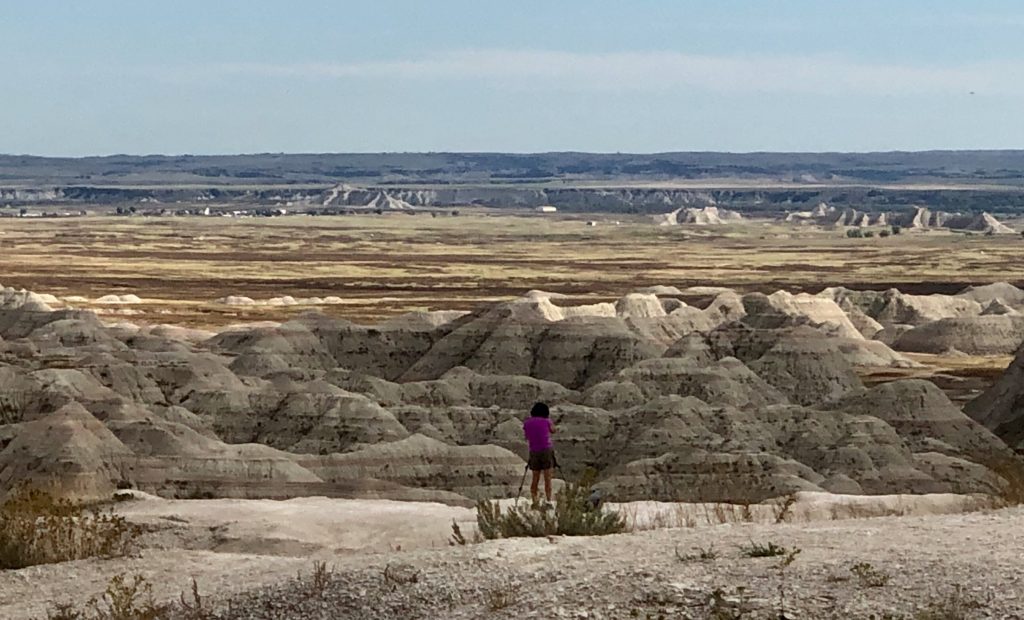
By early afternoon, we reach the Badlands National Park, 244,000 acres of spectacular landscape. We drive the 30 mile scenic loop road with many overlooks and viewpoints. What a beautiful place, so peaceful and majestic, with spires and canyons, gray rock with red striations.
Photo of me courtesy of RayPhoto courtesy of Ray
I also get my first chance to tow today. Ray finally relents… it is really not that hard; both car and trailer are great.
Our last stop today is the KOA in Rapid City and dusk falls as we arrive.
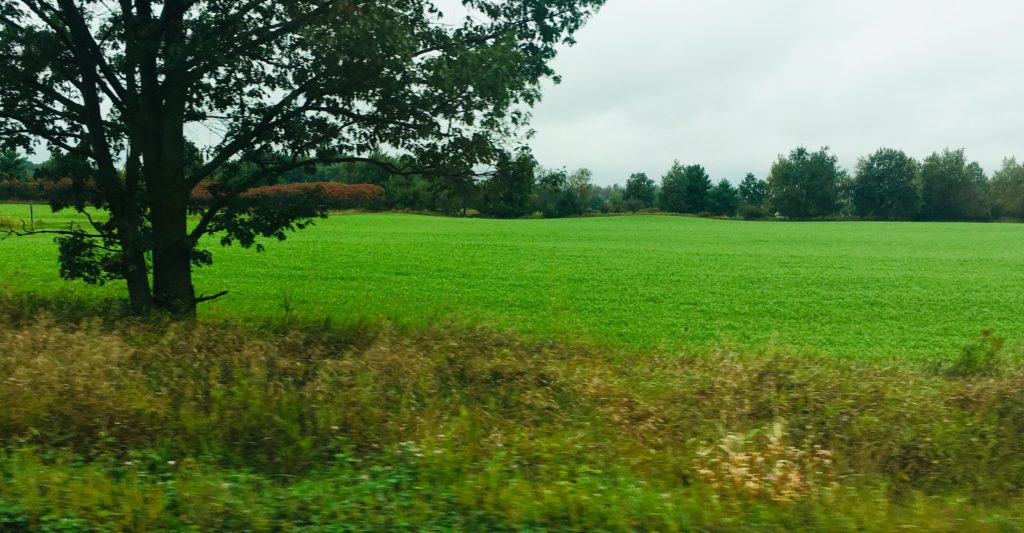
Ray says we are like the old game “Where in the world is Carmen Sandiego” with little dots tracking us across the US. After a nice run 10 laps around the campground, we are ready to travel across Minnesota. Green fields, the St. Croix and then the Mississippi River, quite narrow as it flows through St. Paul. It is a gorgeous day, too nice to be in a car but we have states to cross before the rains and cold weather hit Montana.
So green are the hills! Mississippi River So much corn!!
At a rest stop, we learn that 400,000 square miles of North America used to be prairie. Today, the most fertile and well-watered region, the tallgrass prairie, has been reduced to less than 4% of its original area. This makes it one of the rarest and most endangered ecosystems in the world. This sea of grass stretched from the Rocky Mountains to east of the Mississippi River, from Saskatchewan, south into Texas. It was the continent’s largest continuous ecosystem supporting an enormous quantity of plants and animals. Prairie began appearing in the mid-continent from 8,000 to 10,000 years ago and has developed into one of the most complicated ecosystems in the world, surpassed only by the rain forests of Brazil.
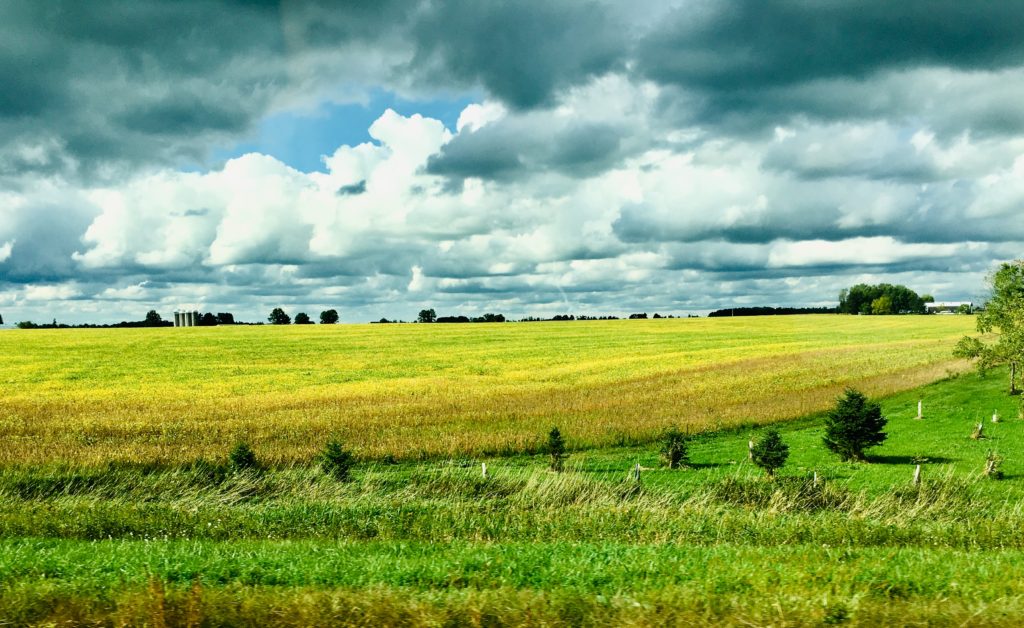
Driving through this area and into South Dakota, there are miles and miles of corn fields. We cannot believe how much corn is being grown. Did you know the US has over 96 million acres of corn, producing over 13 billion bushels and is subsidized at around $3B a year? We see what appears to be soybean fields turning a colorful yellow.
Wind turbines dot the landscape near Sioux Falls and then we see these… not sure what they are.
Tonight we are again at a KOA in Sioux Falls – so many huge rvs pulling in, it feels like a bus depot. Quite an rv culture we had no idea existed! I think visitors from China or Africa would be incredulous.
We have lived in California so long we have forgotten what it is like to have constant rain. No wonder the grass everywhere is so bright green. Some lakefront homes look like they are close to flooding.
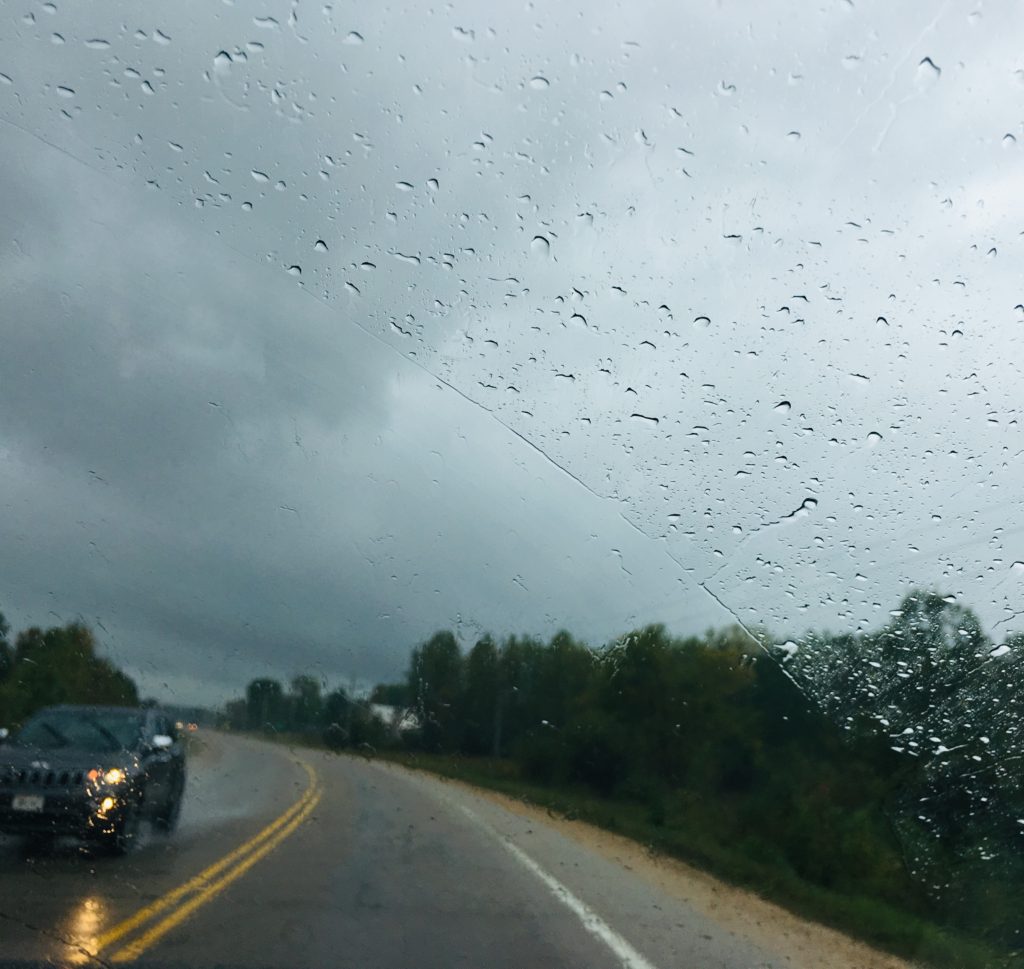
Today starts out gray but the winds of yesterday have died down. There is an approaching storm and we are trying to beat it by leaving early. Weather along the coast of Lake Michigan can be fierce. Well we make it partway but then the torrential rains come, blinding and relentless for 15 min. but feeling like hours! There is no where to pull over so we plow through with white knuckles, kudos to Ray.
This photo doesn’t show the worst of it!
The towns along the Wisconsin coast have a history of logging and shipping, and some have beautifully restored brick buildings. Heading westward from the coast are cornfields, woods, meandering rivers, and many lakes. We take a break in the little town of Shawamo for brunch at the Farmers Inn, a cute little local cafe. As quickly as the rains come, the skies clear and it is a beautiful afternoon. In the sunlight, the ripe corn tassels create a bright golden palette that is breathtaking.
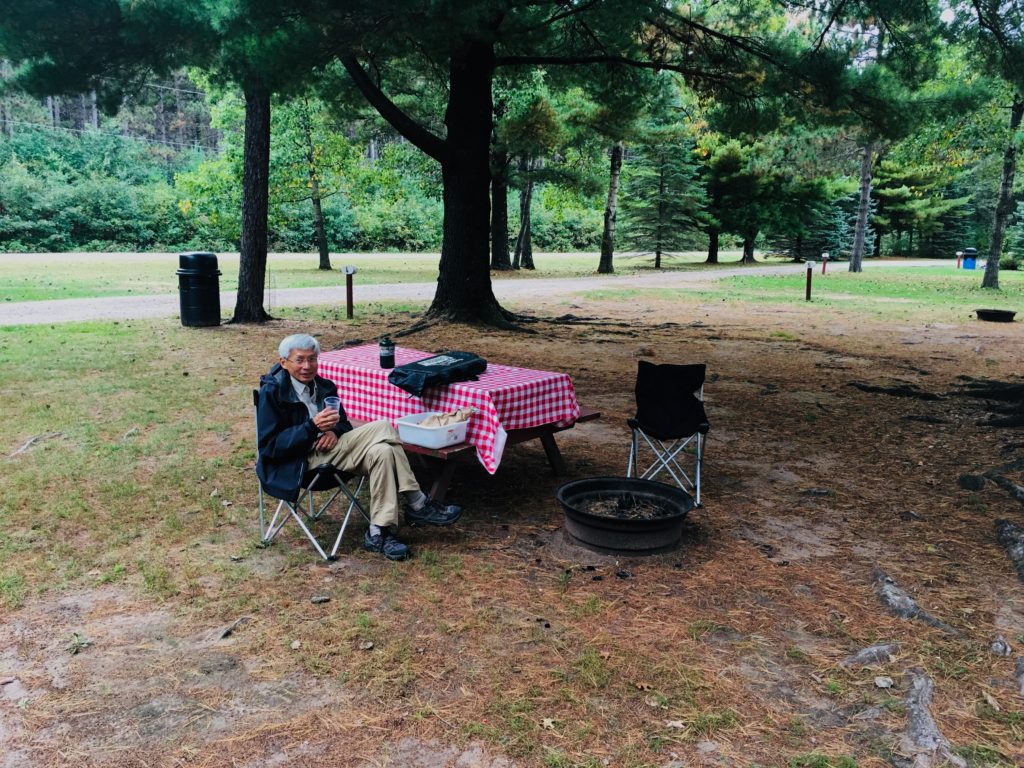
Pine Harbor Campground is near Lake Wissota on the outskirts of Chippewa Falls, almost to Eau Claire, Wisconsin. Out of the lake flows the Chippewa River which flows to the Mississippi. The sites are spacious and full of large pines. We manage to cook, eat dinner, play horseshoes and walk before it rains again.
Relaxing with Baileys Irish Cream Compared to others in the campgrounds, we seem so tiny, a real mini!
Together we are gaining on the learning curve, taking baby steps- filled the fresh water tank today. Funny, I feel like we are on our honeymoon, traversing this incredible country together.
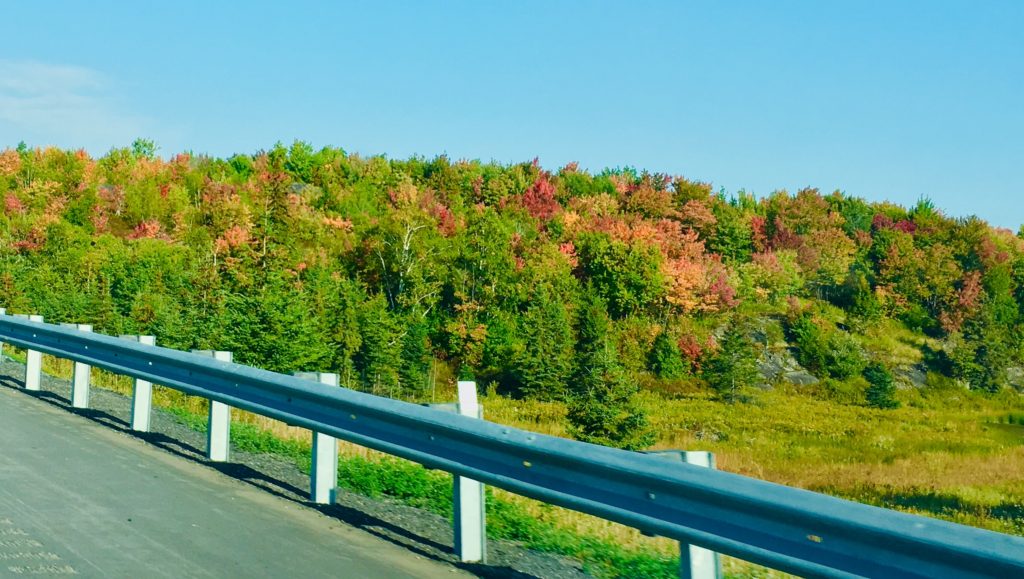
The colors are beautiful driving across Ontario. We see lake after lake, and networks of rivers that run along small towns. Lake Huron is enormous with two large arms, the end of which is the shipping port and Soo locks at Sault Sainte Marie.
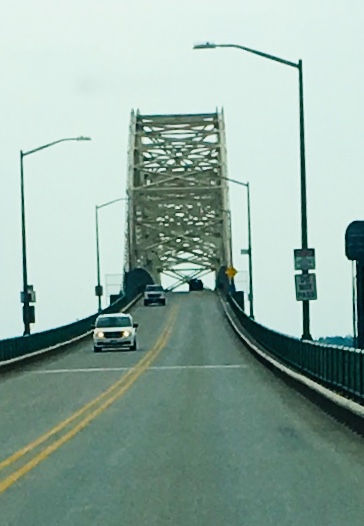
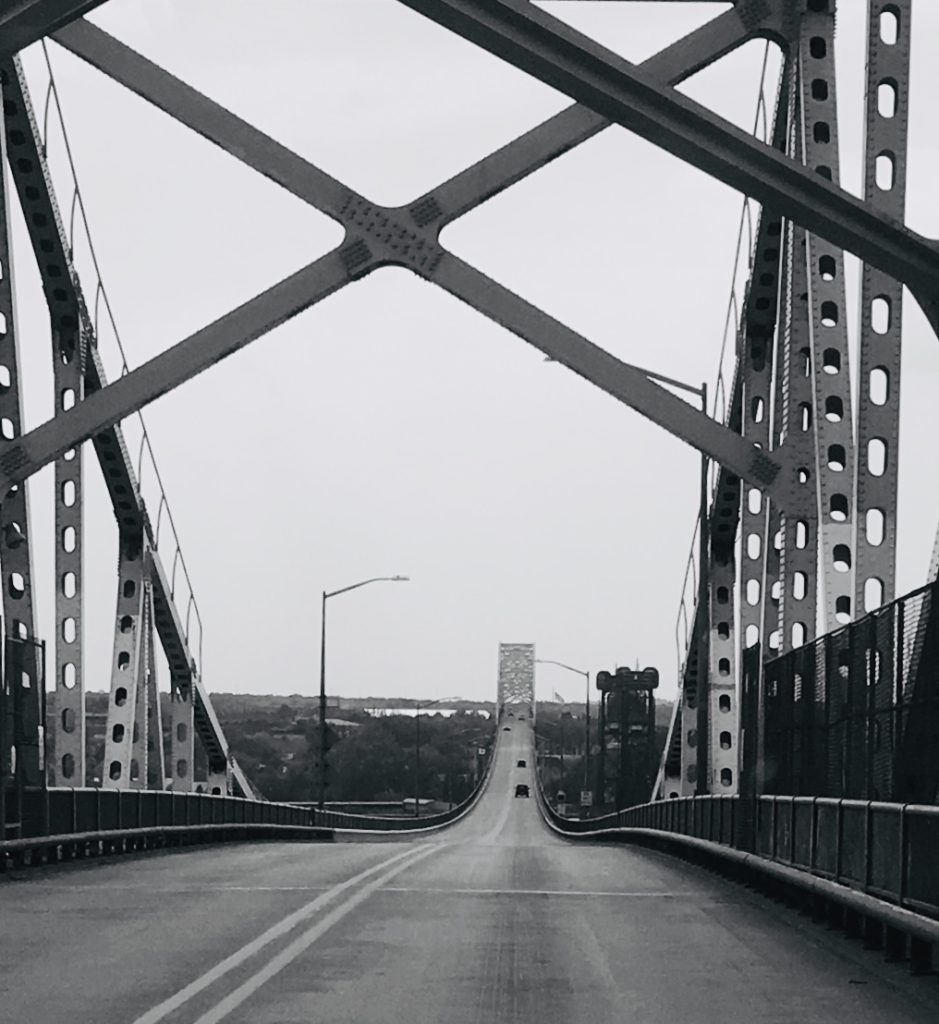
Today’s adventure is taking the trailer over the bridge and into the US. through customs at Sault Sainte Marie.
We aren‘t really sure what to expect and are directed to back up to the dock. I manage to talk them out of the backing up part and they settle for us parking along the edge. We are told to get out of the car and up to the customs office while they search the trailer- not sure what they are looking for (drugs, weapons, people?) but they declare it clear after about 20 min. While we are waiting, we hear them talking about a huge truck carrying spaghetti sauce and making sure there is no meat in the sauce! We breathe a sigh of relief and scramble to get out of there as quickly as possible. For whatever reason, it is an intimidating place and the customs officers are a stern bunch.
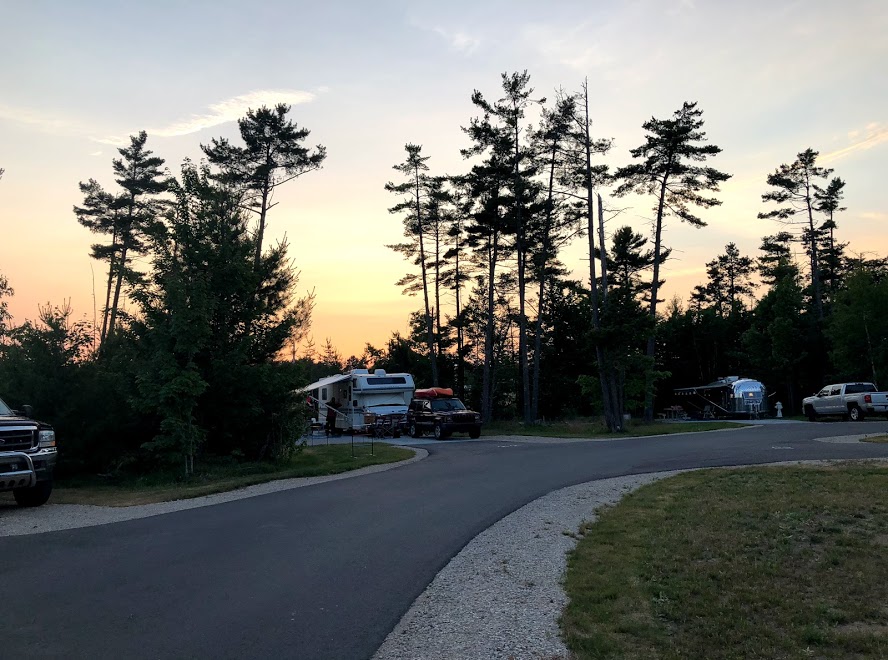
The beautiful Manastique Lakeside Campground is on the northern coast of Lake Michigan and the sites are surrounded by pines and maples. in fall foliage. We arrive right as the rain starts. It is windy and the white caps on the lake are pretty big-wouldn’t want to be in a boat out there!
It’s an angry looking Lake Michigan today
We run into a couple from Michigan who tell us the lake was calm as glass yesterday. They also say getting through customs with a trailer can be dicey depending on the mood of the customs officers. They have friends whose trailers were searched and left a mess; they avoid going to Canada.
Now comes the job of figuring out the rest of our return route to avoid some night time freezing temperatures in Montana and Idaho – in September, really?? That and rain/snow showers may prevent us from fishing…and it is so hot back home!
So far we have not unhitched,; the plan is to do so in the Badlands in a few days.
Today is my birthday and it is a joy to hear from Jen and Robert with Kira. We will celebrate all our birthdays when we get home.
Day 2, today is easier and a bit more relaxed. The highway from Ottawa to Sudbury is 2 lane and goes through small towns. In between are vast areas of forest, lakes and rivers. We are parallel to the river which separates Quebec and Ottawa. The land is mostly flat with some rolling hills.
Our only challenge today is when we go down a side road to look at the lake, and discover that there is no turn around! Backing up for the first time is an exercise in itself.
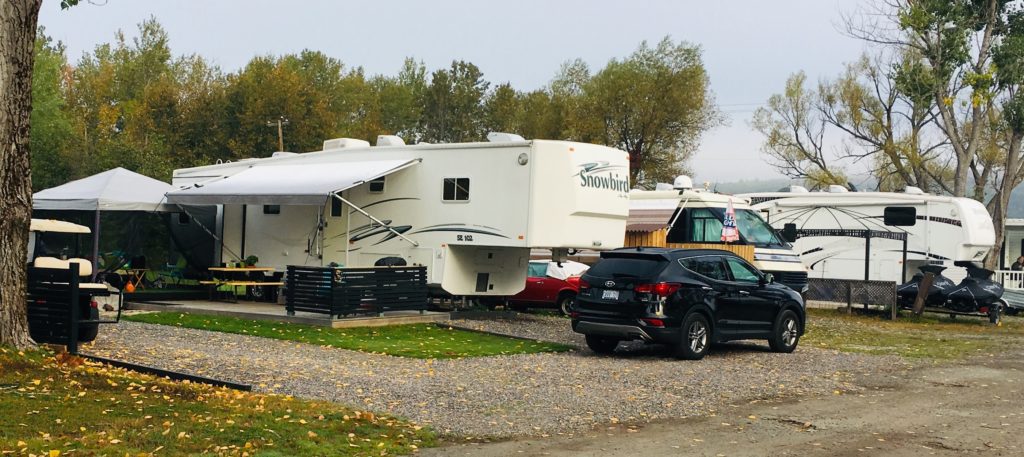
Tonight we are at Carol’s Campground in Sudbury, looking forward to getting back to the west coast and some fun places! Again, the place is full. The owner tells us people come in May and by October, are gone. Some have 2 rvs – one north and one south, and they keep the unused one in storage. We are incredulous because the rvs have fences, gazebos, porches, storage sheds and large potted plants and some resemble small mobile homes! We find this hard to believe.
Can you believe people store all this away for the winter?
We check weather and find that our planned stays in Montana and Wyoming may not be possible as they expect snow showers next weekend! Can you believe it? We will have to wait and see and plan as we go. Hopefully this cold front will move elsewhere.
I start the day with a run, using the large KOA as a track, elderly gentlemen wave and smile to me as I pass with each lap. The KOA in Quebec City is immaculate and well kept. We pull checklists that other Altoistes have created and very diligently go through the motions of breaking camp, hitching up and checking/rechecking each step. Over an hour later we are ready to hit the road. Fortunately, the weather is clear and calm. Ray drives, I navigate; we are both very focused.
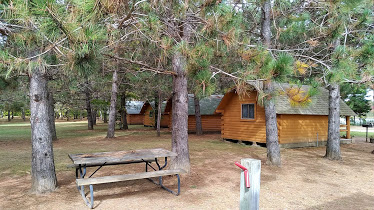
We have forgotten how much summer road construction takes place in places that have cold winters. Our route skirts Montreal by going south with Ottawa as our destination. We pull in to the KOA in Renfrew right at dusk. The site is a pull through, no need to unhitch. The site is next to cabins and pine trees, though all the trailers are packed close together.
We had expected private campgrounds to be empty this time of the year but it is full with huge trailers that appear to be there for the season; they have gardens and gazebos. Only a few spots are open for travelers. We settle in, prepare dinner and relax for the evening. Thus ends our first day of towing.
It is always fun to meet other Alto owners while on the road; the couple in the campground today is from Hamilton, Ontario. They have traveled to CA and back twice in 2.5 yrs. He is a retired carpenter and a wealth of information – basically, don’t worry about all the details! They are going for servicing at the factory after putting over 4,000 miles on their trailer.
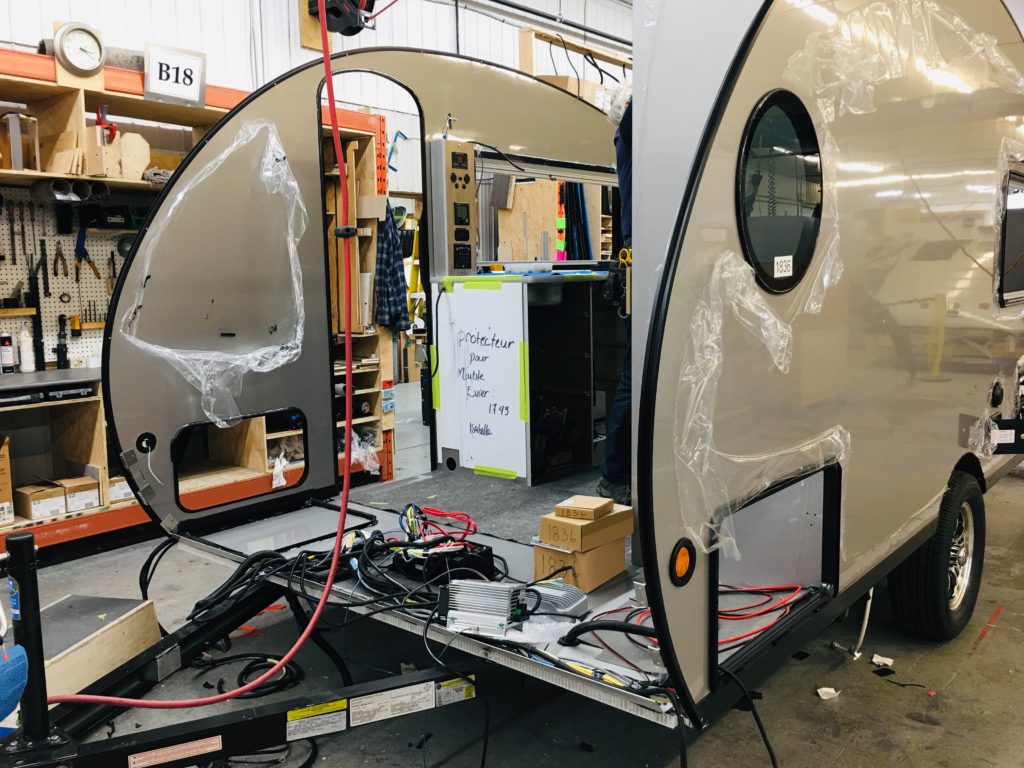
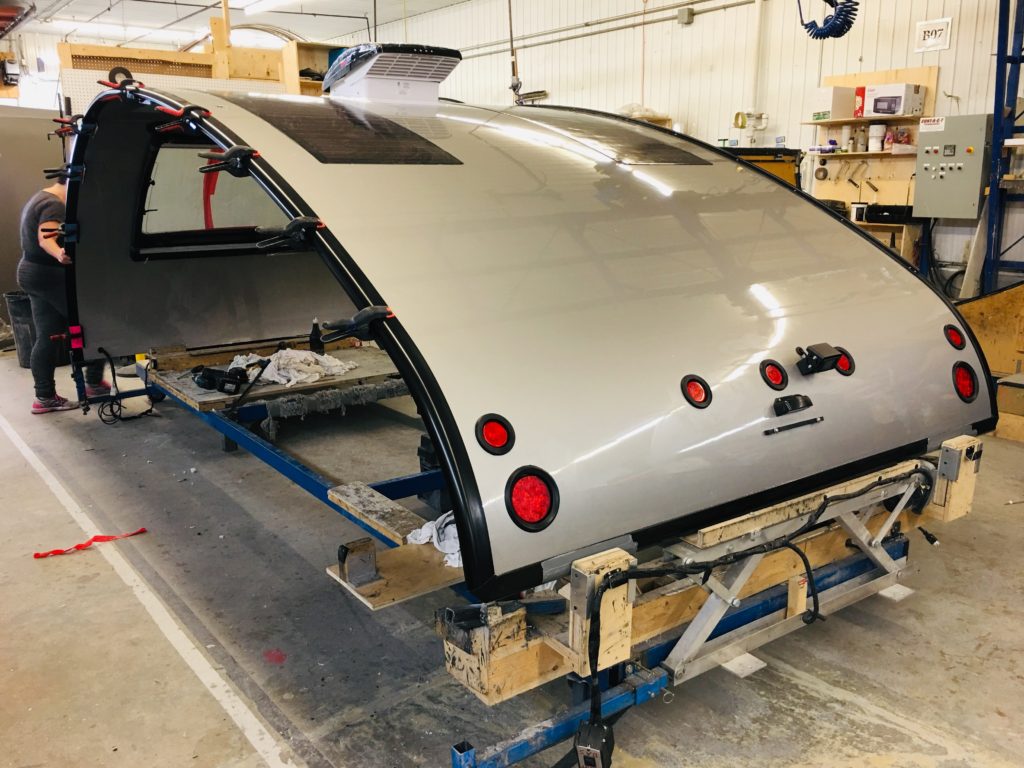
We spend most of the morning testing things out. I fix a latch and Ray reads manuals. In the afternoon we drive through rolling green farm fields to the factory for our tour. St. Frederic is a small town about an hour southeast of Quebec City, and only an hour from Maine. Safaro Condo, a family owned company occupies several warehouse buildings outside of town. I am surprised how small the factory is. Surprisingly, they make each trailer individually and by hand with no large machinery. Ours was number 1807 and the ones being built right now are 1836-1838; it takes approximately 3 months to fully complete each trailer. The guide tells us they use the “just in time” system so they are able to make changes at any time, and have no inventory. Including sales staff, they have 167 employees. He said it is hard to hire people. There is a lot of demand and the waiting list remains at 18 months but they are not looking to expand right now. The Altos sold in Australia are assembled here and finished there. Their Australian partner is a family with a similar culture to the one here.
Wood framing holds the panels in place.The walls are aluminum with a tight honeycomb layer in between; wiring is slipped through that layer. Roof is a single sheet curved to shape.The factory floor – windows being assembled in the center.
Leaving St. Frederic, we admire the changing colors of the forest and rolling hills. The air is crisp and fall is definitely here.
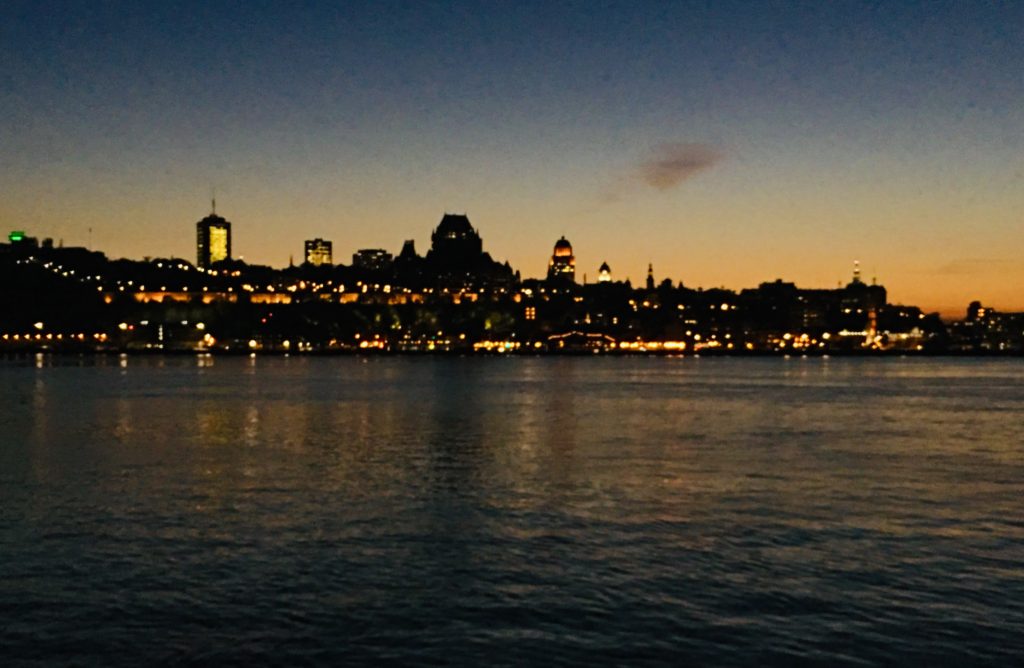
I cook dinner today, testing out the stove and propane connections. We will be leaving tomorrow to avoid Friday traffic around Montreal and to dodge rain in the upper Peninsula. We take a last look across the river at Quebec City from the ferry landing in Levis. It is a beautiful clear evening and the Chateau Frontenac and the city wall are lit up. Au revoir Quebec City. We leave with many memories.
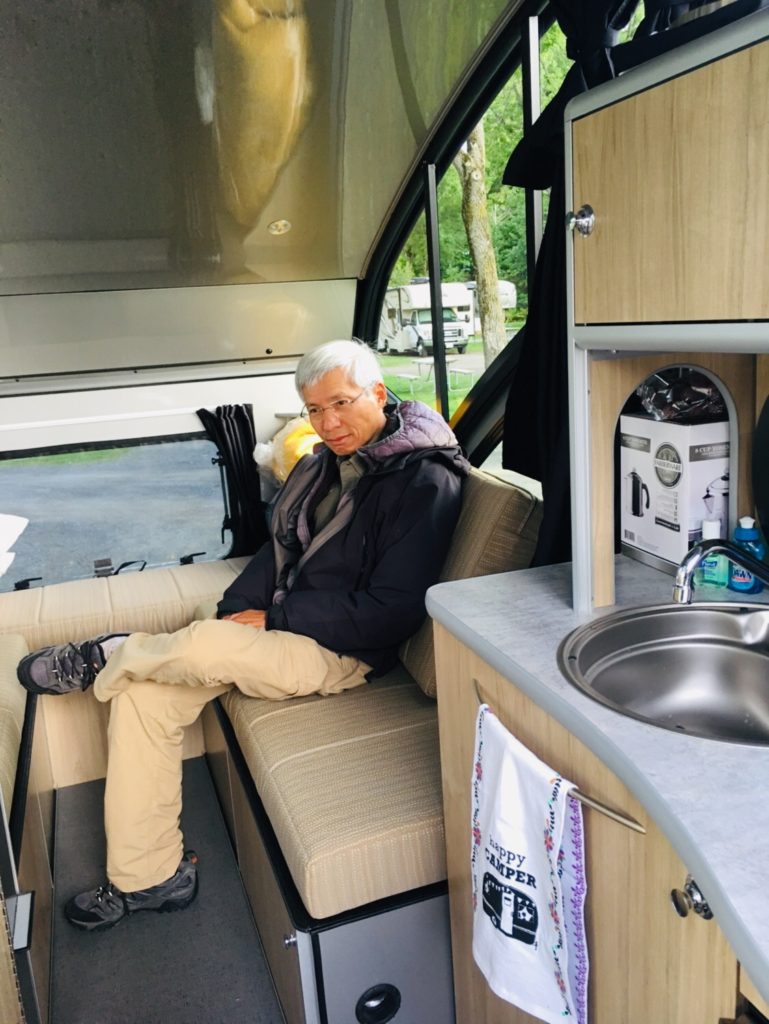
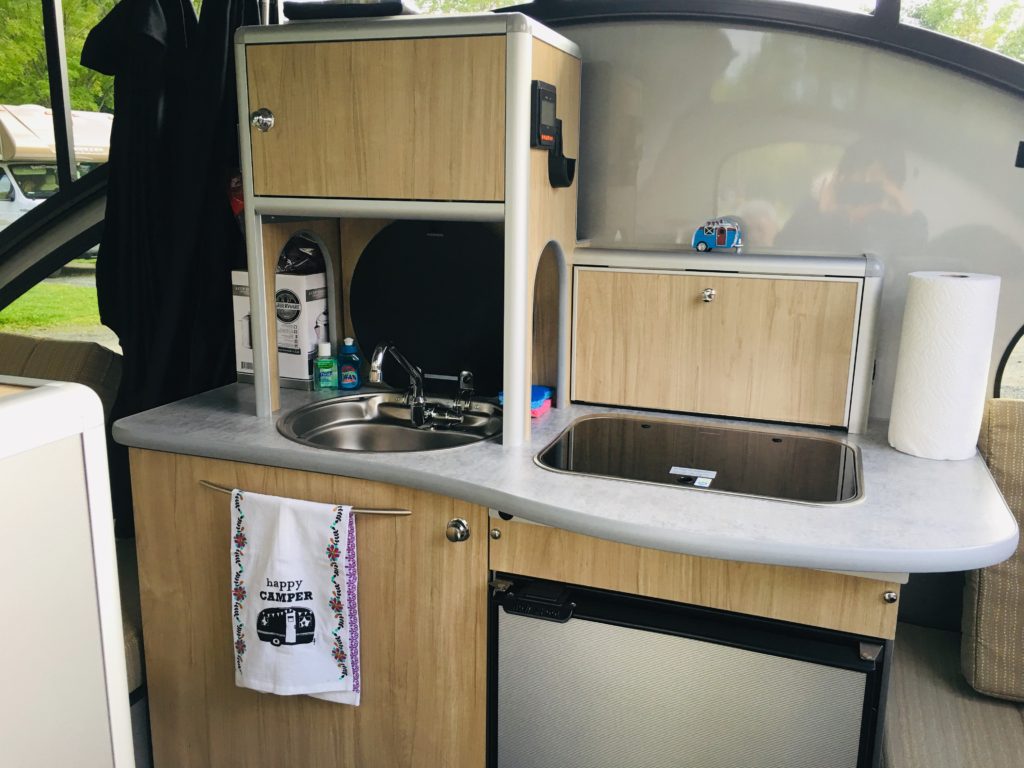
Wow, quite a day, more eventful than buying a house and moving in. At least with a house, it is standing still – you don’t have to take it away, and everything is pretty standard- fridge, stove, etc. A trailer is quite a learning curve though we had an excellent 3 hr tutorial by Francois at Safari Condo and although it’s not as intimidating as I imagined., it is still a bit nerve racking and anxiety provoking. But we are now cozily settled in, eating chocolate, and the heater is nicely warming up the place. I had never liked KOAs but I have to say, having full hook ups is not bad, despite being parked like dominoes, but when you are inside with curtains drawn, you really can’t tell the difference. It’s not the way we plan to camp but it is a good way to start.
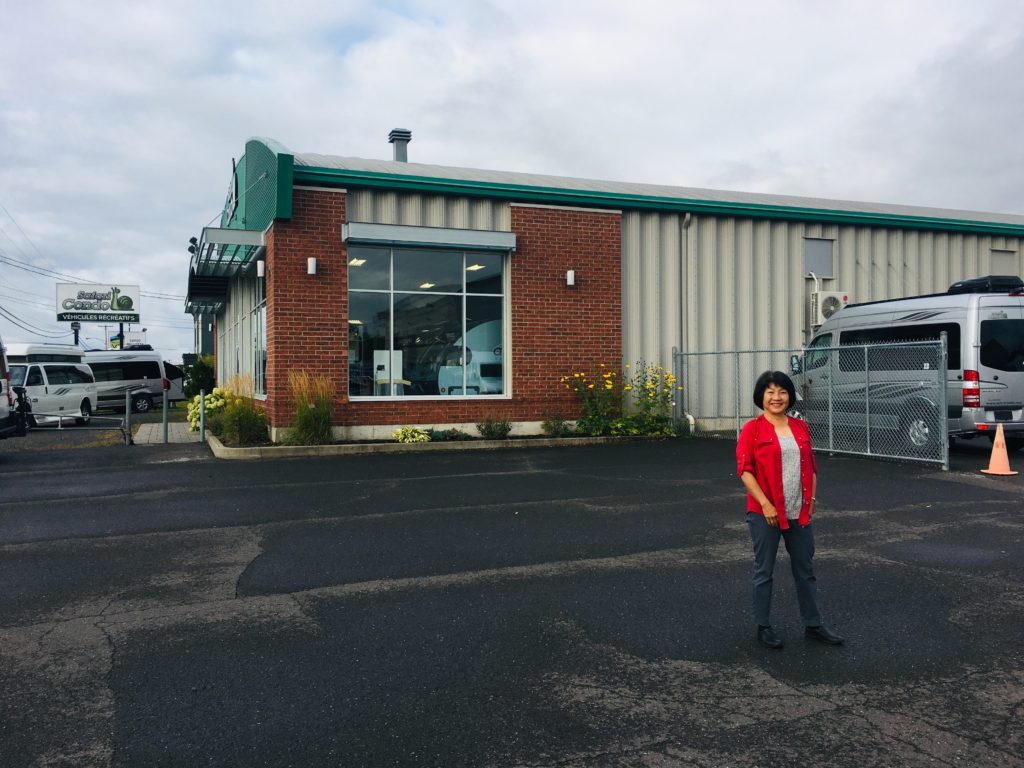
So here is a summary of our day: We arrive promptly at 9 at the Safari Condo office.
We are finally here- at Safari Condo12 days en route and 3,500 miles later
Our trailer is inside and Francois leads us sequentially through the exterior – (lights, storage, locks etc), interior (all the components like tank gauges, heater, water pump etc.) He warns us about errors we could make that would be catastrophic, like leaving the water pump on and flooding the trailer! His delightful French accent and his sense of humor fortunately make the lessons easy to listen to. “No notes, no videos, focus and listen”, he instructs. OK…? Francois tells us that only residents in Washington and Alberta can purchase an Alto from Canway, an RV dealership but that all other customers must make the trip here; they do not ship. 4 are picked up each day and we meet 2 other couples-one from Colorado and the other from Montana. We bond over driving stories. Customers meet and share information on Facebook.
He ends with the most complex – back up camera, brake controller, hitching on and off. This I do video. So much to remember to do and check! Francois says by the time we are back in California, it will all be second nature. I sure hope so!
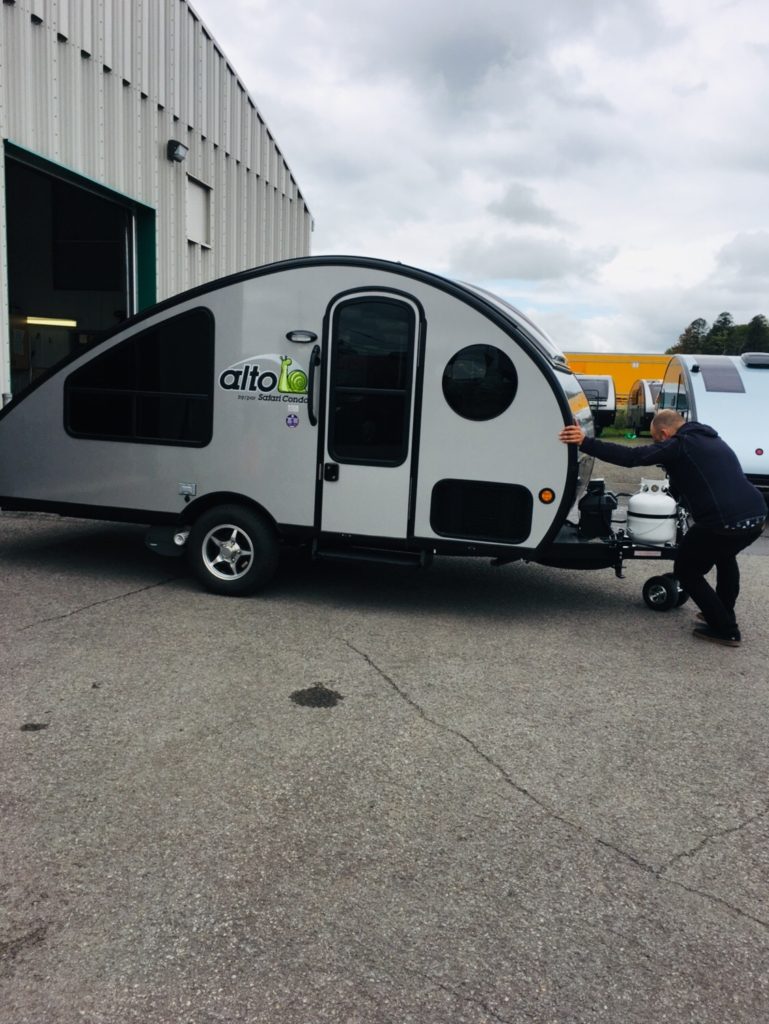
Exiting the shop. It is number 1,807 produced.This is it!
Then we are off and we space out, going out of the lot onto a rural road that is not that well kept. I keep telling Ray to slow down; he is just focused on the police car that so coincidentally is behind us. We somehow end up at the KOA that is only a few miles away, pull in, figure out how to unhitch, chock the wheels and get the roof raised. Hurray! Baby steps- one step achieved, we eat lunch and relax.
A few gifts
We spend the afternoon figuring things out – locking thing up, and unloading the car. We make a trip to Canadian Tire for a torque wrench. The place is huge and the name is deceiving; no food or clothes but just about everything else here.
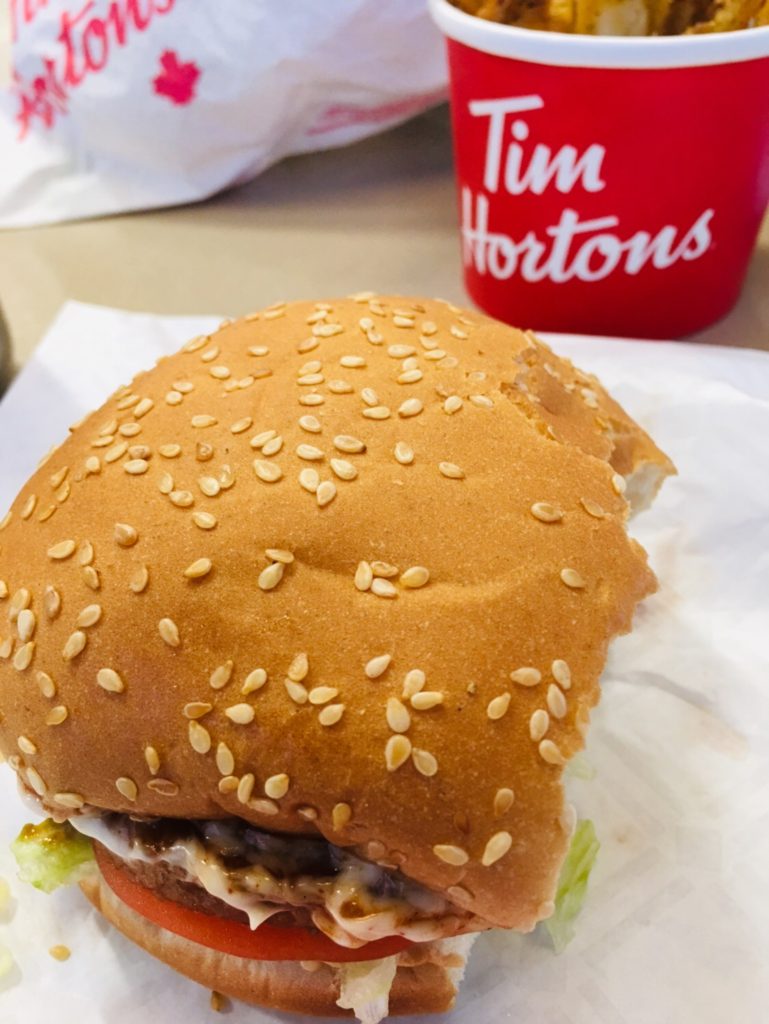
We decide that getting propane can wait until morning so we stop at Tim Hortons, Canada’s equivalent of McDonalds, and have Beyond Burgers. Mine is not cooked as browned as Ray’s and I can barely get it down. His is more flavorful than mine but nevertheless, I am so glad I am not a vegetarian!
Far from being the most delicious burger I have ever had, probably not to be repeated
We are here for 3 nights, testing things out so we can go back to Safari Condo if something doesn’t work. We have a factory tour scheduled for afternoon which should be interesting.
I’m not able to upload a video of the roof raising on the KOA wifi but you can email me if you would like to see it.
We take our time leaving Montreal/Longueuil, lingering over breakfast snd coffee. The drive to Quebec City is around 2 hrs and the highway swings away from the St. Lawrence River in the direction of the borders to Vermont and Maine. The landscape is flat and heavily forested with deep underbrush. We see a hint of fall color on some trees but are about 2 weeks too early; fall color is more dependent on length of day than temperature. Apparently cold temperatures turn the leaves brown and wind blows them off, so fall color can be variable and unpredictable. Today again it is cloudy and breezy, making us wonder how often the sun comes out!
The Comfort Inn is in Levis, across the river from Quebec City. We are staying here for the convenience to Safari Condo, where we will be picking up our trailer tomorrow. The receptionist recommends taking the ferry over to the city but we realize it is a 40 min. drive to the ferry terminal, and the ferry only runs hourly after 6pm. Since it is already mid afternoon, we decide to drive in, which takes about 20 min. and park on the outskirts of the old town.
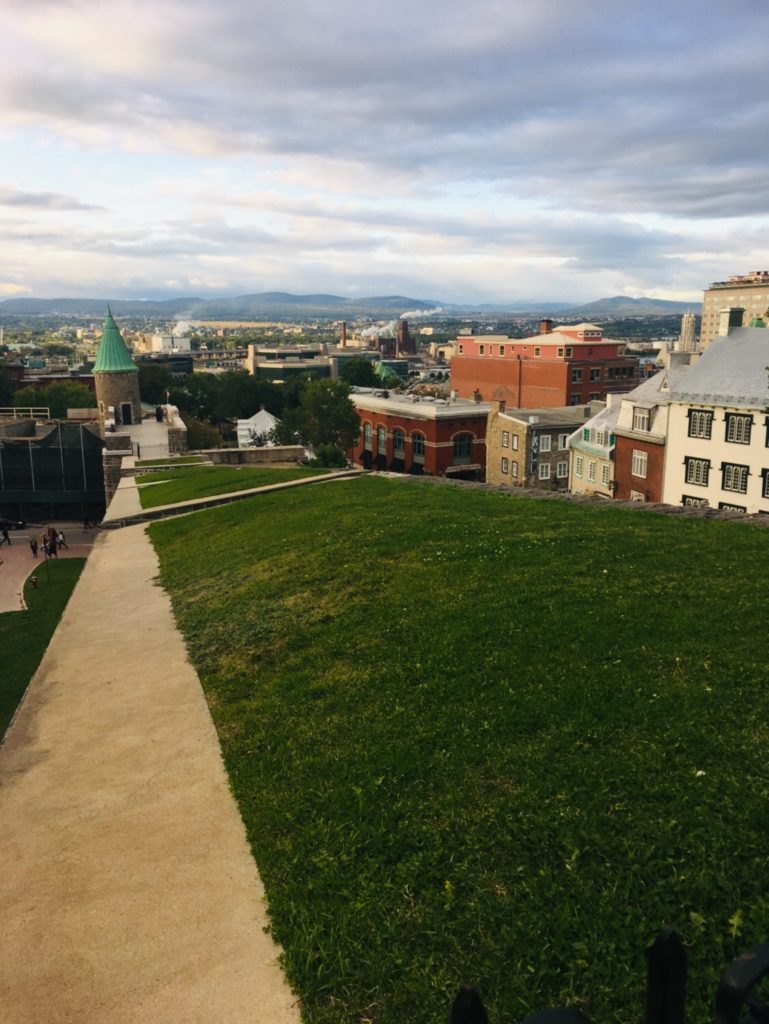
We head for the Paillard, a french bakery, for croissants but later realize that baked goods are best sampled early in the day. These are no match for Alexanders in Mountain View, or maybe they are stale from being there all day. We walk the backside of the old town and a portion of the old city wall. The architecture is charming. The old town sits high up above the riverfront and is reached via steps, 200 on the river side, about 100 from the backside.
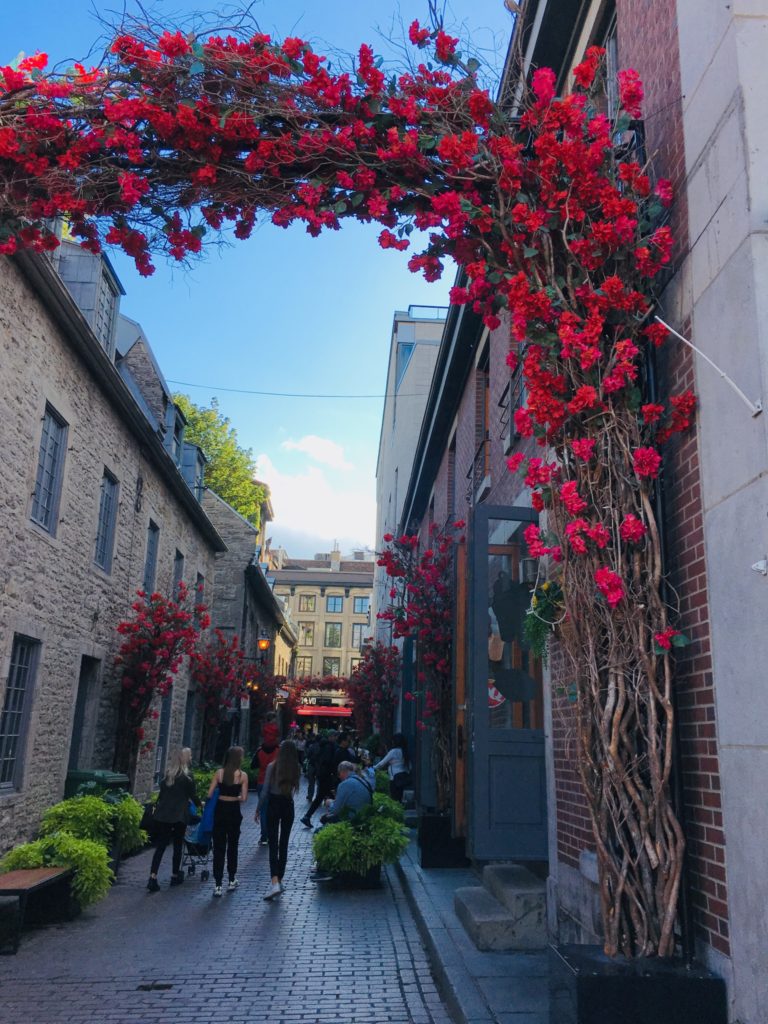
Narrow lanes!
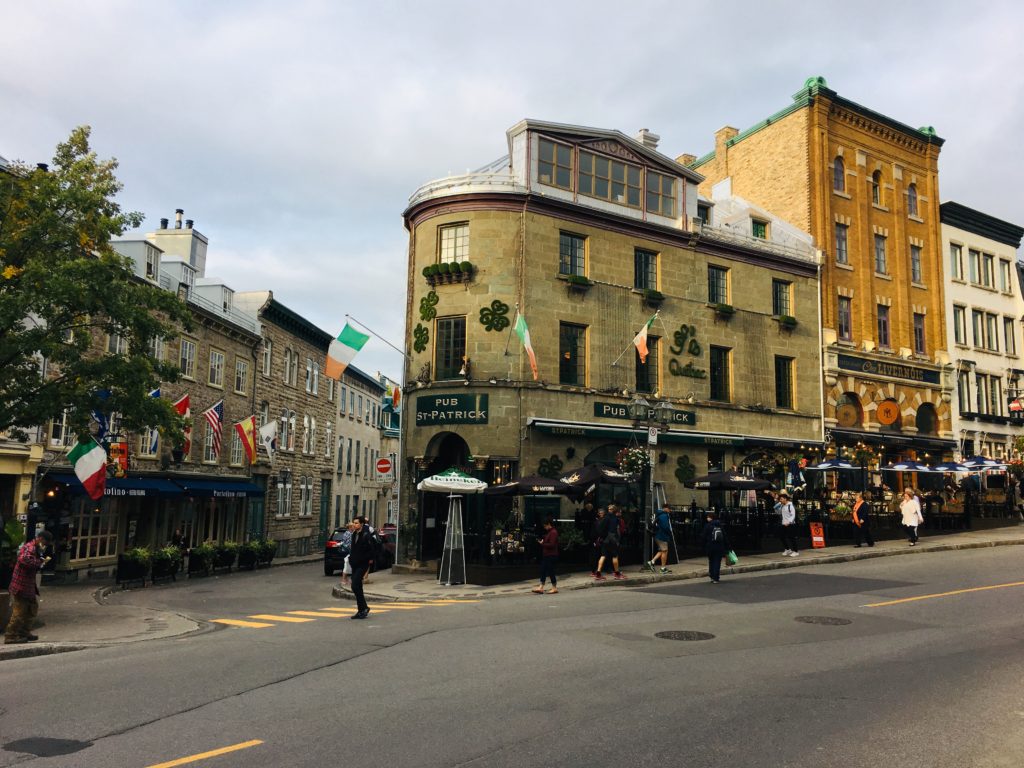
We find the tourist section to be pretty commercialized with gift shops and restaurants, not quite the French city I was expecting. If we have time later in the week, we will tour the riverfront which has historical buildings and the Chateau Frontenac.
Today we are preoccupied with all that we need to know about this trailer, and if we have all the tools we need. We are a bit nervous about how it will all turn out. Stay tuned for tomorrow…
A lazy sunday on a gusty day, doing some laundry and being laid back. Le Dauphin has a nice continental breakfast and good coffee.
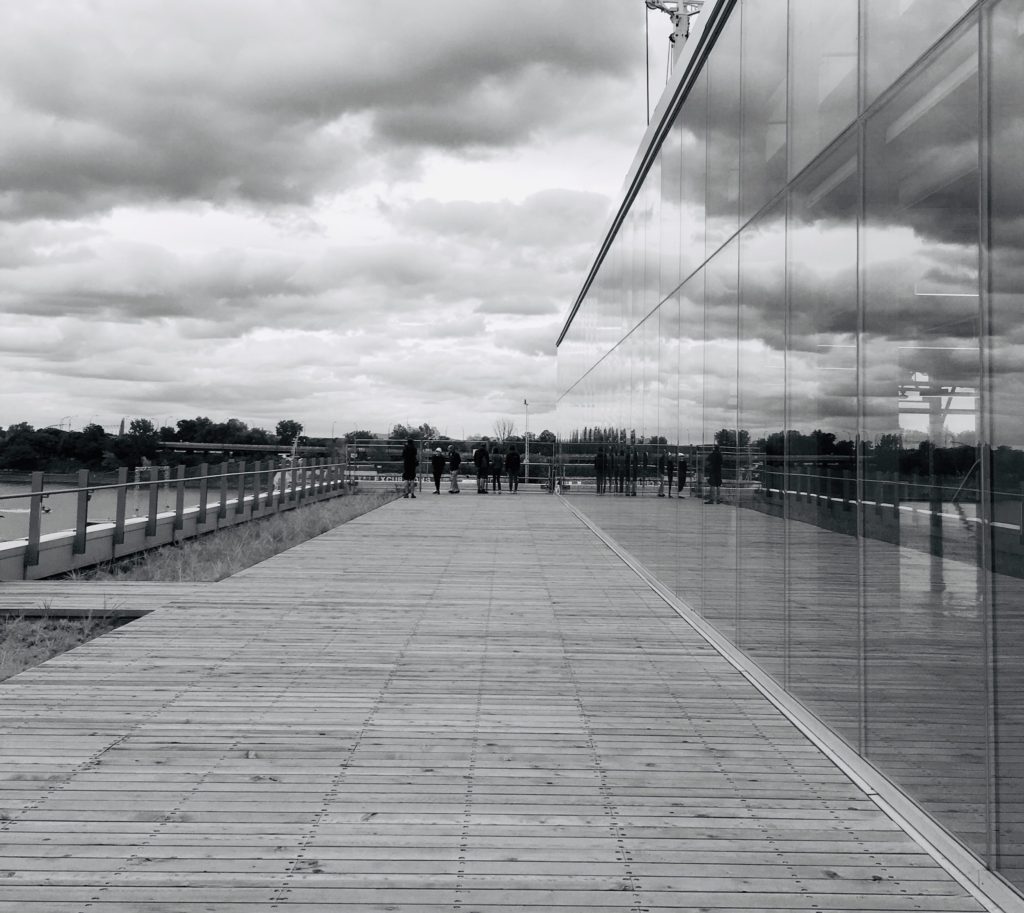
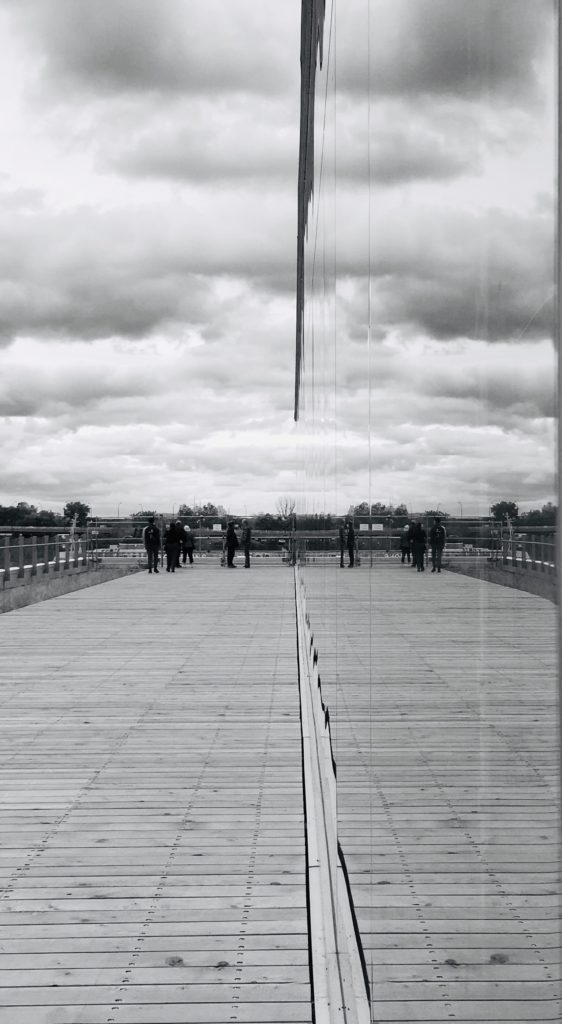
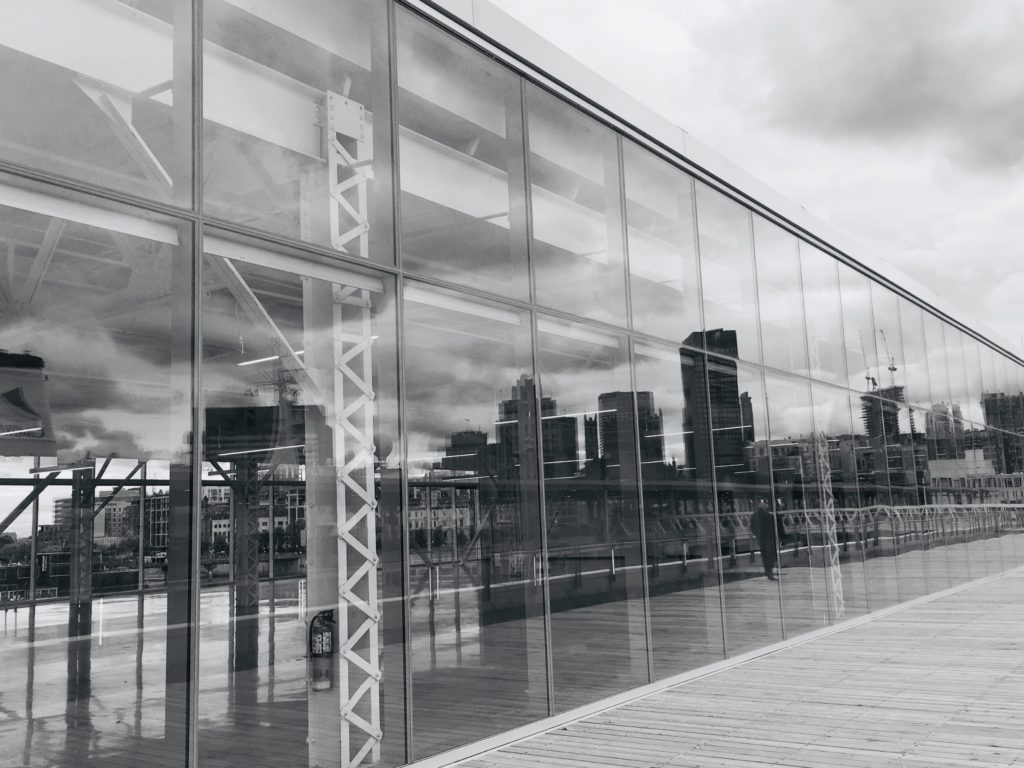
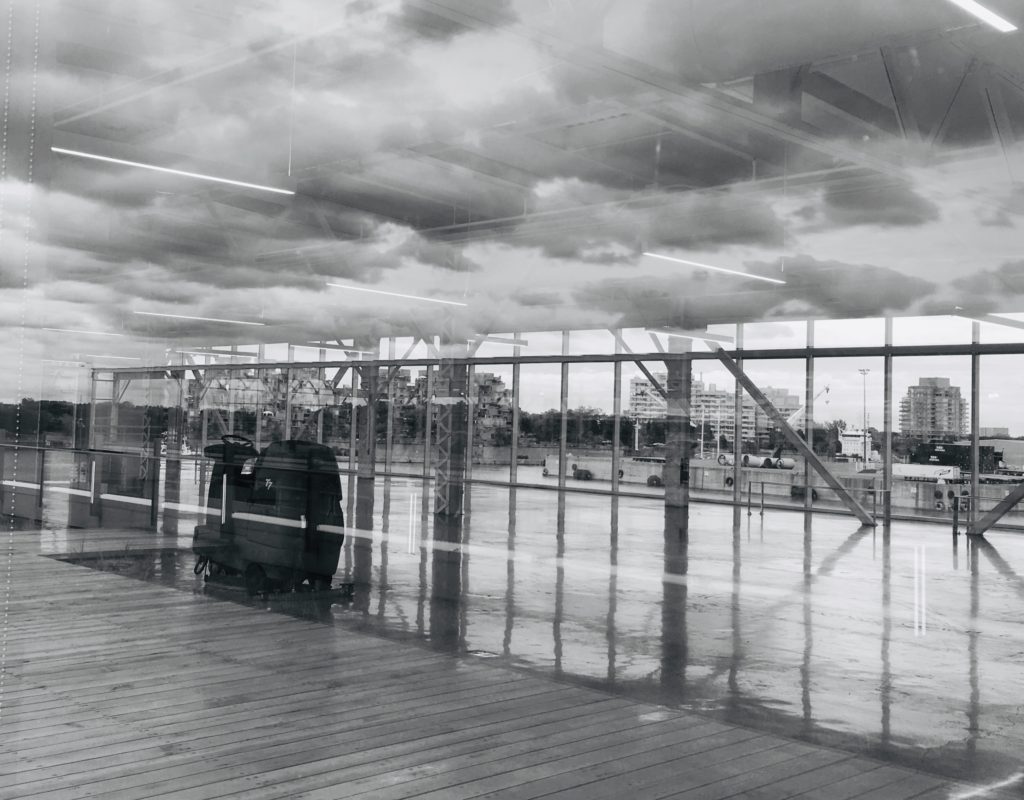
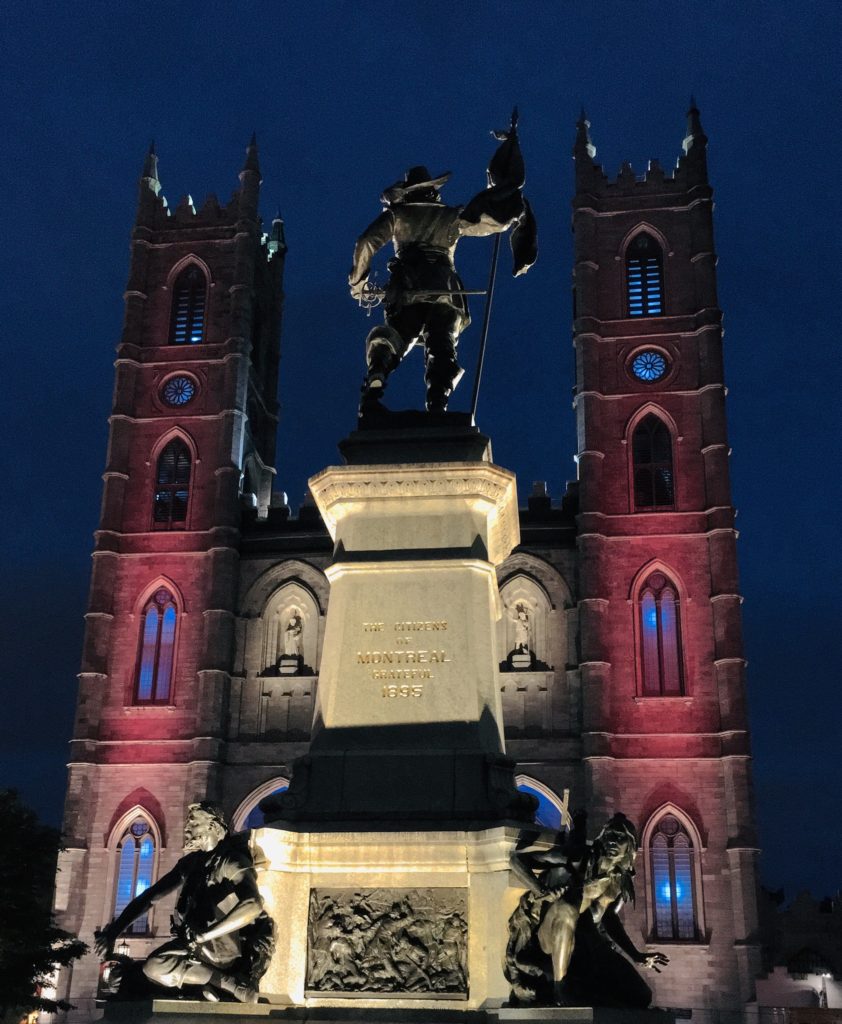
In the afternoon we venture out on foot and wander through Montreal’s boutiques, art galleries and plazas. The harbor’s glass enclosure provides some photographic delights on my iphone.
Lines shooting off into space Converging lines Montreal skyline Mystical cloud cover
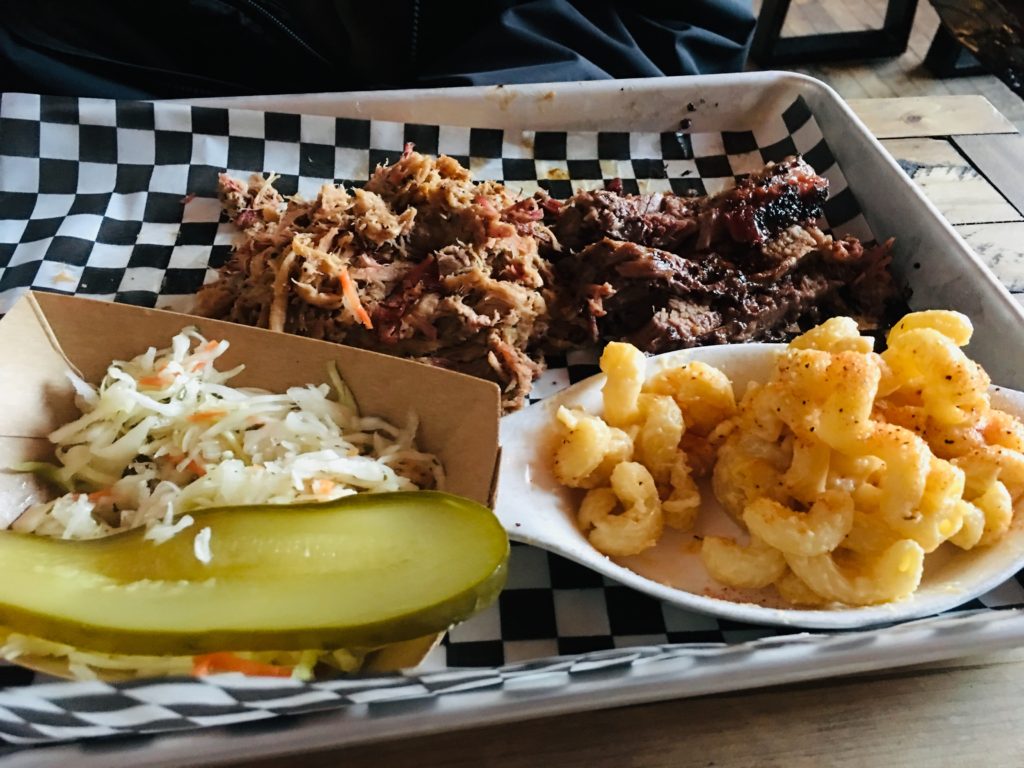
At dusk, we walk by a sign “world brisket champion”, check Trip Advisor and learn it is a highly rated bbq place. The Texas beef brisket is indeed mouth watering and the beans are smoky good. Trip Advisor, we love you!
John, the owner is a native of Montreal with a brother in Sacramento. He went around the country judging and competing in bbq contests, winning world champion at the 2012 Jack Daniels competition, before opening Lattuca 5 years ago. We had a nice chat, hearing his stories.
Award winning beef brisket and pulled pork
Sunday night is quiet in the old town as we say au revoir. Montreal, you are charming and delightful.
The roads around Montreal are a jumbled mess of construction, detours and traffic. I can see why everyone recommends not driving in the city. It takes 2 hours to drive from Brockville; the scenery reminds us of Illinois as do the cloudy gray skies. We are staying at Le Dauphin in Longueuil, which fortunately is across the river from Montreal city center. It is easy to find and has clean and very modern rooms.
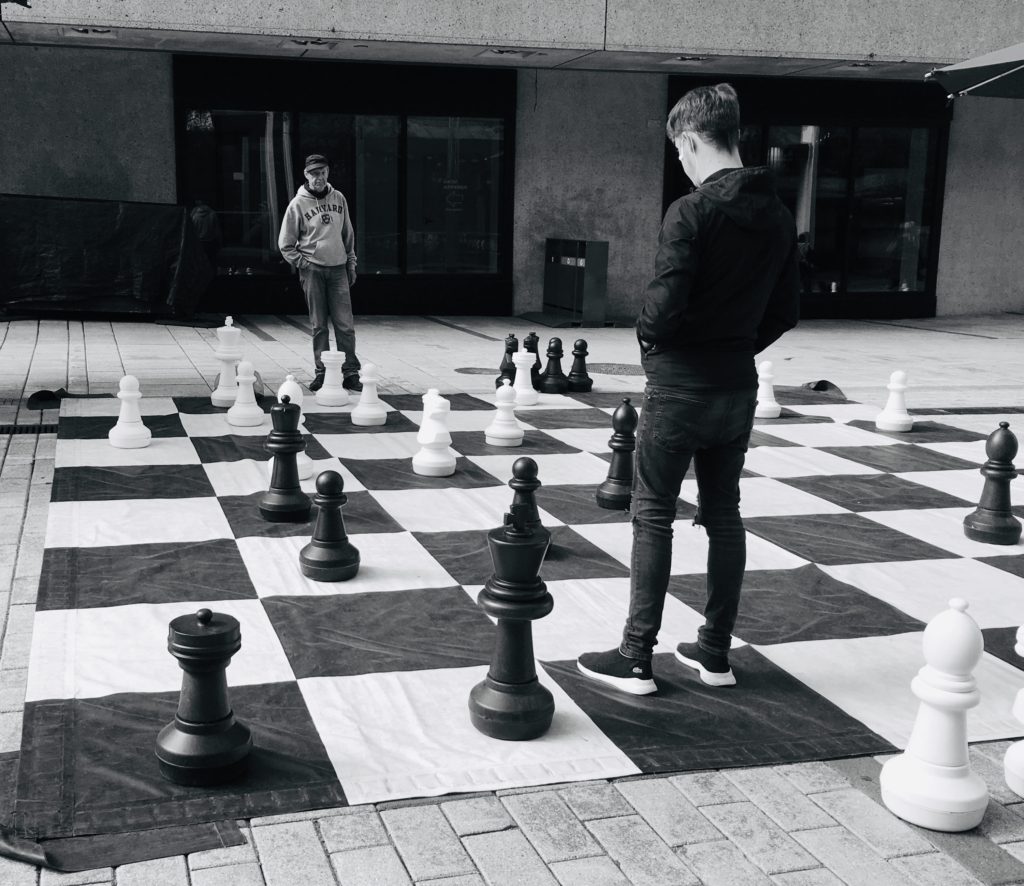
Le Dauphin is just a 5-10 min. walk to the Longueuil-Univ. Sherbonne station. The infrastructure in Montreal is older and the subway, though an efficient system, is not as sleek as Toronto. We easily get into Montreal which appears to be about half the size of Toronto. Since it is gusty and chilly, we head for the north part of downtown where 20 miles of underground promenades connect shops, restaurants, museums, theatres. What does that tell you about the weather here? After walking through one short section, we decide it feels too much like walking through a big mall and emerge at the Palace D’arts. Surprise, it is sunny and warm outside! There is an exhibit of big chess boards and games are being played.
Chess game in progress
We walk and walk and walk, through Chinatown, into the old town, through plazas with street musicians and lined with restaurants.
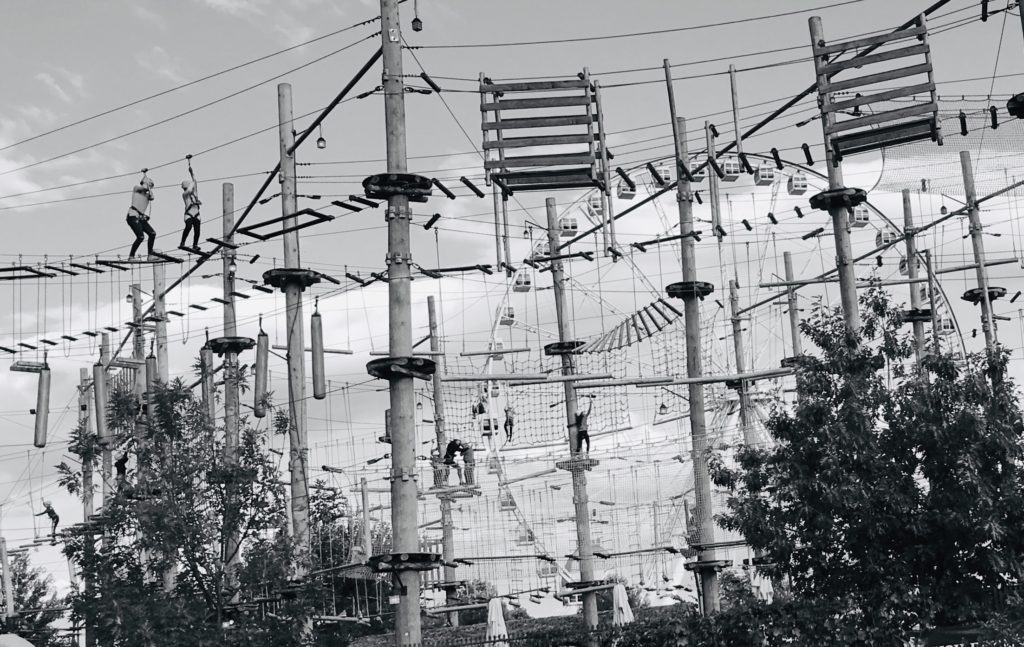
Huge amusement park with zipline and technical course, not an activity for me!
We stop for a simple early dinner at Modavie where tables are still available at 5. She says we must be out by 7! I guess we Americans don’t spend enough time lingering over dinner.
Bison osso bucco and saffron sage risotto
In our strolls, we come upon an Exposition of the World Press Photography Competition. These are the winners of the annual competition of press photographers, powerful images, some difficult to look at but a reminder of the hardships and tragedies we have seen on the news and that people endure – at the border, in Mexico, Honduras, Afghanistan etc.
The streets and plazas are quite lively this saturday night and as we head back, groups of young people are just starting their evening of fun.
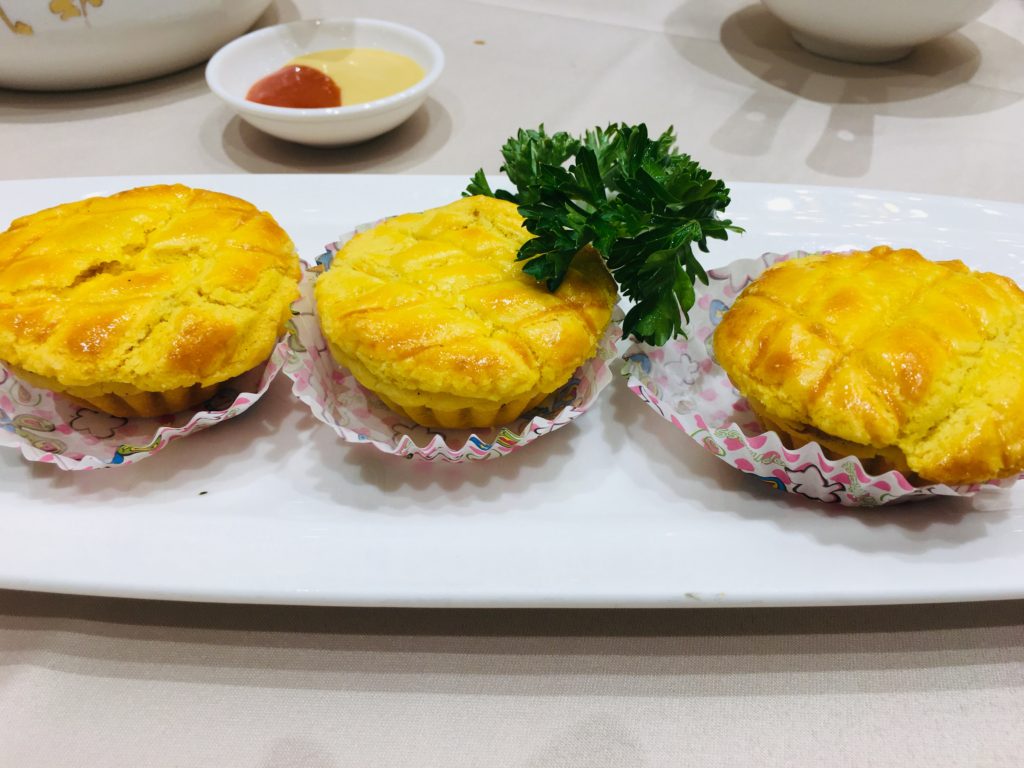
It’s a gusty morning and we cannot resist the temptation to see if we can get in for dim sum again, though it will be light today. We arrive at 10am and the wait is only 20 min. We order just a couple of items and a few for the road.
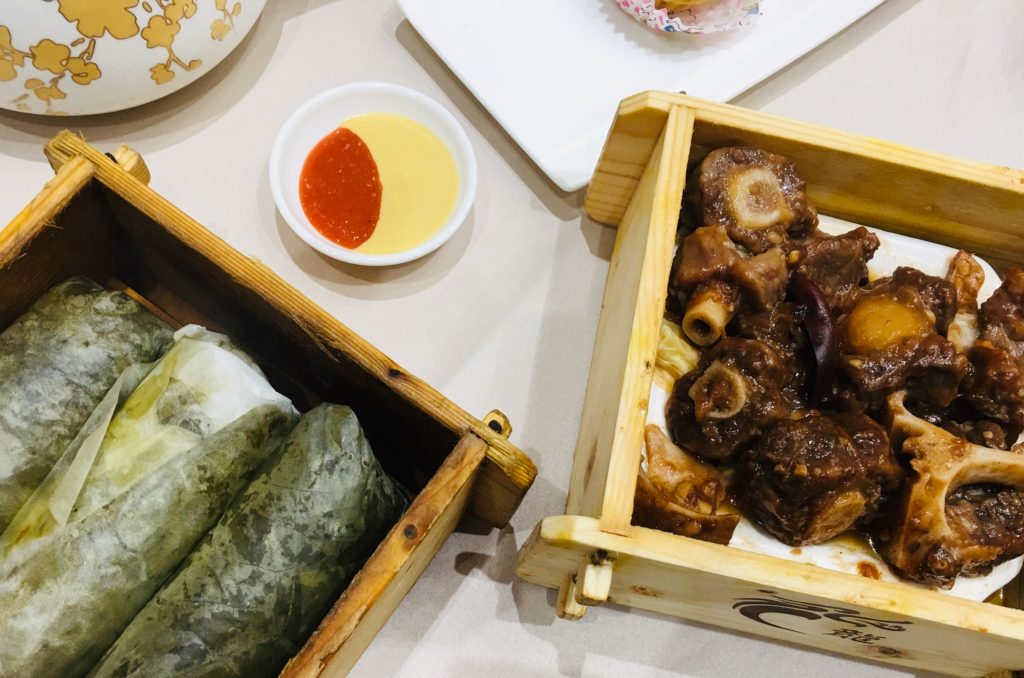
Curry chicken puffGlutinous rice and chicken wrapped in lotus leaf, oxtail
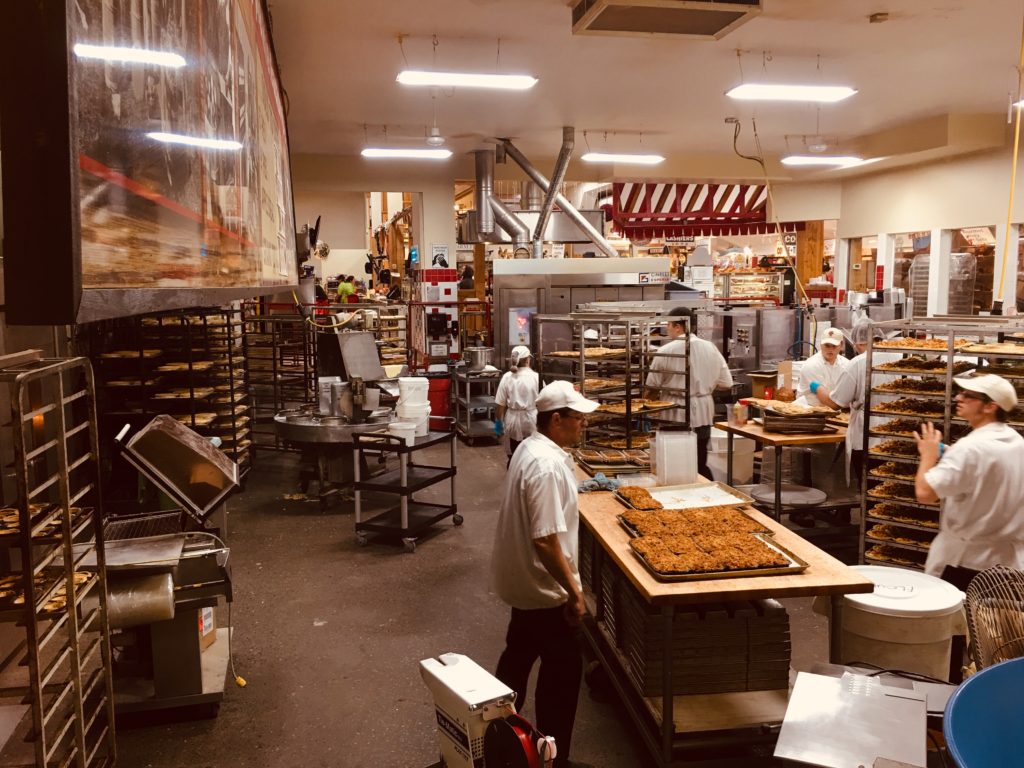
Leaving Markham, we wind our way north along the St. Lawrence River toward the Thousand Islands. We take a break at The Big Apple which turns out to be a big tourist trap. One of the workers tells us the apples are imported, not local! Nevertheless, the apple pie factory is fun to see.
Next stop is the Kingston Visitor’s Center. When I come out, Ray is chatting with an elderly gentleman with an Irish twang, who is sitting on the park bench drinking coffee. He is immensely helpful, directing us up to Gananoque on highway 2, the scenic drive to Brockville. But wait…Ray spots Mio Gelato, and how could I say no?
Oh my, what a gelato shop! Again we strike gold! There are so many flavors and after tasting several, I settle on peach and passion fruit. Ray has mango and is still raving about the cinnamon latte. Will you believe me if I tell you it is the best gelato in north america and just like in Italy?
Kingston has a battery, built in the early 1800’s to protect the area from attack by the US. The streets of Kingston are lined with colorful petunias, one of the benefits of rain!
The 1,000 Islands sit at the northern end of Lake Ontario and the mouth of the St Lawrence River, ranging from tiny islands and ones with just a cottage, to large parks. You need a boat of some kind to access them, or you can take a cruise on a tour boat. We choose to view from shore.
This island has a summer homeSee the bridge connecting the two houses?
We end the day at the Comfort Inn in Brockville. Tomorrow we go back to our salad diet. I’ve got the lettuce and bell peppers waiting!
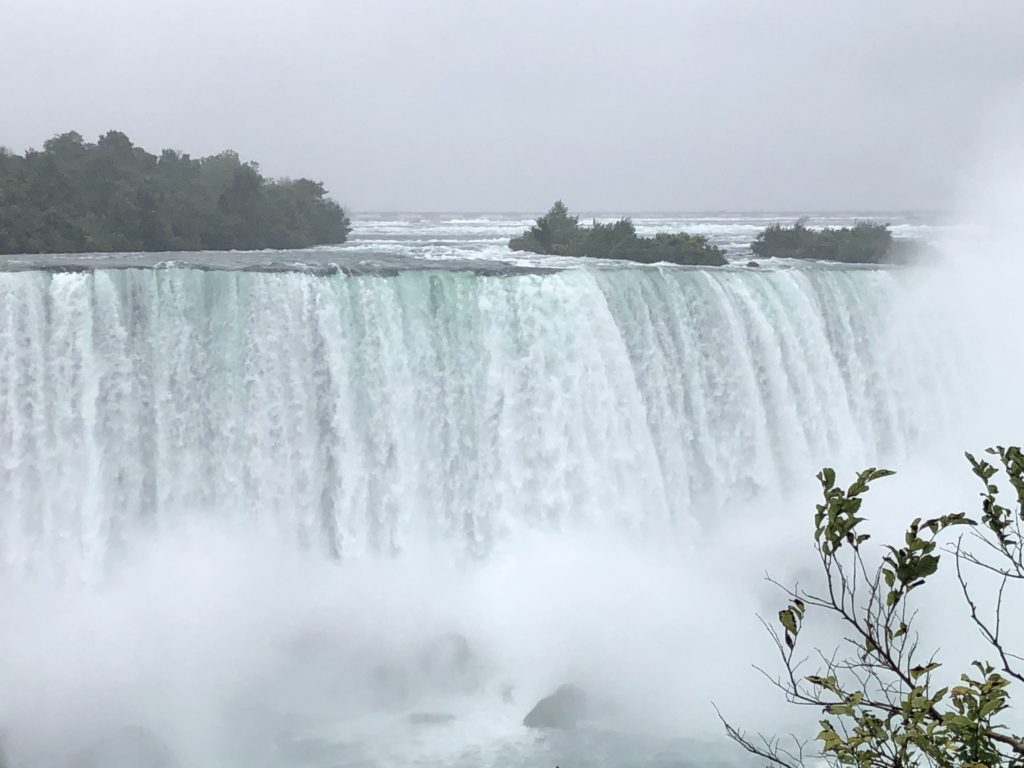
We awake to rain showers in Hamilton which continue all morning as we arrive at Niagara Falls. The falls are as spectacular as I remember as a child even with rain and gusting winds. It is Ray’s first time there. The town itself is a bit Vegas-like but given the weather and time of year, is quiet. We find the grounds of the park to be nicely groomed with beautiful flower gardens and we learn that the objective of the park foundation was to maintain the view free of charge to all, which is terrific.
It takes us 90 min. to get to Markham, a suburb of Toronto, which we had been told has the “best Chinese food and dim sum in north america.” The reception host at the Hilton Garden Inn asks me what brings us to Markham, and I reply, “the food!”
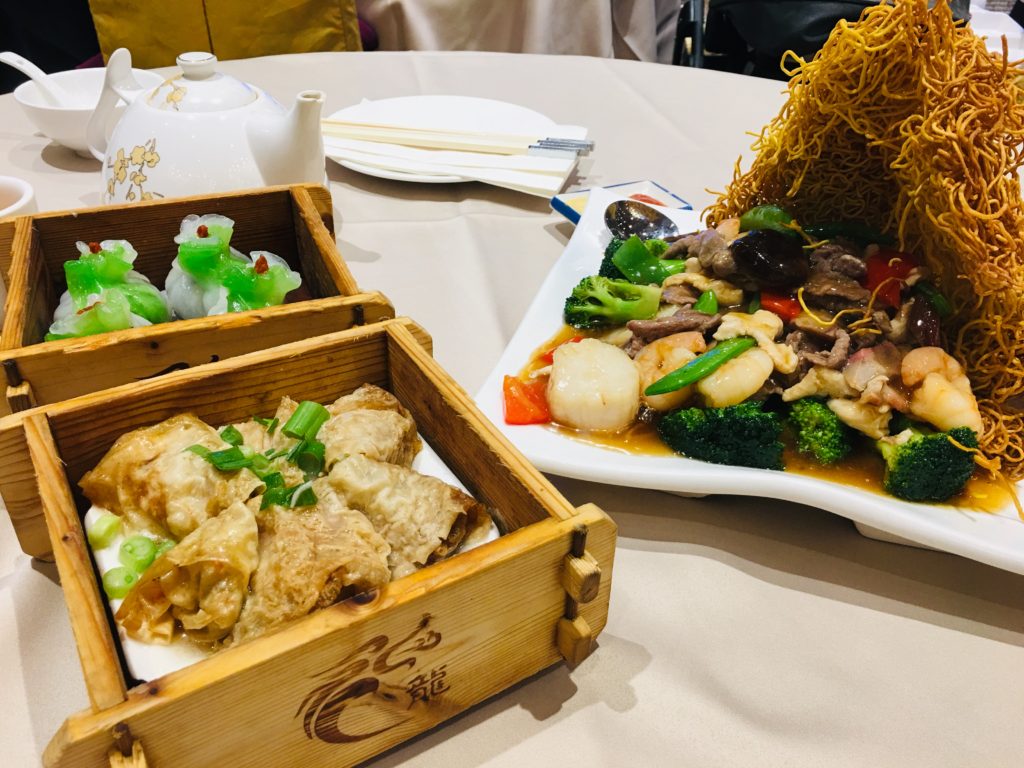
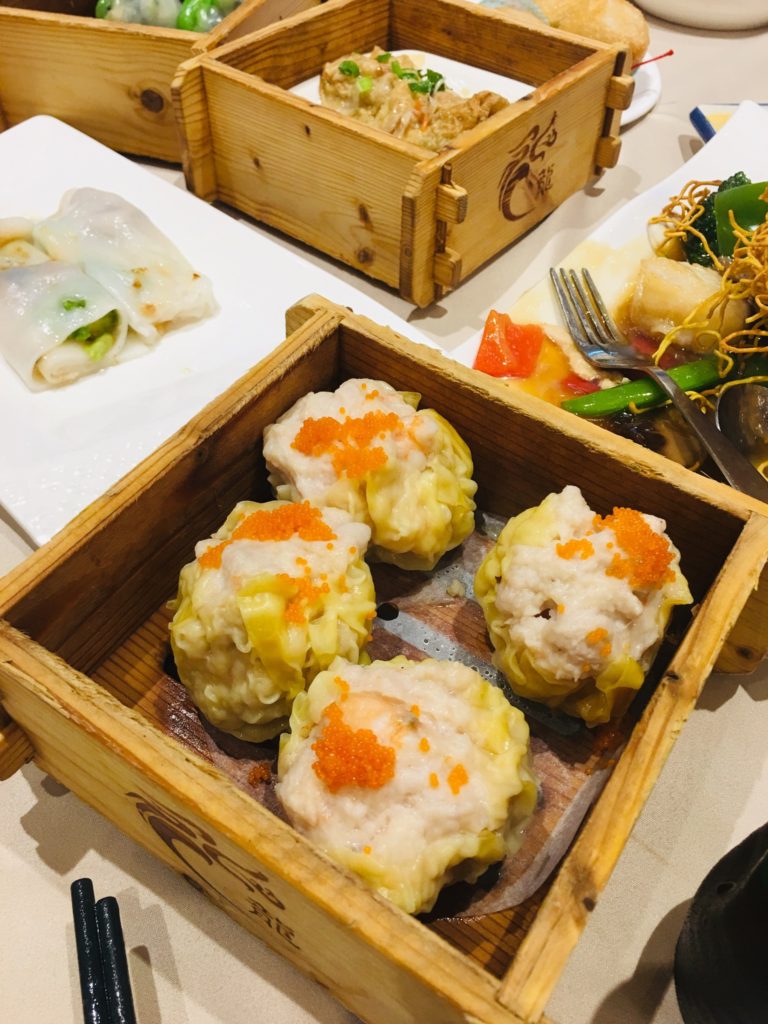
With great anticipation, we walk across the street and arrive at the Dragon Boat Fusion Restaurant at 2; the timing is not coincidental as we were told each day people start lining up at 8am for the 10am opening, and the lines continue until 2. Today it so happens is a slow day and we get a table immediately. The challenge is deciding what to order. We wish we had more people with us. After all, how much can 2 people eat? Apparently quite a bit, as we do pretty well, though we won’t need to eat again for a week! It is truly the best dim sum we have had since going to a floating restaurant, the Jumbo in Hong Kong nearly 40 years ago.
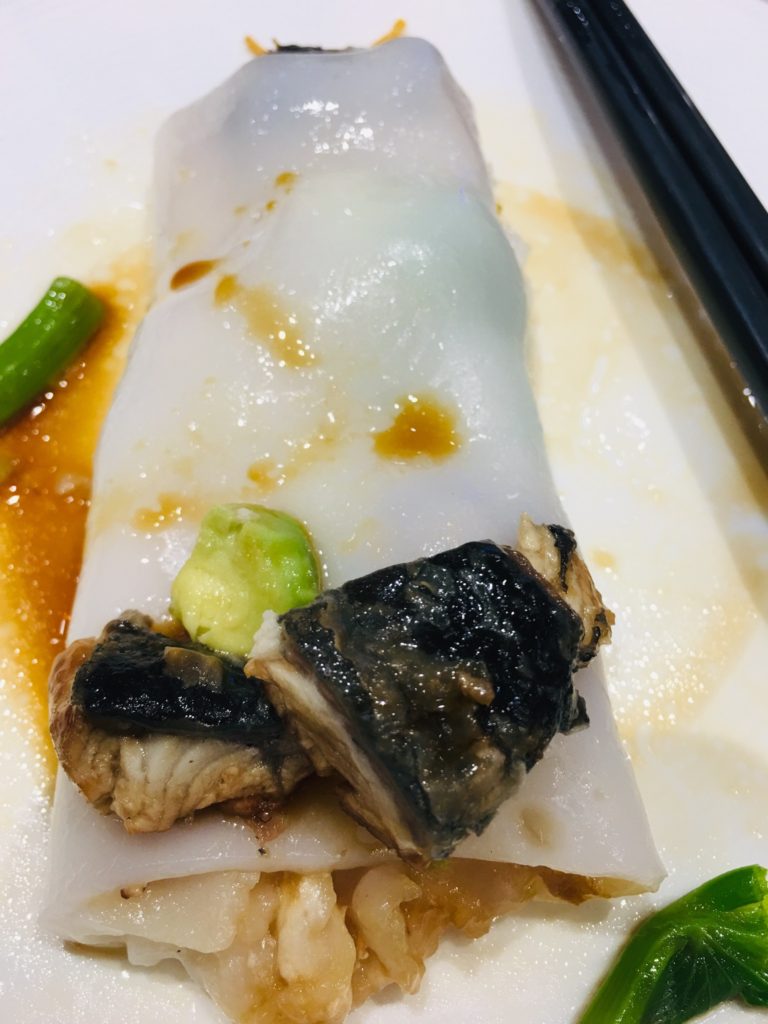
Mushroom and vegetable dumplings, bean curd rolls and very crispy noodlesMy favorite – eel and avocado rice rollsHuge and very fluffy siu maiRay’s favorite – fried glutinous balls filled with pork, very light
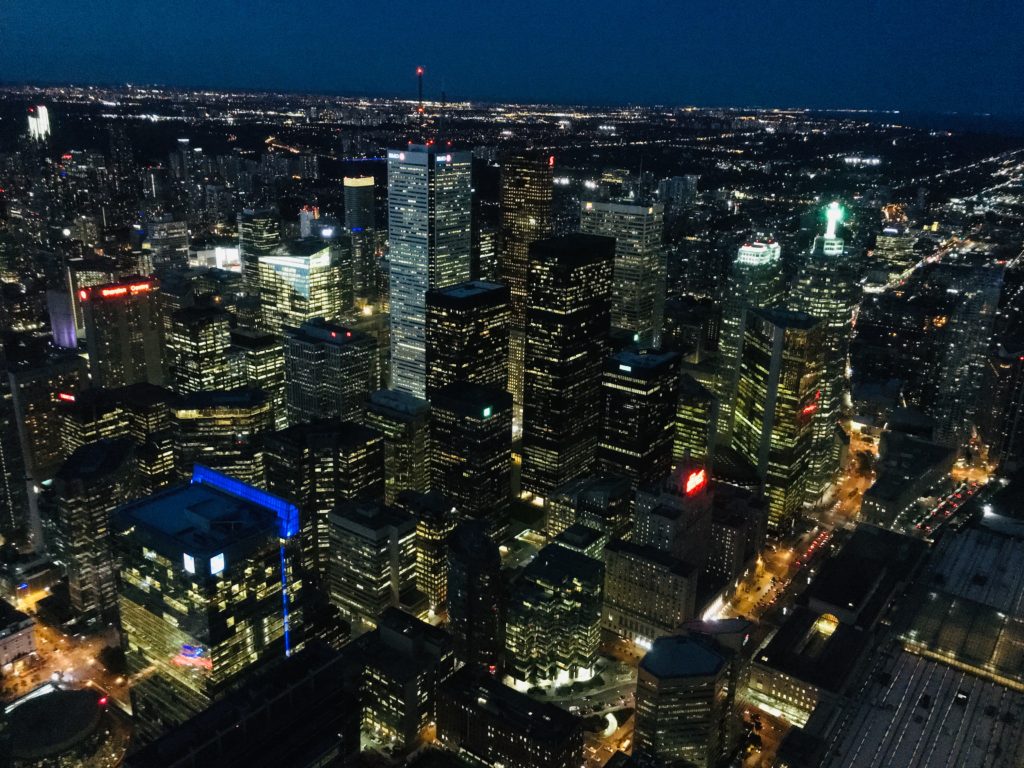
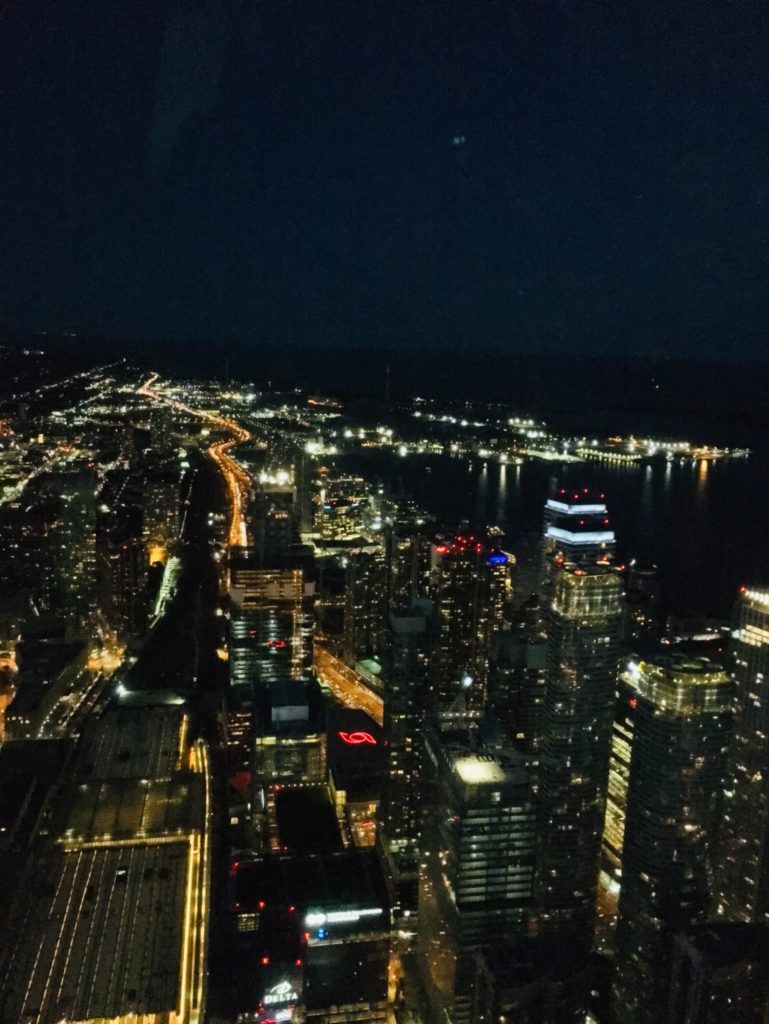
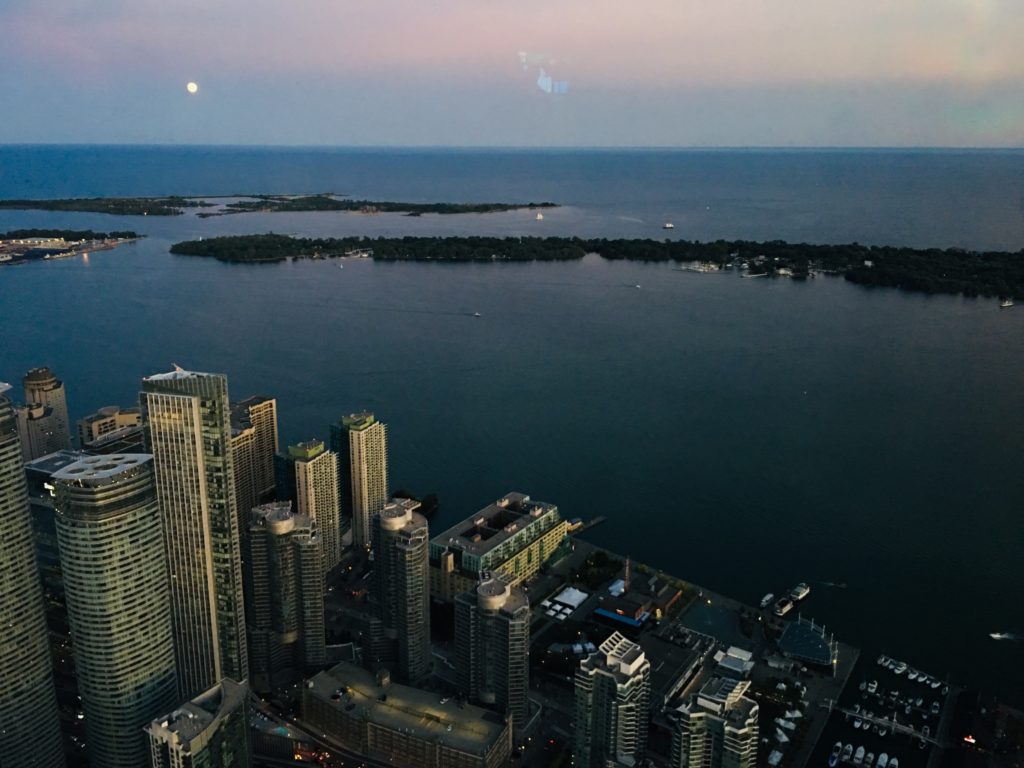
After all this food, we need to walk it off, so we take the subway to downtown. The CN tower is open and we watch the sunset and lights of Toronto from 1,100 ft high. It is a crystal clear evening.
Toronto is a lovely city, very diverse, clean, safe and with a very efficient public transportation system. We are quite impressed with what appears to be a good quality of life here.
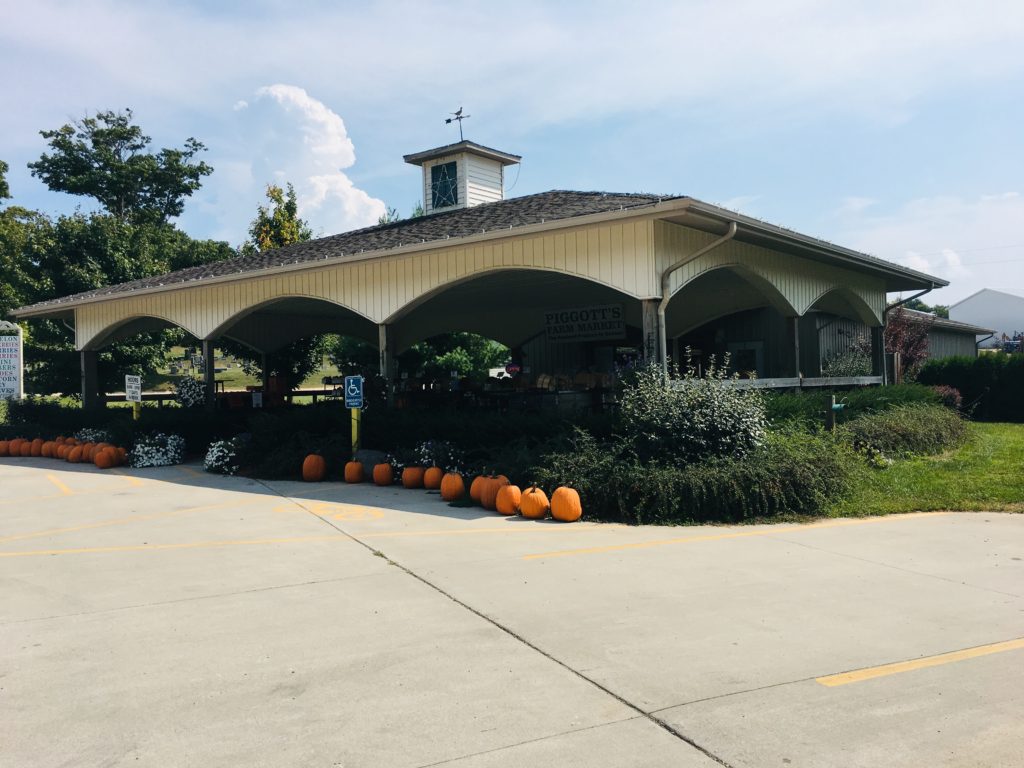
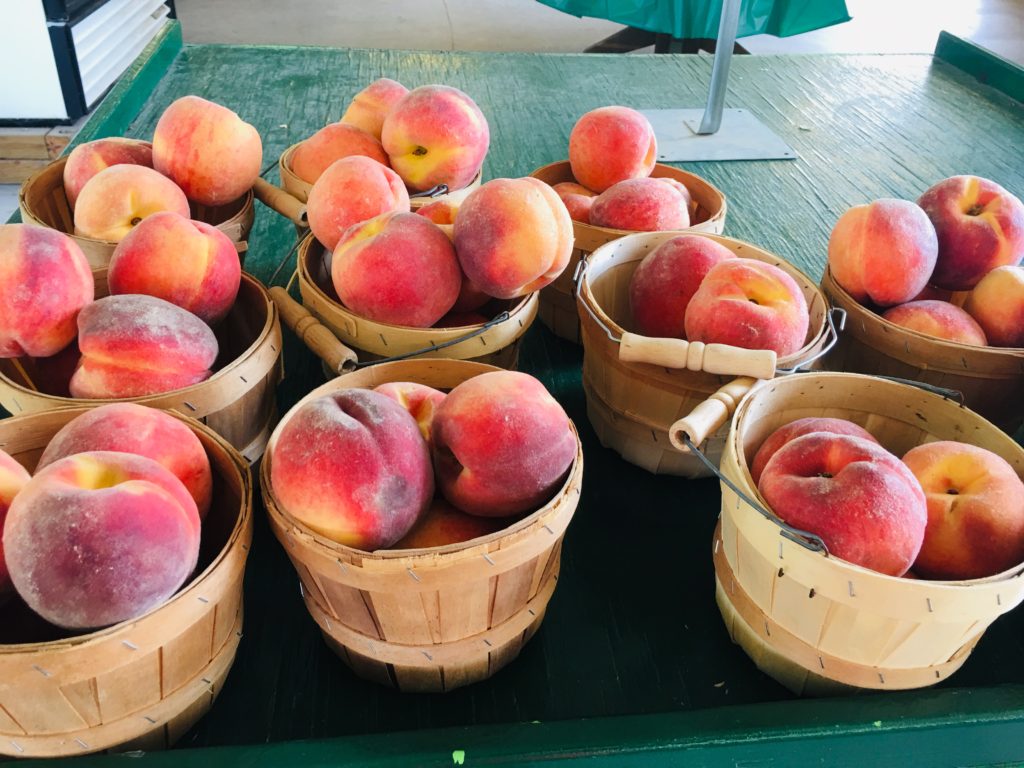
Western Michigan is such a beautiful part of the state with lush thick forests, rolling hills and proximity to Lake Michigan. At the first visitors rest stop, there are shelves and shelves of tourist pamphlets. I find a few on farms and fruit stands which leads us to a stop at Piggot’s in Benton Harbor. How can anyone resist fresh peaches? After all, this IS Michigan! Alas, we cross the border in 3 hours and have to consume all fruit before then. Lunch is fresh blueberry pie and peaches.
I think we are following storm clouds as we drive through strong thunderstorms for about 15 min. Dark clouds loom in the distance. The air is heavy and a warm 90 degrees. I am still doing 100 jumping jacks every time we stop.
It is a short driving day in very muggy and warm weather, and occasional showers. We are excited to be in the Land of Lincoln, and after all these years, still feels a bit like coming home. We arrive mid afternoon and spent a pleasant time visiting with Elaine (Ray’s sister) and Roger, who give us a great tutorial in using dump stations with a trailer, and show us how the hoses attach. The process is so much less intimidating now!
We meet up with Tim, our nephew for a Thai dinner, who tells us about a new assemble together kayak by pakayak. We are intrigued and learn it is a kickstarter company. The kayak can be taken apart into 6 pieces!
Elaine has arranged a surprise birthday wish after dinner and the waitresses lead everyone in singing happy birthday to me-so sweet! It is great to spend time visiting with family, such a rare occurrence these days., and always treasured.
In 1862, the Pacific Railroad Act chartered the Central Pacific and the Union Pacific Railroad Companies, tasking them with building a transcontinental railroad that would link the United States from east to west. Over the next seven years, the two companies would race toward each other from Sacramento, California on the one side to Omaha, Nebraska on the other, struggling against great risks before they met at Promontory, Utah, on May 10, 1869. Construction reached Cheyenne in 1867 and the old historic depot is a point of interest today.
I 80 running across the south of Nebraska runs through grasslands, treeless plains, and wheat/corn fields. I find it surprising to see so much uninhabited land. The small towns grew along the railroad lines or were the site of forts that protected the towns from Native Americans. The Old West, often referred to as the Wild West, encompasses the period after the Civil War the rest of the 1800’s, and the early part of the 20th century up to 1912, when the last mainland states entered the Union. During this time, thousands of pioneers pushed their way westward in search of land, better lives, gold and silver, and sometimes, to escape the law. Geographically, the “Old West” generally applies to those states west of the Mississippi River.
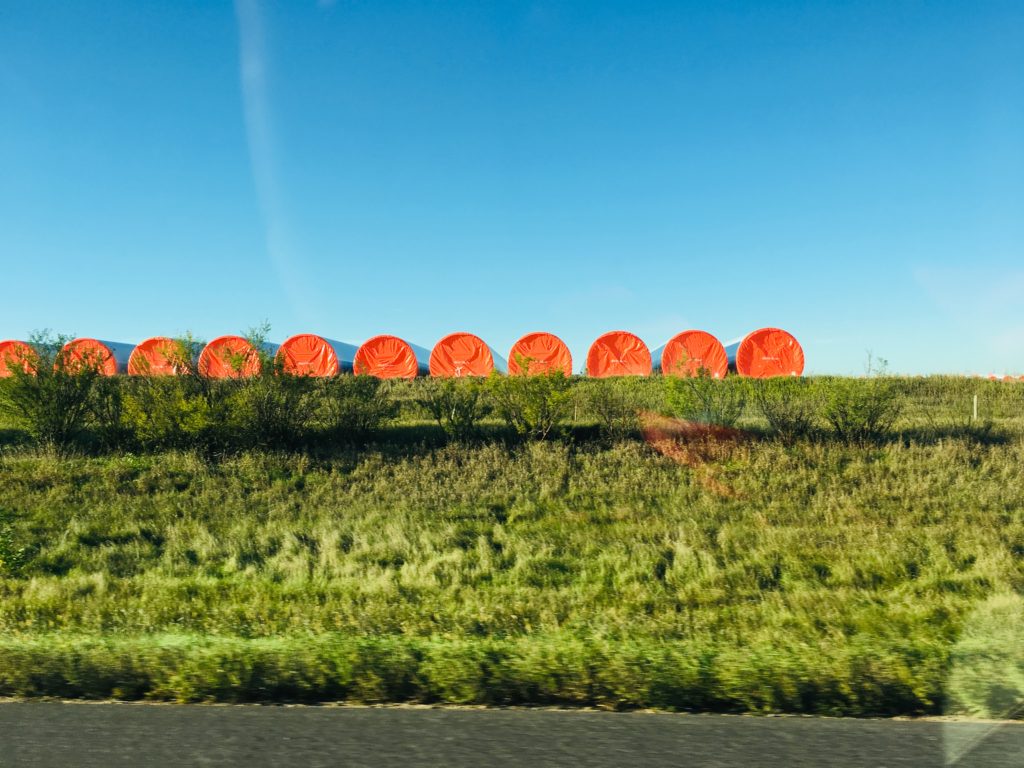
Occasionally some interesting sights are seen on the interstate. Huge headquarters of Sierra Outpost and Cabelas are a surprise to see. Then, we are puzzled by what this is until we see them being installed further up the road. It is a huge wind turbine blade being transported. Then just now, I find this article https://nebraska.tv/news/local/wind-turbine-blades-halted-near-axtell. I learn that Nebraska is the greatest wind corridor in the country; wind farms are plentiful.
Wind turbine blade Replacement blades
We hear so much about Omaha and Berkshire Hathaway so are curious about this city. We find it to be a lovely city that sits along the Missouri River amidst rolling hills and trees. How come there is NO traffic at 6pm? Between Omaha and Des Moines is the largest rural Danish settlement in North America.
Our final destination is Des Moines, where we enjoyed a delicious meal of bbq ribs at Smokey D’s. The Best Western Plus in Altoors is where we end the day.
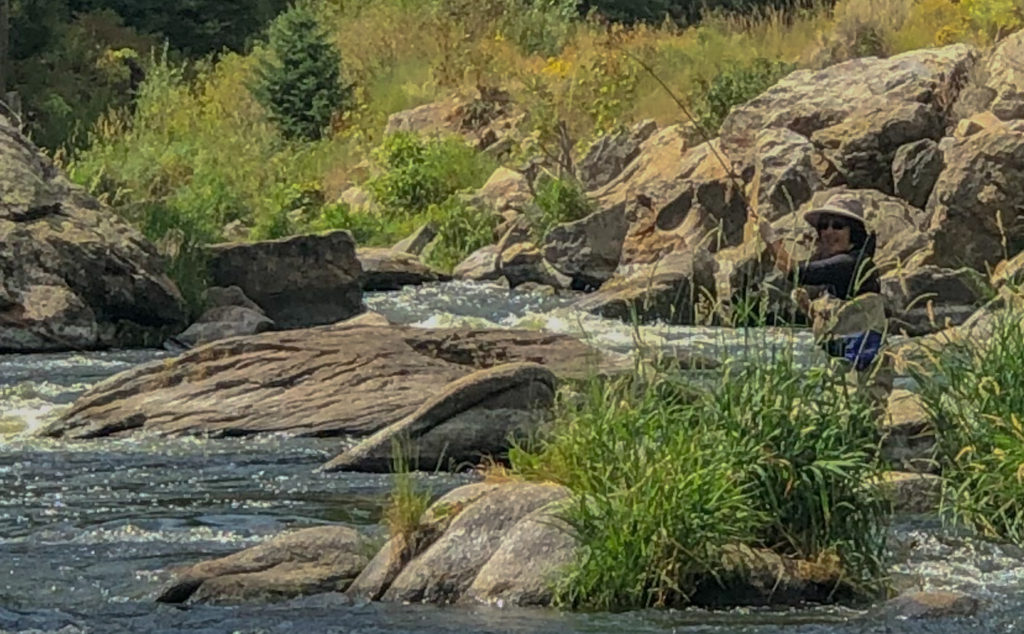
A trip is not complete unless there is fishing! Today we head to the Yampa River in Stagecoach State Park, just outside of Steamboat Springs for a day of fishing. Ray tells me what a great river it is and I am eager to try. We leave early in the morning so to get a good spot before others show up. The river is fed from waters below the dam keeping the water temperature cold year round. We walk a bit under a mile to the spot Ray had fished before. The morning air is chilly and as the river is in a canyon. We don’t see the sun until mid morning. Naturally, Ray immediately catches a couple while I get used to being out there and try to remember all of my skills. The water is sooo cold I end up going back to the car for another layer of pants. After following Ray around most of the morning and not catching anything, I finally branch out on my own, find my spot, set up my own line and lo and behold, actually catch a fish! What a great feeling to have done this all by myself. (see photo below).
a fish caught all on my own!
Sarvis Creek is a mile down a dirt road and that is our next spot. We fish the Yampa right by Sarvis, which is much more challenging and after an hour, strong gusts and dark clouds chase us out. Just in time as a huge rainstorm hits the area. We haven’t seen such a heavy rain in a long time! We take our time leaving Steamboat and manage to get on the road while there is a break in the storm. Misty clouds float across the skies as we ascend the summit above Steamboat.
Steamboat Springs from the summit
The road winds down from 9,500 feet to 7,000 ft. until it reaches Laramie, a frontier town that was founded in 1860 as a tent city near the Overland Stage Line route, the Union Pacific portion of the first transcontinental railroad. The landscape is flat with occasional rock outcroppings but the dark clouds and dwindling light create a very dramatic scene. Cheyenne is just an hour away and we reach town just as darkness falls. We have arrived in the Wild West. The Little America Hotel is a very nice cheap deal, the best we have seen so far.
Our “big adventure” has been in the planning for some time and it is hard to believe that we are really on our way across the US.
After leaving the traffic in the Bay Area, crossing Donner Pass and the Tahoe forests, I-80 drops into Reno and the flat land of Nevada is desolate and barren. I have always found this landscape to be beautiful in its own way, the purple and red mountains a contrast with the golden colored grass and olive green sagebrush.
This time, I look up the history of the small towns along the way that we have passed and ignored so many times. Some interesting pieces of information emerge regarding their roles as railroad towns.
Winnemucca – In the late 19th and early 20th centuries, Winnemucca had a vibrant Chinatown. The Chinese originally came to the area as workers on the transcontinental Central Pacific Railroad which reached Winnemucca in 1868. Some remained or returned to settle. During the 1890s, around 400 Chinese formed a community in the town. Among their prominent buildings was the Joss House on Baud Street, a place of worship and celebration. In 1911 the community was visited by Sun Yat Sen later to become Chinese president. He was on a fund-raising tour of the United States to help the Xinhai Revolution
Elko has been the home of the annual National Cowboy Poetry Competition for the last 33 years. This festival is held each January and is a week-long celebration of life in the rural West, featuring poetry, music, stories, gear, film, photography, and food.Every July, since 1963, Elko is host to the National Basque Festival.
Wells began as a place called Humboldt Wells along the trail to California. It was subsequently founded as a railroad town along the origin of the Transcontinental Railroad and was once a stopover for passenger trains. The Humboldt River as its source in springs and a swampy area just west of the city that today is called Humboldt Wells.
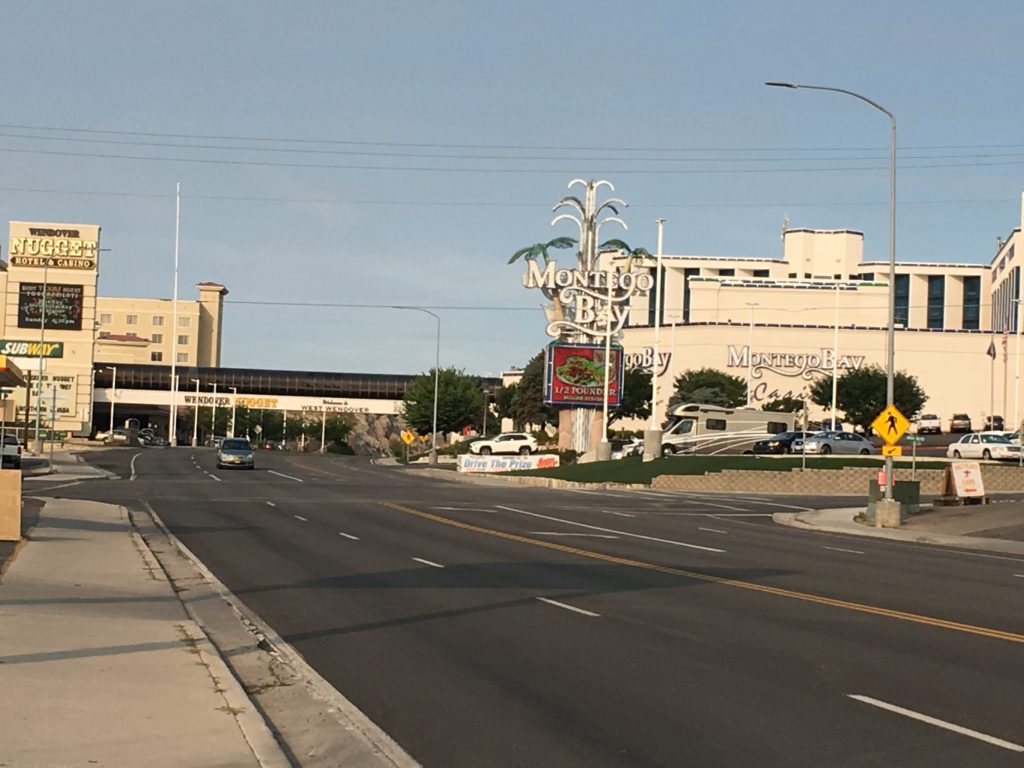
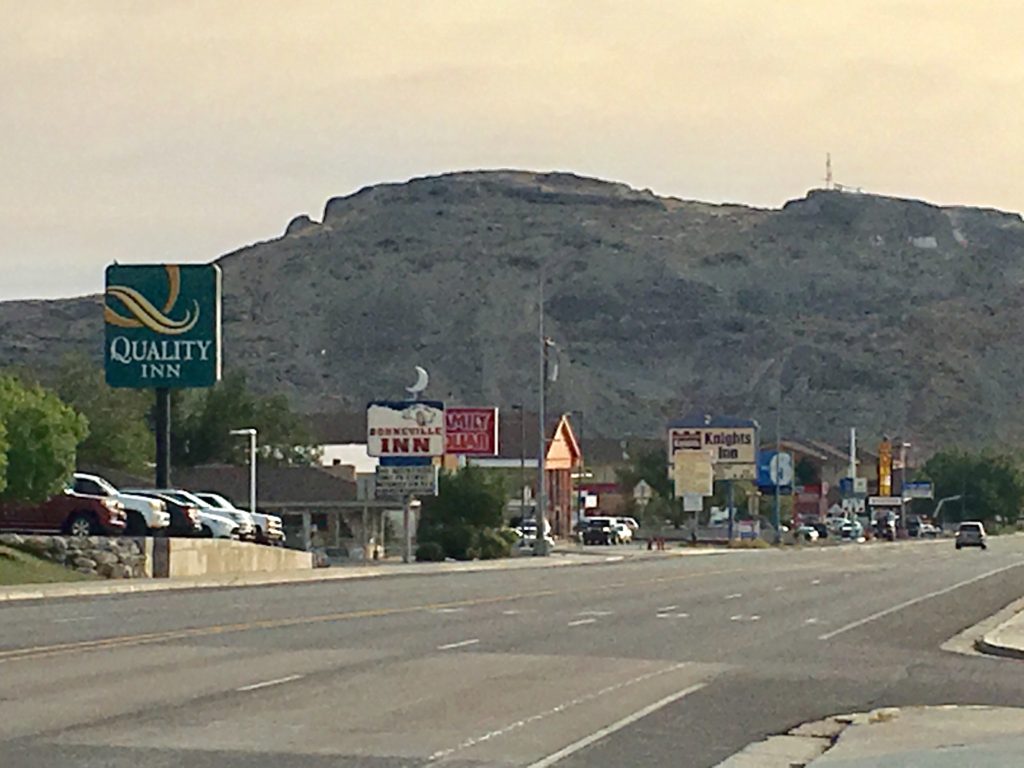
West Wendover is the last town in Nevada and straddles the border with its many casinos. Wendover sits on the other side of the border in Utah and consists of motels with no gambling. The 2 towns run the length of the same street. I am standing in the middle of the road taking these pictures.
Nevada
Utah
The Great Salt Lake is the largest remnant of Lake Bonneville, a prehistoric pluvial lake that once covered much of western Utah. The majority of the Great Salt Lake is dry salt flats. Further east is a small section of the Great Salt Lake that is still water. Last night a large group of movie film caterers were talking about setting up to film early in the morning. The chunks of salt on the floor of the Quality Inn that they tracked in, and the clumps stuck to the wheels of some cars, looked like snow!
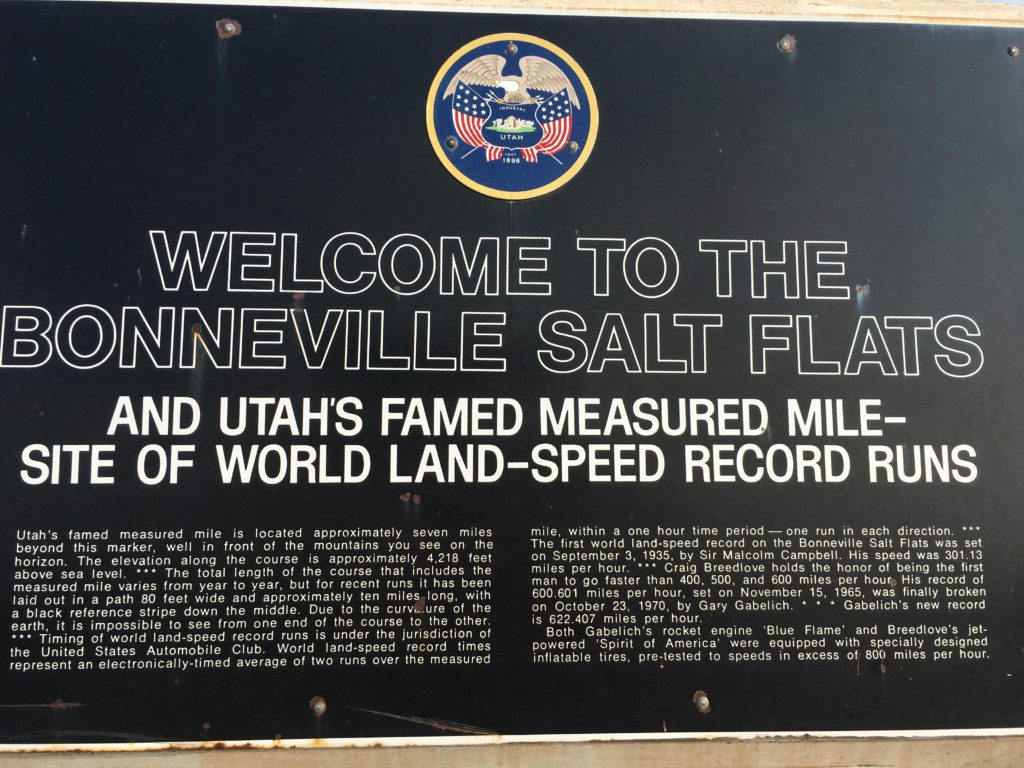
The Bonneville Salt Flats today is 30,000 acres. Here is an interesting site about the speedway https://www.bonnevilleracing.com
Bonneville Speedway
Telephone poles run along the railroad track. An amazing feat to run a telephone line this far across the country!