Kwaheri Tanzania!

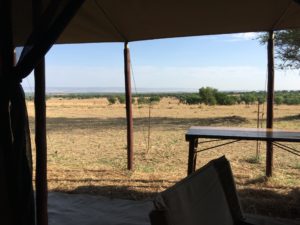
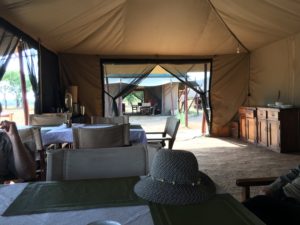
A leisurely breakfast in the camp tent, looking out over the masai mara, there is a cool breeze and the air is fresh and clean. I savor the quiet and try to hold on to this place as we recall all the special moments of our 2 weeks in Tanzania.
The Mara airstrip is only 15 min. away and I am astonished at how many safari vehicles are there. Two cessnas sit on the dirt; there is no gate, no security (and we tried so hard to keep under the 30 lb weight limit!) The guides load their guests luggage into the cargo hold below, the pilot gets in and the planes take off, all in a period of less than 15 min. A herd of elephants crosses the airstrip.  Just when I think getting there an hour before is overkill, our Air Excel finally arrives.
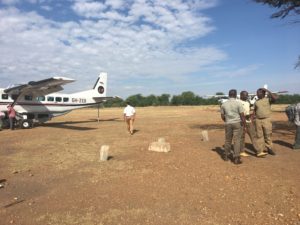
It is a Cessna 208 15 seater bringing new travellers as well as cardboard boxes of food and supplies to the camps. Our pilot telks us this is the only way to get perishables to camp; meat is frozen for the 1 1/2 hr flight from Arusha. We say good bye to our guide, hugs all around; he has made our stay memorable and we will remember him. He has a 12 hr drive back to Arusha.It is a tight squeeze inside and I sit in the first row, relieved that bring my big camera bag on board is not an issue. The pilot tells us another plane is goong to do a low sweep to scare away the herd of wildebeest that is currently on the strip, then we will be able to take off!

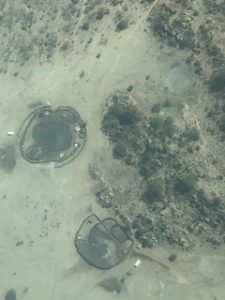
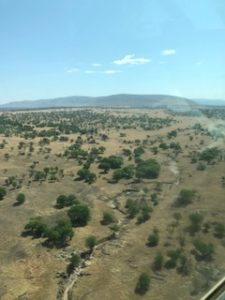
We fly low over miles and miles of the vast Serengeti. I see circular “bomas” or Masai compounds below. We land on the airstrip in Loibor to pick up passengers then continue on to Arusha. The pilot points out Ol Doinyo Lengai “mountain of God” crater, an active volcano part of the East African Rift. The landscape  is now desolate and mountainous. Meru is on our left shrouded in clouds – it is a bit bumpy and I am glad I took my Dramamine!


I am surprised at the size of Arusha, a sprawling city of low metal roofs, small shacks and a few gated mansions. The airport is small with one waiting area and a single conveyor belt; security is not a concern in this part of the world!

A driver picks us up and takes us to the Arusha Coffee Lodge for a buffet lunch. What a great business model, a holding place for safari travelers that charges a hefty price for lunch. We hang out for 5 hours then make a 1 1/2 drive to Kilimanjaro Airport. We pass rows and rows of small shacks with tiny shops, motorcycles and bikes parked in front, men in groups passing time, and uniformed schoolchildren walking home alongside the road. I am in awe of the loads carried by women on their heads, some also carrying  babies on their backs.
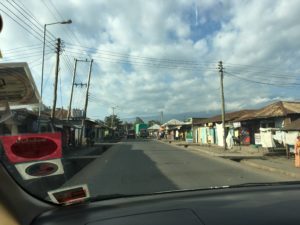
Our driver, who is from Manyara, has been learning English. His goal is to buy a piece of land and build a house. He tells us you can buy a used car for US$5,000 but that in Kenya you cannot buy a car older than 2010. Right now he pays for private school for his young child so he will not “be like me”. This seems to be a familiar story. Leaving the city we see banana fields, some small plots, and very few herds of cattle. I assume that there are fewer Masai in the city since our prior driver told us Masai men are reluctant to move and work in the city.

There is organized chaos in the Kilimanjaro airport. We Americans are so used to orderly processes and it is amusing to see how not having a gate # makes eveyone anxious. We shuffle between the 2 waiting areas, looking at the huge KLM plane that dominates the landing area. Actually there are 4 doors to the outside and they assign each door/gate to a section of the plane – this enormous Boeing has over 60 rows.

Somewhat disturbing is that 1 1/2 hrs into the flight, the flight attendant goes down the aisles fumigating with some kind of perfumed spray!  There has been no mention of this, no opt out or disclaimer up to this point. Apparently when on the ground in Dar Es Salaam to pick up passengers, the authorities check to make sure the pesticide canisters are empty. Our flight attendant remarks that they should be more concerned with bringing insects into Amsterdam than vice versa!

After this, we have an uneventful flught to Amsterdam. Stepping onto Dutch soil thus concludes our journey out of Africa. Kwaheri!
Reflections and Ecotourism

Traveling for me is eye-opening. There is nothing quite like being among a country’s local people, learning about their customs, and seeing with my own eyes, who they are. I leave with a greater appreciation that we are very much alike in so many ways yet shaped differently by our ancestry and environment.

We as Americans are fortunate in more ways than we can count – our quality of life (homes, schools, healthcare, income), infrastructure that we take for granted (clean water, electricity, roads), safety, and values of our country. The Tanzanians are beautiful people, kind and respectful, but life is in many ways a constant struggle in ways we cannot even begin to imagine.

Our driver reminds us that Tanzania is its own country, when the media reports on other countries of Africa, it is not them. They do not have ebola, they do not have strife, etc. They are a safe and wonderful place to visit. Africa, to me, was a far away place that I had little understanding of. I feel a bit more knowledgeable and a feeling of closeness to the people we have met.

Eco-tourism, is both a blessing and a curse. To the local economy, it provides a huge lift. To conservation, it brings much needed awareness of the fragility of wildlife. However, I am left with a feeling that I have in my quest to be here, contributed poorly to environmental protection. I have used more plastic bottles of water than I can count, and it horrifies me to know the totality of bottles both tourists and residents use in a day. As guests, we have consumed great quantities if good food, but we as Americans also waste large quantities of it- much is left uneaten on plates. Safari vehicles, mostly Land Cruisers, with 2-4 passengers drive around for 8 hours searching for wildlife; how much gas did we use and how much in emissions did we leave in this pristine environment? Our presence is surely felt by the animals; we are not always respectful of this place, their home, driving through their lines and forcing them to run off the dirt roads, interrupting their stalk and prey process, or causing them to leave their kill too scared to come out. The increasing numbers of lodges break up the scenery and migration paths, cars driving too fast hit crossing wildlife, birds and rodents are often seen eating plastic wrap of sandwiches, and animals come to drink chlorinated pool water. This article says it well. https://www.bookallsafaris.com/news/impact-ecotourism-african-wildlife

As humans, we leace an imprint and it is not always for the best. I think it is inportant for us to be vigilant, demand more attention to best conservation and green practices, and limit growth and impact. If not, the Serengeti we see today will not be the Serengeti our grandchildren see.

It pleases me to learn that Americans contribute talents, time and financial resources to uplift the lives of people here.

I am also encouraged to read that the government of Tanzania, along with environmental activists have prevented the building of a paved highway running east to west across the north Serengeti. This highway would result in road kill as well as interrupt the great migration, causing wildebeest to get stuck in Tanzania and die.

This trip leaves me with much to ponder and a quest to learn more. I hope reading my blog has taken you on a virtual adventure and given you a better understanding of this part of the world. I welcome your thoughts.

The Great Migration

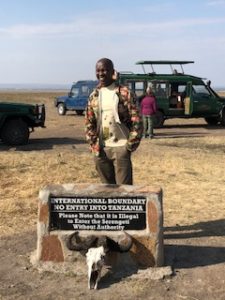
Our last game drive day and we plan to take it easy, leave early and return by mid day to relax at the tent camp.  We have had spectacular sightings and can’t expect any more. Our driver suggests following the Mara River east, then heading north a bit to the Kenyan border. We can set foot in the Masai Mara of Kenya but not go any further.

It is a lovely cool morning. We stop to watch an elephant family, a pair of giraffes, and lionesses with 4 cubs. It is a lazy day in the Serengeti as I ride in the back seat, standing on the seat, with the cool wind in my face. I gaze at the beautiful grassland scene with Kenya in the distance and give a sigh of content. What a beautiful and rich country Tanzania is, and how fortunate we are to be able to experience it.

Two concrete pillars mark the border. One states that those from Kenya are not permitted past this point. I see that the dirt road continues and in the distance the dry brown valley rises to form what looks like mesas with sparse trees on top. A few herds of wildebeest graze but there is no sign of other life. Visitors to Kenya’s Masai Mara must arrive and return via Arusha in order to clear customs. There is no border control here.

Back down by the Mara River, a few cars sit waiting for a herd of wildebeest who are gathered on the banks and look like they may cross. However they would be heading north, and would need to eventualky cross back to join the masses. Sometimes they get confused and cross back the wrong way, we are told. We wait for several hours – eating lunch; our driver teaches me the Jambo Song. The wildebeest turn back. Even though we would love to see them cross, we would rather they go the direction the masses have gone. Further down, another group begins to cross- a mass of safari vehicles moves in, one gets too close and the entire herd reverses direction. Shame on him- we are angry at this driver for interrupting this natural wildlife migration.

I have seen photos of a migration but have no expectations to view it firsthand. So many factors have to come together:                                          1. Right time if the year and being at the right river crossing (there are 7). It is not a continuous crossing as I thought; groups cross separated by nothing.  Some visitirs have been waiting for days.         2. The herd making a move to cross and not getting spooked by cars- they often come down, drink water then go back up.

We sit back at a distance as far away, a herd gathers on the north bank; another herd gathers on the south bank. They watch each other.  We are not sure which herd will cross but suspect it will be the herd on the north -to go in the right migration direction. This time only a few vehicles are there and all at a distance. Suddenly, we are surprised to see a few from the south bank jump in and within seconds, a spectacular show takes place. We estimate 10,000-15,000 wildebeest jump in and swim across within a 20 min. period. It is quite simply miraculous and breathtaking. Grunting, pushing, hesitating and jumping over each other in a cloud of dust, they enter the water, then swim single and double file across. Two zebra are in the group and the swim easily across. Mid-river, only their heads are above water. The line of waiting wildebeests extends far down the plains. Unbelievable, and yet…they are going the wrong direction!! At last it is over, only one is submerged; we think a crocodile pulls it under. We are exhausted watching.

There are no more words. I am in awe. Nature is unbelievable.


”Polay Polay”

“In Africa, everything is polay polay”, says our driver, meaning slowly slowly.  He has heard the gas truck is arriving at 9am to the park but that Tanzanian time means it might be noon so we should proceed as planned and drive out of the park. At the gate is a petro truck and we laugh, but he says no, it is water (strange). We no problem getting out. The dirt road is just as bumpy going up to Mugumu and 3 hours later we get to the gas station, yeah!

On toward the park, we arrive an hour later and the entrance process is not as smooth. They want confirmation from the park manager who signed the form but she is in the firld with no cell service, they have to send a car to tell her to go somewhere where there is coverage. No, the form itself is not enough. He goes from window to inside, person to person. Finally an hour later we are permitted to enter. “Hakuna mutata, polay polay”, no problem, slowly slowly!

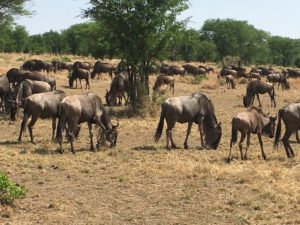
Since the day is still early, we head toward the river. On the both sides of the road for as far as the eye can see, are masses of wildebeest. Like black ants in the distance, there are thousands and thousands, some grazing, some trudging in a line, others running en masse. It is quite the spectacle! They have crossed the river and are slowly making their way southward. Our driver is now convinced the wildebeest are crossing, haha, don’t listen to the internet?? We follow other safari cars toward the river. We see about 6-8 waiting in the grassy knoll. There we stay until the herd on the other side of the river begin to cross, then we move in closer to the bank. What a sight as they line up and jump in, half swim and half march across. Unfortunately some safari cars on that side get too close and the remaining group stops and turns back. We wait but they don’t cross. Suddenly, cars start miving and there is a mad dash to the other bend in the river. Up to 20 cars bump along off road to get there in a rush- it is a bit crazy and really not in the best interests of the animals. I can’t imagine what the crowds are like during peak migration. Apparently hundreds jump in and make their way across in clouds of dust with crocodiles awaiting.

The Great Migration is a bit of a confusing process as every website gives fifferent infirmation. Our driver says the migration is only for wildebeest and some zebras. They make their way from Ndutu, (where millions gather), in the south, with their babies around April-May. By june-Juky theu are in central Serengeti and by August in the north. For about a month, they go back and forth into Kenya’s Masai Mara. When the rains come, in late August and September, they cross the Mara River and make their way south. They cross in groups and meet up in Ndutu again, where they feed and breed in Feb. what we see now is the last of them. Or driver told us crowds congregate in Ndutu in Feb. to see the babies. He said it is incredible to be among the millions of wildebeest.

We arrive lare afternoon at Mara Under Canvas, out above the plains. It is super hot and the bucket shower feels great. We have one more day here before our adventure ends.