A Little Too Much Excitement!

Being techno savvy SV people, we find real time reports online of the wildebeest migration on the Mara River. I share this with our driver suggesting we head there first thing tomorrow. But the Maasai use their senses not the WWW and he tells me not to believe what I read online, that the wildebeest could be there one day and not the next . So while in Africa, do as … and we acquiesce in following his plan to game drive all day driving north and seeing what we see, and not go with expectations.

Today starts out beautifully as we leave early on a game drive while the weather is cool. Almost immediately we see herds of zebras and wildebeest traveling in lines that stretch for miles. As they cross in front of us, the herds become a mass of thundering hooves and clouds of dust as they rn off to our right; this is the Great Migration as animals move southward through the Serengeti. Most photos of migrating wildebeest are taken as they cross the Mara River near Kenya, but what happens to them after this crossing? They continue their journey southwestward through the Grumeti Reserve, reaching the south Serengeti by November, where they feed on grasses rich in protein and calcium, preparing for breeding season in Feb. before repeating their migration northward. Their annual round trip trek is approximately 1,300 miles.  For us, it is a spectacular sight.

Several safari cars alert us to a sighting. This time it is a cheetah with fresh kill, a gazelle. Gazelles live in the grasslands; impalas in the woodlands.

A family of elephants tries to push a few trees over, a giraffe stands alone in the field and we visit a hippo pool. The hippos bob up and down, their noses sticking out of the water, sending sprays of muddy water with their tails- suddenly there is a huge commotion as a crocodile grabs the back of one, trying to get to the baby hippo. Seconds later, all is calm again.

In the parking lot, our driver learns that one of the 2 national park gas stations has suddenly stopped taking cash. We offer to charge the gas purchase and he suggests we rush to fill up in case they run out of gas, which would be “very bad”. He has 1/2 tank and we are to be in North Serengeti tomorrow. Along the way, he stops another driver and we see grim faces.  The stations are out of gas, he learns- we check this out ourselves and indeed, the “government” as he states, has not delivered gas and they have been out for 3 days. In typical African communication, no one knows why or when it will be delivered. Only by word of mouth are drivers finding out. Many are driving around and around, oblivious to tge fact they will not be able to fill up. We may have enough to get north but not enough for our driver to return after we fly out of Kogatende, which has no gas station. What to do???!!!

His plan is to go to the park headquarters to get permission to exit the park tomorrow, get gas in the next town, then reenter north. Permission is necessary because only one entry and one exit is allowed per visit, in our case over 5 days. An hour later he returns with the paperwork, confident that all is well. Turns out this is a faster way to get to the Mara River, which typically is not possible because of entry/exit restrictions. He smiles at me and says we will go to the Mara River in the morning after all!
Prey

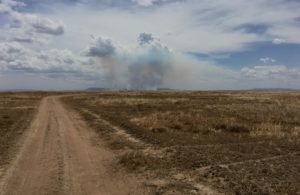
At breakfast, the guests are again entertained by the sight of buffalo at the pool, 3 this morning! Today we will continue our game drives in the Serengeti which is vast. We are currently in central Serengeti – the woodland area with sparse acacia trees stretches for miles and as you travel east becomes savannah with only grass as far as the eye can see. Sections of the grasslands are black from prescribed fires, with new green sprouts of grass emerging. Off in the distance we can see wide plumes of smoke from new fires.

The animals are sparse in this area as they have all migrated north to the Masai Mara in Kenya and have not yet returned. The ones left behind have a difficult time hunting. Early in the morning, we see a herd of zebras and as we watch them, we notice one with gashes on his right thigh and rear end. It appears he escaped a lion attack but is going to have a hard time with these wounds. Far in the distance, a mother cheetah sits under a tree with her cubs. They are quite far away but we are delighted to spot it.

Further into the central area, we come across several safari vehicles and join them watching a leopard sprawled on a tree limb. Further up the tree on an upper limb, is his ‘kill’, an antelope that he has dragged and hung up there. We are amazed at his ability to carry this enormous animal in his mouth and get it up to the tree limb. Hanging on the sane branch is the dried backbone of a previous kill. The leopard sleeps soundly, oblivious to all the cars below. We learn that he will not eat if people are around.

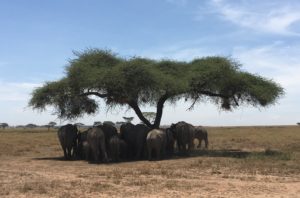
We spot another cheetah sitting on a termite mound, off in the distance. Directly in front of us, a large elephant family makes  its way across the plains, led by the matriarch and with several young ones in tow. They rest briefly in the shade then move on.

Our last sighting of the day is a pride of juvenile male lions with partial manes, sleeping next to and on top of each other. A pride will push male juveniles out in order to prevent inbreeding. Males will sometimes band together to form a pride. They will share a lioness or a harem, but will kill any existing cubs sired by a prior male. Lionesses will teach males to hunt but males are not good hunters. If they don’t find a lioness, a juvenile male risks dying of starvation.

The sun is quite hot in the afternoon and so we call it a day and bump our way back on the dusty roads 8 hours from when we started.

Competition appears to be fierce for safari guide companies. Every vehicle has a different company name on it. Our guide tells us that some drivers are not well trained and are somewhat unscrupulous in their behavior, such as crowding around a lion’s kill, causing the lion to run away. We see a zebra, recently killed, left in the ground with close to 10 vehicles watching. Our driver passes by muttering his frustration at this behavior which is interfering with the lion’s natural environment.


Dusty and Bumpy

Today is a travel day as we make our way north to the Serengeti. We stop at Olduvai Gorge, the site of the Leakey’s 70 year study of archeological finds. From there it is a 3 hour ride on the bumpiest and dustiest road I have ever seen. The fine brown dust whips up as cars drive by and permeates throughout the car. It settles on everything-clothes, skin, seats etc. After a few hours, we all feel liked Pigpen in Charlie Brown. The dirt road is also heavily rutted and creates a journey that is jarring to every bone in our bodies and vibrates the car so badly it is amazing parts don’t fall off.

The Serengeti is 14,000 square miles comprised of the national park and Conservation areas. We will be in the central part for a few days.

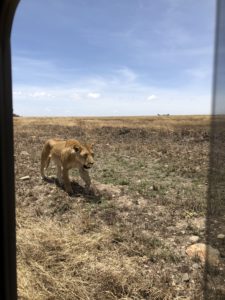
Our sighting of the day us a leopard in a tree. Leopards are solitary animals and will not share their kill. They will drag it into a tree to devour it. We learn that cheetahs on the other hand are great runners and do not climb trees. A few miles up the road, a lioness walks alongside our car, close enough to touch, oblivious to the passengers inside.


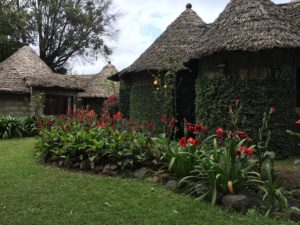
We arrive at Serengeti Serena Lodge, a far cry from the tented lodging of last night. The grounds are green and rooms ressemble thatched huts. Dinner is a circular buffet of salads, meats and side dishes, certainly not what I imagined we would be eating in Africa! A bit of commotion and excitement during dinner when a buffalo end up in the lodge’s pool. It takes several staff to chase him out and he rushes away.

The food selections have been impressive: fruits-watermelon, pineapple and banana      Breakfast-eggs, sausage, bacon and breads   Lunch boxes- chicken, salad and cake      Dinner- grilled beef, chicken and fish with variations on carrots, zucchini and potatoes. Indian dishes are common.

We have been here a week now and I am struck by how little these Maasai people have compared to the safari guests that are in the hotels. The food we are served could feed a village, but most cannot afford to eat this way. Our driver tells us that the Chinese have been investing heavily in infrastructure, sending engineers and construction crews to build roads, buildings etc and providing sponsorships for students to study medicine, engineering, piloting etc. They also take alot of Tanzania’s natural resources. Schools are teaching children mandarin. The US provides much assistance by individuals, church groups and others in building schools, volunteer doctors, sponsoring children etc. We pass Maasai children in uniforms waiting for school buses. It appears to be a common thought that travelers may send money back or sponsor your child’s education.

We find the people in the hotels to be extremely respectful and service oriented.

The wildlife faces a huge challenge in poaching. Our driver points out a ranger carrying a AK37 and says this is a very dangerous job as poachers often have poison arrows. No one is allowed to be in the parks after 6pm as rangers are patrolling for poachers. In south africa, rangers killed poachers and left them, resulting in lions who developed a taste for humans and are attacking people. It is a difficult problem to solve but one that is endangering what wildlife is left, such as black rhinos, elephants, lions and giraffes.


Ngorongoro Crater

We get up before dawn in order to leave by 6:30am. A day permit to Ngorongoro Crater is limited to one entrance and exit and our driver tells us that animals are most active early in the morning. As we drive down, the view is magnificent; the caldera is much larger than I had imagined, covering 100 square miles. The original volcano was taller than Mt. Kilimanjaro. The entire Ngorongoro Conservation area consists of 9 craters but the main feature is the Ngorongoro Crater, the world’s largest inactive, intact and unfilled volcanic caldera.  The crater, which formed when a large volcano exploded and collapsed on itself two to three million years ago, is 610 metres (2,000 feet) deep and its floor covers 260 square kilometres (100 square miles). It reminds me of coming into the Death Valley area.

Animals are able to move freely in and out and migrate to and from the Serengeti. During the rainy season, the grass is tender and water is plentiful. The main lake is alkaline and there are several fresh water ponds and small streams where most of the animaks like to congregate.

As the fog lifts, we enter the crater floor. Herds if zebras cross the dirt road. Gazing across the dry grass, we spot a total of 8 lionesses, two of which gracefully slink across us. We gasp as a male lion saunters toward our car, its main heavy, handsome and splendid.

Throughout the morning, we find two black rhinos rising out of the grass. A gazelle gives birth and her baby on thin legs learns to run and wslk within an hour. We see enormous hippos, both walking in the road and wallowing together in the mud. What a special place.

The crater roads fill with safari vehicles later in the morning and at lunchtime, I count over 70 in the picnic area. Communicating via radio, many congregate at major sughtings. Our driver prefers to drive and search independentlt, providing fir a better experience. By afternoon, the winds build up to gusts and clouds of dust are everywhere. We call it a day, a splendid day!


The Rift Valley

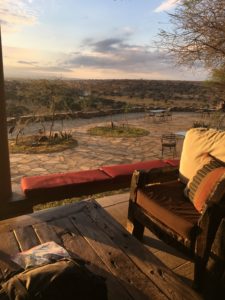
From the lodge patio, we watch the harvest moon rise over the Tarangire plains and the Tarangire mound. We sleep, waking during the night to the sound of lions roaring outside our tents; I count five times tonight.

In the morning we leave after breakfast with a last view of the baobab trees. Along the way, our driver explains that you can tell how many wives a man has by counting the huts in his compound- one for hmself and one for each wife. We pass a huge compound of the local “famous” witch doctor. Going through town we see street stalls and 3 wheeled taxis, then make a stop at the local gift shop, owned by people from India. Seeing the number of safari vehicles in front leads us to believe there may be some collusion going on and we feel sorry for the local residents trying to sell their souvenirs to tourists.

Lake Manyara is the northernmost end of Tarangire migration path as animals are unable to cross the rift.  This is the edge of the Rift Valkey before the Maasai Steppe. At Mosquito River Town which is extremely lush with many “Yellow Fever Trees”, water table is high and rice, sugar cane, and bananas are grown here. This area belongs to an alternate tribe from Ethiopia.

At this point, the road climbs over the rift and toward Ngorongoro Crater. Ngorongoro mens “bell” and refers to the Maasai herders whose cattle have bells on their necks. N. Crater is a conservation area and not a national park. The Maasai were moved there from the Serengeti in the 1950’s through a land exchange in order to create Serengeti NP. Ngorongoro was set up ss a conservation area, protected ftom development but allowing the Maasai to live and graze there.

We officially enter the park and are forced to wait as there is some unexplained issue with our permits. Finally we are permitted entrance and drive for another hour on an extremely bumpy and dusty road arriving at Sanctuary Safari Lodge.


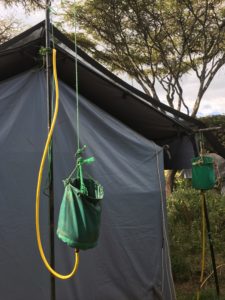
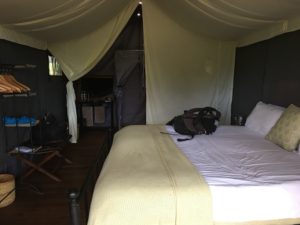
At first sight the “lodge” appears somewhat sketchy as it is a tented lodge in a jungle-like clearing. No guests are here and there are several male hosts. However, our impression of the place improves after we are served a lovely lunch under the trees and then shown to our tents, which have wood floors, furniture and ensuite bathroom. The bucket showers are an adventure! An attendant stands outside hoisting a bucket of water up which flows through a tube for your shower. It is ingenious though we don’t quite get the hang of it and end up with a cold trickle shower! This lodge turns out to be wonderful experience. We were told to expect zebra and leopards outside our tents at night but hear nothing. We are excited about tomorriw when we will travel down to the crater floor and view the animals there. Stay tuned..


Water is the Key to Life

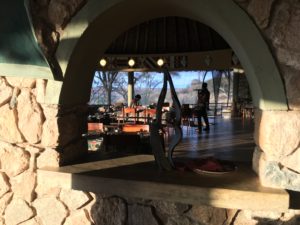
Tarangire NP is comprised of 1,000 square miles of proctected land. Many lodges sit outside the park; the Tarangire Safari Lodge is in the park, and overlooks the plains. There are two rows of tents, each has a sleeping and a bathroom area. The dining and sitting lodge are in between.


Because mid day is so hot, we have done game drives early from 6am-noon and late 4-6pm. The park closes at 6:00pm and all vehicles need to be back by 6:30 to avoid fines. The park is not crowded this week and the mist we have seen is 3-4 vehicles at a lion sighting. Some drivers communicate and share sighting locations but our driver or safari company operates independently. He seems highly skilled in identifying birds and knowing where to go to spot animals.

This morning we see sausage trees (long seed pods) and baboons grabbing them and racing to the river bed to feed on them in the morning. Ostriches walk across the road-they stay together and can lay up to 70 eggs in a pile. The lions are the kings of the park, with no predators- we see two on the cliff above the beach, waiting for prey to appear. The lioness from last night sleeps with her cubs, guarding her kill which is mostly consumed and dragged to the bushes. Male lions and elephants stay apart from the females and babies and the male lion is absent today.

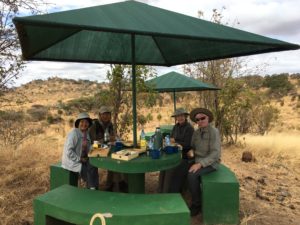
The morning excitement is a huge herd of wildebeest and zebras going down to the river for water. They return in the evening to sllep hidden in the grass and bushes. We have our lunch on a peak overlooking the Tarangire plains.


As the sun sets, we encounter an elephant family feeding on dry bushes, close enough to touch. Two lionesses and several cubs lounge near the beach. We cross paths with the zebras and wildebeests on their way back.

The herds of zebras and wildebeests are making their way northward this time of year, following their source of water. Naturally their predators move with them. Wildebeests mate in August and all calve in Feb. Only about half will survive as they are defenseless against lions. These animals only migrate within Tarangire.

Water is the lifeline for all, driving animal movement each day and through each season. It makes me think how drought and climate change will alter their lives and existence.


Maasai and Beyond

The harvest moon is shining brightly and a cool wind is blowing as we relax under the peaked thatched roof of the open air lodge. We are told we must not walk outside without a guard as animals such as zebras, wildebeests and monkeys can walk freely on the premises. Tarangire Safari Lodge is in Tarangire Park; the Tarangire River runs through and is the main water source for the animals some of which migrate from the Maasai Mara in Kenya southward when the rains come, and back northward as the rivers dry.  It feels like a completely world from what we left this morning.

Arusha is one of the major cities in Tanzania. We drive through areas that remind me of tge poorer villages of China, with shops and shacks that line the major thoroughfare.


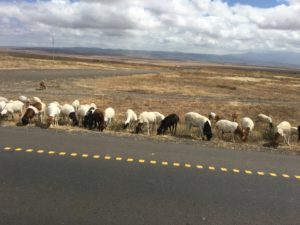
Leaving the city, we pass Maasai villages and clusters of cows being led to water by Maasai herders. Finding water is a major part of this nomadic life, and water sources are few and far between. The land is very arid, much like the eastern sierras. Some herders and women with jugs walk to water each day, others walk farther and farther away frim home, only to retun when the rains come. Their diet consists of meat and a drink that is half milk and half blood, which according to our guide, allows the Maasai to survive months without drinking water.

Maasai men have many wives. A rich man has many wives, cows and children. After a woman gives birth, she stays away from her husband for 3 years. We see a few young boys by the side of the road with white painted faces. Boys at 14-15 are circumcised, and after 3 months  their faces are painted so they cannot be seen by their mothers. At 6 months, they appear as men.

Following a dusty road, we enter the park. It is hot and very dry as we make our way to the lodge. We watch herds of zebras and wildebeest in addition to many soecies of birds, and are spellbound as a small family of Asian elephants walk by. They are huge animals with large flapping ears and big tusks.

In the late afternoon, we head out on a game drive. We watch a large herd of elephants, the young frolick in the sand and water, the mothers watch over the young, and the juveniles tease eachother. Their behavior is so human like  that we are entranced. At the end of the drive, we come upon 4 young lions in a tree, and on the way back, a mother lion with 3 cubs, a recent wildebeest kill which mother prepares for consumption. It is an incredible sight and a dramatic ending to our day


Intro to Safari 101

The grounds of the lodge are lush with well tended gardens and tall trees. Breakfast is buffet style with fresh juices, fruit, breads, and eggs cooked to order. We are told most of the food is grown locally, a surprise to me but we learn that Arusha is very fertile as groundwater flows diwn from Mt Kili and Meru. Stefan our driver and guide meet us this morning and we set off for Arusha National Park at annelevation of 4,500 ft. The park is surprisingly lush, small but varied with spectacular landscapes in three distinct areas. In the west, the Meru Crater funnels the Jekukumia River; the peak of Mount Meru lies on its rim. Ngurdoto Crater in the south-east is grassland. The shallow alkaline Momella Lakes are known for their wadjng birds.

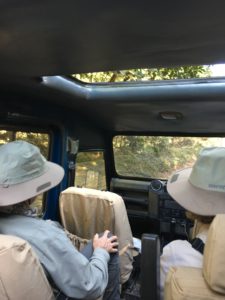
As this is a small protected park, there are a limited number of species but a good introduction to looking for animals in trees, plains and water. We learned that the Masai use many of these plants for medicinal purposes.  Highlights are seeing zebras and giraffes, as well as cobusa monkeys, blue monkeys and baboons. It is difficult to put into words the excitement of seeing these animals in their natural environments. Finding them is a combination of knowing where they are in general but no sightings are guaranteed. The road is bumpy and dusty in spots but we enjoy the pop open top which provides an open view.


Stefan tells us that poaching and corruption result in decreasing numbers of animals especially in vast ares like the Serengeti. When he talked about needing corridors for wildlife to travel, I realized we share similar needs all over the world. He also told us how difficult life is for local people, that there is no government assistance for education healthcare. The local schools do not permit kids to bring food for lunch because stealing and fighting takes place when some children cannot afford food. Some children walk several miles to go to school and do so without eating all day. It makes us feel guilty not eating the huge lunch that the hotel prepared for us.

All in all it is an enjoyable day and we are definitely ready for safari 201 tomorrow.


We Arrive

After a 8.5 hour flight from Amsterdam on KLM, we arrive at Kilimanjaro International Airport early in the evening. The big blue Boeing 777 looks out of place sitting in front of the airport door. some of us deplane; the rest will go on to Dar Es Salaam. we are a group of safari tourists mixed with Killi climbers; one group of Dutch travelers has “Specialist” boxes as they will cycle in Tanzania. the lines are long and slow as we wait to get visas then through passport control. the small airport is modern with a brand new, cardboard still attached air conditioner in the corner. There is not a mosquito in sight! (we remembered to take our Makarone)

Denniis is our driver, waiting outside and loads us into a small minivan. we drive on a paved 2 lane highway for 45 min, occasionally seeing a bicycle or moped on the side, and passing small huts with single lights on the doorways and people sitting on porches. It reminds us of driving into small villages in China decades ago when cars were a rare commodity and people travelled by bike.

The Arusha Duluti Serena Hotel is inside a gated compound. We are greeted with warm towels and pineapple banana juice. The well appointed main lodge has tall ceilings and wood beams. We walk along a stone path with flowering plants and banyan trees. I am eager to see the grounds and Lake Duluti during the day. our room is by no means rustic-semicircular with a tile floor and wood furniture, a large mosquito net around the bed.

I feels a bit unreal, this lovely compound outside of Arusha!


Food Finds

We have one free day before leaving for our safari, a day to shake off jet lag, and to explore.

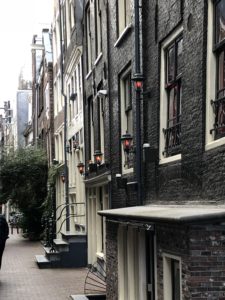
In Amsterdam, bikers rule! It is truly the bikes that define this city – red brick bike roads are wider than pedestrian sidewalks and auto streets. Bikes are parked everywhere and at the train station, we even see a 3 story bike lot.

Every 2-3 blocks, a bridge crosses a canal lined with houseboats. Below is the well knowned red light district. Looking to my side, I am startled to see scantily dressed ladies of the night posing in each window trying to entice passerbys to join them inside.


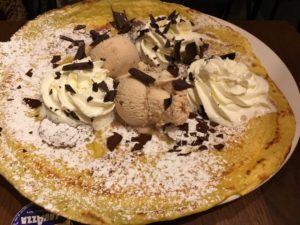
Our destination is the Pancake Bakery, an underground hole in the wall, with a short Alice in Wonderland front door. Dutch pancakes are somewhere between a crepe and American pancake -thin and plate-sized, served either savory or sweet. I have one with bacon and apples. This one is topped with waffle cookies, cinnamon ice cream, chocolate and cream.

Our coffee is served with a Stroopwafel, made of thin layers of dough filled with an extremely sweet caramel syrup.

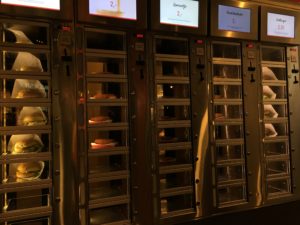
It is lunchtime and workers line up at the FEBO– a fast-food chain that sells snacks via wall-spanning, coin-operated vending machines. The hamburgers on a bun look a bit like play food.

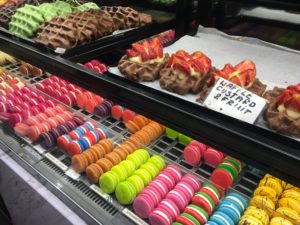
At the local bakery, macaroons and cookies are a colorful sight.

We have now made our way from north to south and west to east. The wind is gusting at 20mph and the rains are approaching (there is a reason for the lushness). We ride the city bus back to the hotel and call it a day. There is packing to be done for our safari.

Amsterdam

We take off under clear blue skies, land in Houston and on to Amsterdam, arriving 14 hours later. With a birds eye view, I am constantly struck by the lushness of places outside of our area, Houston’s broad swatches of forests, and the flat green fields of Amsterdam broken up by sinewy waterways. In my mind I see colorful fields of spring tulips.

We stay in an area full of airport hotels. The Ibis is european simple but quite adequate. It is time to walk off our plane legs, the bus takes us to old town in a matter of minutes. My birthday dinner is at The Seafood Bar. The dish in the photo is layered, mussels cooked with herbs and onions, baby dover sole, adult sole, lobster halves, langoustines, skewers of shrimp and squid. Thank you TripAdvisor!

Leiden Square near the city center is vibrant and bustling, full of young adults, light rail and masses of bicycles. As we walk, I tell myself “red is for bikes”. Do not walk on the red brick pavement. Every few blocks, the pavement crosses a canal, quiet and unpretentious compared to Venice. Amsterdam feels comfortably  “local” in contrast to many European cities, a surprisingly lack of tour buses and cruise liners. Though we cannot escape the plethora of US establishments like McDonalds, Starbucks and Dunkin Donuts.