“In Africa, everything is polay polay”, says our driver, meaning slowly slowly. He has heard the gas truck is arriving at 9am to the park but that Tanzanian time means it might be noon so we should proceed as planned and drive out of the park. At the gate is a petro truck and we laugh, but he says no, it is water (strange). We no problem getting out. The dirt road is just as bumpy going up to Mugumu and 3 hours later we get to the gas station, yeah!
On toward the park, we arrive an hour later and the entrance process is not as smooth. They want confirmation from the park manager who signed the form but she is in the firld with no cell service, they have to send a car to tell her to go somewhere where there is coverage. No, the form itself is not enough. He goes from window to inside, person to person. Finally an hour later we are permitted to enter. “Hakuna mutata, polay polay”, no problem, slowly slowly!

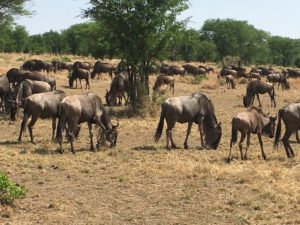
Since the day is still early, we head toward the river. On the both sides of the road for as far as the eye can see, are masses of wildebeest. Like black ants in the distance, there are thousands and thousands, some grazing, some trudging in a line, others running en masse. It is quite the spectacle! They have crossed the river and are slowly making their way southward. Our driver is now convinced the wildebeest are crossing, haha, don’t listen to the internet?? We follow other safari cars toward the river. We see about 6-8 waiting in the grassy knoll. There we stay until the herd on the other side of the river begin to cross, then we move in closer to the bank. What a sight as they line up and jump in, half swim and half march across. Unfortunately some safari cars on that side get too close and the remaining group stops and turns back. We wait but they don’t cross. Suddenly, cars start miving and there is a mad dash to the other bend in the river. Up to 20 cars bump along off road to get there in a rush- it is a bit crazy and really not in the best interests of the animals. I can’t imagine what the crowds are like during peak migration. Apparently hundreds jump in and make their way across in clouds of dust with crocodiles awaiting.
The Great Migration is a bit of a confusing process as every website gives fifferent infirmation. Our driver says the migration is only for wildebeest and some zebras. They make their way from Ndutu, (where millions gather), in the south, with their babies around April-May. By june-Juky theu are in central Serengeti and by August in the north. For about a month, they go back and forth into Kenya’s Masai Mara. When the rains come, in late August and September, they cross the Mara River and make their way south. They cross in groups and meet up in Ndutu again, where they feed and breed in Feb. what we see now is the last of them. Or driver told us crowds congregate in Ndutu in Feb. to see the babies. He said it is incredible to be among the millions of wildebeest.
We arrive lare afternoon at Mara Under Canvas, out above the plains. It is super hot and the bucket shower feels great. We have one more day here before our adventure ends.