Our last game drive day and we plan to take it easy, leave early and return by mid day to relax at the tent camp. We have had spectacular sightings and can’t expect any more. Our driver suggests following the Mara River east, then heading north a bit to the Kenyan border. We can set foot in the Masai Mara of Kenya but not go any further.
It is a lovely cool morning. We stop to watch an elephant family, a pair of giraffes, and lionesses with 4 cubs. It is a lazy day in the Serengeti as I ride in the back seat, standing on the seat, with the cool wind in my face. I gaze at the beautiful grassland scene with Kenya in the distance and give a sigh of content. What a beautiful and rich country Tanzania is, and how fortunate we are to be able to experience it.
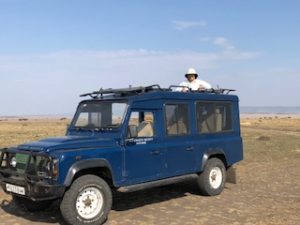
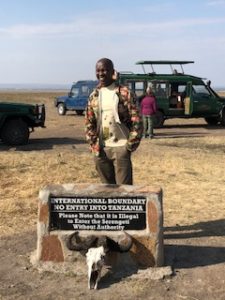
Two concrete pillars mark the border. One states that those from Kenya are not permitted past this point. I see that the dirt road continues and in the distance the dry brown valley rises to form what looks like mesas with sparse trees on top. A few herds of wildebeest graze but there is no sign of other life. Visitors to Kenya’s Masai Mara must arrive and return via Arusha in order to clear customs. There is no border control here.
Back down by the Mara River, a few cars sit waiting for a herd of wildebeest who are gathered on the banks and look like they may cross. However they would be heading north, and would need to eventualky cross back to join the masses. Sometimes they get confused and cross back the wrong way, we are told. We wait for several hours – eating lunch; our driver teaches me the Jambo Song. The wildebeest turn back. Even though we would love to see them cross, we would rather they go the direction the masses have gone. Further down, another group begins to cross- a mass of safari vehicles moves in, one gets too close and the entire herd reverses direction. Shame on him- we are angry at this driver for interrupting this natural wildlife migration.
I have seen photos of a migration but have no expectations to view it firsthand. So many factors have to come together: 1. Right time if the year and being at the right river crossing (there are 7). It is not a continuous crossing as I thought; groups cross separated by nothing. Some visitirs have been waiting for days. 2. The herd making a move to cross and not getting spooked by cars- they often come down, drink water then go back up.
We sit back at a distance as far away, a herd gathers on the north bank; another herd gathers on the south bank. They watch each other. We are not sure which herd will cross but suspect it will be the herd on the north -to go in the right migration direction. This time only a few vehicles are there and all at a distance. Suddenly, we are surprised to see a few from the south bank jump in and within seconds, a spectacular show takes place. We estimate 10,000-15,000 wildebeest jump in and swim across within a 20 min. period. It is quite simply miraculous and breathtaking. Grunting, pushing, hesitating and jumping over each other in a cloud of dust, they enter the water, then swim single and double file across. Two zebra are in the group and the swim easily across. Mid-river, only their heads are above water. The line of waiting wildebeests extends far down the plains. Unbelievable, and yet…they are going the wrong direction!! At last it is over, only one is submerged; we think a crocodile pulls it under. We are exhausted watching.

There are no more words. I am in awe. Nature is unbelievable.