Dunedin
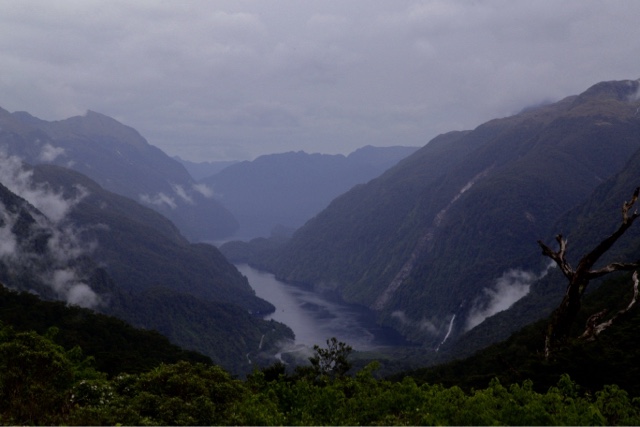
Doubtful Sound
Milford Sound
Fjordland National Park, consisting of Milford and Doubtful Sounds and the Routeburn, Kepler and Milford Treks, is considered to be the best place in NZ for hikers. The owner of the Arran Motel is extremely friendly and helpful with tips on spots to fly fish and points of interest going to Milford Sound. We are learning to appreciate the few sunny days we have and are joyful that we have blue skies for our outing.
Wet
Leaving Wanaka, the winds are fierce, especially at the lakefront.
Mt. Cook
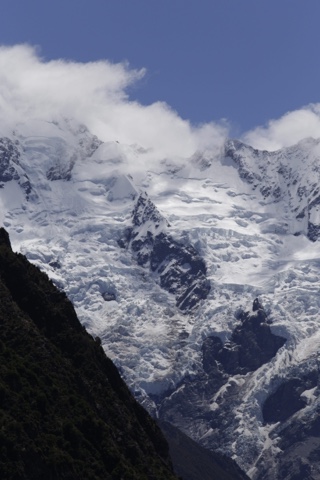
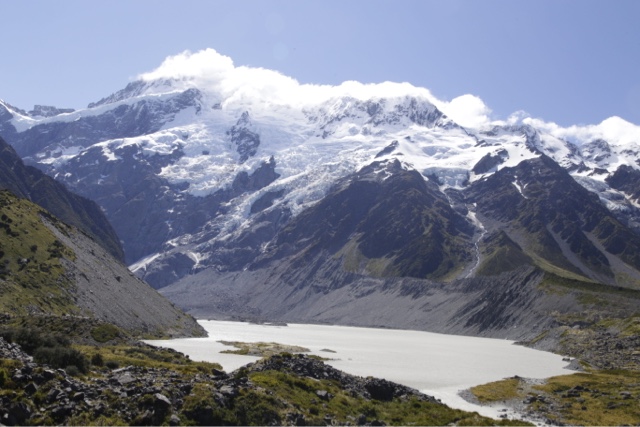
Blue skies and warmer temperatures, perfect for a day trip to Mt Cook and its surrounding lakes. The 2 1/2 drive from Wanaka passes through tan and yellow canyons and high rolling hills, the only vegetation – bushy yellow grasses. On the side of the road, we do a doubletake and u-turn, seeing thousands of bras hanging along a long stretch of fence. It is to bring awareness and to raise funds for breast cancer-very clever!
Mt. Cook has several trails and we hike 2 short ones, one of which overlooks Tasman Glacier. Along the way, we hear a crash and look up to see an avalanche of snow tumbling off the cliff. We all agree that it must be terrifying to be on a mountain during an avalanche.
Walking in the Rain
Snow capped peaks, beautiful lakes and wonderful trails of Mount Aspiring National Park provide a gorgeous setting for Wanaka. We wake to very gusty winds followed by showers and a steady downpour. In true kiwi fashion, we brave the weather, don rainpants, ponchos and boots and hike through the lush forest to the Blue Pools and Cameron Creek. On our drive back, the skies clear and Lake Wanaka and Lake Hawea are beautifully colored. This is sheep country and freshly shorn sheep are everywhere. We chuckle to see a long line of sheep trotting quickly, following eachother across the pasture to some unknown destination.
Glaciers
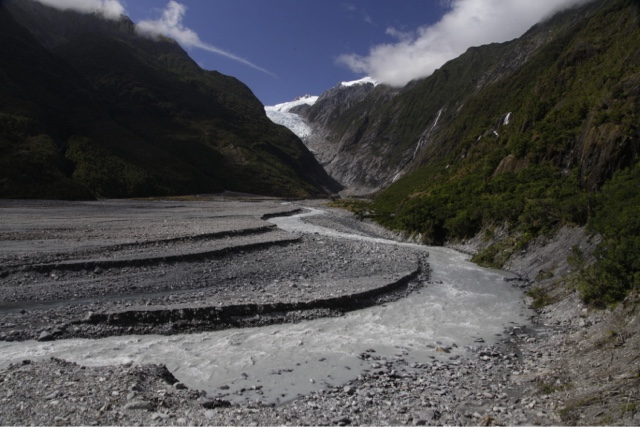
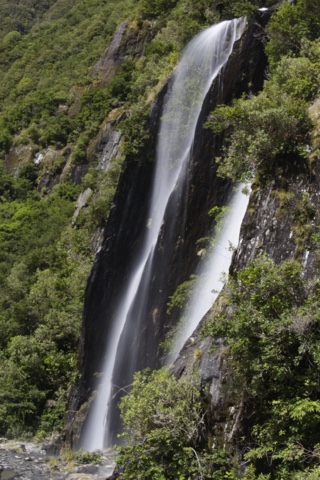
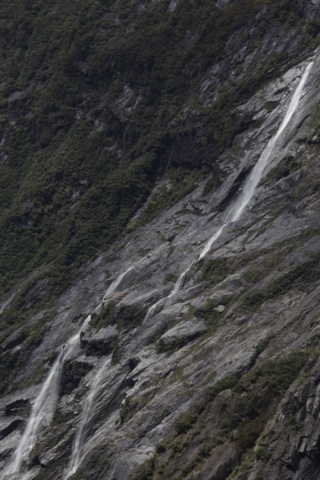
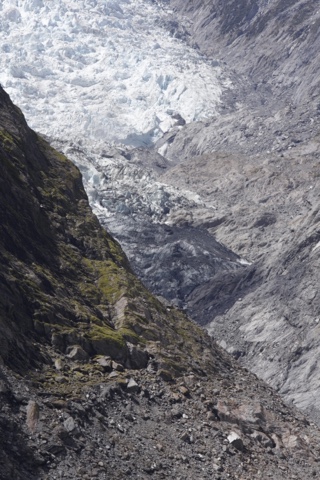
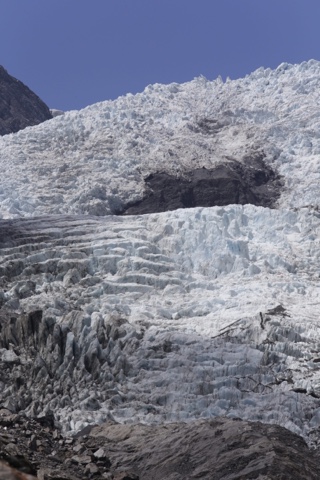
the The town of Franz Josef Glacier consists of a few motels, restaurants and a large gravel bed helioport to take tourists up to the glacier. We opt for a 3 mile walk through the wide glacial canyon rimmed by tall cliffs and ribbons of waterfalls. The walk ends at what used to be the terminus of Franz Josef Glacier, which shockingly has retreared considerably since our last visit almost a decade ago. I look at the remaining stretch of blue streaked ice and am disturbed at the thought that our granddaughter Zoe may not grow up seeing glaciers like this.
Kiwi Spotting
We leave Greymouth under cloudy skies and head south along the coast, stopping in the historic and quaint downtown of Hokitika, an old gold mining town that now consists of local craft studios.
Lush and Wet
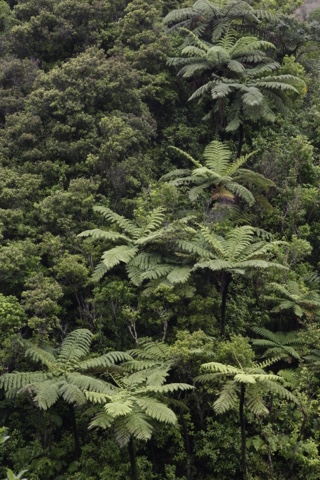
The west side of the south island is incredibly lush but also very wet. it reminds me of the road to Hana on the island of Maui. Rain has been in the forecast every day alternating between mist, showers and very brief moments of blue sky. We are glad we have brought rain jackets, rain pants and hiking boots. Many of the trails in this area are closed due to mudslides, flooding and muddy conditions. We spend part of the morning at the mouth of the Grey River as it enters Greymouth, watching the striong surf crashing on the breaker walls.
Slip
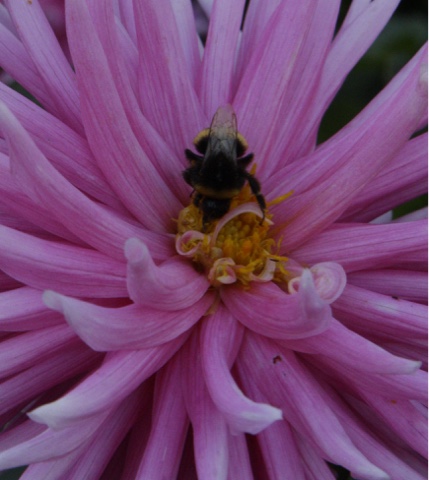
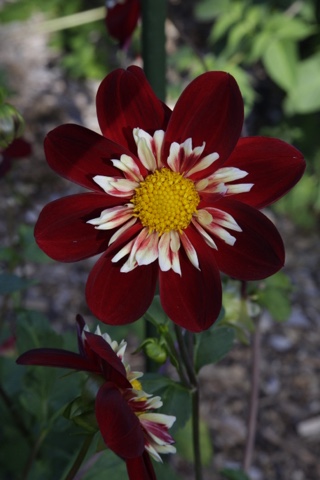
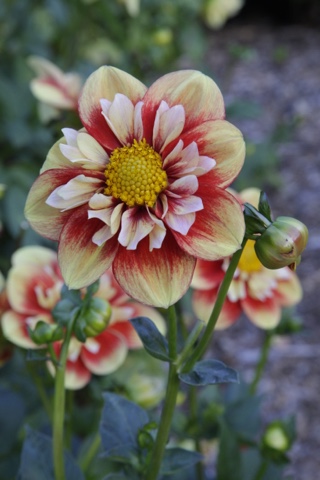
Summer mornings are delightful and as we walk into the botanic garden, the canopy of trees above us is alive with the sounds of birds chirping. In the creek, ducks forage for their breakfast with tail ends sticking up out of the water. I am eager to photograph dahlias in the morning light and spend an hour studying their intricate designs and contrasting colors. I am captivated by a bee, working so diligently to extract nectar that it ignores my camera lens, practically on top of it.
Restart
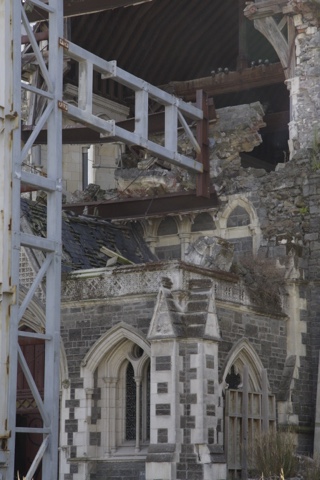
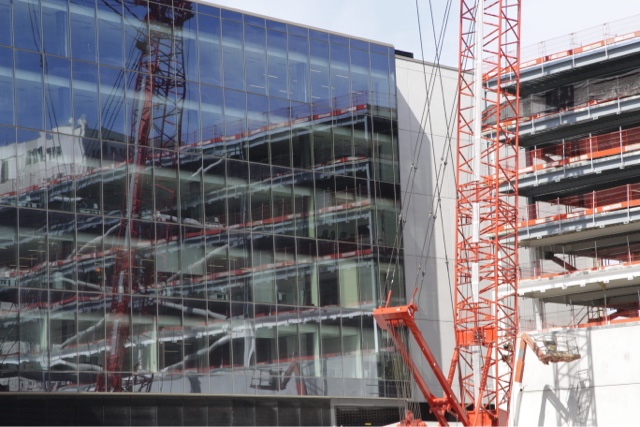
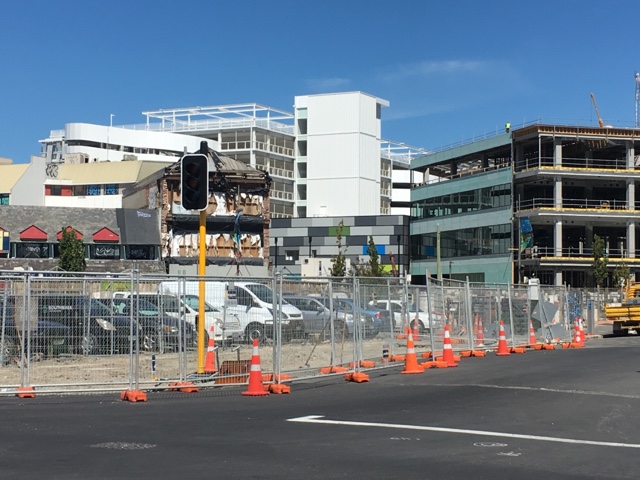
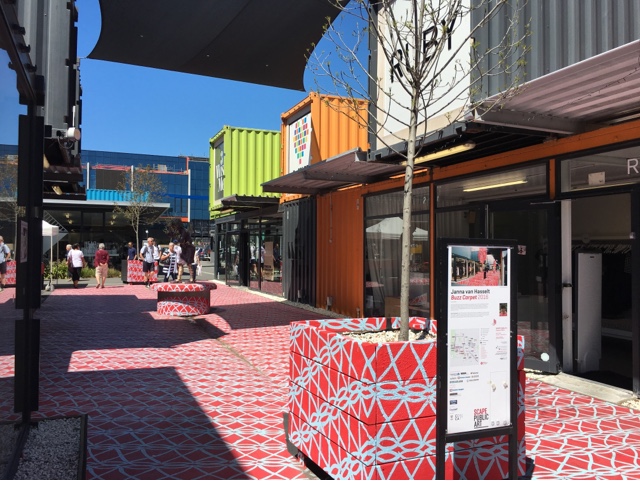
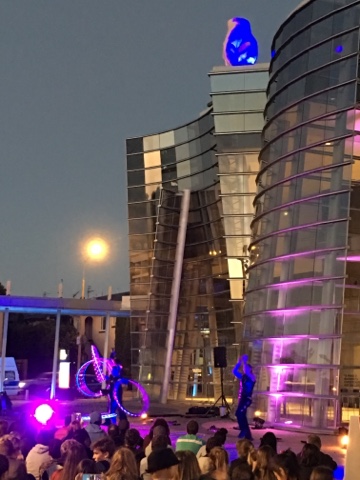
On the edge of downtown is a transitional cardboard cathedral, designed by Shigeru Ban, the architect of the cardboard church built in Kobe after their earthquake.
Back to the Future
Starry Skies Day 3
Today we are on the move. Class starts at noon in Lone Pine, so we check out late morning and make the 1 1/2 hr drive up 395. I stop at the charcoal kilns and also at scenic spots along the highway. Driving through he desert, I see a bright green patch of farmland with a motorized watering system. I also pass an enormous orchard as far as the eye can see in either direction. Not good uses of desert land that has no water. I also pass a large solar farm which seems like a much better use of land. I also pass the Owens Valley, parts of which flows as a river. This must be water for LA.
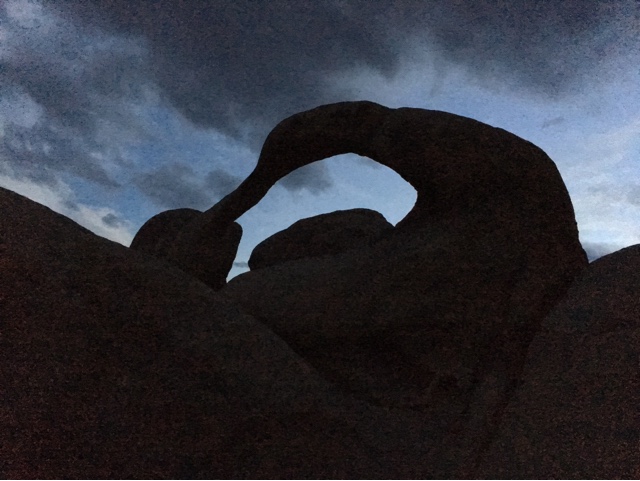
Class today is discussion in blending of images in Photoshop. I will need to do some brushing up on my skills. In the afternoon, we head out to the Alabama Hills, 30K acres of geologic formations that are a popular filming location for television and movie productions, especially Westerns set in an archetypical “rugged” environment. Since the early 1920s, 150 movies and about a dozen television shows have been filmed here, including Tom Mix films, Hopalong Cassidy films, The Gene Autry Show, The Lone Ranger and Bonanza. It is a beautiful area with very unusual rock formations. We shoot the rocks at sunset, then practice star photography and light painting until 1am, dragging ourselves to bed in the wee hours of the morning.
Starry Skies Day 2
In class this afternoon, we learn processing techniques for our images. Then it’s back out to the field. We start by reviewing star photography and are interrupted by a helicopter circling overhead. It is completely distracting as it is dropping unidentifiable objects onto the China Lakes field, shining beacons down and making considerable noise and light. We think they are doing exercises in the night. Today we learn how to do star trails. My group is doing trails around the North Star. I realize that I need some lessons in identification of constellations as I cannot even find the North Star! We also practice light painting and taking shots of the tufas lit up in different ways, which we will combine with other images tomorrow.
Starry Skies Day 1
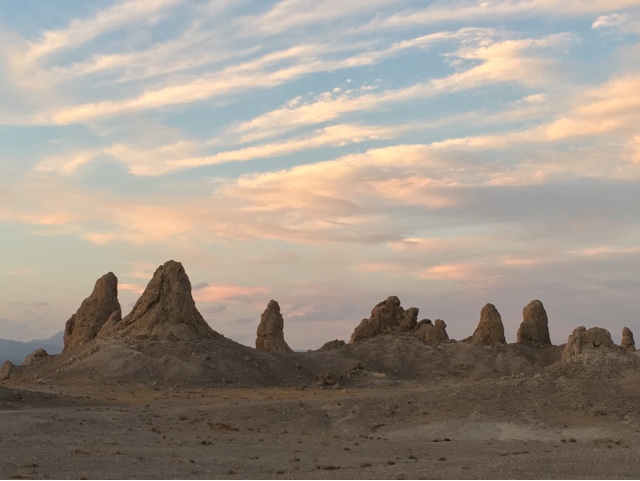
We are all filled with anticipation in creating images that we have seen online of the stars, Milky Way, and constellations. This workshop consists of lecture from noon until late afternoon, an early dinner, then field work from sunset until midnight. We learn the techniques of night shooting then head out to the Trona Pinnacles. According to Wikipedia, the unusual landscape consists of more than 500 tufa spires (porous rock formed as a deposit when springs interact with other bodies of water), some as high as 140 feet (43 m), rising from the bed of the Searles Lake (dry) basin. The pinnacles vary in size and shape from short and squat to tall and thin, and are composed primarily of calcium carbonate (tufa). They now sit isolated and slowly crumbling away near the south end of the valley, surrounded by many square miles of flat, dried mud and with stark mountain ranges at either side.
The Dunes and the Desert
It is still dark when I head out to the dunes. From the Mesquite Dunes parking lot, I walk straight out to the highest dunes but soon realize that there has not been much wind lately; the dunes are covered with thousands of footprints! I do some shooting but hike out to a remote area that is much more pristine. It is a cloudy morning so the temperature stays below 80 degrees until late morning but as soon as the sun peeps through, it is unbearably hot and time to leave. Because of the cloud cover this morning, there are minimal shadows but I find some interesting sand patterns and plants that keep me busy for several hours.
Around noon, I head out toward Ridgecrest where I will spend the night in preparation for the workshop. I am not taking the side roads of yesterday and choose to drive the longer route on main highways. Driving past Panamint Springs, the wind picks up and all the way west to 395, the winds are howling and blowing sand across the road. Along 395, it is gusty and dusty. The drive takes less than 2 hours and I am surprised at the size of Ridgecrest, which I had expected to be a tiny town in the middle of the desert. It is the home of China Lakes Naval Air Weapons Station, which I find out has 38 percent of the Navy’s land holdings worldwide. In total, its two ranges and main site cover more than 1.1 million acres, an area larger than the state of Rhode Island! The town has new homes and shopping centers under construction, a new mega Walmart is at the very outskirts. Funny that I should go shopping in Ridgecrest but I find a huge selection of fabrics at Joanns and exercise pants at Big 5 and makes me realize how “not normal” our Peninsula cities have become.
Off to the Eastern Sierras
I’m off on a great adventure into the eastern Sierras with a destination of Ridgecrest for Michael Frye’s Starry Skies Workshop on Monday. My drive will take me south and east into Death Valley for some dunes magic. My excitement makes the 8 hour drive seemingly short, with a few quick breaks in between. The temperature as I get further south is quite warm and so it is more pleasant to keep driving than to stop and stand outside! As I make my way through the Central Valley, Trump signs become more and more visible. Google maps takes me off the main highway onto a few country roads, which it has determined is a shorter path. I end up on a backroad into Death Valley through Searles Valley and then onto a section of gravel road that is under construction. I arrive at Stovepipe Wells at 4pm. It is still in the high 80’s so I will wait until early morning to photograph. The air is very dry and still, and there is not a lot of tourist traffic. The management is a bit rigid here, I would say. One couple tries to sign up for a sunset tour. This morning at 11m, they were told sign ups are only taken after 4pm. They arrive at 4:15 and are told it is full and there is no way around that. They look so disappointed!
Reflections, Tips and Recommendations
Reflections:
Journey’s End
As always at the end of a journey, leaving is bittersweet. I wish our adventures could continue indefinitely and I have so enjoyed this beautiful country and it’s simpler lifestyle. At the same time, all vacations must come to an end.
On Foot
Beauty at the End
The campground at Varmahilð is a greasy field in an elderly couple’s yard. All the campers are older adults in campers and Rvs. I have to say Icelanders are clean and neat people. Every bathroom has been immaculate!
Light Show
Aurora
Ready for winter!
Civilized
Goðafoss (Waterfall of the Gods) is a large arc of cascades, where the Skjalfandafljot River tears through the canyon right next to the Ring Road. It’s glacial blue water winds its way through Barðardalur Valley, the 7000 year old lava field. It is a beautiful sight, though we don’t stay long in the drizzly and gusty morning.
Goðafoss
Steam
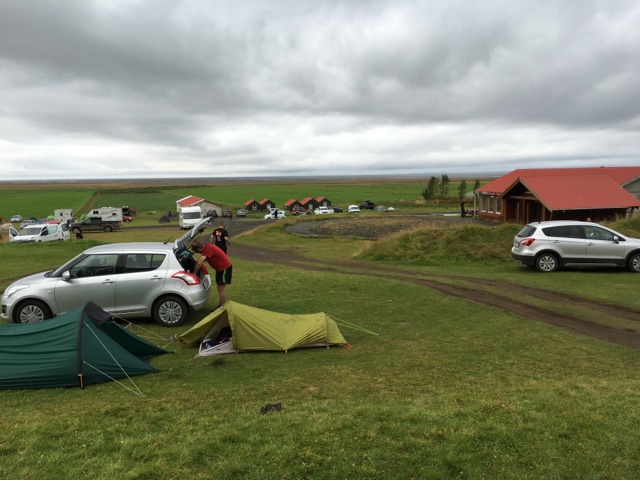
It was sure cold last night, down to the high 30’s! Although the camper van has a small heater, we discover it runs on diesel and the fumes would obliterate tent campers on the grass around us, so we huddle deep in our sleeping bags and look forward to hot coffee with bell pepper/ham egg scramble in the morning. The campground at Lake Myvatn is basically a place to park; I have to say the bathrooms in all the campgrounds are too few in number but really clean. The hot water from the faucet, heated geotherally, is burning hot.
Geyser bread bakery
Fjords
Ice
Well we have spent 5 days 24/7 living together in a camper van often hours on end waiting for the rain to quit and talking pretty much only to each other; I say that it is a good sign we are still liking each other’s company! Ray is doing a great job driving our home on wheels, one lane bridges, dodging potholes on gravel roads, and what Icelanders refer to as “suicide sheep”.
Wary of Raindrops
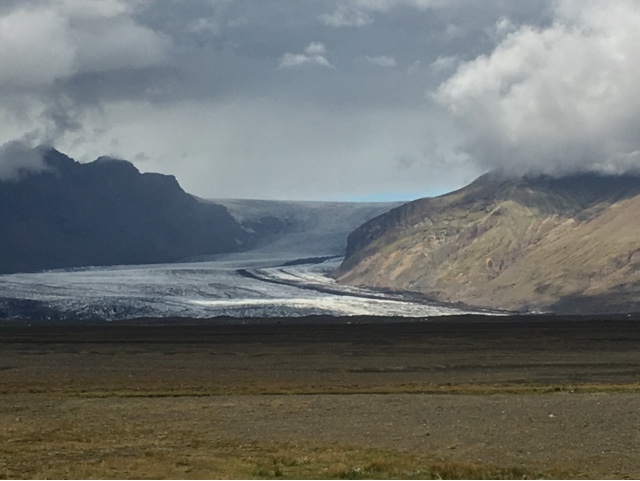
The day starts gray and drizzly and most of the tent campers pack up early. We have a leisurely morning, knowing that there is not much to rush to in this weather. We head back to the park and take the gravel road to Svinafellsjokull. A short walk up to the ridge overlooks the glacial lagoon with twisted icebergs of all sizes. The main glacial walls reflect in the murky but mirror like water. We have a good couple of hours before the raindrops fall. Hiding in the camper, we watch bus loads of tourists get drenched. The rain let’s up for a short while and we walk down the path, only to get caught in another downpour. This time we were prepared, fully covered in rain garb. The rain never stops and after a number of hours we give up and leave. We think the glacier creates its own weather. We take a short drive and walk to the side of Hvannadalshnukur, its peak at 2199 meters emerging from the clouds. Back to the campground, charging devices and dinner finishes the day.
Campground at Svinafell
Ending in a Downpour
Home Away From Home
Typical Icelandic day, low clouds, light drizzle from time to time. Today we pick up our camper and what a busy morning it is. We return our car, exchanging it for a Big Campervan, not an RV but about the size of a Sprinter Van.- complete with cabinet holding cooking and eating supplies, small sink, running water from a big jug, and butane campstove. We learn that water anywhere in Iceland is clean amd drinkable, having been filtered numerous times through volcanic rock. The table folds into a bed; it is a very cool unit! We pick up our Trawire wireless hub, buy gas cards (US chip and signature cards do not work at gas pump machines) and food. The grocery store was another example of simplicity with very fresh offerings of produce and meat but center aisles (packaged goods) was a third of our stores- no sugary cereals, no sauces and dressings, no aisle upon aisle of junk food etc. Quite simply, a healthy diet within a store.
We are finally on our way, a little anxious about driving this big thing, and hopes that parking isnt a problem. The plan is to drive counterclockwise around the island on the ring road, which is about 800 miles. Other than taking a few side routes around fjords on the east and west coasts, we will stay on route 1, as the roads going toward the interior are gravel and not recommended for camper vans. Route 1 or the Ring Road is a 2 lane well maintained road with not much shoulder and rarely a place to pull off for photos. Occasionally, a short section of farm road can be used, but once we stop, everybody else seems to want to stop as well! Heading east outside of town, the terrain changes from lava fields to green farmland with Icelandic sheep and horses. We stop at what is to become my favorite falls thus far, Seljalandsfoss, three falls cascading over a long cliff, the largest of which has a footpath leading to and behind the falls along the carved out rockface. As you walk through, the spray is immense and the view breathtaking. The path leads you out over boulders and down a long staircase.
The second set of falls for the day is Skogafoss with 527 steps leading to the top. Yes, I did climb them but the view is more magnificent from in front. Our last stop is the black sand beach at Reynisfjara along the southern coast near Vik. The tall basalt columns cliffs resemble a rocky step pyramid called Gardar with puffins and sea gulls nesting in the ledges. Once I start taking photos, everybody on the beach has turned their cameras up to the cliffs! The interior walls of a cave are made up of what looks like twisted basalt columns -I promise to share photos. The beach itself has polished smooth black pebbles wet and shiny from the mist. In the distance are sea stacks called Reynisdrangar. Twilight here is long; darkness does come but not until close to 10pm.
Campground at Vik
Spray and Steam
All flights and connections through Minneapolis to Iceland on time, hallelujah! We landed in Keflavik, a small airport town outside of Reykjavik. The very efficient Grey Line door to door service whisks us to Hotel Vellir in less than an hour. I am immediately struck by the simplicity of the towns and buildings. For example, our hotel looks like a concrete block with windows but inside is typically Scandanavian – clean, tidy and utilitarian. It is a pleasant change from the traffic, heavy construction, and overabundance of material goods we have gotten used to. I love the crystal clean air with dampness from a recent light rain, and the unbelievably quietness. With barely any traffic on the highway, it certainly seems that stress levels must be low here!
In the morning, a large German tour group occupies most of the seats at breakfast and we end up sharing a table with a woman who lives on an island north of Hanover. She is here with her adult son who is accompanying her on her dream trip, so sweet. Our Go Car driver arrives and we set off in a little VW Polo. We are feeling lucky as we are told this sunny clear day is highly unusual! The plan for the day is to visit stops along the Golden Circle just outside of Reykjavik. First stop, Pingvellir National Park, site of one of the world’s great geological boundaries, a rift valley where the North American and Eurasian continental plates are breaking apart. This rift stretches across Iceland but here is 4km wide and 16 km deep at this location. Pingvallavatn was the site where Iceland’s chieftains gathered to formalize their laws.
Only 30 min. from Rejkjavik, this is a top tourist stop and we are shocked by the large numbers of people. The crowds thin a bit as we walk further to the boardwalk and descend to the Almannagja Canyon. The footpath follows the river past the old church to join a network of paths.
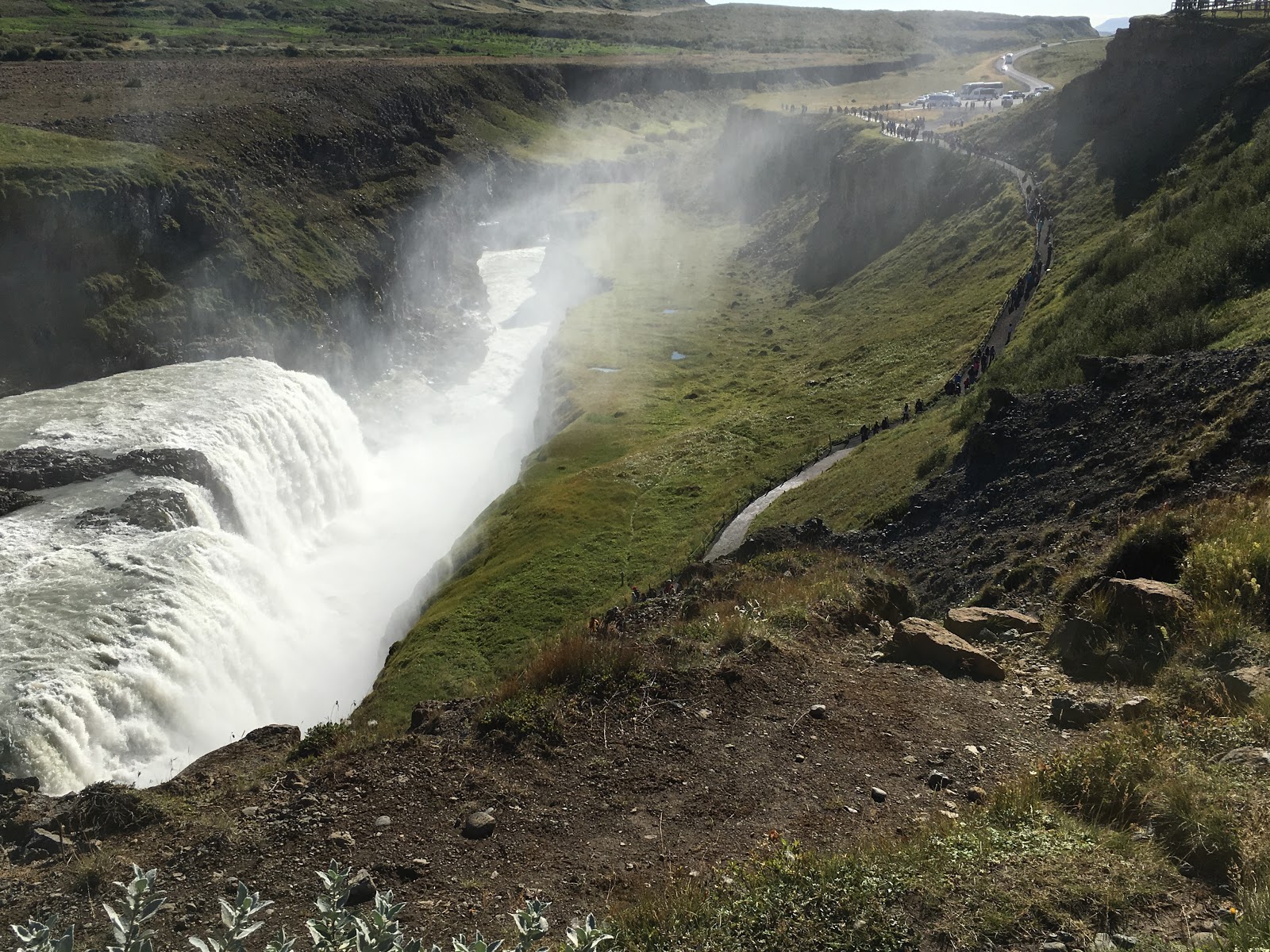
Leaving here, we follow the tour buses past Geysir, a gift shop and small geothermal area in the grasslands. Next stop up the road is Gullfoss, where the mighty Hvits River thunders into the canyon at the “Golden Falls” with its massive spray and rainbows delighting the hundreds of visitors. Two viewing platforms give very different perspectives.
Back on the road, we take the road until it ends as a gravel road and are at the edge of Iceland’s interior, with a view of the glaciers. Our afternoon is spent making our way back, stopping at small geothermal areas with very unusual permafrost-like undulating scenery. We end the day with a quiet meal of fresh fish and lobster bisque from Talent in Hafnarfjorður where we are staying.
Gullfoss
Italian mosquitoes!
Last town
Winding down
Hundreds of steps
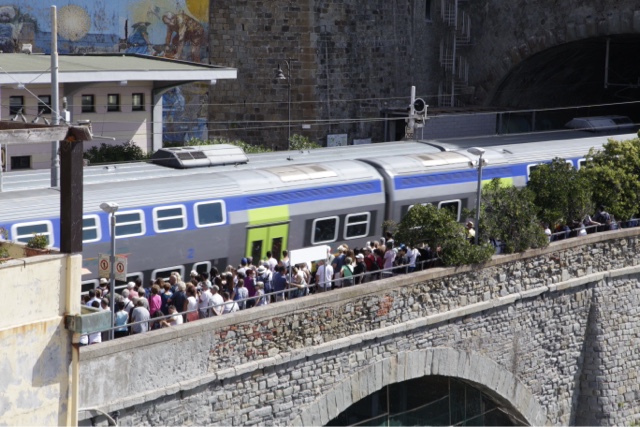
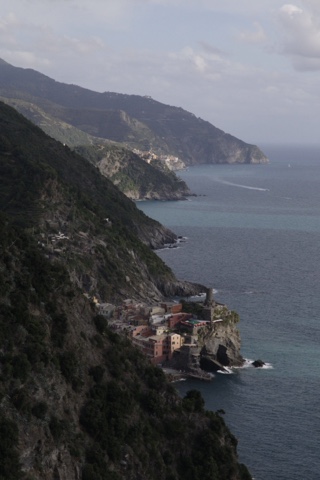
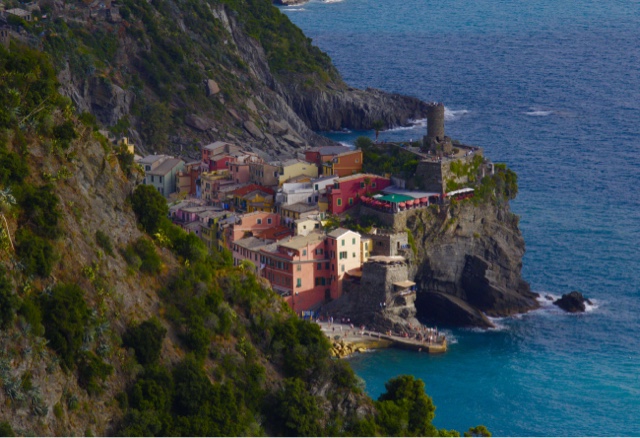
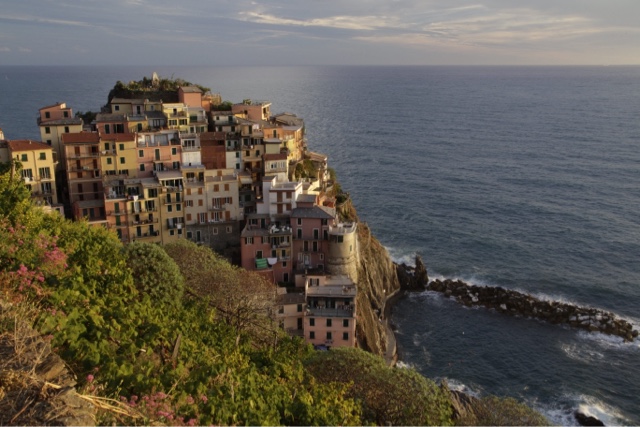
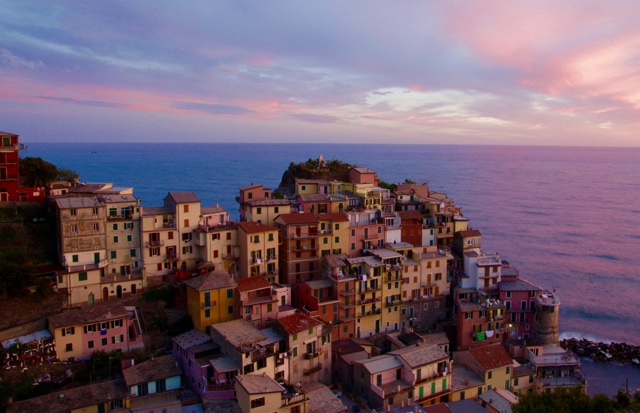
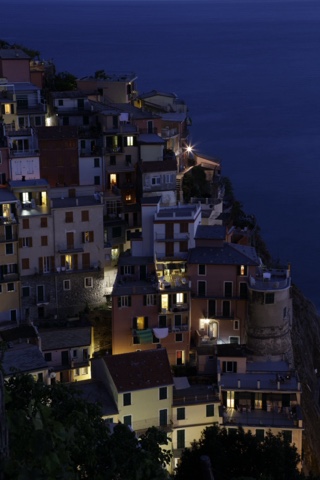
We are advised to hike early or late in the day as the midday sun is quite hot and sweating is guaranteed. We start out at 8am but our efforts are thwarted in many ways. On the path, we find a gate blocking the coastal trail from Manarola to Ćorniglia due to dangerous trail conditions; then we find people turning around because the trail from Manarola to Riomaggiore is not scheduled to reopen until 2017. The heavy flooding in 2011 destroyed many of the trails of the Cinque Terre and devastated the towns of Vernazza and Monterossa. Although the towns have been cleaned up and restored, the trails have not. In addition, trail maintenance is often unscheduled and unannounced, typical of Italy, so the trail from Monterosso to Levante is also closed. By now, it is getting quite warm so our Plan B is to ride the “milk train” to Riomaggiore and have coffee, then explore all five towns by train. Figuring out the train system is an education in itself. They run about every hour but not all trains stop in each town; the information booth has printed schedules that change every few months. We learn that tickets are sold at machines and are good for a few months so fines are high if you don’t validate them before boarding. The most crazy sight is the crowd of people trying to get on and off the trains at mid day, mostly due to all the tour groups that descend from La Spezia and cruise liners around 10am. We later learn that October is a better time to visit. As we watched one train arriving, some got on board but a tour guide was frantically waving the other half of his group to run and get on another car. People were yelling at family members to hurry up and get on. One tourist said she saw people’s faces pressed against the doors. Is that insane or what? Fortunately, most tour groups had already bypassed Riomaggiore, the first town so our train was fairly empty.
Trains, trains and more trains
We leave Venice just as the crowds begin to stream into the city. Huge groups follow tour guides waving little flags. Our train from Venice to Florence is filled with tourists, many who have suitcases way too large to fit in the overhead racks and we watch with amusement as people desperately try to fit their bags somewhere, anywhere. I wonder what is in their luggage and why they need to bring so much stuff! In Florence, we transfer to a regional train to La Spezia, which stops at many small towns. These towns are grittier than the ski towns up north, graffiti art decorates the concrete walls. Air conditioning is weak and occasionally a cool breeze blows through. Passengers on the train are a mix of local residents, students and tourists. I spend my time people watching- the young teen couple sitting across from us, she sharing photos on her cell phone with him; he looks totally disinterested.
Arrivedercie Dolomiti
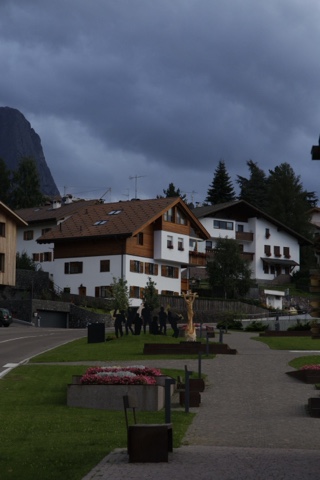
Our destination today is Venice where we will return our car. Patchy clouds turn to gusty winds as we make our way around the Alpse mountain plateau to Selva in the Val Gardena. One after another, we see small ski towns carved into sections of mountains and we think of Tahoe, – that this would never be acceptable. Though people tell us that Colorado, particularly Breckenridge, is similar.
…maybe
The winds have been gusting all night long and the bedrooms feel like a frigid 45-50 degrees. I don’t think anyone washed up last night. The price of breakfast puzzles us- for 7.50 euros you get a basket of bread with jams, and coffee. A la carte we get coffee, eggs and speck for 7 euros, with a basket of bread but no jam. We linger in front of the space heater and listen to the howling wind. Everone is very quiet this morning, most likely contemplating the hike out! I decide against a 20 min walk up the nearby trail to the overlook of m. pez.
Paradise Found
This morning, we are just about to seat ourselves at a 2 person place setting, at a different table from yesterday when Michaela’s mother very quickly stops us and says, ” no, no,no!” motioning for us to sit in the exact same chairs as yesterday. We dare not argue and obediently take our appointed spots! What difference does it make, we wonder? The b&b only has 5 rooms and they are not even full!
Rain Day
It is cloudy and gray outside and we are in a quandary as to whether we should hike today or not. Michaela from our b&b helps us change our reservations at the rifugio and delay hiking until tomorrow. We learn that her mother has owned the b&b for 30 years and she has been there for 22. They formerly ran a hut up on the plateau where she grew up and would walk out and come down to Siusi to school. In the winter they rode snowmobiles to get around. What a different childhood she had; reminds me of the story of Heidi in the Swiss alps.
Detours and winding roads
German rules must be followed
Today’s lesson is the importance of German order and processes and the domino effect leading to chaos that occurs when a link is broken in the order of procedures. In the wood paneled dining room this morning, various groupings of placesettings are arranged on the 6 tables. Not particularly liking our seats from last night, we fill our plates from the buffet and seat ourselves at a different table where there is a setting for two, in the half empty room. Midway through our meal, the waitress comes over and tells us we must move and sit in our assigned seat from last night. Not seeing any logic to this, we voice our desire to remain. She is not happy with us but accepts that we are difficult Americans or Chinese and in response, begins to completely rearrange place settings at these two tables, which we don’t yet understand the importance of. She proceeds to remove four place settings at our assigned table, bringing dishes and bread baskets to our current table, which now is super crowded! We watch with amusement and curiosity. Soon after, more guests arrive, including the two women who last night were seated where we currently are. They sit at our so called assigned table, which now has only a few settings(?), but then, uh oh, the German couple arrives and also try to sit there. The two women get up and are now standing in the middle of the roon, coffee cups in hand, with nowhere to sit. If they take different place settings at another table, others will not have their seats and there will be mass disorder! We watch horrified and totally amused that we have created chaos in the breakfast room! We quickly gulp the rest of our cofee and duck our heads to slink away before we are spotted! As we make our way down to the shoe room to retrieve our boots, still giggling over German order, we are tempted to rearrange all the boots which sit so neatly in pairs on the wall. The thought of everyone trying to find their boot mates fills us with laughter.
A Hike to the top of Italy
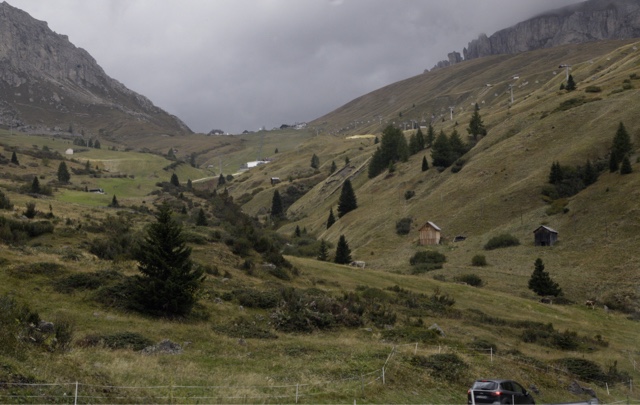
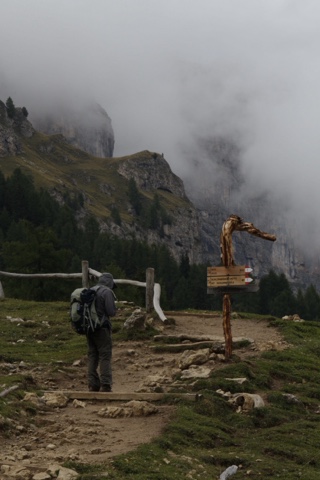
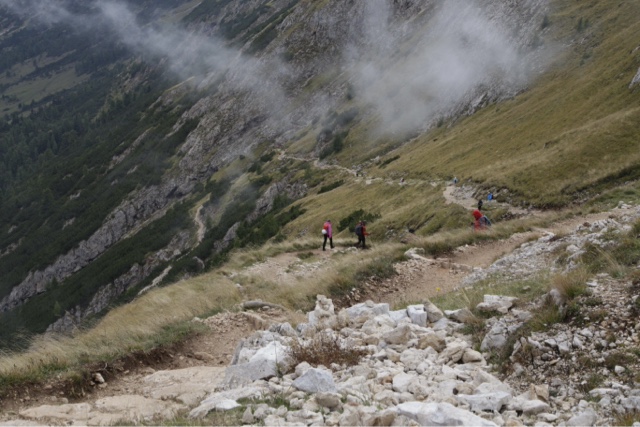
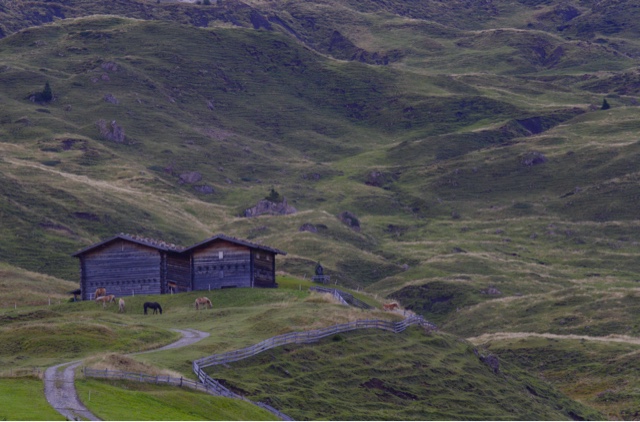
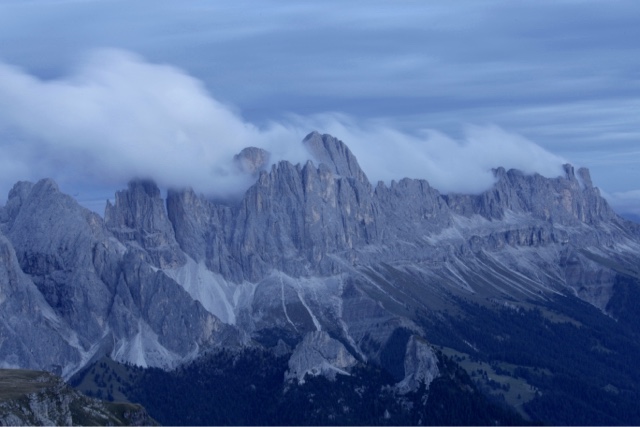
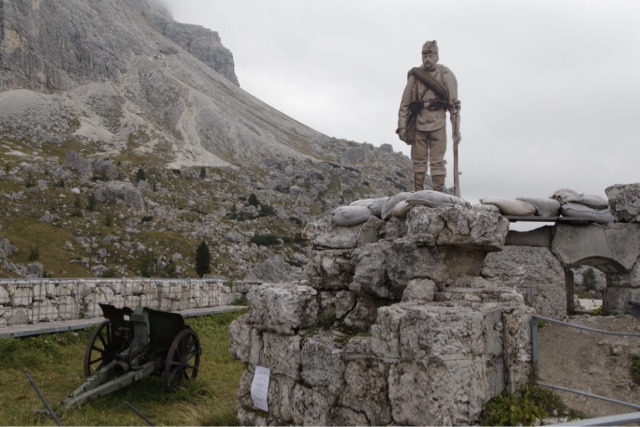
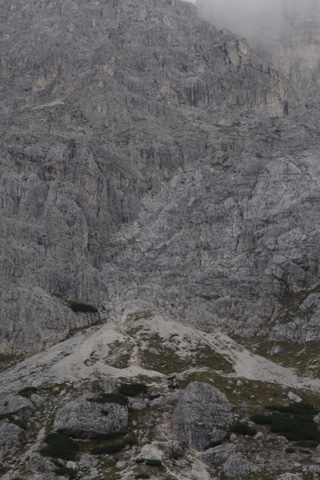
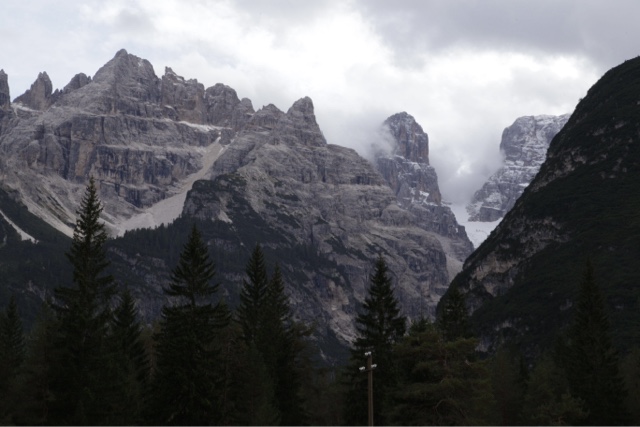
The Dolomites located in northeast Italy, are regarded as among the most attractive landscapes in the world with vertical limestone pinnacles, spires and towers in a diversity of colors. The highest peaks at 1500 meters are the tallest limestone walls in the world. They were declared a Unesco World Heritage site in 2009. During WWI, they formed the line between the Italian and Austrian-Hungarian forces. The protected footpaths, numbered 1-8, are the long distance trails that are hiked today, most take a week to complete. The most comprehensive guide, recommended by hikers is the Cicerone Guide, Walking in the Dolomites. We are hiking only a segment of path number 5 in the Val de Fane.
Mountain Air
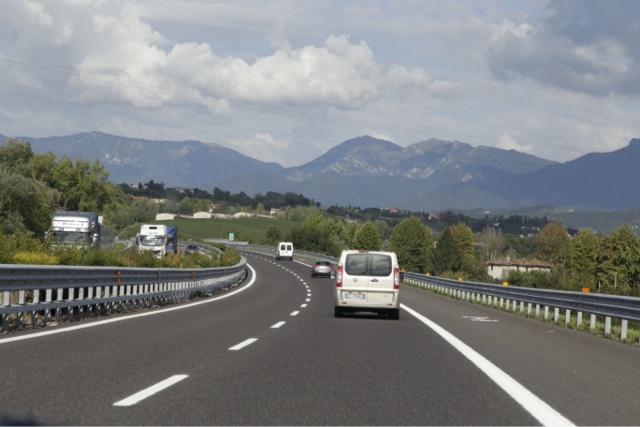
A quick ride back to the airport in the morning, a stop at Europcar and we are off, equipped with a compact Nissan. The autostrada immediately takes us past farm fields of grapes and surprisingly, lots of corn. Has Italy joined the global market for corn syrup? In less than an hour, we climb in elevation, passing charming towns that sit in valleys and cliffsides. Is it the uniformity of houses with their red tile roofs and stucco walls that give them their charm? Many of the small towns in the Sierra foothills feel out of place in the forested landscape and certainly do not add charm. What is it about Italy that gives these small towns such character? I am reminded that everything in Europe is a smaller scale than the US, from the size of cars, highways, tractors, houses, to cups, shower stalls, and even forks and spoons! Are we just used to excess or why are our things so big?
Ciao
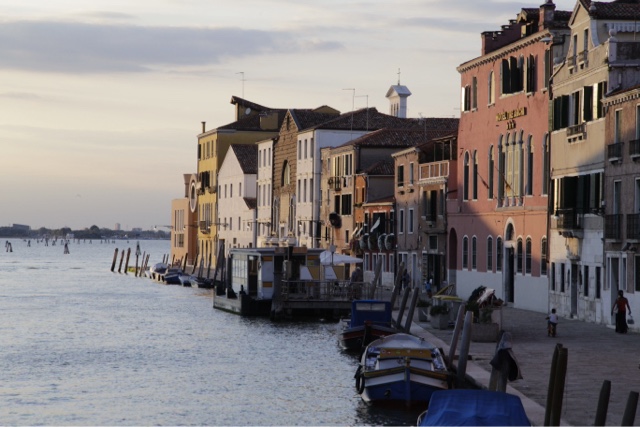
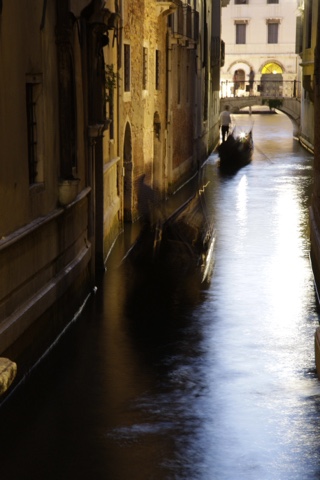
We leave home before sunrise marveling at the peaceful and near empty highway. The hustle and bustle at the airport in these wee hours of the morning is reminder that as the city sleeps, the day has already begun for so many. There is a sense of excitement in the air, of the unknown adventures and new places to explore. We fly to Newark then on to Venice as the sun rises over the jagged peaks of the Dolomites and a colorful palette of polygon shaped farm fields. We are greeted by cool breezes, sunny skies and bonjournos; after 12 hours, like the blink of an eye, we walk out into early morning in Venice, this city too coming to life.
Final travel tips for France
It has been an interesting trip, full of history, new sights and good food. We both agree that the Dordogne area has been our favorite because of the deep history, amazing caves, scenic beauty and gorgeous towns. Our recommendation for other travelers would be to day trip or overnight to Mt. St. Michel from Paris by train or bus. Spend a few days in the Loire Valley and 5 in the Dordogne (rent a car for a few days in Sarlat) then take a train to Chamonix and hike the alps. The south of France is far to get to and unless you enjoy the coastal areas, may not be worth the time. It is probably better combined with a trip to Italy.
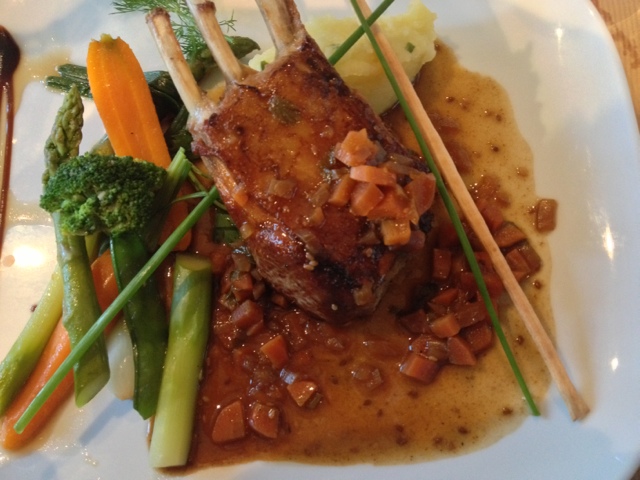
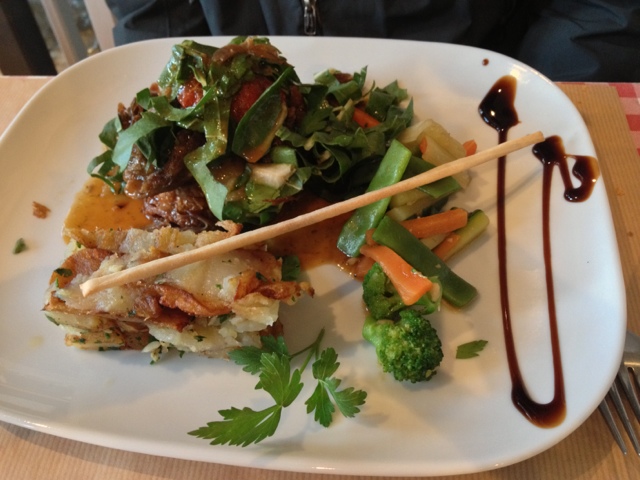
Do spend time reading restaurant reviews as there is a big difference in quality; you can pay the same and get a totally different experience. We found dining to be better in northern and central France; it may just be a function of the area and towns we were in, but we enjoyed more exquisite cuisine in those areas. Mot places had reasonable fixed price menus for around $20 euro and up.
We have always found bed and breakfasts to be preferable to hotels. It gives you an opportunity to meet other travelers, and the hosts are usually eager to offer recommendations. Staying in a b&b gives you a totally different experience, one that is more personal and cultural. Trip Advisor has been our best resource for finding lodging. We found this time, that traveling in May, you don’t necessarily need to reserve ahead of time, which gives you more flexibility. Some come with breakfast, others have an add on option. In most cases, breakfasts are much more expensive than going to the nearby patisserie and buying your own, unless a cooked breakfast is offered; however you do lose the
special experience of chatting with other travelers if you eat breakfast on your own.
Weather is totally unpredictable throughout France; the southern part of the country warmer than the north, but sudden rain showers are normal.
We found that English is not the language of choice in any part of France, except maybe Paris. Expect that no one will speak English and try to learn at least a few words, which works wonders in trying to communicate. Menus are generally in French, unless you are in a tourist cafe, so go with a offline based translator. I had downloaded the Laroussse English French dictionary after the translate off line version didn’t work; offline because restaurants don’t have wifi.
Dress is pretty casual these days and there was no expectation to dress up for dining. Tourists were there in gym shoes and hiking clothes. We brought “dressy clothes” and never used them so unless you are planning to go to a 5 star place, leave dressy clothes at home. Walking shoes are a necessity, as walking on cobblestones is hard on the feet.
Travel light – having multiple sets of luggage is difficult. Many times, rail stations, hotels etc do not have elevators or escalators and maneuvering up and down narrow stairs is much easier with a backpack and small suitcase. Besides, the French rooms are much smaller and having all that luggage will become a burden. Bring enough power convertors for charging all your electronic gear.
Most of all, enjoy. The French are delightfully friendly and relaxed people. They seem to enjoy life and the people that have come to visit. We found them to be patient in trying to communicate and eager to help. It is quite modern and you will find all the conveniences of home everywhere you go.
Au revoir
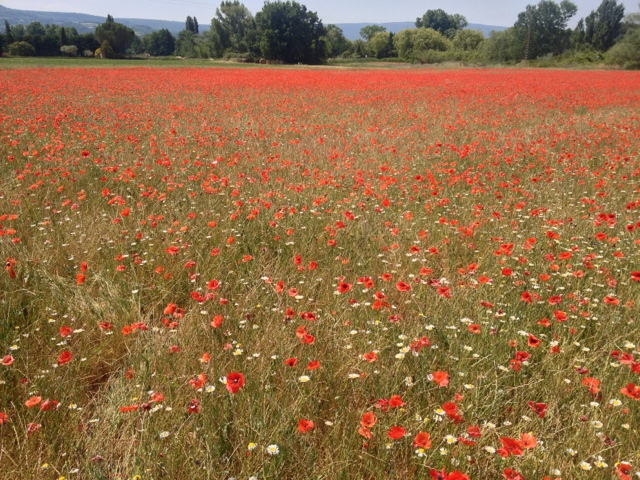
A field of red poppies and a fitting way to end our sty in Provence. We have seen bright red poppies lining the roads but a field of red has escaped us until now. This is the last photo op for now as we head for our afternoon train from Avignon to Geneva.
Hill Towns
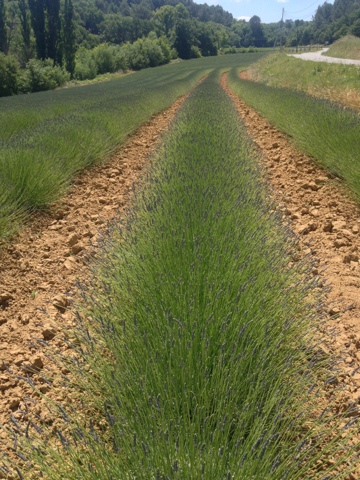
As we drive out on the country roads leading to hill towns of this area, I spot several fields of lavender. This is what I am hoping to see but thinking perhaps we are too far west and that the lavender won’t be in bloom until July. The undulating rows form such wonderful geometric shapes, and the young flower buds are purplish gray and seemingly soft like velvet in the distance. I think we have created a tourist stop as after I am there for a few minutes, we soon have a crowd of 6 cars, Australian, Japanese and Chinese tourists standing in the field taking pictures! The iphone doesn’t do it justice so you will have to wait for real photos to be posted to get the real effect. Ray patiently waits while I shoot from all angles.
Pont du Gard
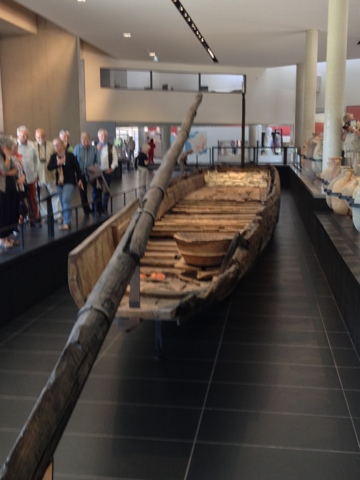
In the morning, we locate our car, grateful it has not been broken into yet, and head out to Provence. Our first stop is the Pont du Gard, an incredible feat of engineering and construction. In ancient times, aqueducts heralded the greatness of Rome and carried water to cities for luxurious baths, fountains and sanitation. This Roman aqueduct was built around 19bc as the link of a 30 mile canal, carrying 9 million gallons of water each day for 150 years to Nimes, one of ancient Europe’s largest cities. It is a massive bridge spanning a canyon, now one of the most impressive surviving Roman ruins. We walk from the left bank up to the top, then down and across the bridge to the right bank. Families are below, on the small sandy beaches, sunbathing, swimming and kayaking. At the other end, teenagers jump of the cliff into a deep pool below. The bridge is 160 ft high with 3 tiers of arches and columns, originally 1,100 ft long, with stones weighing 6 tons each forming the arches which were constructed without mortar. There is an excellent museum that provides us with a lot of information about its construction and leaves us in awe of the magnitude of the project. We spend about 3 hours there.
Arles
Gusty winds today of up to 25 miles an hour, and along the river, strong enough to make you cautious about not walking too close to the edge. How strange that the winds are only in this area and that the regions we left are now enjoying warm temperatures and clear skies. Such is the way of traveling. . Arles was a key stop on the Roman road from Italy to Spain, an important port city. Vincent Van Gogh settled here in the 1800’s. Arles sits alongside the very wide and flat Rhone River with concrete walls on both sides as it flows through the edge of town. Our hotel is just a block away. Parking is tight, the lot is a block away but spaces are along the river wall and up a curb; if you go up the curb too forcefully, you will hit the wall. It’s a little difficult to say the least. The Hotel Musee has 28 rooms and the room is spartan but downstairs is a charming courtyard with many garden sitting areas. We are taking note of all these small space gardens in order to create our own French paradise. Breakfast is in this sitting area, baskets of croissants, baguettes and large cups for coffee, a welcome change from the tablespoons of coffee we have had elsewhere.
Moving South
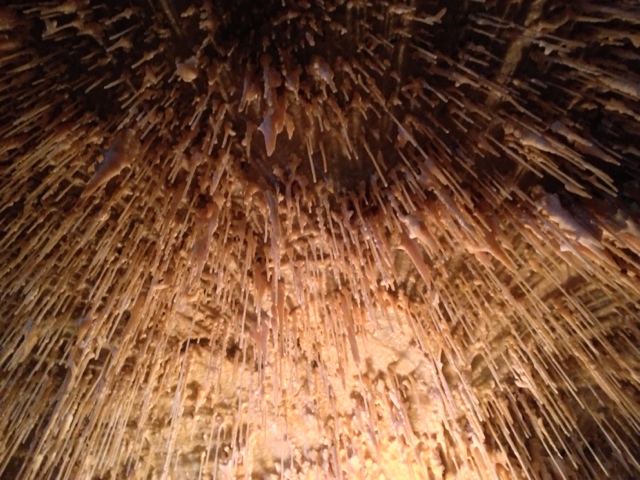
Wendy and David of our b&b Le Jardin give us a warm French send off with kisses. On our way out, we stop in Gourdon at the Grotte de Cougnac, a natural cave with art that is 20,000 years old. The group just entering is a group with the American Natural History Museum, and mostly from the Bay Area! I ask if we can join their group for the tour since it is in English. We enter into an immense chamber with stalactites like we have never seen before. Millions of delicate threads cover and hang from the ceiling. Stalagmites rise from the ground and upper surfaces, some joining with threads like cobwebs. The next chamber has bare walls and the guide points out the red and charcoal drawings of mammoths, horses and prehistoric extinct megalocerous reindeer. The original red and black animal drawings are believed to have been made 23,000-25,000years ago when the cave was inhabited by Cro Magnon men. Neanderthal man bones from 50,000 years ago were also discovered in the cave. There are 2 very rare “wounded man” motifs that have lines drawn pointing outward,
The Sun Shines
Town hopping, photography and so happy to see the sun! The clouds in France remind me of Montana, big, puffy, full of personality and unpredictability. We linger over coffee in the old town of Sarlat while watching locals carrying baguettes and tourists buying foie gras. We meander through the old cobbled alleys taking pictures of the overlapping angles of slate roofs and muted pastel colors of the ancient walls. Today is the annual farm day and there are animals of all sizes in hay covered small fenced areas-black pygmy Vietnamese pigs, geese that are the only things fatter here than in the US, and a special display of the most unusual looking chickens we have ever seen. Pekin chickens from China that look like small spotted fluff balls and others with tiny heads and vivid plumage which Ray says would make great fly tying material. Intermixed among the cages are rabbits with enormously long ears!
Canoeing the Dordogne
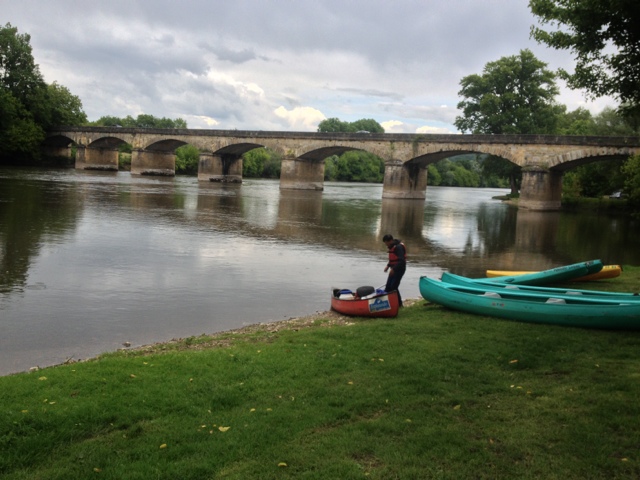
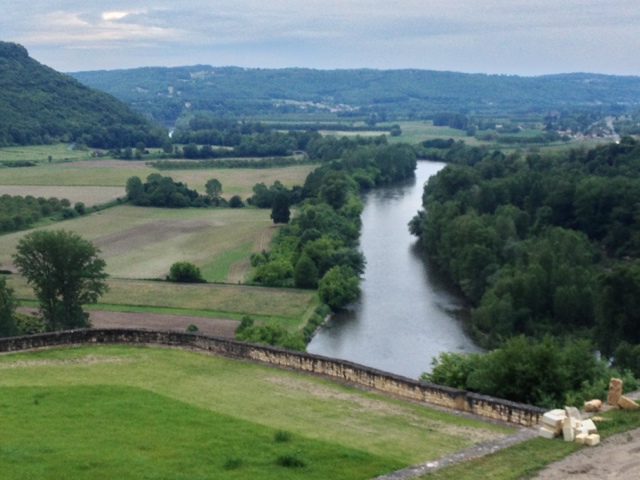
We are worried about the speed of the currents with the recent rains but fellow guests at the b&b assure us that it is an easy float. We follow their recommendation for a canoe operator out of Carsac, a few miles from Sarlat. It appears that we are the only customers this afternoon, and we only see one other canoe on the river during our 3 hour paddle. The plastic canoes are very stable even through some wave action due to the wind. We are well equipped with a plastic bucket with screw lid. The current carries you down the Dordogne and it is a beautiful and relaxing ride. The river is lined with lush greenness and along the way you pass under 2 old arched bridges, high limestone cliffs and end with a most breathtaking and spectacular view of La Roque Gageac, a one street town along the river built on the side of a cliff. Though Ray was worried about not finding the correct beach to be picked up, all was easy as the boat operator was at the shore waiting for us to take us back up to Carsac.
Cave Art
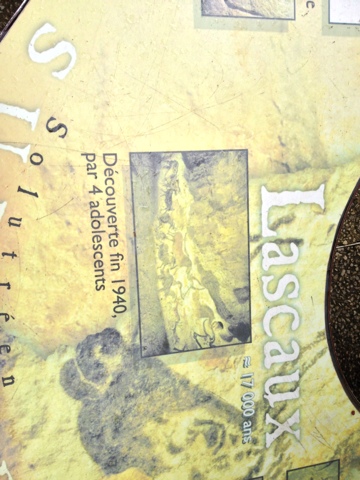
Breakfast at the b&b is an assortment of fruit, croissants and ham, plus Welsh Rabbit, which to Ray’s surprise has nothing to do with rabbits, but is bread with cheese and small dollops of beaten egg whites, toasted. Not quite the breakfast we were expecting-you can’t beat China for breakfast buffets or Germany for their assorted meats. It is unfortunately another rainy day and we decide it is the kind of day to spend in a cave. There is a wide assortment of caves in the area, many with prehistoric cave art, and we choose to see Lascaux. The visit starts in Montignac where tickets are sold nd where there is a small nterpretive museum. Lascaux was discovered in 1940 by a bunch of kids and their dog. The original cave is no longer open to the public due to deterioration of the artwork, but an exact replica of 80% of the cave and art has been made, and it is stunning. Cro Magnon man 17,000 years created these drawings of animals using their hands and handmade brushes. Black, brown and ochre were created using ground up minerals mixed with water or saliva. The artist’s ability to depict 3dimensionality, movement and depth is astonishing. The guide says such use of perspective is not seen again until the Renaissance. They used reindeer fat lamps in the dark caves. Little is known how long the artwork took to create or how they were able to paint on the ceilings. Seeing the actual art is breathtaking and the impressiveness of the work is not adequately conveyed by pictures in a book. We are unable to visit the Prhistoric Museum Les Eyzies de Tayac as parts of it are closed due to rain.
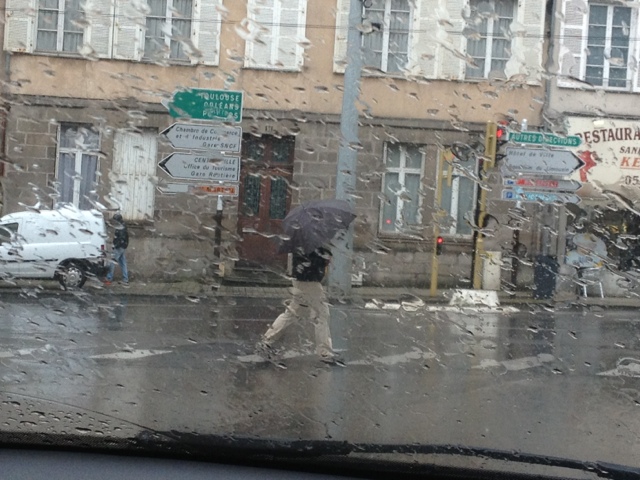
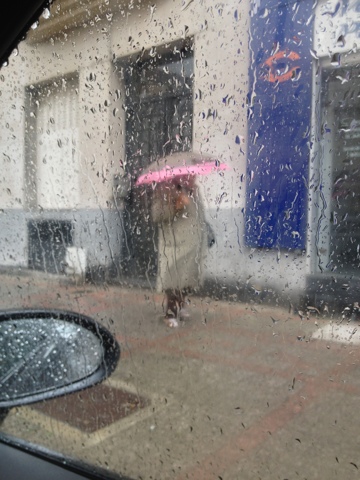
Rain, rain, go away
IPouring rain all day, luckily today is a driving day from Amboise in the Loire Valley down to Sarlat in the Dordogne. The Dordogne River Valley was called the Perigord during the Hundred Years War, the river separated Btirain nd France.The roads have been easy to drive, the highways and terrain much like Wisconsin. Driving through small villages, the roads are narrow but free of heavy traffic. Matter of fact, some of the towns look like they are uninhabited, as there is no sign of people! We often wonder where everyone is hiding, behind their closed shutters we are told. The small towns are full of round abouts. We find the navigation system in the car to be very useful and probably wouldn’t be able to find some of these b&b’s without it.
I am enchanted by the young server hostess, who has a beautiful smile and black curly hair. I am calling her Simone in this blog as she feels like a Simone.
Castles
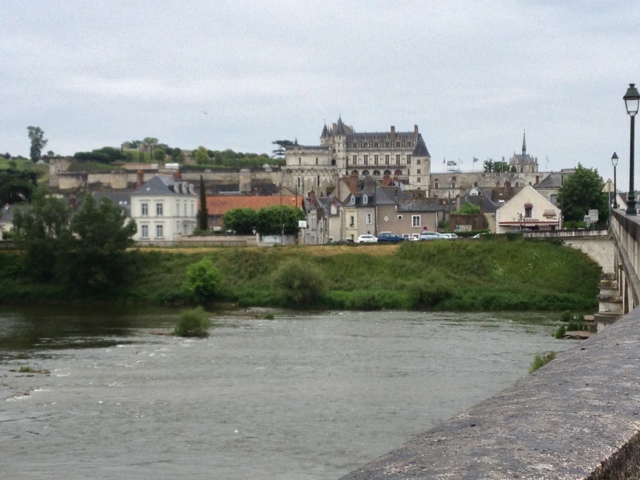
Today is a kick back day in Amboise. Tim from the b&b tells me to be sure to go to the big Sunday market, and that most businesses including restaurants are closed on sunday afternoons. We start the morning with our usual visit to the local patisserie for coffee and pastries. Many people are buying cakes and we later learn it is Mothers Day in France. Pastries are unbelievably light and flaky and not very sweet. Coffee comes in demitasses amounting to a couple of tablespoons. Some places give you a small decanter of hot water to dilute it, others do not. They would be horrified to see a large cup of coffee from Starbucks! We walk the square and wander through some interesting shops then make our way to the market. There is a large assortment of produce, cheeses, sausages, breads, fish and meats, in addition to clothing, shoes, and flowers. We buy Sunday dinner, sausages, fresh white asparagus, small potatoes, baguettes and paella being cooked in an enormous wok. We feel very French with our goodies. My bit of French has come in handy however when I utter a carefully constructed phrase, I often do a double take because the person turns out to be n English speaker. It’s when I am struggling to find the words that it turns out the person speaks no English at all! We take our time walking the old town in the rain. Amboise straddles the Loire River, with an old stone bridge that crosses over to the small “Golden Island” with houses and buildings; another bridge provides access to the other side. The river is quite shallow and muddy brown.
Gardens
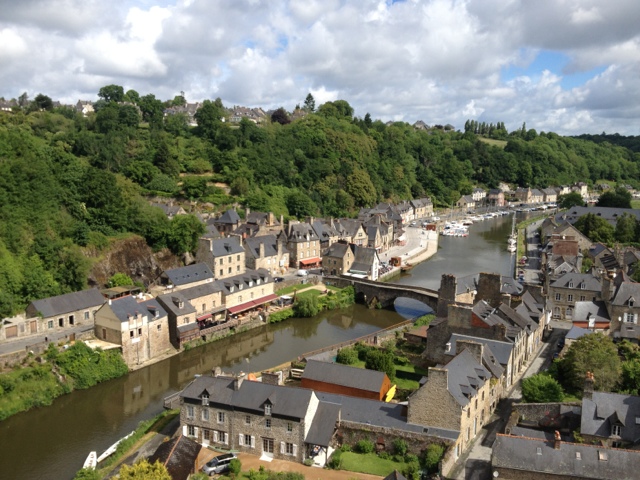
Le Logis de Jerzual, our b&b has a tiered English garden with flowing water and moss covered rock walls. Every morning, fresh croissants and bread are delivered fresh, and we enjoyed these while visiting with a couple from Perth. We laugh at their Alice in Wonderland story of her finding the b&b by locating and attempting to enter what appeared to be a tiny gated entrance, that actually was the cat door. He tells us about credit cards in France and their anxiety in tring to find a gas station on a sunday. Apparently without a chip on your credit card, you cannot use auto pay machines. This can be a problem if stores are not open on sunday. Before leaving Diman, we drive up to the tall bridge overlooking the river valley and admire the view, the fortress walls high above, the steep forested cliff walls, the old town and meandering river below.
It’s All About History
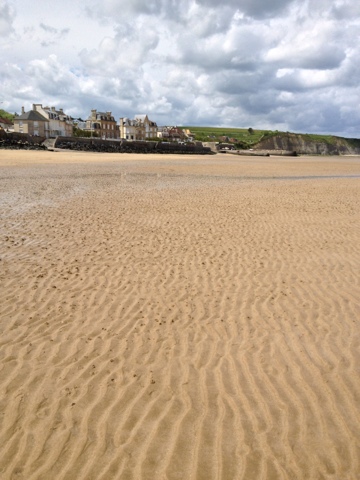
The rolling green farm fields characterize Normandy today, but the history of the area is filled with war. The beaches contain stories of the largest military operation in history. On these serene beaches on D Day, June 6, 1944, almost exactly 70 years ago, the Allies gained foothold in France ending WWII. We start the driving tour in Arromanches at Port Winston, where the British had built a makeshift harbor consisting of 4 miles of concrete pontoons strung together, and 7 floating piers, a remarkable undertaking. Further down the road is Omaha Beach, the site of the most intense battle where thousands of Americans lost their lives. Walking along the clean sandy beach, one can almost see the masses of troops pouring out of the Higgins boats, making their way up the long beach and up toward the cliffs. Entry was made during low tide so they could see the mines in the sand. Having raised a son, it is hard to imagine sending a 19 or 20 year old off, and even harder to realize thee young men were there dodging bullets and throwing grenades. Looking at the beautiful backdrop of the town, it is hard to believe this is the same place that is in the videos with all the destruction that took place. One has to see it to truly visualize the immensity of what occurred here. The American cemetery has rows and rows of white crosses with a dog tag number inscribed on the back of each. The French have adopted the crosses and on Memorial Day, each is adorned with flowers. It is a powerful place to visit.
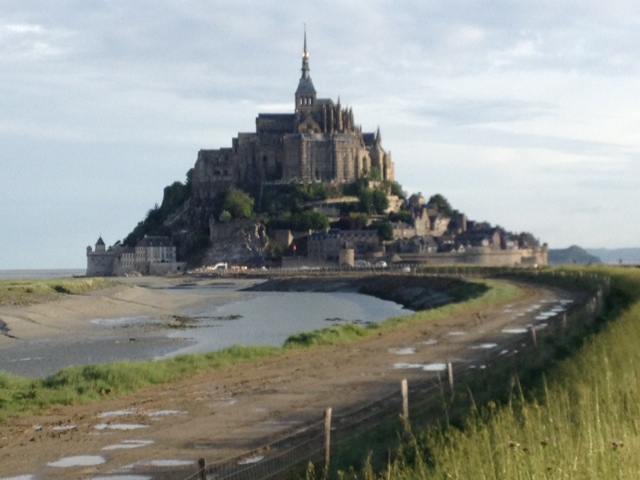
Le Mont St Michel
It’s the land of baguettes and flaky pastries which is how we start our morning. Even a plain patisserie at the railroad station bakes on site fresh each morning. The baker is in the tiny back kitchen with balks and balls of freshly risen dough, and girls roll tall carts with trays of neat little croissants ready to be baked. Piles of breads and rolls are constantly being replenished and we are amazed at the volume of sales the must make each day.
Planes and Trains
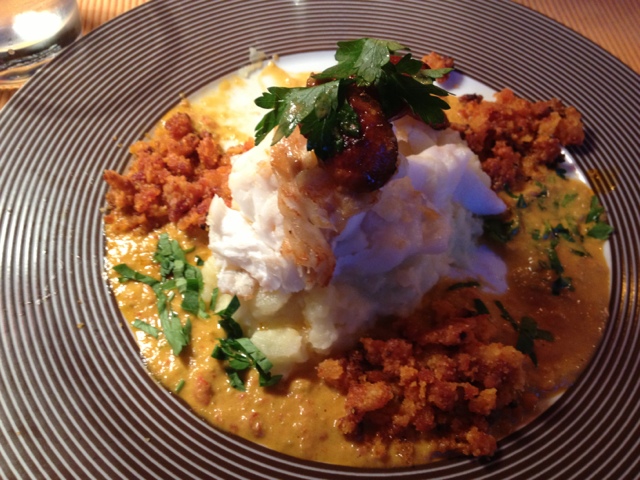
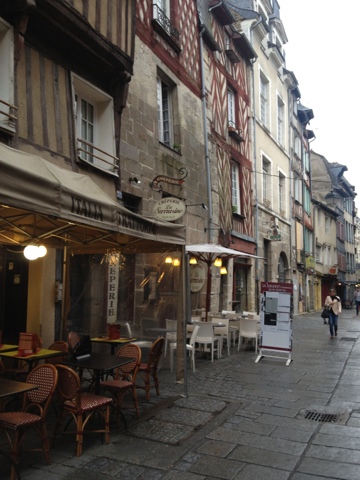
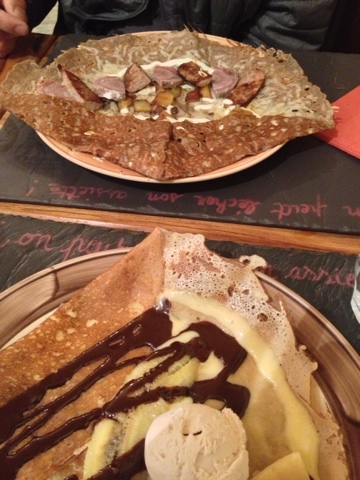
We leave on a beautiful day, sunny and blue skies in SF to land 12 hours later under gray skies and drizzle in Paris. It must be the explorer adventurer wanderer in us that leads us to want to venture new places. It’s certainly not for the weather! the flight was fortunately uneventful and time quickly passes with a wide variety of movies, of which I watch 4 romantic chick flicks. Our fast train to Rennes takes us on a 3 hr ride through farm fields. The speed and efficiency of the European mass transit system puts us to shame, as do the beauty and comfort of the train stations. Rennes is a charming small town with the typical old world charm of a large square and 4 roads leading from it , each with a unique view of arches, churches, and narrow cobblestone alleys. This is not an American tourist destination and we have to do our own interpretation of the menu at the tiny La Gavot Creperie with the waitress’ un peu d’anglais and my equally peu de francais. Not knowing the difference between a crepe and a galette, shame on us for not reading Rick Steves before dinner, we are very confused by the choices. Nevertheless, our sausage, potato and onion galette was delicious, and our banana, chocolate, ice cream crepe was equally satisfying. For your education, a galette is made from buckwheat flour and is usually savory. A crepe (which confused me when she said it was salty) usually has a sweet filling. Brittany is famous for its crepes and restaurants offer an impresive array of fillings and toppings, with paper thin skins.

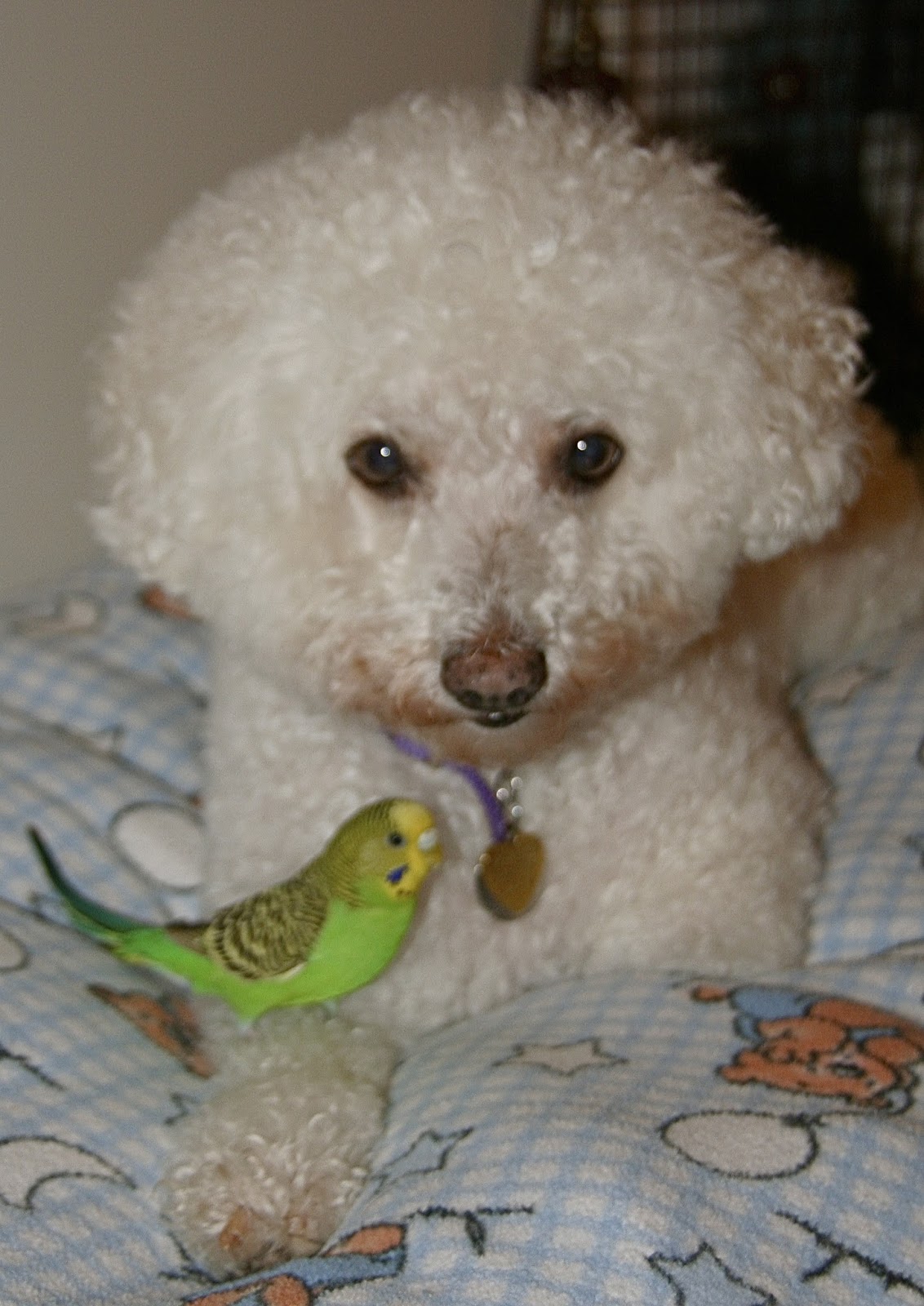
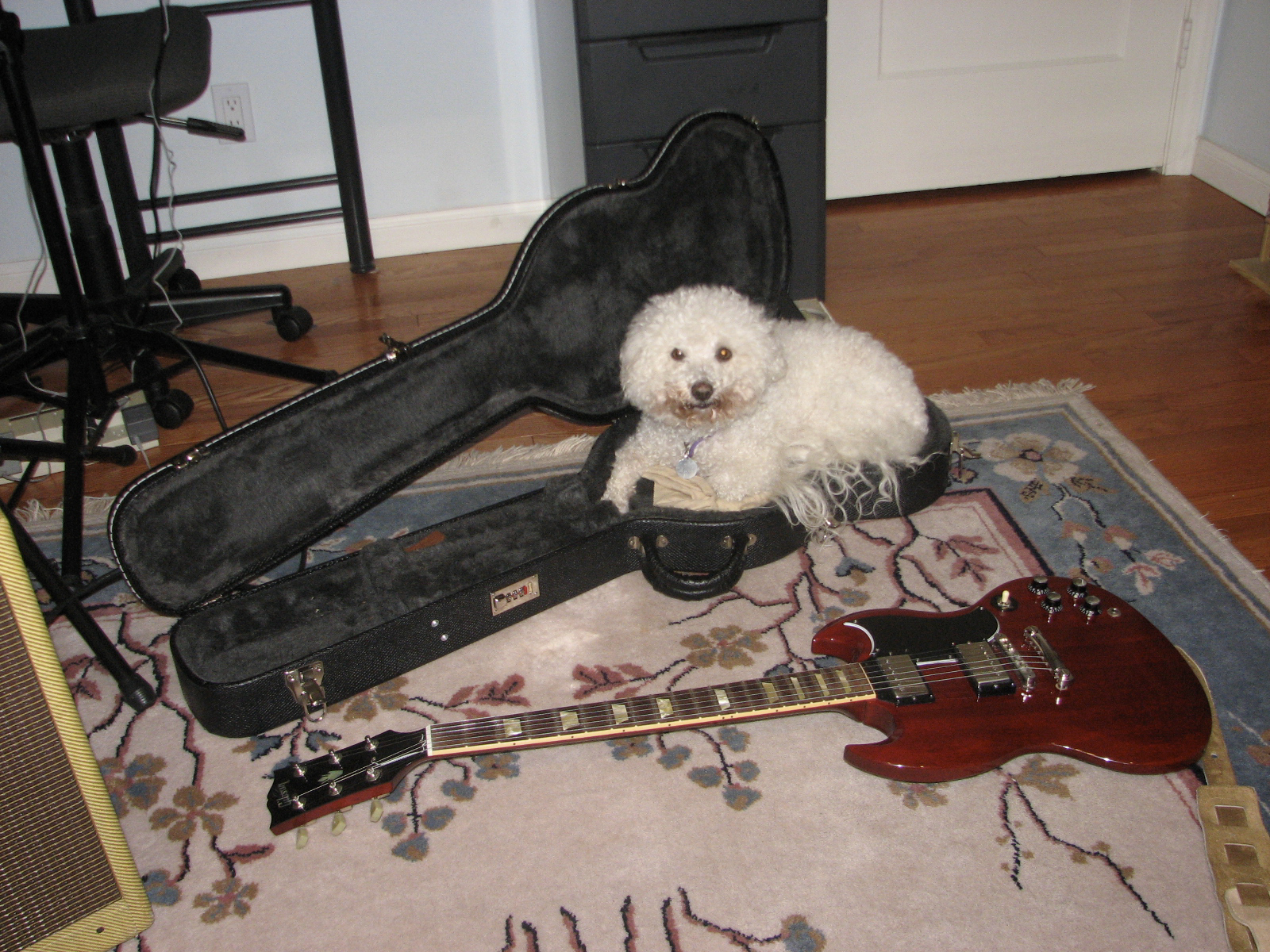
Heidi the Princess
I’m not sure when she became MY dog but the breeder had said that dogs know who is mom in the house, and when the kids left to go to college, Heidi and I were left here alone. I like to think that she thought of me as mom. A vet once said, “She looks at you with such trust”. You never think that a little animal can weave its way into your heart and family, and that when they are gone, a hole remains. It feels silly to mourn so strongly for a dog and I realize I never until today really felt empathy for those who told me their dog had passed. To live it is to understand what it feels like.
Penny told me her dogs like to use their paws for functional purposes. Heidi’s was being able to maneuver her pillow or a towel to a place that she wanted it to be. Every day, she would use 2 paws and scoot herself backward until the pillow was strategically placed right in front of the door, or down the hall near one of us. We would often laugh as she pawed and pawed at a towel so it was a perfectly comfortable lump that she could rest her head on.
BA and home
We spent the morning walking the streets of Palermo, winding our way through the botanic garden and then back to the hotel. Our flight isn’t until 9pm so we lounge in the hotel lobby and I walk the streets nearby one last time. Thames Ave. is quite nice, with boutiques and cafes. They are making an attempt to clean up the area and I see several newly painted buildings in bright colors. Amazing how the color gives character to the neighborhood. I hope they continue to repaint the rest of the buildings.
We leave for the airport and prepare for our journey home. It has been an interesting adventure, learning about the culture and economy of Argentina. We were not victims of scam nor theft and wonder if the stories have been overplayed. When asked, the locals seemed to agree it has not gotten better, so perhaps we were lucky. In any case, we found the Argentinians we met – cab drivers, waiters, hotel personnel, shopkeepers etc. to be friendly and kind people. It is amazing how well we got by on just a few words of Spanish. Gestures work well, and the language is not too difficult to figure out. The country is so sparsely populated and the landscape changes quickly and is very beautiful. What we saw in scenery was spectacular. We were told that the weather is normally not so good, so we assume we were fortunate in that respect. I think life for Argentinians right now is difficult. Inflation is at 34% and the cost of living is high. We found clothing and food to be comparable in price to the US but Argentinian wages are much lower than ours. It seems to be a land of animal lovers as dogs roam all over, and seem to be happily coexisting with people, whether owned or stray. Infrastructure needs are great as sidewalks and roads are in need of repair. We’ve enjoyed our 2 weeks and have many stories to tell, photos to share, and advice to give!
Return to Argentina
Today marks the end of our journey. We wake up to an email from United saying our flight has been delayed. Thanks to Ray’s status on United, we learn that we have been taken care of and rebooked on a better connection that goes through Houston.
After getting cash and gas, we return the tin box car to Hertz and are back at the airport for our trip to Buenos Aires. A young man in line tells us he has had clothing and sunglasses stolen out of his luggage on a prior trip. He advised not checking in too early so as not to give baggage handlers time to rifle through your stuff. He tells us about his adventure, he had just finished scaling mt. Fitzgerald Roy over a period of 4 days, impressive!
Our flight is uneventful and our ride through BA goes through some charming streets. We return to the Esplendor Palermo Soho, where they have also upgraded us to a nicer room. We walk a few blocks to a neighborhood restaurant serving Spanish food, and have their seafood paella. On our way back, we stop at the Chinese owned small grocery store and learn that they are Mandarin speaking. We’ve been there several times now, buying apples for Ray.
Glacier View
It´s another beautiful day, blue skies, a slight chill in the morning air turning warm by mid morning. We wake a bit stiff but surprisingly not sore. On the agenda today is a boat ride to Glacier Viedma. The girl at the Poincenot Hotel is again quite helpful in providing information. Reservations are necessary for the tours, run through Patagonia Adventures. They have only one space left but after checking, are able to accommodate us both. It appears that several tour operators use one boat operator. Bus transfer to the dock is 80 pesos per person round trip for the 20 min. ride to Bahia Tunel. Bus leaves at 11:15, boat leaves at 11:45. There is an afternoon trip at 2:30. We will do Viedma Light, which is a boat trip only, no glacier trekking. The boat holds 30 people, bringing a group to the glacier, and picking up an earlier trekking for their return trip.
I choose to sit on the upper deck, the fresh breeze blowing in my face as the boat rapidly approaches small then large icebergs. So beautiful they are,. floating in the aquamarine lake. Close up, they are translucent blue and emerald, like crystalline formations. Viedma is 378 square miles, the biggest glacier in south america. The face is 131 ft. tall and 2.5 miles wide, stretching19 miles in depth. We spend 30 riding out, 1 hr. cruising the icebergs and the face of the glacier itself. The tall face is whiter than I had imagined and unlike Perito Moreno, we don´t hear much calving. They tell us that this glacier has been quite stable and has not retreated in several hundred years. Glacier Upsala which can be visited on a 6 hr. boat ride is retreating at more than 600 ft a year!
Most of the guests are young and almost all leave to go on the trekking adventure. I take more pictures than I will have time to do anything with but can´t resist the beautiful lines in the rock formations and ice structures. I imagine floating through bright blue icebergs in a boat and how magical it must be.
After returning back to El Chalten, we lunch on waffles at Wafleteria and then Ray goes in search of rivers.
We see the trail head to Laguna Torre, another 7 hr. round trip hike that takes you up to Cerro Torre. The trailhead is off the main road and down across the steel bridge. Finally at 5, it is time to head back to El Calafate. The jagged peaks are blue along the highway, what they call the loniest highway, and at sunset, the rolling hills turn golden yellow. We arrive at Hosteria Roble Sur where they have upgraded us to a suite, then have a fabulous meal at La Tablita, a parilla serving grilled meats. According to Fodors, it is the best in town. It is way too much beef but quite tasty – tenderloin, buttery soft and Argentinian chorizo, which is not as spicy as Mexican chorizo in sf. Matter of fact, the food here is not highly seasoned or spiced, and there is a distinct lack of fresh vegetables everywhere.
There are many couples there, young and old and I realize that we have seen so many young couple, in love, gazing into each others eyes, reaching across the table for each others hand. Reminds me of being 20 something, how quickly we become 50 somethings, but fortunately still with a glow in our hearts!
A Long Hike
The town of El Chalten is small, and with character. There are 500 permanent residents but in the summer, over 60,000 people descend on this trekking capital of Argentina, and the starting point for the northern part of Parque Nacional Los Glaciars. The main street consists of hostels, hosterias, small restaurants and adventure operators. During the day, it empties out and at night, dogs roam and many people are walking up and down the street. It appears that many of the guests are tourists, young hikers and climbers.
We end the day with a fine dinner at the Microbrewery, the apple pie is excellent.
Glaciers, and travel to El Chaten
We had plans to leave the hotel early for photos and return for breakfast, but the girl at the hotel was not convinced we would make it back by 10:30 so we wolf down a quick breakfast at 7am, then head out to catch the early morning light at Perito Moreno glacier, which is a 1 hr. drive out of town. The roads are quite empty and we try to beat the tour buses out there. This is the southern part of Park Nacional Los Glaciars. Most of the visitors go out on a day tour, or a tour package. Driving out is actually a nicer option as you can spend as much time as you like. The weather is perfect with blue skies and no wind; it is a photographer’s paradise.
We return back to the hotel to pick up our luggage and head into town for gas, then on to El Chalten. It is a trip that takes 2-3 hours. Much of the landscape is barren, but you can see Fitz Roy in the distance, and there are some interesting terrain along the way. We have the road to ourselves and arrive in El Chalten by dark. Unfortunately, the hotel I booked, Hosteria El Pilar is 17km down an unpaved road and we don´t think this car can make it so far. So we end up not staying there and finding an alternate place, the Poincenot, right in the center of this tiny town. Dinner at the Microbrewary is cheap and satisfying. I have the locha, a local stew, and Ray has homemade ravioli, yum! As we wait for our food, we try to make sense of the hiking trails and which one we should take tomorrow.
Aerolingus Argentinas and El Calafate
We leave the hotel by 7 after a quick breakfast. The only people in the dining room are a group from India. We are flying Aerolingus to El Calafate today and I have read about their horrible on time record and service, so we hope that our flight leaves on time. We have only a one hour layover between flights. We end up in line behind the group of people from India. They are with a tour group, and are from Australia, also going to El Calafate via BA. We chat with them and all agree that it is silly to have to fly all the way back to BA and then flying back south to El Calafate since El Calafate is only a few hours south of Bariloche. Security rejects Ray´s fly rod and wants him to check it in. Knowing that fly rods get lost when checked in separately, we come up with the great idea of wrapping green plastic over my suitcase with his rod holder secured to the side. Hopefully it will make the journey safely.
The flight is completely full and we arrive in BA on time only to find that our connecting flight has been DELAYED from 11:30 until 2:30. We manage to pass the time watching the baggage carts on the tarmac, and identifying my suitcase. Ray stands watch over his fishing rod. This flight is also full, delayed by almost another hour on the tarmac due to congestion. Sure is congested, suddenly all the planes at the airport are taking off, all before ours.
We fly over very flat and brown terrain, with a single river flowing southward and land at the small airport in El Calafate. The ride by cab to town is 30 min. long and we wonder why they built the airport so far away from this tiny town. Were they expecting super growth? The Hertz office in town is a small place and the cars are soooo old, old Chevys, ours has many dings and scrapes, and the knob to the air vent is missing. It is basically again a tin box on wheels. Isn´t there any quality control with Hertz franchises? The Hosteria Roble Sur is outside of town, on a hill overlooking the lake and quite nice. We eat at a local Argentinian restaurant serving traditional stew and lamb pie.
Windy
We have reservations at Villa Huinid, along the shore of the lake. We pick up McDonalds for dinner and discover their hamburgers have no ketchup, mustard, onions or pickles. The hotel is beautiful and sits across the street from the lake. What a pity we have to leave early the next morning to catch our flight back to Buenos Aires and El Calafate.
A View of Lanin Volcano
Lanin volcano is a majestic sight from the picture window of the dining room at Spring Creek Lodge. Although Lanin is not active, it is a reminder of the strong forces of nature and the other volcanos in nearby Chile that continue to erupt each year. Can something so innocent looking spew forth so much ash as to create area wide devastation?
This morning’s photography is satisfying as the early rays of sun cast orange beams on the mountains and clouds of mist erupt from the ponds. Tall thistles, some still bright purple stand tall among others that have withered with the autumn temperatures. Frost sits on the boards of the footbridges and I hear the sounds of an unfamiliar bird call. The dog with no name scampers behind me wanting to be petted. After hours in the chilly air, I am more than ready for the scrambled eggs and hot coffee that await me. Ray is fishing today with a guide and I have the day to myself which I will fill by reading, photography and walking among the ponds and paths of the property. Their 2 black dogs are friendly and protective, following me as I walk, and waiting for me when I stop. Batman and Humpy are their names. They are well behaved except for their barking at night. The third little brown wire haired terrier apparently appeared 3 days ago. He is the one with no name but seems quite happy to have found this new home. Dogs in Argentina are free to roam, and maybe because they are given the freedom to roam, they are better behaved. I haven’t seen any on leash except the dog walkers in Buenos Aires. They all seem to know to stay out of the street and mind their own business. Matter of fact, all the animals roam free, the horses, guanacos, etc.
Dinner tonight at the lodge is is grilled pork, onion bisque and tiramisu. Ray is happy as he caught over 20 trout and had a good day on the river. Tomorrow we head back to Bariloche.
7 lakes
Today’s agenda is to drive north through the Ruta de los Siete Lagos, 7 lakes route, which will go past San Martin and to reach Junin de Los Andes by dark. This is part of the Circuitos Grande. As we head out of town on Rte 237 we pass the Rio Correntoso, the world’s shortest river at 984 feet, flowing from Lake Correntoso to Nahuei Huapi. Further north, we see lake after lake, surrounded by heavy forested mountainsides. The pristine surroundings are void of power lines, boats, signs and houses. The paved road quickly ends as we see workers building guardrails and stone walls. In a few years, the road to San Martin will be a regular highway; for now, we bump along through the dust for about 30 km feeling adventurous. We stop to check out rivers and streams, and run into the couple from San Leandro by the side of a trail. By late afternoon we reach San Martin, a resort and ski town as lovely as the guidebooks say, built around a central square. The buildings are modern and cohesive, giving it the look of a well planned resort town. The streets are quiet until 5 when the stores reopen, and suddenly throngs of cars and people appear! We have our daily helado, Ray gets his fishing license while I check to make sure the fishing guide, Dario, he has booked is legit, and we head back out to complete our journey.
The terrain changes from thick forests to desert scrub brush then to grasslands with fields of cattle–grass fed beef perhaps?. The town of Junin de Los Andes is small and primarily residential, workers’ shacks then newer apartments and small houses. The paved road ends and we turn onto a dirt road for about 10 km, and reach a wooden gate of Spring Creek Lodge. It is an oasis among the dry landscape, set along the Chimiquien River. The bright blue cottages sit on green grass and framed by mountains on both sides, with Lanin volcano at the end. The hosts are attentive and dinner is superb- pumpkin muffins stuffed with eggplant purée and followed by huge steaks. We are surprised to meet a couple from Palo Alto, both educators, and also supporters of POST no less! We share travel adventures and give them the name of the bistro in Buenos Aires. Either it is a small world, or the Bay Area is filled with adventurous travelers, for we never fail to meet others from Silicon Valley when in faraway places.
Circuito Chico
The clouds are orange at dawn and the skies are clear; the air is crisp and clear. What a beautiful sight! I immediately head down to the lake to take pictures and we decide to drive back up to the panoramic point. How different it looks from last night! You can see out past several lakes toward Chile. Below is the Lao Lao hotel. The blue of the sky matches the crystal blue waters. The hotel manager encourages us to take the gondola at Cerre Otto which takes you up to 4,600 ft. and we spend several hours up there, me taking photos and Ray taking photos for other people. He makes many people happy today. From the top, the 360 degree view is breathtaking. The lake district is a favorite vacation spot for skiers in the winter and tourists in the summer.
We then drive to the National Park office for Parquet Nacional Nahuei Huapi in Bariloche proper. It is closed-yes it is sunday. We head to Villa Los Angostura, 50 miles NW of Bariloche on route 231 and check in at the Hosteria El Establo before going exploring. The Hosteria El Establo is a tranquil bed and breakfast on the edge of town built of logs and with a huge great room where breakfast is served. Thinking about going to Villa Traful, we decide it is too far down an unpaved road and opt instead to drive west in the direction of Chile. Further down the road we see more and more evidence of the Chilean Puyehue volcanic eruption of 2011 that left 3-4 ft of ash in places, wiping out homes and roads. The river is a gray landscape, stopped in time, with dead trees and no signs of life. On the lakeshore, we come across an unusual sight. The rocks are as light as paper and the surface is a sheet of floating pebbles. At first sight, you would think it was mud or sand, but upon closer examination, you see it is a solid mass of pebbles sitting above 2-3 ft of water. As the wind blows, the mass moves, breaking up in spots. It is such a curious and fascinating phenomenon that we spend hours there. We then drive over to the guardhouse, not sure if it is a park entrance or border checkpoint, and turn around.
It is dark by the time we return to Villa Los Angostura and our restaurant choice is poor, as it is the worst pizza ever. We end with pretty good gelato, “helado”, which is piled high on a cone, and buy enough chocolate to take home. At the chocolate store, we meet a couple from San Leandro also buying chocolate. Bay area residents are everywhere.
Hertz, are you for real?.
We are excited to be continuing our journey to the Lake District. It is a 30 min. ride to the AEP airport near the city center, costing 50 pesos. As we stand in line at the BA airport, we see people with their luggage wrapped in green plastic wrap. Thinking there might be a theft problem, we decide to do the same, despite our misgivings of being totally unecological. We fly out on LAN airlines at 11:45am and land in Bariloche at 2 in the afternoon to winds at 30 knots and foreboding looking clouds.
Hertz, you can’t possibly be serious! If we opt to use our credit card’s collision insurance, the we have to guarantee the full cost of the car $16,000US on our credit card?! If we buy your insurance, the deductible is $1,000US and we void our credit card’s coverage? Bad deal all around.
On top of that, the cars are so low end, no auto lock, all stick., and basically a metal box on wheels.
Ray drives very cautiously to avoid dings, crashes or rollovers. We head to Bariloche, the gateway to the scenic splendors of the northern Lake District and headquarters for the 2M acre Nahuei Huapi National Park. The wind is so strong the whitecaps on Nahuei Huapi lake, a glacial remnant, are huge. Most of the town sits within a block of the waterfront with soaring peaks separating Argentina from Chile in the background. We drive around the west side of the lake to the Peninsula Petit Hotel, which sits at the northern end of the peninsula not far from the famous Lao Lao hotel. It is a beautiful lodge constructed of huge logs; the big picture window looks out over the lake. Our room also has a lake view. We drop off our bags and head out to an overlook but the skies are cloudy and visibility is poor, plus it is gusty. From the overlook, you can see over 3 huge lakes and the Lao Lao Hotel below.
Our hotel is located on a less traveled road and there are few restaurants in the area. We go to a nearby restaurant where we are the only diners. We have thin pizza and head back.
A full day
First order of the day was to buy a pair of gym shoes. My blistered feet are much happier after that. Next we opted for a taxi today down to Plaza del Mayo, the setting for Argentina’s most politically turbulent moments. It is a site for ceremonies, rallies and protests, and was the setting in the movie Evita, where crowds cheered for the Perons, who were standing on the balcony of the Presidential Palace, the Casa Rosada, which sits at one end of the Plaza; it was originally whitewashed with oxblood, and today is still a pink color. The plaza has a strong police presence and is filled with people enjoying the out of doors. Government buildings surround the square and the side streets. We walk up and down several of them, admiring the architecture.
We duck into the cathedral to read our guidebook. Mass is in session and we are later to learn that people will throng here after the new pope, from Argentina, is announced.
We walk south to San Thelmo, to get a flavor of the area. As we walk, we notice that the
neighborhood becomes more run down, and automobile repair and machine shops line the
streets. Grafitti is everywhere, some of which we admire for the great artistry and colors, others
are merely words that destroy the historical brick and architecture. The streets fill up in the late
afternoon and we mingle with Spanish tourists, local residents and workers.
Our return walk takes us past the Theatre Colon and in the direction of the Plaza San Martin.
Huge Banyan trees are in the park, their branches propped by stands of varying heights. Dogs
are everywhere, some strays, some with owners, none on leash. The only leashed dogs are those
being walked in groups of as many as 10 or more by dog walkers! I must say, this is a land of
Bichons as I have seen more white fluffy dogs than anywhere else.
We are vigilent about where we read our map-it is unrealistic to think you can get by without
looking at one, though we have seen so few Asians that I’m sure we stand out as tourists. We
have not used the atms in the city, using the pesos we brought. Even though the rate at Travelex
was poor, we are convinced that was a good move. We carry some cash in zippered pockets and
my purse has only a guidebook, water and my old shoes. We are careful where we walk and
keep our belongings to ourselves, but neither did we see any bird poop scams nor any purse
snatchings, even in this crowded area. So far so good!
We had made another reservation at Las Pizarros and again enjoy a fine meal of duck breast and
rabbit. We felt sad that we would not be returning there any time soon.
Fine dining
We find Buenos Aires to be very walkable and the streets are busy in the morning and late afternoon. Many of the stores and restaurants are closed between 2 – 5pm and at 5 or so, traffic picks up. Argentinians are like the Spanish, and enjoy their late nights with dinner at 9pm.
We walk 10 miles today starting with one of the world’s greatest necropolises, Cementerio de Recoleto 14 acres of wide leafy avenues, narrow streets and small alleys. Among the 6,400 tombs and mausoleums, 70 are National Historic Monuments. The architecture is eclectic. It is like a city neighborhood. Some crypts have 2 floors of basements holding up to 18 caskets each. They stay in a family for generations but if they are sold, the caskets must be removed. The crypts are airtight; occasionally one will leak and the bodies will decay giving off an odor. We see how elaborate some of them are.
Eva Peron’s tomb is a part of the Duarte family’s tomb and no doubt the most visited since the movie Evita came out. After the cemetery tour, we walk through the Evita Peron museum dedicated to her history and then through the Musee de Belle Arts, the fine arts museum. We sample Argentinian gelato, helado, which is more syrupy and custard like than Italian gelato, and try to get wifi at Starbucks. The weather report says 89 degrees but the breeze and clouds keep the air comfortable. Recoleta has different feel than Palermo Soho where we are staying. Void of graffiti, the area is upscale with modern hotels, touristy cafes and high end shopping. The streets are pretty empty and there are very few tourists, so the sidewalks are quiet, compared to the local daily activity of our hotel. We see no evidence of “bird poop scam” or pick pocketing and begin to feel more at ease. Day 2 with everything we own still intact!
Our greatest find of the day is a Fodors choice Las Pizarros Bistro on Thames and Charcas is around the corner and a few blocks from Esplendor Palermo Soho where we are staying. Walking up to the building, you would never guess it was a restaurant. When closed, the bars on the windows, no sign, and black heavy doors make it seem like a shuttered building. It is by reservation only-doors are locked behind each guest that enters. Many of the guests seem to know the chef and eachother. The menu appears on chalkboards hanging on the walls, and is always changing. Described as eclectic, the food is superbly prepared and delicious. Small and intimate, the local chef visits and describes his preparation with us. We start with rabbit, slow cooked for 7 hours then pan fried and shredded with leeks and zucchini. My pork loin sits on a bed of risotto and is accompanied by a nutty paste and an apricot chutney. Ray’s rib eye is a good cut and served on a bed if potatoes with beets and mushrooms. The pear crumble tastes fresh and light. Guests linger over wine and dessert, and we find this to be simply delightful. We make plans to return the following day.
Arrival Argentina
Argentina – it’s a place we have talked for years about visiting. I’m not sure if it is the name “Patagonia”and its association with adventure clothing, the fly fishing opportunities, or the photos we’ve seen that have made it so attractive to us. We’ve never been south of the US and don’t speak more than a few words of Spanish. Planning this trip, the hotels/flights/car rentals has been challenging as there is much less advice on the forums regarding traveling independently in South America than for Europe and most of the people we know have gone with tour groups. Originally, this trip was scheduled for April but after talking with people, realized that it might snow in the mountains by then, and the fishing will be very poor. We are going with a sense of adventure but also apprehension at all the unknowns. We’re not sure what to expect other than the fact that there seems to be a lot of petty thefts! I spend the entire evening changing purses and bags, trying to decide on the most secure way to carry my camera equipment, and finally decide to leave the good camera and ipad at home.
The biggest barrier to our departure is an hour delay at sfo for what is described as “we are waiting for maintenance to sign off”, but what is later revealed as a mechanical problem. United certainly packs their planes to the gills these days. I wonder why the overhead bins are designed such that luggage does not fit. We watch as countless fliers and attendants move bags back and forth much like solving a puzzle to making it all fit. Free movies for all was the consolation gift for our delay; people are easy to please– cheers go up with this announcement- how quickly people forget that movies used to all be free as were meals. Soon they will be charging us for seat cushions and for the privilege of using the bathroom! Our trip takes over 20 hours with a layover in Houston.
It is early afternoon when we arrive to sunny skies and temperatures in the 80’s in Buenos Aires. From the air Buenos Aires reassembles Chicago– trees, green parks, sprawling, flat and with waterways snaking and winding across the land. The very brown Rio de la Plata frames the eastern side of the city. As we waited for customs, I couldn’t help looking at people’s jewelry and clothing, trying to make sense of travel forum warnings of jewelry theft and the importance of making oneself look like a native. What does a native look like? I soon realized that natives look just like middle class Americans walking through the shopping mall on a Saturday afternoon. Jeans, gym shoes, t shirts etc are the norm. I had pictured Argentinian women well dressed in heels but that is not the case.
Taxis are prepaid for at the very prominent and official taxi desk; it costs 220 pesos to go to Palermo Soho, and we are led out to a very organized taxi line. It takes about 40 min to get to Palermo Soho. We drive through an area that is old and run down, clearly a poorer section of town. The majority of walls are covered with graffiti. As we approach the city center, we see a few high rises and I again am reminded of Chicago along the lakefront. This is not a wealthy city and is a distinct contrast to central Beijing and other European cities like Paris, Rome, London etc. Our hotel, the Esplendor Palermo Soho is very well located, just a few blocks from the botanic garden and zoo, a small boutique hotel in a residential neighborhood that feels safe, and with police presence at night. Rooms are spartanly furnished but quite clean and service is wonderful. but we feel safe walking the area.
The city is divided into sections – Palermo, Palermo Soho, Belgrano, and Recoleta are higher end tourist areas. Palermo has more green space and parks; Recoleta has the larger hotels. The Centro area is the banking and trading district. San Thelmo is a residential area for the working class with auto and industrial shops. La Boca is described as colorful but we were warned about walking in this area and so avoided going there. We wander out for the afternoon walking to Recoleta. The streets are lined with small shops-pharmacies, clothing stores, restaurants, etc. much like the smaller streets of China and there are very few big department stores. I am reminded of the fact that walking in these cities as in China, is hard on the feet and quite unlike walking around in the US. The sloping sidewalks, broken pavement, uneven tiles, holes etc put stress on my feet and I long for the comfort of gym shoes.
Fodors recommends Don Julio, a parillo, for its grilled meats. Since it is only 4 blocks from our hotel, we opt to go there on our first night as we gradually build our confidence in walking the streets here. Ray’s sirloin is buttery tender but my rib eye is tougher and our plain boiled vegetables are not too impressive. We high five at not having been pickpocketed.
Death Valley
Death Valley, as I discovered, has a diverse topography and a beauty unique to itself. Many Californians have never ventured to this park, picturing it as barren desert landscape. The winter months are ideal for visiting as the skies are blue, temperatures cool, and with fewer visitors, the dunes are free of footprints. There is a special magic on the quiet dunes as the color changes by the minute from the glow of the morning sun to cool whites of afternoon and browns with the setting sun. Shadows give softness to the waves of sand that form dips and undulations. Captured on camera, they appear as shapes and curves unrecognizable as sand. The distant mountains and layers of rock reveal an artistic combination of colors and patterns. One finds solitude – time stands still.
Manzanar
North of the town of Lone Pine, is Manzanar, site of the historical first relocation center. In 1942, this was home to over 10,000 Japanese American internees after WWII. Comprised of 26 blocks on 6,200 acres, residents lived communally behind barbed wire fences and endured harsh desert conditions on this barren landscape. Not much remains on the site but standing in the middle of the open field, one can almost hear the voices of children and the clattering of dishes in the mess hall. I am struck by the resilience of the human spirit to endure, and the gentleness of the Japanese in accepting their fate.
Grand Junction
We spend the night at comfort inn and find the Pufferbelly for breakfast. According to Yelp, it is the best breakfast place in town. That is a sad statement as we find it not so good. We head for the Black Canyon of the Gunnison, a national park, but it starts to snow and the mountain road is quickly getting an accumulation of new snow, so we descent and head out to the Umcompagres River. We then drive in to Grand Junction where I had reserved a room at the Los Altos B&B.
It us a lovely place high on a hill overlooking Bookcliffs. We follow the innkeeper’s recommendation and have a wonderful meal at Il Bistro Italiano.
Bryce Canyon
The hoodoos at dawn are spectacular and I spend hours shooting photos of the canyon. The only other person out there is a man from Australia, who greets me with, “Weren’t you on the road yesterday?” I responded with, “You were the only car that went by, other than the FedEx car!”
It is crazy cold at that hour, but totally worth it. Ray then takes me down in to the canyon, I hand on to him with dear life as it is difficult traversing the trail due to snow and ice. The drop off is steep! We make our way down to the bottom and hike across the narrow canyon floor on snowy trails, looking up at the blue skies and red hoodoos. The sight is unbelievable and the weather perfect. There is no wind. We hike several hours, alone in the canyon and make our way to the Queen’s Garden and a horse trail that takes us up the canyon walls. It is our 33rd anniversary and we are adding up the 33 kisses today. The 3 mile trail gets steep as it ascends, and the view is interesting looking up at the hoodoos, then seeing them at eye level. Some of the columns are so tall and have such interesting shapes, eroded by weathering. There are holes in some, which I later learn are not fully carved hoodoos. In the distance, we can see Utah and its mesas. Some parts of the trail are quite muddy, others ice covered. It is a spectacular time of year to see the canyon as the patches of snow provide an interesting contrast to the sandstone. Besides, the lack of visitors creates a very peaceful setting.
After a lunch of crackers, cheese and lunchmeat, we drive to the other points of interest and view the canyon from many different perspectives. I like Inspiration Point and return for a few shots at sunset.
Ray sees that the weather is changing and a winter storm warning appears for Grand Junction. This has us worried and we decide it might be smarter to leave tonight and get out of the canyon before the wind and snow arrives. We go back to the motel and check out early. They agree to give me a refund for the evening, minus a $30 cleaning fee, and we are off on our way. It is dark as we drive and alas, we cannot see the scenery, which we believe must be interesting and beautiful. It takes us 5 hours to reach Grand Junction, when alas, the weather report changes drastically, and now only light rain is predicted for tomorrow. Oh well, we have a full day to explore!
Route 12
The guidebooks highly recommend Route 12 from Green River to Bryce, as one of the most scenic routes in the US, especially between the town of Boulder, Utah and Escalante. They weren’t kidding! The road meanders up to the summit which in Jan, is covered in snow, the aspens are leafless but grey lacy branched and intermixed with pines. It descends into the canyons high above the Fremont River. Off in the distance are mesas and plains. There are photo ops at every turn and we make multiple stops. The mountains in the distance are snow capped and we know that the scene is unique to this time of year.
We end up in the town of Tropic late in the afternoon, which exists only to provide lodging and food for visitors of Bryce Canyon We get to the canyon at sunset and as I walk up to the canyon overlook, it takes my breath away. I had seen many photos of Bryce but seeing it up close is magnificent. The scale and depth of the canyon is something that cannot be conveyed in a photo. We watch the sun dip behind the clouds and as the evening falls, we drive to Tropic for dinner.
To our surprise, the only restaurant is closed for the winter and the only option is Ruby’s Restaurant which has only 1 stars on yelp. I have never read such bad reviews for any restaurant before and people suggest eating anything except going there. We decide to purchase frozen food at the general store and microwave it in the motel room. I choose lasagna, a chicken tv dinner and frozen veggies. The motel next door is “fully booked” which when I questioned incredulously, learned that only a few rooms are open. We go to the Best Western Ruby’s Inn, rated well, unlike it’s restaurant. The lasagna is actually quite good, we discover. Obviously, winter is not a time when one has lots of options!
Canyonlands
It was another early morning and we first drove to Dead Horse Point, an overlook that gives you a view of the canyon and the bend of the Colorado River. It is a beautiful sight, especially looking off in the distance to the mesas and buttes of Utah. Windy, windy, windy and being outside is difficult today. Our next stop is the north section of the Canyonlands National Park, Island in the Sky, south of the Arches and about equidistant from Moab. We hike out to Mesa Arch, which overhangs the cliff-part of the front of the rock had fallen, leaving a very wide arch, that at sunrise glows from beneath. Mid morning, the arch is still beautiful. Again, we hit all the popular sights, but the gusty winds make it somewhat unpleasant to be standing at overlooks, especially at sunset, over Destination Point. Even more than the Arches, the park is ours alone and we see only a couple of people our entire stay.
Our plan is to leave the park after sunset and begin driving out toward Bryce. We stop for burgers along the way and stayed in a practically empty Comfort Inn in Green River. It is obvious that these towns depend on summer traffic to survive and just about shut down in the winter.
More Arches
We had lots to see and many recommended spots to photograph. We started at the northern end, hiking to Landscape Arch for the early morning light. The arch is delicate and wide,and hard to believe that it is through the process of erosion that it has developed. A nearby arch had collapsed not too long ago and it was unknown as to how long this one would remain. Ray and I had a bit of a miscommunication, causing us to lose each other for a bit, making me realize how scary it could be to lose each other in the canyon. We drove throughout the park, hiked to all the sites and ended the day at Delicate Arch. The 3 mile round trip trail starts as a developed path and then runs on top of “slick rock” marked by small piles of rocks or cairns. The last section gave me the heebeejeebees as it was narrow, without railings and steep drops on the left. But…..the last turn on the path comes out over a simply breathtaking sight that made me gasp. The full arch over the canyon, with the snow capped cliffs behind it, glowing red in the late afternoon light. What a sight! There were only 3 of us couples up there, quiet, serene and magnificent. We watched the sun set and the colors dim, and walked the trail back down at dusk, arriving at the parking lot just as the darkness hit. It was a perfect ending to a beautiful visit and wonderful day.
Before driving back to the ranch, we decided that we had had enough of bad food, and purchased a roasted chicken and frozen veggies to microwave in the room. Another early night with plans to see the Canyonlands tomorrow.
Arches
Photographers say that the best photos are taken at dawn and sunset. Well, how can one come to the Arches and not get up at the crack of dawn? The downside is that the weather report says the temperature will be in the mid 20’s. Even though we had brought lots of winter clothes, the thought of getting out there in the dark and cold, was not terrifically motivating. Ray partook of the free motel breakfast; I ate the instant oatmeal and banana bought the night before. We set out close to dawn and entered the park as the first rays of light appeared. I had my list of recommended morning sites for photography and we headed for “the windows”. The park had an eery feel as we drove the winding park road among the huge sandstone columns and wide expanses of desert. Unfortunately, the skies were cloudy and though “the windows” were interesting, they appeared dull and colorless. We walked the short trail and took photos but I was uninspired by the sights.
By mid morning, the skies gradually cleared and patches of blue appeared. What a difference it made as we looked through openings in the columns. The contrast of the red sandstone with the blue sky was striking and my excitement grew. We drove to selected points of interest and hiked the trails, taking pictures along the way. With limited daylight hours of winter, we walked, photographed and gazed in awe at the monoliths. The park was ours alone to enjoy as we saw only 2-3 couples the entire day. We ate lunch in the car, sitting at an overlook, while warming our fingers and taking a brief break from walking. Suddenly, the clouds turned dark and snow flurries swirled around the car. In the distance, we could see snow blowing like sheets in the air. I jumped out of the car to catch the moment on camera. Lightning bolts appeared across the desert floor and a crash of thunder behind me made me jump.
We ended the day at sunset watching as the reflected light turned the columns deep red and balanced rock was striking. We had been outside for 10 hours! January in the Moab and the dining choices are limited. Zax for pizza, recommended by Yelp, wood fired but somewhat lacking in tomato sauce was again food that filled the stomach, but not a culinary delight.
I had made reservations at the Red Cliff Resort, half price in the winter, but a 20 min. drive from Moab. Again, we made the drive in the dark, wondering about the scenery which appeared to be bordering the Colorado River. The ranch was practically empty with only 2 other guests. The room was comfortable with living area and small kitchenette, and stood at the edge of the river. We had plans to get out early again in the morning, and so it was an early night.
Winter Holiday
For one week, I am free of all job responsibilities, a break between jobs. Where to go in the middle of January? Yellowstone…Death Valley…New Orleans…? We didn’t want somewhere too cold and we had eaten way too much over the holidays to go somewhere known for its cuisine, thus we finally settled on Utah. The Arches and the Canyonlands had been on the “to see” list for a while but timing had never worked out. With only a week to travel, driving was impractical so we decided to use frequent flyer miles and fly to Grand Junction, CO. From there, we could drive to the Arches, which was only 2 hours away.
Here we are, dropping off Jen at Continental for her return to school, and us, over to United for our little adventure. We arrive in Denver, change to a United Express small plane and fly to Grand Junction. The small airport reminds me of Champaign Urbana and our rental car at Hertz is right outside the door. It is already dark and we make the 2 hour drive to Moab, the main town of the Arches National Park. We speculate at what the scenery is like as we drive the deserted highway.
Not much is open and we find a local bar Eddie McStiff’s for a quick dinner right before their kitchen closes. It’s food that fills the stomach but not a culinary delight. We check in to the Ramada Inn and call it a night.
Departure
It was a bittersweet departure – leaving Jen to face greater adventures on her own filled me with joy and I knew that she would continue to make leaps and bounds with her command of the Chinese language. The trip had been successful – we had accomplished all we had set to do and had all grown with the experiences. I very much treasured the time I had with Robert and Jen, knowing that these times are few and far between.
I was however, eager to leave the heat and humidity, and greatly anticipated the clean air, clean water, and personal space in California. I left with a greater appreciation for China and all that it had accomplished. It is a country not to be feared, but to be respected and embraced, for the people have so much to offer the world. Our globe has truly been flattened and the distinction among our cultures is merging more and more rapidly than one can imagine.
Stories
Robert left early in the morning. Jen and I had promised to visit my aunt one last time. I had offered to bring vegetable buns but she insisted we come for boiled potstickers, which she said were cleaner as they were packaged neatly in a colorful bag.
This 90 year old woman had prepared soup for us, not a bit bothered by the warm temperature and humidity. I stood in her tiny kitchen, preparing the potstickers and watched as the thunder and lightning led to pouring rain. “It is rain that keeps company around,” she stated happily. She told us story after story as we ate, and I observed Jen’s discretely placed tape recorder on the table. She greatly enjoyed our photography session, wanting to see how she looked in each picture on the back of my digital camera. Finally, it was time for us to leave. We carried books she had pulled off the shelves for us to take back, and little “treasured” things she had gathered for us. We were not allowed to hail a cab at the streetcorner, “Too unsafe”, she admonished, and called a taxi for us. Nothing could stop her from walking us down the hall to the elevator with her walker and telling us not to use the elevator on the left because the door sometimes doesn’t open, and getting a last glimpse of us as the elevator doors closed.
Our last night in Shanghai, too hot and tired to wander far, we took a cab to Shintiandi, the new nightclub/restaurant area for dinner. We sat at a long shared table and enjoyed steamed dumplings and soup noodles. The young people next to us were clearly Chinese Americans and we chuckled to hear their Chinglish, and conversations about their experiences in China. I wondered if our Chinese sounded like that as well. It was a perfect way to end a fruitful trip to China.
Shanghai
The previous evening we had left Ningbo by train, after spending three hours in a very warm and stuffy train station, waiting for time to pass. It was a window into the average Chinese person’s life – fighting the crowds, putting up with the environment, and taking a cheap mode of transportation. In some ways, life has improved dramatically as I recalled much earlier train trips with fellow passengers bringing live chickens in cages and big round sacks of clothes tied up in a sheet. I remember shoving and pushing to get on to the platform, lest the train leave you behind. Asking for directions of those in the ticket line, I was still confronted by blank stares and one smart aleck who told me I was in the right line to buy a ticket to anywhere, even America if I wanted to. But there were also some helpful young people who were eager to be of assistance.
The train ride was three hours, a considerable improvement in travel to Shanghai since the completion of a new bridge. Our previous trip to Ningbo ten years ago, took two days via Hangzhou.
Steamed vegetable buns were the reason for staying at this hotel – a half a mile away from a sidewalk window that sold the very best shanghai steamed buns. I often have a longing for these buns and have never been able to replicate them at home. I bought several for breakfast. Today would be the second part of our genealogical adventure; I would introduce Robert and Jen to my mother’s family. Family stories always make me realize how our lives are carved by simple decisions we make along the way. The dramatic differences in the lives of my mother versus those of her siblings, who remained in China during the cultural revolution. Who could have imagined how significant those life choices were to be in framing their futures. My aunt’s husband, a scholar like my father, was punished for being learned, and forced to pull a cart like an oxen, injuring his neck from the heavy rope. My aunts and their families faced tremendous hardship escaping from the Japanese to Shanghai. Survival was tough, food and clothing was scarce, and many of my generation were denied the opportunity for an education – when they returned back to the cities, they were deemed to old to go to school. My mother left the country early in her adult life and never realized she would not see her family again for over 50 years. Is it even possible for a family to reconcile these differences? How can one begin to understand each other after so many years and such disparate experiences? A childhood together, an adulthood more than worlds apart.
My aunts were fiercely independent and strong willed, and even in their late 80’s, determined to be self sufficient. The oldest of my mother’s sisters, travels around town in a small walker, the handlebars cushioned by wrapping in layers of black plastic. She hides her purse and purchases in the space under the hinged seat. She was waiting for us by the street so we wouldn’t get lost. The second sister lives along in a 2 bedroom apartment filled with books of her late husband. She showed us her wedding album; she was a girl of startling beauty with a face of joy and hope. From there, we went to dinner at the restaurant of my uncle’s family. My cousin spoke of the times in his childhood when they would receive bundles of clothing we had sent. I remember helping to pack those bundles. It was a time when we were told to clean our plates because there were starving people in China. They have worked hard and now enjoy a very comfortable life. We ate Asian fusion dishes and the young adults talked a common language of iphones, ipads and youtube. Funny how the divergent lives have converged once more to commonalities made possible by technology and globalization. Shanghai, always cosmopolitan, is now akin to the western world.
It has been an interesting visit and will take time for us to fully process what it has meant to each of us.
Ancestral Roots
Nine years ago, I had come to Ningbo with my brother and parents to find the Chang ancestral village that we had heard and read about. At that time, I had felt totally out of place as a Chinese that wasn’t really Chinese, but really excited to be so close to where we all began. We were full of hope and anticipation, but didn’t really know if the village still existed, or even where it was. Suspecting only that someone at the Ningbo museum might have a clue, I had led the family in that direction. How fortuitous that an elderly gentleman at the museum happened to overhear us talking in the office and said that his home town was next to a village he believed was Changhuashan. He only knew how to get there by bus. We managed to find a cabdriver willing to help us locate the place. Today, my heart sank when I called this same driver, and he said he had sold his business and was no longer driving. My only hope was that I would be able to safely retrace our steps and that this trip would not be in vain. This visit, aside from visiting Jen, was the sole purpose of Robert and my trip to China. I was however, one step ahead of last time, I had the phone number of elderly Mr. Chang who owned the small general store there. I had no definite plan, only two companions that were curious about the mystery of their background and eager and willing to take whatever mode of transportation necessary to get there.
We flew from Beijing to arrived in Ningbo, finding it to be lush and green with waterways running like canals through the city. The growth here was evident as well, however Ningbo did not share the same landscape of tall high rise buildings and crowded streets we had seen in Beijing, and had a feeling of openness. Late in the evening as we walked the city’s boardwalk, a miniature replica of the Shanghai Bund, we saw promenades and the huge outdoor mall with fountains that were dancing in synchrony to Lion King and other pop songs.
My kids have taught me to go with the flow when traveling – my original plans for getting a driver had fallen flat – I should have known that cars at a 5 star hotel would not be cheap, but 1,400 rmb? It was more than our plane fares from Beijing! I told him I didn’t need a big black Audi; after all, I really didn’t want to arrive in to Changhuashan looking like a wealthy American. Plan B was to try to take the bus, which Mr. Chang seemed to say, stops in front of his store. But I really didn’t understand his Shanghainese Mandarin on the phone and couldn’t verify that this was true. In the end, we decided to hail a taxi and negotiate a rate on the spot, perhaps for him to wait for us, or to find a return taxi in the nearby village.
Truly times have changed, and today, we have Google maps to help us with our adventures. Thanks to my brother, Calvin’s research and thoughtfulness, an email arrived with Changhuashan clearly marked on a city map.
In the morning, we stuffed ourselves on the elaborate breakfast buffet the hotel offered. Very mother-like, I had advised them to eat heartily in case we didn’t have a source for food until we returned in the late afternoon. A waiting taxi driver was eager to make the trip for 80rmb, quite a discount over an Audi car! He did not suggest paying him to wait and said there were plenty of cabs to make the return trip. The driver immediately identified us as being foreign and when questioned said he doesn’t just drive cars, he pays attention to people and how they speak. It was our umm, umms that gave us way, he said. Locals are loud and vocal in responding. I vowed to be more vocal and tried hard to avoid grunting in agreement. To our surprise, Ningbo had expanded such that Changhuashan was very close to its outer edges, a short distance from the main road on a small highway – we arrived 20 min. later following several phone calls to Mr. Chang via cell phone.
The familiar Chang gate stood imposingly in the middle of a very busy street filled with stalls, carts and goods laid on the ground. Mr. Chang, grinning from ear to ear was waiting. We had arrived. Further up the road was his old general store and Mrs. Chang greeted us heartily with fresh watermelon and cool green pea soup. In his 70’s, Mr. Chang remembered hearing stories of my great grandfather and how he had built the school and taught the villagers how to avoid cholera by building latrines and keeping the creek clean. We were VIP’s and the day’s tour had been planned to the utmost detail. A visit to the old school building to see my grandfather’s plaque, a tour of the new temple and then a sumptuous lunch at the village’s only restaurant – and a fancy black car waiting to drive us around!
We were given incense at the school house and I did my best to model for Robert and Jen what I thought we were supposed to do with it, bowing 3 times and putting it in the holder. We had attracted a crowd of people watching us. What were they thinking? Who did they think we were? Us silly Americans? Rich Americans taking pictures and not saying much? I wanted to remove the laundry hanging in front of the stage, thinking it was a far cry from how a village’s ancestor should be treated but realized that although this village was named Chang, to these residents, it was just a village name. Most of the original families had moved on, and the village now rented both “garage manufacturing” space, farm plots, and living space to outlying rural people who needed a better life. They most likely had no idea who my grandfather was and why this building was here. It was probably what my great grandfather and grandfather would have wanted, that the village continue to provide livelihood and a safe place for families to thrive.
In the fancy black car squeezing through the very narrow alleys, and attracting a lot of attention, we were taken to the restaurant, where little dish after little dish appeared of local delicacies – salted raw crab, salted dried fish, shanghainese shrimp etc. We were still full from breakfast and tried to give the appearance of eating heartily while nibbling lightly. My limited Chinese vocabulary didn’t allow me to carry on a complex conversation in Shanghainese Mandarin and so we answered many questions related to how much cars, airplane tickets, iphones etc. cost in the US.
After lunch we walked through the village, admiring the new school building and new apartments. There was an old run down house where we had previously been told my great grandfather had lived with his mother and siblings for safety during the Japanese occupation. We were never really sure if he had actually lived there, or if it was a good story to tell us, but this time, we were told to take pictures because it most likely would not be there the next time we visited. Jen wanted to spend more time talking with the villagers unescorted by village officials, but in hindsight, it would have been like Obama knocking on neighborhood doors asking them how their lives are. An American girl wandering the alleys, knocking on doors asking them how the village was treating them – I don’t think so!
At the end of the day, Mr. Chang’s son in law, driving the big black car returned us to the hotel. The Chang family, from parents to daughter to inlaws had spent a lot of time today, hosting us and making us proud of our little village. Mr. Chang said we were the only family that has returned to Changhuashan and I believe seeing the 4th generation return was an honor for the village officials and Mr. Chang’s family. For me, it was a day to treasure and I was very proud, not only of my heritage, but of the next generation that has it in their hearts, to care about their family’s history. I have fond memories of my grandfather, how he would smile at all of us and tell us how our family members were highly educated and good people, and how proud he was of all of us, and I knew that today, he was smiling down on us.
I was surprised that the village was still similar to what we saw 9 years ago, since at that time, I had a hunch that urban development would have changed it into modern apartments and malls. Isn’t it funny how brick and mortar somehow tie us to a place? I wondered if the village would have the same appeal to me if high rises replaced the crumbling homes. The village officials reassured us that the temple will always remain, as it is a symbol to the Chinese of their ancestry, and an important place of worship. For now, my mission had been accomplished and my obligation fulfilled and I left Ningbo with a sense of peace.
Olympic Village
Olympic Village is impressive – acres of forest, green grass, and park land surrounding 3 main structures, the Aquatic Cube, the Bird’s Nest, and the Olympic Stadium. Busloads of Chinese tourists flood the streets to take pictures, wander the grounds, and play in the huge indoor water park that resides in the Aquatics Center. At night, the Cube glows blue and the Bird’s Nest’s woven metal shines bright white.
These are masterpieces of architecture, as are so many of China’s new buildings. At night, as we were whisked through the streets by cab, we craned our necks to see all the skyscrapers and oohed and ahed at the patterns of light reflecting off the shiny surfaces, the unusual shapes and designs, and the combinations of buildings that seem to play off each other to create a palette of structures like we had never seen before.
We were surprised sometimes at the interiors where the walls appear older than the building itself, and wondered if it is the quality of materials, environmental weathering, or high density of people. Public bathrooms seem to be China’s demise. Even the most sparkling museums and malls have either too few, or not so sparkling restrooms. There will be a day, I believe, but that day has not yet arrived.
Robert and I spent the day in the Chinese Ethnic Minority Park, where one can experience 40 minority cultures over several acres. Buildings are lifesize replicas; some were actually transported from the villages. From Tibetan dancers and temple to birch covered teepees, and even Buddhas carved in a mountainside, we were amazed at how realistic everything was. Surprising, the park was empty and we wondered if it drew the number of tourists during the Olympics that it had obviously been built to attract.
We ended the day at a chic Taiwanese restaurant, stuffed again, we anxiously and eagerly anticipated the following day’s adventure to the Chang ancestral village. In our hotel room, I read my translation of Grandpa’s autobiography to Robert and Jen, and we talked deep into the night about the Chang family and our upcoming visit.
Museums Revisited
We retraced our steps back to the museums that we missed the previous day, walking about as much today but being much more productive. The Ancient Observatory contained old relics from the 12th century, reminding us of China’s long history in science and technology. In contrast, the Beijing Museum was a gleaming new building filled with art, history, and cultural displays. Entrance was free but registration was required. “Do you have a registration card?” she asked. “No? How about ID, passport?” Still no, but she needed a number to let us in, and settled for Robert’s health insurance card number and my United Mileage Plus membership number, which we entered carefully in the blank labeled “number” next to our Chinese names!
How far China has come compared to the early bilingual signs and rudimentary displays of a decade ago! I was truly impressed and encouraged to see the large groups of schoolchildren and families. Throughout the trip, I was often struck by the care and attention being given to children by their parents. I observed patient and thoughtful conversations between mothers and their children, loving care by grandparents, and well behaved groups of young people off from school for the summer. Education is of the utmost importance and something right is happening in the raising of young people in this vast country. I met bright, hard working, and eager college students, full of hopes, dreams, and vitality.
After another full meal, we came out of the restaurant to see thunder, lightning and pouring rain. This time we had umbrellas but no taxis to be found. The few drivers parked in the lot shook their heads at us through their foggy windows. We finally snagged a cab after the rains cleared and this very vocal driver gave us a piece of his mind as he whipped through the streets of Beijing. No way was he driving in the pouring rain when he can’t see through the windshield. He can’t afford insurance and it is not worth the risk. People don’t get out of the car when it is pouring. People don’t understand why he refuses to pick them up. He’d rather sit there all night than drive in those conditions….. Moral of the night – don’t even try to get a taxi in the rain!
Duck Dinner and Then Some
Beijing has become a sprawling city and the taxi ride from Jen’s apartment to our hotel, where Robert and I were to be staying the duration of the time in Beijing, was about 45 min. It was a few feet outside a subway station, not far from the “tourist” area of Beijing, so Robert and I could explore while Jen was at work. 5 star hotels in China are about the price of a Best Western in the US and the Swissotel was lovely.
Can one go to Beijing and not eat Peking Duck? I had very fond memories of a favorite restaurant and the three of us, lured by the thought of crispy duck skin and pancakes, found our way to the Duck King. Together we devoured countless pancakes and duck, practically rolling out of the restaurant, too full to move. This was just the beginning of our gastronomic adventure, which was to tantalize our palates throughout the week.
Robert and I began our foodie journey searching for a Chinese breakfast the following morning. The options were many, ranging from street vendors outside the hotel selling fried eggs, the small roadside stands serving bowls of soybean milk and fried crullers, to bakeries with buns galore. We opted for a steamed buns in a somewhat dark and dingy place that was self serve. A floor to ceiling board listed a huge variety of buns and other delicacies. With my limited reading skills, I feigned ignorance and ask what was being offered. As usual, I am one who looks educated, but is by all measures,illiterate, with the reading skills of a third grader! She looked at me quizzically, and pointed to the board, of course. 20UScents for a pork bun – the cost of our meal, less than $!. An old man, skinny as a rail, was seated next to us, eating a dozen. We chuckled in thinking what could be in the buns if he ate a dozen every day, and still remained as thin as he was!
By then, the streets were filling with people on their way to work. We explored Beijing on foot, walking almost 6 hours, and squeezing ourselves on to subways back and forth across town. As the day progressed, we were to learn that we should have rested along with all the other government workers who were supposed to be working in the museums – Mao’s Mausoleum was closed, as was the Ancient Observatory and inside of the National Theatre. The Museum of Architecture was closed for renovation and we were out of luck. As a last resort, the taxi driver dropped us off at a new tourist promenade, the size of which stunned us. Miles of wide boulevards, still somewhat under construction with upscale retail stores and restaurants on both sides, complete with its own streetcar, was filled with strolling Chinese visitors.
Watching the masses of workers heading for the subway station, we opted to take a taxi to meet Jen and her friend’s family for dinner. It is sometimes the most nondescript places that are the best eateries. Around the corner from her apartment complex, we had a distinctively Beijing meal of unique and mouthwatering dishes, we could never have ordered ourselves. It was delightful meeting a new friend and spending time learning about their lives as educators at Tsinghua University.
Saturday Exploration and New Shoes
I greatly overestimated the comfort of my sandals and the first order of the day was to find a pair of gym shoes. At the Oriental Plaza, there was an assortment of ladies’ Adidas footwear in silver, lime green and purple. The salesman asked us if customer service is better in China. “I hear in the US, you have to go get your own shoes”, he said. We reassured him that his service was much superior; my feet were significantly happier in silver gym shoes lined with hot pink that he proudly proclaimed matched the socks I bought.
Beijing’s public places are devoid of benches and places to sit, so we spent several hours at Starbucks, enjoying each other’s company and dodging the humidity and heat outside. Two girls next to us were puzzled about where to deposit their trash. We learned they were from Hebei, their first visit to Beijing, and not too enamored with the Starbucks coffee they just had – “too bitter”, they said, and having put too many envelopes of sugar in, “too sweet at the bottom”.
In the mall, I was surprised at the buying power of the shoppers. Clothing prices of US brands were comparable to what we pay and the shops were doing a steady and good business from what we could see.
We headed home at the end of the day via multiple transfers on the subway and emerged an hour later from underground to find that it was pouring rain with heavy thunder and lightning. Given that we had no umbrellas, it seemed like the best decision was to wait it out. We counted seconds between thunder and lightning, and just when it appeared to be clearing up, it started to come down in sheets. Hours later, we took a chance and left. Fortunately, the evening’s remaining raindrops cleared to a lovely evening.
Exploration
I was completely in awe at the expansive growth of China since my last visit 5 years ago. Jen’s apartment and office were between the 4th and 5th Ring Roads, not far from the Olympic Village. This area, previously undeveloped, is now a densely populated residential area. My goal for the morning was to buy a city map and SIM card. I walked the main street for several miles with no bookstore, coffee shop, or department store in sight. Feeling somewhat sticky and warm, I returned to her apartment and decided that if I was to go anywhere in the next few days, I needed to learn the local bus system. Although somewhat intimidated by the thought of ending up in the wrong place, I was determined that if Jen could figure this out in the few days she had been there, I should be able to as well. Over and over, I read the Lonely Planet guide, subway map, and map of Beijing before venturing out. The bus schedule required deciphering but I managed to find the correct bus that connected me to the subway, which took me to the Sanlitan area, embassy row which had modern shops and a huge outdoor mall boasting names like Adidas, Starbucks and yes, even an Apple store. Feeling quite empowered in having reached my destination without difficulty, I walked the streets and the mall, losing myself among the crowds of black haired people. On previous visits, local residents pointed me out as a foreigner on first sight. With the westernization of China, I was told this time, that unless I spoke, I resembled every other local Chinese person. What was it, I wondered, that made me different in the past – my clothing, mannerisms, facial features?
Children were playing in the spouting water midway in the mall with a backdrop of a huge LCD screen showing advertisements and music videos. The Apple store was packed with young people playing with ipads and iphones. Downstairs was a large supermarket with recognizable American and European products, and neatly displayed fruits and vegetables. After work, young people flowed into the mall like SF after the July 4th fireworks. This was apparently, the happening place to be.
I arranged to meet Jen here after work and the two of us found a nice restaurant to eat in, then went in search of a club playing live music, so described in the Lonely Planet. The small bar, it turned out, was filled with punk looking kids listening to heavy metal and thus we moved on to walk the streets, ending up in the Hutong area of Beijing. This converted hutong was also packed with young people out for a cheaper form of entertainment than Sanlitun on a Friday evening, looking in the gift shops, eating yogurt, and other snacks. We laughed at all the girls wearing small bunny ears on their heads, which were being sold by vendors on the sidewalks. We walked and walked and walked and the hutong winded on for probably a mile.
Beijing is densely populated and I often felt like an ant moving orderly with a flowing mass of ants, indistinguishable from the others. Is that what we look like from above, I thought? At the subway station, we wait en masse, the door opens and a few manage to squeeze in. Like ants, sometimes others are left waiting for the next opening. Body to body we stand. I don’t know the person next to me but we share skin to skin contact. Across from me is a blond haired foreigner to whom I feel a bond, yet to her, I am like one with the other Chinese faces on the subway. I feel a loss of identity; I am unknown among the crowds and from all appearances, the same as everyone else. I realize there are millions like me out there and my life suddently feels somewhat expendable.
Entering China
The heavy warm air hit me like a blast from a steam furnace as we walked off the plane in Beijing. The skies were hazy and the familiar sounds of people chattering in Chinese welcomed me back to China. I exchanged my cash for a measly 5.5rmb to the dollar – a sign of the times and a reflection of the rising economic growth of China. Outside I joined the line of travelers in a fast paced process of transporting people out, among the dizzying mass of taxis and honking horns. My taxi driver mumbled bewilderment at where I wanted to go, asking me for directions and which highway he should take. I was clueless and tried to give an impression of knowing exactly where I needed to be, knowing full right that he could see beyond my “foreign Chinese”. Either he was a master at trickery or he knew nothing about the area because he took me for what seemed like a long extended ride on the outskirts of the city, stopping twice for directions and finally depositing me at the entrance to a huge apartment complex. Feeling a bit like “country girl in a big city”, I got out and went in the direction he pointed me to, the gatekeeper in a small white room. Section A, building 14 was written on my notes. The building before me was number 2. People pointed me down the interior drive that encircled the complex and so I made my way along the path, pulling my luggage behind me. It was a typical afternoon in Beijing. The complex was a city in itself with over 20 highrise buildings, every 4 or so buildings surrounded a small park like area with benches, swings and a few trees. End to end, the complex ran about 3 blocks covering about 1/2 mile. I passed areas with swings and jungle gyms, grandparents with young children, older men engrossed in their chess games, and clotheslines covered with drying towels and sheets, before reaching building 14.
Jen’s home away from home consisted of a futon and couch in the living room area of a fairly modern 2 bedroom apartment. Earlier that morning, the power had stopped, leading to a full lesson in apartment-style utility purchase, consisting of a stop at the “utility desk” to purchase a power card. The challenge of the afternoon was to figure out where to insert this power card. It didn’t work at the gas meter box, nor was it to be inserted in the water meter box. After 30 min, the AC kicked on, Jen had found all the power boxes for that floor sitting in the hallway power closet. Interestingly enough, cable tv, phone and internet, water, gas and power are all paid for in this way. No pay, no power.
I followed Jen to the bus stop where she attempted to give me a lesson in how to navigate the Beijing bus system, dependent on knowing and recognizing the Chinese characters for the name of your final destination or transfer stops, and following the connections on the posted schedules. It was a bit too much for my jet lagged brain and I mentally logged the information in for the following morning. The bus took us to her office – an impressively large and beautiful Zoological building, where we visited with her office mates. These 3 very friendly young women laughed at the similarity between Jen and her mom and pointed us in the direction of the nearest dumpling house. Between the limited reading literacy of the two of us, and Jen’s phone as translator, we managed to order a huge meal of boiled and pan fried pot stickers that truly hit the spot.
I didn’t last much longer than that and upon returning to her apartment, fell fast asleep.
Reflections
It has taken me a few days to process my thoughts on this trip. This was a trip like none other we have taken. The scenery is certainly not as splendid as the Alps of Austria or the hills of Slovenia. The environment is not as relaxing as being on the beaches of Hawaii. The weather is much less desirable than Yosemite. However, This trip leaves me with a profound awareness of the fragility of our natural resources and diminishing plant and animal life that have lived on our planet since the beginning of time. The fact that these remaining areas are unsustainable and that once gone, irreplaceable, leaves me feeling small and helpless.
It is almost as if I have been transported in time, so great was the contrast between the initial and ending parts of this trip.
I felt a sense of peace walking through the rainforest, so close to nature, yet vulnerable to the unpredictable forces that occur in this environment. The rain, leeches, insects, animals, and changing weather, in this remote environment are beyond my control and made me consider how difficult life was for those forging new paths and fighting for survival long ago. Fighting the elements without the creature comforts of a hot shower, warm bed, modern medicine, 4 wheel drive, running water etc. How difficult that must have been. Flying over the acres and acres of palm trees, born out of land that was cleared of forest, made me gasp. How little remains of this forest; this small enclave of conserved land is all that remains. The local paper tells of the Malaysian government setting aside funds for future development to increase economic returns for local residents. What will happen to the orangutans, the monkeys, the rhinos?
I walk through the streets of Kuala Lumpur, filled corner to corner with high rises, megamalls, overpasses, and towers, a city filled in with concrete and glass, cars everywhere, and think about human consumption and what it really means. Progress is endless so where does it take us? Are we all destined to a life in a mall?
I feel so deeply immersed in the culture of Malaysia and how this island and its people came to be. The audience of this wedding include those from the Bario village of Sarawek, who travelled all day to take part. The 1,000 remaining people in this small tribal village carry on the traditions of their ancestry, an ancestry is is destined to disappear in the next couple of generations. We are a melting pot of cultures and sustaining individual culture is nearly impossible. After a while, all become Malaysian, neither Chinese, Malay, Kelabit or Indian. Just as we all become American, neither Chinese, Japanese, Italian or Russian.
I am grateful for the opportunity to feel the rain on my sweaty body as I walk over the canopy of forest, hearing the gurgling of the frogs and the cooing of the birds. I am also immensely grateful for the chance to experience and interact with an ancient culture of people and the very accepting Malaysians, who live so harmoniously together. They set an example for the rest of us in the world.
Lastly, I was struck by how similar we, as mothers are, regardless of culture and geographical location. The Malaysian young mother, the Muslum mother of grown children, the Irish mother to be – we all share the same hopes, dreams, and pride in our families. We fight the same stereotypes of mothers and women in the workforce, and we share the same frustrations of being the best mother, wife, daughter, and worker we can be. We are more similar than different despite the color of our hair, tone of our skin, our headscarf or lack of.
My life feels significantly richer, the adventure we had will never be forgotten.
Departure
Our last day in Malaysia. We take a taxi to Merdeka Square, Independence Square, which sits in front of the Sultan Abdul Samad Building. It is here that the Union Flag was lowered and the Malayan flag hoisted for the first time in 1957. It was the original cricket green of the Royal Selangor Club. the Sultan Abdul Samad Building is one of the most significant landmarks built by the British. The architect was inspired by Indian Moghul architecture and housed the Secretariat and later the Supreme Court before the Ministry of Heritage. The square is surrounded by the National History Museum and St. Mary’s cathedral. On the next block is the oldest mosque in Malaysia and we can hear the sounds of prayer chants floating out. I try to capture the varied shapes of the buildings and the contrast between the tudor style buildings, the Islamic mosques and the new highrises. Petronas Towers rises very elegantly in the distance. it is a challenge crossing the main streets as the crosswalk lights do not work and there is a continuous stream of traffic. I think they are putting tourists lives at risk here! The area is beautiful and I linger to take pictures before making my way to Little India and catching a taxi back to the hotel.
We relax and cool off at the Coffee Bean in the mall and I wander around the large bookstore. Bookstores in Malaysia, especially the ones in the airport, cover most of their books with saran wrap. They leave a few out for browsing but for the most part don’t encourage reading without buying. We have plans for dinner at Din Tai Feng again. I have my own plans to take a couple of mushroom vegetable buns with me on the plane to eat instead of United’s food. Our flight is at 11:30pm but we leave early as the traffic is unpredictable. Good decision as we end up with a flaky taxi driver who obviously has not been to the airport in a long time. He first drives in the opposite direction looking for a gas station, then misses the turn in to the airport and has to drive several miles back to make a u-turn. Over an hour later, he deposits us at the airport. We were not guaranteed a reserved seat on Air China and end up squished in economy class with Ray hugging his legs. Fortunately, we sleep practically the entire way and arrive in Beijing for a long layover.
Beijing – site of the Olympics has outdone itself with this airport. Spacious and beautiful, the lights above sparkle on the marble floors below. Large plate glass windows look out over the airfields and the city. What an impression it must have made with visitors. Upscale stores are in the center and the upper level has food courts galore. We area able to enter the Star Alliance Club which is enormous, with many seating areas and 3 different sections of food. Unfortunately, wireless is not open and free for visitors. One must officially sign up with a passport in order to use wireless, even in Starbucks. The time passes quickly and we soon board our United flight back to San Francisco.
We have bulkhead seats which is a not too shabby way to travel. Across the aisle from me is a young woman with a 9 month old baby traveling to join her husband in Monterey. She doesn’t speak English and the flight attendants, none of whom speak Chinese, continue to try to speak English to her. It is rather amusing as they obviously have learned after a few hours, that she speaks no English at all. Service is rather miserable – she asks for warm water for the bottle and gets cold. She is a very devoted mom, who wears a face mask most of the time and handles her baby with plastic gloves on. She holds the baby the entire 11 hour flight and does not eat or drink anything. I am so curious about her that she provides inflight entertainment for me. Her baby is very cute.
Landing in SF, we relish the dry cool weather and feel quite lucky to call this place home.
Kuala Lumpur


As we leave Kuching, it is raining again. Our flight is to Kuala Lumpur for the last leg of our trip. The flight time is less than 2 hours and we arrive to the hustle and bustle of a major Asian city, full of cars and overpasses. This definitely is a city made for driving not walking. It takes us nearly an hour to get to the Cititel hotel, located in the mid valley mall on the southwest outskirts of the city. The room is tiny! We meander into the adjoining mall and I am in awe at its size. Kuala Lumpur is home to some of the biggest malls and this one is the biggest mall in southeast asia at 4.5 million square feet and 430 stores. it seems to be a mile long and several stories high. Decorations are up for Chinese New Year and it being sunday, is full of families and shoppers. Can all these stores stay in business, I wonder? I recall a comment one of the wedding guests had made, that she likes to shop because it is too hot to walk around outside; she doesn’t like to sweat, and sweat you will upon stepping foot outside. Can you imagine living your life inside shopping malls? We find the dumpling restaurant Ray has been telling me about, and it turns out to be the famous Din Tai Feng, also located in LA, Taiwan, Hong Kong, Australia etc. We gorge ourselves on Shanghainese dumplings, filled with a pocket of juice and tasty filling. We roll out of there and decide to visit the Golden Triangle and the Bukit Bintang area, the premier shopping and nightlife district. It is a bit like Fifth Avenue, mall after mall and a shoppers heaven.
Somewhat overstimulating! We decide to buy sushi at the downstairs grocery store and end the day with gelato. California seems sweeter by the day.
Kelabit Wedding
The day was clear and the skies blue, a wonderful day for a wedding. We assembled early to catch the transportation provided for wedding guests. The Church was a distance from the hotel, a simple church with a huge worship hall decorated for the occasion.
Among the guests were families from Taiwan, villagers from Bario, friends and family from Kuching and Kuala Lumpur, and the few of us from overseas. It was a traditional western wedding translated between English and Mandarin. The bride’s gown was incredibly beautiful with the longest and widest train I have ever seen. The sermon, delivered by a Malaysian minister, was somewhat amusing as he talked about subservience on the part of the wife and following in his footsteps, showing obedience and respect for her husband. As with all weddings, it was a happy and touching ceremony followed by photos and more food.
We spent the afternoon in the Islamic Museum before heading to the dinner reception.
The dinner reception was quite the affair and we found it to be both fascinating and entertaining. The hotel hall accommodated approximately 500 guests, several hundred from the Kelabit village in Bario. It was more than a family wedding, but a village celebration. The guests were treated to dancing performances traditional to the Kelabit tribe. The bride and groom entered the hall in native costume, complete with headdress and blowpipe, and made their way slowiy to the main stage. Midway through, a group of local woman made a traditional rice wine toast by chanting a folk love story as they walked slowly toward the couple. They also presented the couple with a beautiful traditional musical instrument. Dinner consisted of 10 courses of Chinese banquet style. It was a wedding like no other!
Sarawak History
Contrary to the hotel’s information, we find as we walk the city, that the museums are indeed open today. We spend some time in the textile museum and then the Sarawak Museum where after 2 hours, have a thorough knowledge of the history of Sarawak, from prehistory to modern Malaysian independence. Chinatown is like a ghost town with all businesses closed until Monday.
The wedding prewedding reception is on the hotel pool pavilion deck overlooking the river, and we feast on Chinese, Malaysian and native Kelabit foods. We learn that the rice wrapped in leaves is special rice from Bario, grown in the mountain hillsides without rice paddies. This type of rice is difficult to obtain and is unique to the village Gabriel is from. Bario is located in the Kelabit highlands near the border of Indonesian Kalimantan. It is home to one of the smallest ethnic groups in Sarawak, with only about 1,000 remaining in the village today. Some of the villagers have driven 16 hours to attend the wedding. The small group of guests are from Malaysia or Taiwan, delightful company that makes for a very pleasant evening.