Longhouses


Looking down from our hotel window, I see the river cruise ferry boat meandering its way upriver to the sounds of the call to prayer, the chanting from the nearby mosque. The sights and sounds of a city unlike any other. The day starts out clear but it quickly begins to pour. We are beginning to realize that this is a common occurrence and don’t leave the hotel without umbrella in hand. The hotel breakfast buffet is quite a spread of fresh fruit, Asian dishes, pastries, eggs and breads and is quite filling. Upon the recommendation of the bellboy, who apparently is working in conjunction with a local tour guide to fill his minibus with visitors, I reserve seats on the minibus going out to the Sarawak Cultural Village, a 45 min. drive away. 12 hotel guests cram into a rickety old minibus – no one seems to be worried about the lack of seatbelts, or the little girl sitting in between the driver and her dad in the front seat, or the young man on the fold down bench along the side. The ride takes us out of the city past orchards and farms, more and more palm groves.

The Cultural Village is set around a small lake, a combination of houses that describe the indigenous tribal ways of life in Sarawak. We spend the day walking among the various longhouses where the different tribes of Sarawek had their origins. Each house is very different and the cultural show, consisting of dances from different tribes is quite interesting; the costumes are beautiful.Most were river tribes who subsided on fishing and the houses were built of wood, reeds or grasses, and sit on high stilts. The most fascinating tool they used was the blowpipe, a long ironwood tube around 8 feet long that they blew spears out of. Each of the houses has artifacts on display and native people demonstrating cooking, weaving etc. Ray is particularly interested in the Oran ulu, an upriver tribe in Sarawak, Gabriel’s ancestry. More specifically, their family is of the Kelabit group, a population of originally 3,000, but currently only 1,000 that live in the remote plateau of Bario. The local people are rice farmers but many from their tribe have moved to Kuching to find work. Their long house is built high above stilts with posts that are intricately carved and painted. In order to become a “man” and be eligible for marriage, a boy must come home with a “head”! As I walk out the back of the long house, two monkeys dash into the forest and up the trees.

This is monsoon season and the rains come unexpectedly throughout the day shifting from clouds to pouring rain within minutes. After returning back to the hotel, we go out in search of dinner and find ourselves at the Coca Restaurant in the Riverside Majestic Hotel. We have a delicious Chinese meal while watching others having a hot pot buffet dinner. The food in Malaysia is a combination of Chinese and Malay, with some traditional Chinese dishes but others that appear to be a hybrid with curries and spices.

Kuching


Our flight leaves Miri and within an hour, we are circling above Kuching. Kuching, located at the southern end of Borneo is a beautiful capital city situated along the Sarawak River. The river curves like a brown ribbon through the flat bright green landscape before entering the South China Sea. Kuching is a city honoring cats. Today is Chinese New Year and all businesses are closed. As we ride through town in the taxi, we can see fireworks lighting up the sky in many directions. The Grand Margherita Hotel is along the waterfront and our room looks down on the river, which is lit on both sides with colored lights. Fireworks can be seen in the distance. We are unsuccessful in finding dinner and end up in the hotel coffee shop with an unsatisfying meal.

Miri

Miri is in the state of Sarawak, which extends the length of Borneo down to the southern coast. 29% of the people in Sarawak are Chinese. It is the largest state in Borneo and is known as the “Land of the Hornbills”.
A little bit of history – Western Borneo was traditionally trading ports and there was regular trade with China and the East Indies and England from very early on. The Sultanate of Brunei ruled much of North Borneo in the 15th -17th centuries. In teh 19th Century, james Brooke, an Englishman was given the area to rule after suppressing a rebellion. Their family ruled for 100 years and were known as White Rajas. The Japanese occupied Borneo between 1941 – 45. In 1945, it was liberated the Australians helped it to recover from the war. In 1963, it declared its independence. Miri is one of the northernmost cities. Much of the population resides along the western coast as the inland and eastern areas are not well developed, with few roads. Those areas remain forested, or are palm groves and farms. Many of the tribal groups still reside in those remote areas.

We learn that traveling to Mulu to see the caves takes more than a day and we decide to stay in Miri and explore the small town. We spend some time shopping and eating before heading to Kuching. Malaysia is one country where so many races of people live harmoniously. Black haired people are predominant but their ancestry may be Malaysian, Chinese, Indian or a combination. Christians and Muslims have a seemingly mutual respect for each other. The call to prayer sounds regularly and women in headscarves are a common sight, yet people wish each other a Happy Chinese New Year and at first glance, it is difficult to distinguish one race from another.

We walked to Canada Hill, the sight of the first oil well in Malaysia and spent the afternoon at the petroleum museum which was quite interesting. The displays show the process of oil exploration all the way to production. Dinner at the Imperial Hotel was surprisingly good.

Sightings


We awaken to the sound of light rain but are eager to get out and explore on our last morning here. We set out by ourselves toward the canopy and are surprised see a mouse deer dash across the road. We are scheduled to meet our guide at 8:30 so don’t have too much time but walk across one canopy bridge and enjoy the early morning air. The sky is clearing and we are overjoyed to see a small patch of blue sky. Hopefully it will be a decent day.

Breakfast at the lodge is delightful as usual, with a different assortment of eggs, pastries, fresh fruit and Asian offerings . We are all prepared with the appropriate clothing. Alas, it is raining again but we are determined to see an orangutan today and all 4 of us are charged up for the final hike. We set off on a nature trail along the very brown river when our guide hears on his radio that an orangutan has been spotted by researchers along a different trail. We quickly head back and down a different path. By now, it is raining heavily and we hurry, sloshing through muddy puddles and wet trees. We wonder if he is going to still be there when we arrive. Before long, we see a small group of students from the field research station, sitting on the ground with binoculars, looking up into the trees. There he is, a large copper colored orangutan, going from branch to branch. We follow him, this small group, walking around among the leaves and puddles, our eyes focused upwards in the tree canopy, totally disregarding our caution regarding leeches. The guides tell everyone to avoid standing below him and not to invade his personal space. They say he may drop pee, poop, branches, etc. Sometimes in their swinging from branch to branch, they miscalculate or grab a dead branch and land on the ground. It is fascinating to see him so close and in such a natural environment. We are all so thrilled to have had the opportunity to sight one in the wild. He eventually moves out of sight, and we continue down this trail along the river, still in the rain. By the time we turn back, we are all muddy again and back at the lodge, go through our leech seeking routine one more time. This time we are shocked to find so many – our traipsing around among the leaves made us magnets for them. Ray finds one on his abdomen, bloody, ugh. One more in his armpit. I find one on my abdomen, just ready to suck. We find them on our leech socks and pants and do a thorough cleaning of our stuff before packing everything away.

We have our final lunch at the lodge and load up the Toyota Land Cruiser for the trip back. The driver looks from side to side looking for animals. We bump along the road when the driver suddenly stops and points out an orangutan in the top of a tree down slope from the road. He is laying on his back, arm curled around his head, lounging. He is close enough to see with the naked eye and we are all thrilled. What a delightful way to end the trip! It has been quite an adventure, and not one I would recommend to everyone but has been a unique experience and one we will never forget. It has given us a new
perspective on life in the rainforest and the need for conservation of our resources to protect these animals.

Our flight takes off from Lahad Datu in the pouring rain. It is clear that they are used to this weather as it doesn’t seem to deter the propeller plane from taking off. Furthermore, they are well prepared by handing each passenger an open umbrella to walk to the plane, and taking it from each person as they enter the plane. Good customer service by Malaysian Airlines! The flight lands in Kota Kinabalu and we see groups of people standing outside a waiting plane near a runway. We later learn that there had been a bomb threat and these passengers going to Jakarta were 3 hours delayed. We transfer to a flight to Miri, arriving late in the evening. Air Asia which we fly, is a local commuter airline, with very, very low fares, which allows anyone to be able to fly between cities in Malaysia –great concept. A lot of young people traveling home for the New Year holidays.

Leeches and Monkeys


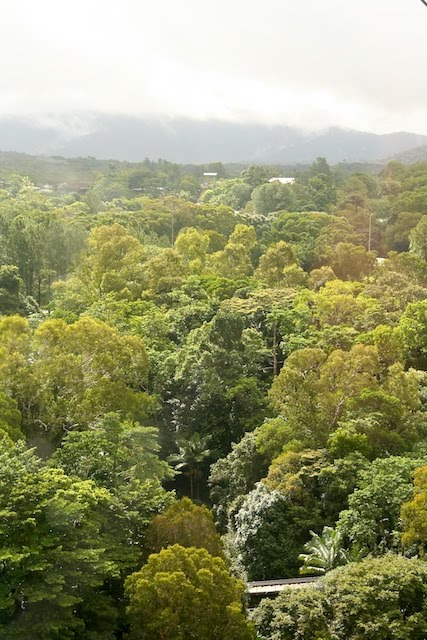
We decided as a group to do an early morning hike before breakfast thinking that early morning might be feeding time for animals in the wild. Eager to see some animals, we set off at 6:30am with umbrellas and leech socks. It is clear but very humid and we walk uphill toward the canopy. I start out with a poncho, which I quickly discard after feeling like I am walking in a hot sauna. Off of the main dirt road, there are 5 canopy walkways and several platforms of different heights and it is mystical being above the rainforest and in the clouds so early in the morning. There is no feeling quite like it. The air is damp and moisture fogs our glasses and camera lenses. There is a cacophony of forest noises – birds, frogs and insects, all awake at this early hour. What a treat to be among them. I overcome my fear of swinging bridges and walk gingerly along the canopy paths overwhelmed by this untouched and pristine part of the world. What lies below in the dense foliage, I wonder. How special this area is, the acres of protected land. How can we preserve such places from encroachment by development and how do we sustain the wildlife that live here? On the way back, our guide points out a red leaf monkey having his breakfast on top of a tree, right by the side of the road. Hand to mouth, he enjoys his food, not bothered by us watching him. A few minutes later, another one appears and the two frolick in the trees before disappearing. We are all excited about our first sighting.

Breakfast is an elegant spread of eggs, noodles, fried rice, breads and meats. The staff are very responsive to our needs and cater so nicely to the guests. We feel quite pampered. After breakfast, we set out again, though this time not as enthusiastically, as it is pouring. We hike up to the overlook, a 1.5 mile hike uphill in the rain, muddy, slippery and very humid. We sweat like hogs and try to avoid touching leaves so to stay away from the leeches which come out in droves in the rain! Sounds unpleasant? I would say it is not the most pleasant hike we have ever done, but a true rainforest experience. The cloud and fog are heavy and we do not see much from the overlook. Totally soaked inside and out, our pants and leech socks covered in mud and harboring some leeches, we end our hike. Other than millipedes, we don’t see any other life and decide to call it a day as far as trekking. We pick off a few leeches from inside our boots, on the leech socks and try to clean our pants and leech socks as best we can. It rains and rains and rains, lots of muddy puddles where even animals wouldn’t be caught outside! I find it more pleasant to sit at the lodge, looking out over the river and watch the clouds and mist roll past. Reading a book on their patio is bliss.

We spend much of our evening drying our clothes in preparation for tomorrow. We decide not to do the scheduled night walk as our guide tells us that we most likely will not see much in the dark when it is raining so hard. We learn that this is monsoon season (Oct. – March) and wonder if we should have picked a different time of year to come out. There is internet access in the lodge, no TV in the rooms or lodge, so we read and head to bed early, planning an early morning hike on our own.

The Rainforest


We leave before dawn for a 7am flight to Lahad Datu. The airport is empty except for the few waiting for this flight and I wonder where all these people are heading to. They certainly don’t look like they are going jungle trekking. One elderly couple comes on an ambulance; he has a hospital band around his wrist. Perhaps he was discharged from the hospital and is going home to this remote village. On the tarmac is a small propeller plane. We board and much of the plane is empty allowing everyone a window seat. We fly at a low elevation and thus get a wonderful view of Sabah, the northern part of Borneo. Borneo, the third largest island in the world is represented by Brunei representing 1%, Malaysia 26% (Sabah and Sarawek) , and Indonesia 76% (Kalimantin). The Borneo rainforest is rich in diversity with 221 species of mammals and 420 species of birds, one of the most biodiverse places on earth, home to one of the only remaining species of endangered Borneo orangutans, and refuge for the Asian Elephant, Sumatran Rhino, Borneo Clouded Leopard, and Dayak Fruit Bat. We hope to see a few of these on this trip.

We take off over the South China Sea and coastal Sabah (northern Borneo) where we can see the islands, the houses on stilts along the island of Gaya, and then heavily forested mountains. Heading east, we can see Mount Kinabalu, its peak at 13, 435 ft. rising above the clouds. People have told us it is possible to trek the mountain, which takes 2 days, the second requires setting out around 3am. The rivers are brown curly ribbons running through lush green forest. Soon we see acres upon acres of what appears to be trees that are pinwheel shaped, forming interesting geometric patterns. I soon realize these are palm groves and my heart sinks to think that all of this land has been cleared of forest to plant palms. Apparently half of the annual global timber (hardwood plywood) is supplied by Borneo and thus logging has taken away much of the rainforest. Palms grown for palm oil encroach on the remaining forest.

The area is remote and tiny villages of a few lone houses appear between the groves. There is a clearing below and a single landing strip runs next to a line of metal shacks that are people’s homes. This is Lahad Datu – an actual small town with a few stores and gas station; much more developed than I had imagined. The airport is a single room with a whirring fan that does a fairly decent job of creating air movement in the very heavy and moist warm air. Gray clouds threaten rain. There is a single baggage conveyor sitting about 3 feet off the ground, that is not more than 10 feet long. A few plastic chairs line the wall and most of the local people are standing outside the main door. We are greeted by people from the Borneo Rainforest Lodge with a 4 wheel drive, who take us and another couple to their main office a few blocks away. We are met by the people we have been emailing and settle our account. One young man shows us where we are on the map and gives us some basic information; our bags are loaded on the back of a Toyota 4 Runner. The other couple is also from the US and we will be hiking with them. Guests are grouped by 4’s and remain together throughout the stay. The 4 of us crowd into the SUV and are ready for the drive, having taken our Dramamine, and are prepared for a bumpy ride to the lodge.

The Toyota 4 Wheel Drive, fairly new, with A/C and good shock absorption, bumps along the sometimes gravel, sometimes muddy, sometimes dirt road, passing through a few checkpoints, each leading to more undeveloped roads. Although not terribly windy, there are some potholes and dips where we are jolted upright! Dense forest lines the road which is basically uninhabited-we encounter only one other SUV from the lodge going the opposite direction. We all agree, that it is not as bad as we had anticipated. After 2 1/2 hours, we finally arrive at the Lodge and are greeted by several staff who take our luggage and present each of us with a bamboo leaf lei. They take us to the top of the stairs, and it suddenly feels like we have been transported in time. In the middle of the jungle sits this beautiful lodge built of hardwoods, with high ceilings, which is beautifully decorated, open air on all sides with hardwood floors and several seating areas of rattan and upholstered armchairs. There is a large bar in the center of this huge area and small dining tables toward the back and on the adjoining balcony, all overlooking the river and forested mountainside. The lodge rooms are individual units all connected by elevated wooden boardwalks. The lodge is surrounded by lush vegetation – bushes and flowing trees. It is a lovely setting and we are treated to a nice buffet lunch of both Asian dishes and salad fixings. After lunch, we are briefed and scheduled for our first nature walk at 3:30. We learn that there is a set routine of activities, 4-5 day walks, night walk, and evening ride.

The adventure begins here as right before 3pm, the rain begins to fall, a drizzle turning into a downpour right before our nature walk. The guide decides to give us a video tour and introduction as we wait out the rain. The afternoon shower usually only lasts a few hours. After watching several dvds about the area, the four of us opt to go out in the rain, eager to see some wild animals! We are highly encouraged to purchase leech socks, simple loose stocking shaped covers that are sewn of cotton/polyester fabric and tie below the knee. You wear them over your socks and pant legs, inside your shoes. Fortunately, we had brought waterproof hiking boots. We are given large umbrellas since it is way too warm and humid for rain ponchos. The trail runs in the woods and we climb over tree roots and slosh through puddles; the ground is very wet and muddy. There is the sound of frogs, insects and animals, and falling rain. Leeches, what are they? The leeches are a lesson and adventure in themselves and we get an in depth lesson as they like the rain and warm wet bodies. They look like skinny worms that can extend and stretch their bodies. Apparently, they have suction cups at each end of their bodies, which they use to attach themselves to you. They look like a dancing worm, stretching themselves out toward us, trying to reach any part of us in order to adhere. They then crawl to find open skin and proceed to suck your blood. We weren’t too concerned at first, as the guide didn’t make too much of the fact that we would encounter them. However, we come to realize after the hike, that they can quickly burrow around your clothes, land between your fingers, or in my case, land on my neck. Feeling a sensation that something was on my neck, I brushed my hand back there to find something attached to my skin. I got to him before he began to suck and uncoupled him from me. They are difficult to get off as they quickly can attach to your finger! B. who was hiking with us, found one between his fingers, which left a bloody mess and continued to bleed, not profusely, but more like a shaving cut, for an hour. Leeches apparently deposit an anticoagulant as they suck. If you watch them on a leaf or rock, they seem to stretch out toward you as they sense your body heat, and almost jump to attach to your skin or clothes. Not dangerous, but they can quickly cause you to become phobic, thinking they are all over your body! Certainly not for the faint of heart.

We didn’t see any animals on this hike but did hear that others had seen an orangutan near the road. We were still hopeful and enthusiastic, despite the rain. We retired to the lodge to remove our soggy and muddy gear and check each other for leeches, reminding me of monkeys in the wild, which we didn’t seem to be that far removed from. Dinner was buffet style, an interesting and delicious assortment of Asian and Western dishes. I am particularly attracted to the Malaysian curries and chili prawns. There is a table of fresh mangoes, melons and papayas at each meal. After dinner, we head out for a night drive in a misty rain which clears to a decent evening. We start out in the 4 wheel drive pick up truck, with our guide riding on a garden bench tied to the floor of the cargo area. In the middle of the dark jungle, we transfer to the flatbed of a truck, equipped with benches along both sides. We ride along the bumpy road, holding on tightly as the road is bumpy, while our guide, perched above the cab, shines a huge spotlight into the dark forest. Amazingly enough, he finds a leopard cat, civet, and flying squirrels by looking for eyes reflecting off his flashlight like little dots in the trees. My vision is not so sharp and I have a difficult time seeing them, even when he points them out with his green laser pointer. Through the binoculars, I am amazed to see the face of a leopard cat staring back at me. After a couple of hours of looking at eyes in shining back at us from treetops, we head back to the lodge.

Our room is closed in, with screens and glass on the doors and windows. There are no mosquito nets, and no need for them, as we had read about online. The floors are varnished wood and a powerful ceiling fan provides cooling. The bathroom is modern with a wonderful shower. The sliding glass door leads to a covered patio. Some of the rooms overlook the river, others the forest. We spend some time drying our clothes with the hairdryer – the air is so damp that our clothes seem to absorb moisture as they hang there. We fall asleep to the sounds of the rainforest – the insects and frogs calling and the pattering of rain.

Malaysia First Impressions


The hotel offers a simple breakfast of Western and Asian fare. First item on the agenda is to find a SIM card for the Malaysian phone which will require a walk in to town. Kota Kinabalu, a coastal city and capital of Sabah, was most certainly not designed for foot traffic. We don’t see a traffic signal for many blocks and the sidewalks are uneven and absent in areas. Crossing the main street in front of the hotel is a major challenge and we quickly learn that standing on the edge of the road waiting for traffic to clear is not the correct solution unless you have an entire day to spare. We end up doing the quick dash across the 3 lanes of traffic and as the day goes on, learn to do the lane by lane crossing method of the locals. The plan is to go to the Jettison Harbor and take a ferry to one of the islands. At the harbor office, we discover that Gaya Island, the largest island is a private resort, accessible only through the resort boats. In order to get to the opposite side of the island where people live in traditional houses on stilts, we would have to charter a ride with a private boat and we are somewhat leery of doing so. The other islands are forested with beaches for snorkeling. After spending some time on the pier, we decide to walk the town instead. Walking does not appear to be a favorite pastime of residents as it is warm and very humid; the shopping mall is where most people hang out. I now understand why Ray spends his life in a shopping mall when in Malaysia!

We walk through the large city market, a covered expanse of small stalls selling fruits, vegetables, dry goods and meats, and we see how local Malays shop. You can find just about any kind of foodstuff in the street market.

In contrast, the mall is a 8-10 story affair, with offices on the top 4 levels and an assortment of shops on the lower 4. As you go up the levels, the stores are more upscale, with Starbucks, Puma, Adidas etc. on the upper level. I am delighted to find some sandals at a price of $8US.

Sitting at Starbucks, we surf the net and find a well rated place for dinner. It is a bit of a challenge finding it and we sort of end up there, not realizing where we were. It is a bit like an open market with restaurants along the inside walls, a corrugated metal roof on top and whirring fans. Tables are shared by the restaurants. Fish tanks are at one end. You select your fish, and place your order. The food is acceptable, not fancy, but filling and fresh; the ambience interesting. The hotel employees are having their annual party and we laugh as we walk by – all of them are dressed in Western gear, cowboys in jeans and hats. Thus ends our first day in Malaysia.

Leaving California

It’s a beautiful day in California as leave on our Malaysian adventure. This was somewhat of a difficult trip to plan as the travel sites had very few reviews from tourists going to Borneo. Therefore, some of this trip will be “wing it as we go” and I am not too sure what these places will look like, and don’t really know what to expect about transportation and points of interest. The United flight is fairly empty and we board early to find lots of empty seats. The guy across the aisle tells me there are many seats in business class. Alas, we should have requested one. It is a 12 hour flight to Seoul and 3 movies later, full of terrible food, we arrive in a country buried in winter. Below, the terrain is heavily mountainous, gray with a dusting of white, giving it a very somber and bleak look. I wonder if the city is as gray as it appears from the air, or perhaps neon lights give it life and color. My thoughts turn to the landing and I wonder if we will have to walk outside to get to the terminal. I am dressed for the tropics, certainly not prepared for the 20 degree temperature outside. Fortunately, a jetway appears and we deplane directly in to the terminal. It is afternoon, but the airport is eerily quiet and empty except for the passengers on this United flight. The Star Alliance lounge, as typical of Asian cities, is well equipped and offers a nice selection of food and drink. The kimchee mixed with canned corn is particularly good. Boarding Malaysian Air, we embark on a 7 hour flight to Kota Kinabalu, in northern Borneo.

It is 11pm. Walking outside, we are hit by the moisture laden air, which sits heavily on us. Our taxi drops us off at the Hotel Shangri-la, not to be confused with the Shangri-la Resort, the 5 star luxury hotel on the coast.

An Ending


We awaken to the sound to falling rain – it is pouring outside. I suppose that is a sign that it is time to leave. Zoran is ready for us and takes us to the airport. We see Jen off and then sit and wait for our flight to leave 3 hours later. It has been an interesting adventure, taking us over 1600 miles of road, 3 countries, cold to hot climates, and mountain to sea terrain. We gained an insight into the Slovenian and Croatian cultures and have a much better understanding of the political conflicts and hardships that people in this part of central Europe have lived through. So much of what we see on TV and read in our newspapers and magazines becomes humanized when you see it up close and talk to the local people. At that time, it really touches your heart.

The people of this area are genuine and kind. There is very little crime on tourists and the cities are safe, even in the poorer industrial areas. The forests, rivers and lakes are pristine with so much of the countries uninhabited. People live a more minimalist lifestyle with local fresh food and laundry hanging out their windows each day. Outside of Vienna and Ljubljana, w saw no McDonalds and no Starbucks – I hope they keep it that way. Construction is going on everywhere and tourism is alive and vibrant. We hope that they can maintain their quaintness, character, and charm despite their growth and modernization.

I have taken up to a thousand photos and hope to share them in the coming weeks. This part of the world is a wonderful place to visit; it is truly one of the most beautiful places I have ever been. Take plenty of time to soak in the culture of the area – it is a place that shouldn’t be seen in a rush, stop and breathe the air, listen to the birds, and feel the warmth of the wind on your face. Most of all, get to know the people for they are very, very special. I am grateful to all of the wonderful hosts of these villages, who went out of their way to make sure we enjoyed our stay and I hope you will be inspired by this blog to take your own journey there.

Local Streets


As we watch from our balcony this beautiful morning, we are surprised to see a cruise ship anchored outside of the harbor. Small boats are ferrying passengers to the dock, over and over again they go. There must be thousands of people! This is definitely not a day to roam the city center, we decide. We make an alternate plan to walk north up the peninsula to the suburbs of Lapad and Boninovo. Part of the road runs above the sea and past a large resort. Then turns inland toward the larger harbor and Yacht Club, where we are surprised to see yet another cruise liner with a parking lot of buses waiting to ferry passengers to the city center. We choose to sit on a bench and watch all this action, and to enjoy the sunshine and scenery of the surrounding hills.

Toward afternoon, we make our way back and are shocked by how the old city has a completely different feel with the masses of tourists and tour groups. The wall looks pretty congested and we are grateful for having had the opportunity to walk it in peace and quiet. We again frequent Oliva for our usual. We sit in the square and watch people. We watch as a young girls’s ice cream, dropped on the ground is carried off on the shoes of passing tourists – in less than 5 min., it is totally gone! Wouldn’t it be amusing to see how far bits of the strawberry ice cream ends up? One guy is trying to stand on a piece of rock that juts out from the church. It must be in a guidebook, we think, since so many groups stop there and try to stand on it. People walk with their dogs–Europe is certainly dog friendlier than the US. We hear people speaking a myriad of languages – Italian, Russian, Chinese, Japanese etc. and we try to figure out where they are from before they speak. We escape to our favorite bench on the harbor and watch a group of elderly local gentlemen fishing from the edge with dough balls and bread.

We end the day back at Konoba Komenice and gelato at Dubrovnik Ice Cream. The boys now recognize us as having been there 3 times in the past 2 days. He gives us free cones and asks to have his picture taken with Jen, who he has been eying from the beginning. We leave in a jolly mood and head back up the 384 steps to pack our things, our final evening in Dubrovnik coming to a close.

City Walls

Dubrovnik is a place for lounging. There is a lazy, slow feeling in the air that deters any rushing around. We spend the day reading on benches by the harbor, sipping coffee, and people watching on the square. We now have our favorite pizzeria, Oliva, where we sit for hours in the alleyway, and our favorite gelato shop, Dubrovnik Ice Cream, where we watch as the boys throw scoops in the air and catch them on cones.

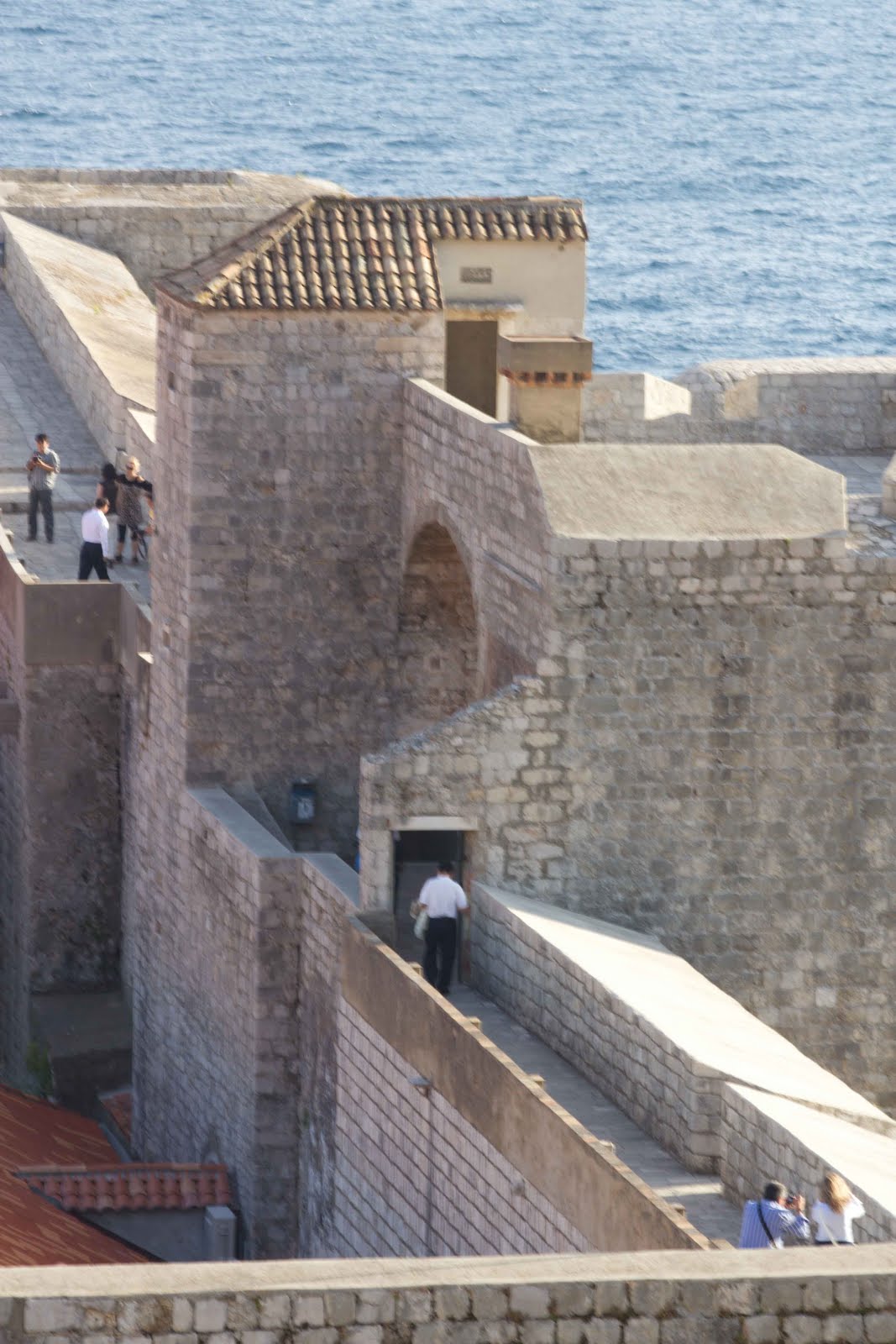
Jen goes for a swim in the warm Adriatic while we watch on the sandy beach. Toward early evening, we head up to the city wall for a walk around the city. This walk is over a mile and takes up to a couple of hours. The high walls, some 3-4 feet tall were fortified in the 15th century to protect the city from the Ottoman empire. During the recent war, local residents hid inside these walls. There are a series of steep steps take you to viewing platforms higher and higher up. The view is stupendous and you can see the city from all angles. One side looks down over the sea. You can see a dense cover of red clay rooftops, 2/3 of which were rebuilt after the war. Looking down, you can see the wide moat, now gardens, and drawbridges that allow tourists into the city. The building are inhabited by families and laundry billows in the breeze to the sound of music and the aroma of cooking food. We are the last to leave giving us a feeling of being the only ones on the wall.

Dinner tonight is another guidebook choice, Konoba Kamice, with tables in the small square -mussels pasta, fried squid, and fresh salad are winners. We end the day on the balcony talking to a young newlywed couple from Istanbul, the husband tells us that Turkey is even more beautiful with forests and waterfalls. He invites us to visit.

War and Rebuilding


Today is set aside for exploring the city of Dubrovnik. 500 years ago, this city was a major maritime power with the third biggest navy in the Mediterranean. Much of the tourist sights are located within the old city walls. To reach this area, we walk 384 steps down from the pension – this walk deters any thought of unnecessary trips back to the room! From 1991-92, after Croatia declared its independence from Yugoslavia, the city was heavily bombed by the Serbs dominated Yugoslav army, who wanted to move north toward the town of Split. Over 2,000 bombs and missiles fell, destroying much of the monuments and homes. This is documented in photographs at a historical gallery – the images bring tears to my eyes. Today, much of the city has been rebuilt with a walking path on the city wall, the wide cobbled Stradum-pedestrian central artery and myriad of alleys. No cars are permitted inside the city walls.

We visit the aquarium to see marine life in this part of the world, saunter the quiet alleys, stop for coffee and yummy pizza at Oliva, wander to the harbor and sit for hours with our feet in the water, and sample Dubrovnik’s gelato. Pretty laid back, I would say and easy to get used to! It is a quiet day in the city with few tourist groups. Everywhere we go, we are mistaken for Japanese – is it the cameras, do you suppose?

Having checked out the reviews on restaurants, we choose Lokanda Peskarija on the harbor. The seafood risotto and pot of mussels are served in heavy iron pots. We also try their baby squids and salted anchovies. We eat heartily and mop up the juices with fresh bread, leaving not a morsel or drop!

Dalmation Coast


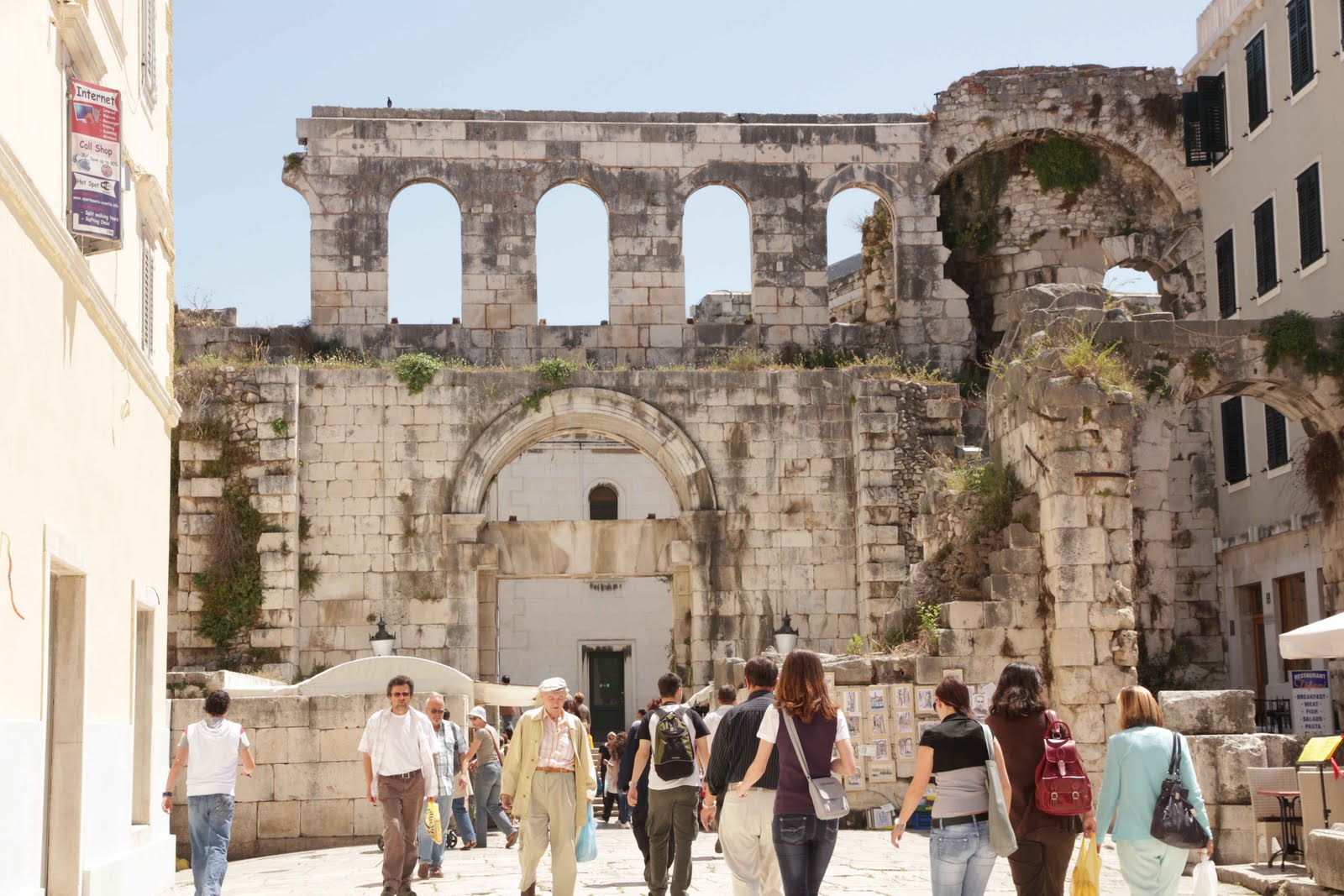
Split, Croatia’s second largest city is a vibrant harbor town on the coast of the Adriatic, about 2/3 the way down the coast. It is a transit place for people taking ferries to the islands of Hvar and Korcula. Unfortunately, most do not spend any time in the Old Town itself, which is a delightful way to spend 2-3 hours. We are quickly learning that every village and city has an Old Town with a square and cathedral which you can see from miles away. It is usually the city center where the tourists gather. Split’s Old Town sits adjacent to the harbor and is probably one of the most interesting and less touristy Old Towns we have ever seen. Most Roman ruins stand alone with grass and weed leaving you to use your imagination as to what the buildings looked like, and most Old Towns are a collection of touristy ancient buildings around a town square. But Split has used these ancient Roman walls to create a very interesting city. The ancient Roman Emperor Diocletian in the 4th century built a huge palace to retire in with its front entrance flanking the harbor. Later, after it was abandoned, the locals, fleeing Slavic invaders in the 7th century, moved in and built over the old palace. The ancient palace walls now stand and a combination of ancient to modern architecture forms the city’s buildings. You can see ancient columns which support stone walls built throughout the centuries; the 4 main gates surround the palace and the hallways are now lined with shops. People actually live within these buildings and we thought how interesting it must be to live in a palace structure with narrow staircases leading up to your home, and old Roman ruins scattered about in your backyard.

Driving down the Dalmation coast is going to take a good part of the afternoon. The weather is perfect-sunny and warm and the water of the Adriatic is bright blue in the distance and blue green by the shore. The main highway from Split runs inland and we choose to take the coastal road which winds through villages and takes you up and down the mountain. Some sections are high above, the winding road risng on sheer cliffs, which take your breath away. Other sections are down by the shore, running close to villas and resorts. We have a couple of close encounters with impatient Croatian drivers trying to pass and coming directly at us! Fortunately, Jen is nimble and alert. The scenery on the left changes from forested mountains to high rounded hills that are brushy and resemble southern california’s desert landscape. We arrive in Dubrovnik in the early evening just as the sun is casting a low glow on the water, and the skies are turning a pale pink. We drive on past the city to Cilipi, 13 miles south where the local airport is located. We return our rental cart to Sixt, whose one desk clerk has the job of “only checking in and out cars”, and can’t do anything about out Auto Europe overcharge. We call Zoran from the Pension and he comes to pick us up in a Honda Accord. Zoran has lived here all his life and runs the place with his mother and brother. He impressed us with his skill in navigating through the narrow alleys, dodging oncoming traffic and pedestrians on the highway. We carry our luggage up a huge flight of stone steps to be greeted by an incredible view and homemade muffins and jelly roll cake, warm from the oven.

I am sitting on the balcony of Pension Stankovich, 320 feet and 384 steps above the Old Town with a fabulous view of the Adriatic and the red roofs of the city. Below, the lights of the fortress walls shine bright gray and the yellow lights of the harbor form a bright chain surrounding all the yachts. The almost full moon radiates a bright oval on the dark sea waters.

Plitvice and Sibenik


House Tina sits among grassy fields about 8 km. outside of Plitvice. Our hostess/owner serves us the best scrambled eggs I have ever had – fresh eggs, she tells us, from the neighboring farm. of the interesting aspects of B&B’s is meeting people from other parts of the world. We have breakfast with a group of Romanian guests and learn that Romania is even more beautiful than Croatia, except that the roads are undeveloped. These visitors drove 15 hours to get to Croatia. I think what has struck me on this trip is how westernized Central Europe has become and how well the Slovenians and Croatians speak English. Their children learn English from grade 3–as a country they believe that it is unrealistic to expect visitors to be able to converse in their native languages, and thus have adopted English as a universal language. The majority of tourists we have encountered have been from Russia and other central and eastern european countries. The pensions have been immaculate, well furnished, with modern appliances and amenities. It has certainly been an eye opening experience for all of us and I would highly recommend this as a destination spot.

Knowing that tour groups descend on the park in the late morning and afternoon, we hit the park early and are one of the first to be on the trails. We continue our walk from yesterday by working our way up to the upper lake and circling around to the middle area between the lakes. By early afternoon, at the boat dock, we are shocked to see hundreds of schoolchildren and hoards of tourists and feel fortunate to have seen most of the park by then. There are so many people walking on the boardwalks, it is like holiday crowds in a shopping mall. There is no way I would have been able to set up a tripod with people shaking the boardwalks and trying to pass by. We walk up to the highest waterfall and at the top have a view of the 2 lakes and the chain of smaller falls below them. Escaping the crowds, we head on down the coast.

We have dinner in Sibenik, a blue collar town, and find a very local eatery with homestyle cooking. I feel a bit like Frankenstein as we get so many looks when we walk in – have they never seen an Asian before? We head toward Split, our only night of spontaneity since I have not reserved any hotel for this evening. What a mistake that was! Trying to find a hotel in the dark at a reasonable price becomes quite a challenge. There are no chains of hotels in this part of Europe, and unlike the US, there are no hotels by the highway. We go in to several, and decide against them because of the price, finally settling on one in the north part of the city, because we are tired of driving around. It reminds me of the only other time we had no reservations, early in our marriage in DC when we drove 30 min outside of the city.

The Hotel As will suffice and it is a lovely room with a huge whirlpool bathtub, not a cheerful b&b but nice just the same.

Plitvice Jezera

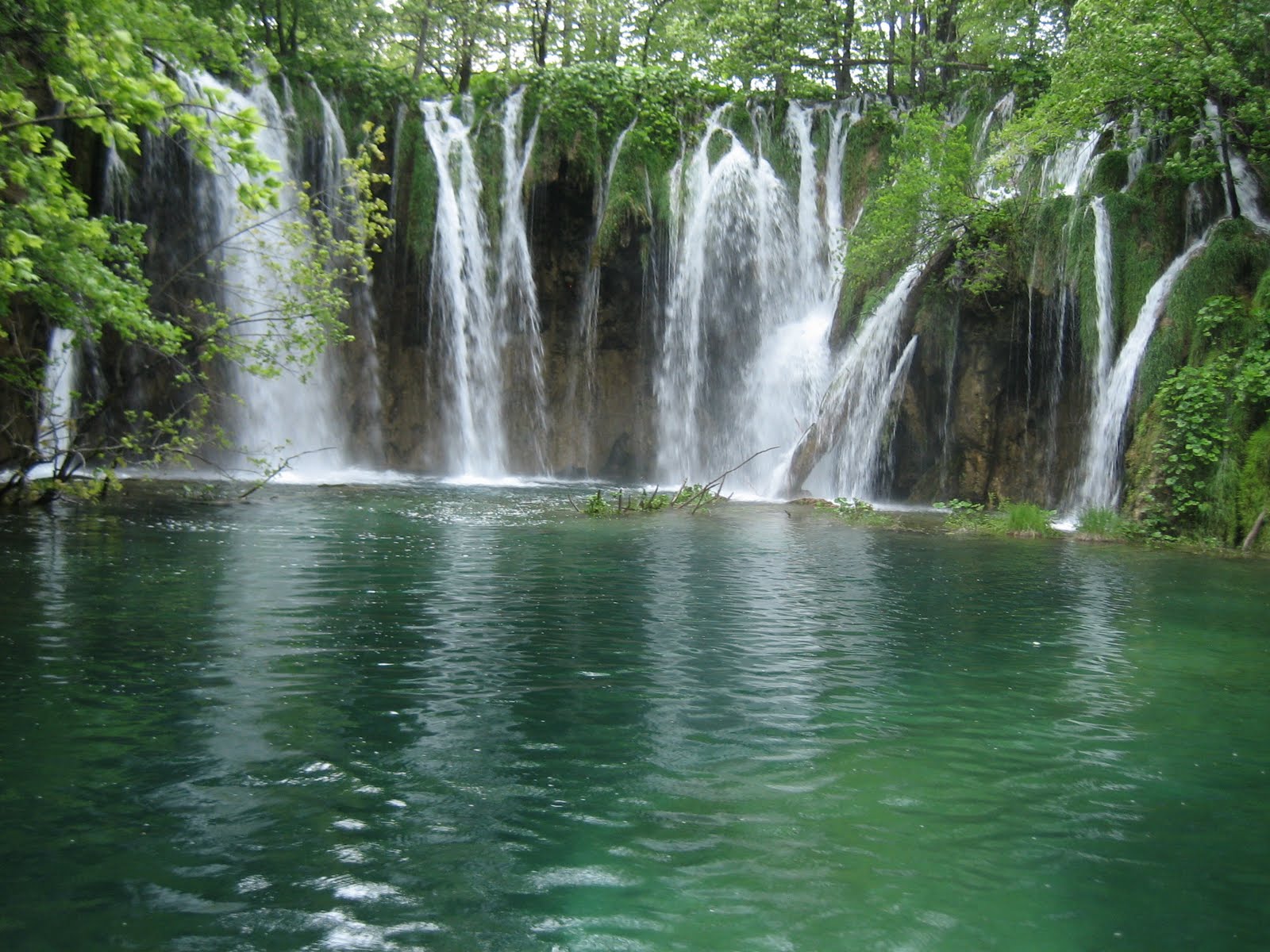
It takes us a good part of the day to drive across the Istrian Peninsula from Rovinj to Plitvice, stopping along the way to take pictures of the valleys and mountains. The highways are new and traffic is very light. We are discovering that Slovenia and Croatia are not heavily inhabited. The area is very similar Tuscany with many hilltop villages dotting the landscape. We arrive at Hotel Tina in mid afternoon and immediately head to Plitvice National Park. I have high expectations of this park and am not disappointed. I can imagine how even more beautiful it is in the fall with the changing colors. There are miles of boardwalk trails that connect 16 terraced lakes, 2 of the largest are referred to as the upper and lower lakes. In between are countless waterfalls and cascades spilling out over limestone canyons and among the trees and greenery. Around every turn is a surprise and a feast for the eyes. Late in the day, the tourist groups begin to leave and fortunately for us, a late afternoon shower chases all the other visitors away. We have the park to ourselves until 8pm and the solitude is wonderful. I am able to set up my tripod wherever I desire, catching the early evening light without worrying about people walking by. I am able to slow down the running water to create an illusion of milky water flowing. It is a photographer’s paradise and we are the last car to leave the parking lot!

Rovinj


The Vukman family runs the Pension Vega and it is a 28 room B&B with modern facilities – clean and spacious. When we arrived last night, their youngest son was waiting for us; the parents were at a graduation party for their oldest son, who had graduated top of his class and will be going to the university of Zagreb. His dad, who had been a merchant sailor and had traveled the world, is very very proud. He shows us his framed photos of his visits to the US -the White House and New York city. We have the “penthouse apartment”, perhaps the only time we will ever stay in a penthouse suite!

As we are only a 10 minute walk to the city center, I get up early and walk the streets to the Old Town and take pictures of the curved alleys and the harbor. Local people are up and about and shops are opening. I seem to attract a lot of curious looks as I take photos of the many old shutters. People probably think it odd that these worn out shutters are getting so much attention. Furthermore, I don’t think they see many Asians – must be mostly Japanese tour groups, as we are greeted by “Konichiwa” everywhere we go. Today, we relax and kick back, reading, chatting and just roaming the streets – eating gelato and pretending we are Japanese. Later in the day, we wander in to the local market, bargain for jars of truffles which are found in this area, and sit by the harbor, enjoying the view. Toward evening, we wander down and find ourselves some dinner and gelato.

A Touch of Italy


After a walk down to the lake once more, we depart this lovely area and continue our journey south toward the Istrian Peninsula.
We want to make it to Lipica to see the Stud Farm of the Lipizzaner Horses – the tour is at 2pm. It is drizzling on and off. The tour is quite interesting and we learn that the horses here are not the same ones in Vienna. After WWI, the horses were split evenly among Austria and Italy, which is now Slovenia, and the horses here have been bred in this area since then. Did you know that they are born brown and turn white, only 3% stay brown? At age 4-6 the stallions are trained and work until age 25 or 26. The horses are beautiful and apparently the breed is known for its gentle personality. They are for sale and can cost up to $60,000. We were entranced by the performance, though felt the horses at the Spanish Riding School were a bit superior in their execution.

Next stop, Piran, by the shore, where we stop to walk and have dinner. The Italian influence is clear, and this seaside town resembles a small Italian coastal town. We have seafood and watch the sunset over the Adriatic. Moving on down the coast we cross the border into Croatia and finally arrive at Rovinj at night. The GPS is not quite perfect this time in taking us to the hotel, and we stop in front of a house to check our map. A group of young men walking out of their house tries to help us. They are so helpful and kind, laughing and offering to ride with us up the street. We end up following them up the street and they very happily point us to the Pension Vega, where we are to stay. I have to say, I have been impressed by the kindness, friendliness and safety of Slovenia and Croatia. It has exceeded my expectations of comfort and level of westernization.

Somewhere Between Heaven and Earth


Breakfasts at the Penzion Berc are lovely – a wide assortment of breads, fruit, and cereals in a charming breakfast room. I love bed and breakfasts for this reason; it’s a great way to start the day. Today we are driving out to the Julian Alps and will follow Rick Steve’s driving tour which will take us west towards the Northwest corner of Slovenia near the Italian and Austrian borders. The mountainsides are so lush, covered in different hues of green from conifers and deciduous trees in various degrees of budding and leafing. Ski resorts dot the landscape and we take a detour past Jesenice and Kranjska Gora at Planica to see the world’s highest ski jump. I can’t imagine jumping from that height; obviously those people are made up of something different than I! I can see 2 men working at the bottom and they look like ants in contrast to the hundreds of stairs and height of the platform. This region is very close to the Italian border, which Ray is excited to pass through and photograph, just because.

Apparently, it had rained for 14 days before we arrived, but we today is breezy but clear. Our drive takes us into the Triglav National Park and the beginning of 50 hairpin turns, cobbled for traction, 24 up and 26 down. The temperature dips quickly and we are among the snow. High above the green valleys, the granite looms gray and cold. It is windy up here and pretty desolate and I wonder what would happen if this very basic Slovenian rental car were to break down. The road reaches a summit and on the other side, we can see the Soca River Valley below, with the turquoise water meandering through the green fields. Coming down, the river churns in places and flows placidly in others. The small villages have only a few houses. We stop at a small restaurant for lunch and I wonder when the last guest was here and how they can keep food fresh with so few passersby. As our food is served, the lights go out! The road follows the river for miles and miles and the color is so blue and tranquil.

As it is getting late, we decide not to continue the loop, but to take a shorter route back to Lake Bled. Our B&B is in a residential neighborhood just a 5 minute walk through a shortcut path to the lake. There are many houses under construction and from our balcony, we can see homes and gardens. It has been quite a day! We find ourselves back at the pub again, today quite busy with groups of people from England. We eat and call it a day.

Gorges and Rivers


Ray spends the day on the Sava Bohinjka with a guide who he says looks like a young Mick Jagger and is a fan of KnIght Rider. He asks if all Americans are like the people on the Jerry Springer show! Ray falls in the water early in the day and the loaner waders act like a sieve, soaking his clothes. But, yes! He has a great time, catching 10 fish that are 12-18 inches in size.

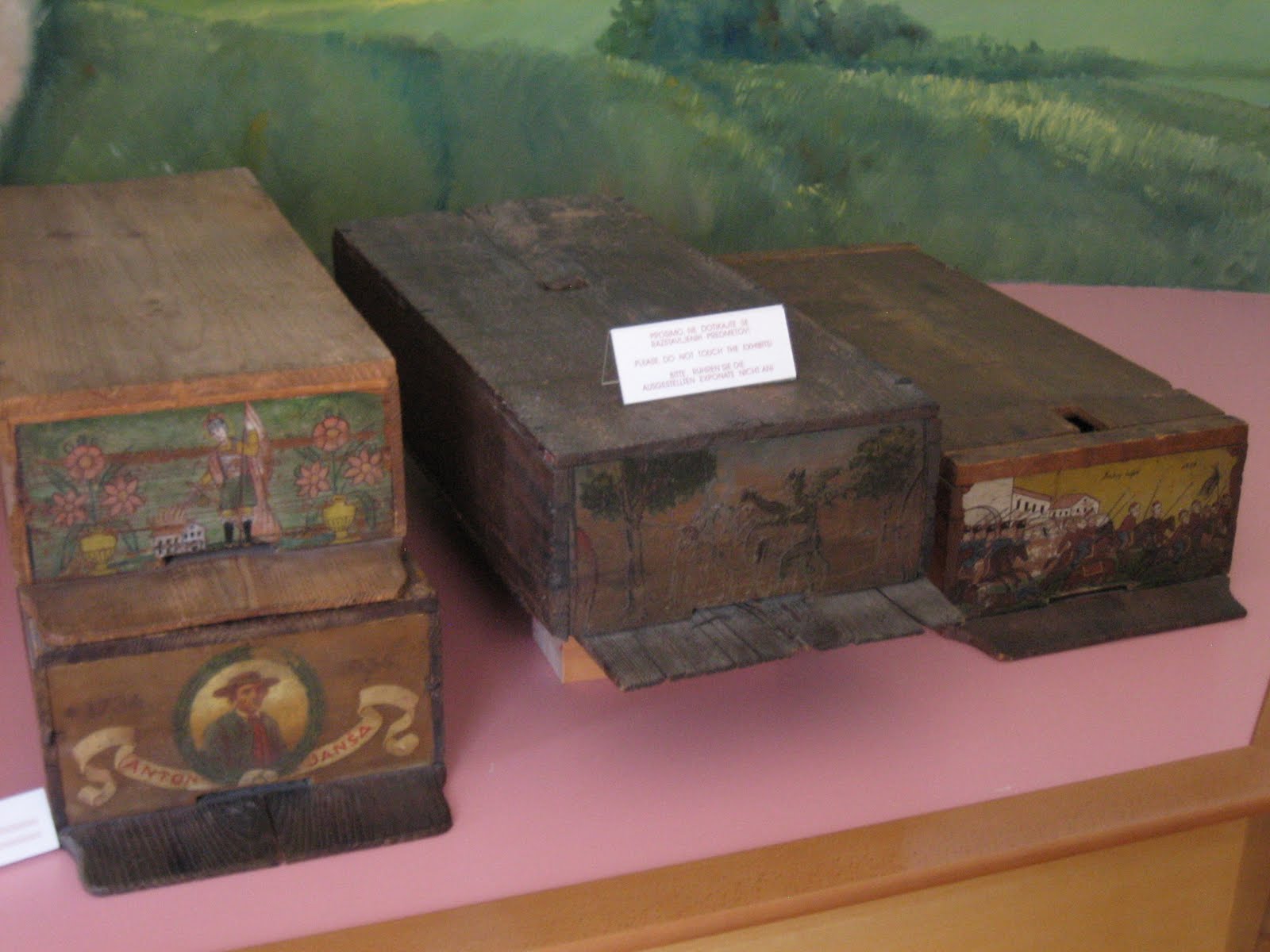
Jen and I first visit the Bee Museum in Radovlica, a town perched above the Sava River. Beekeeping is part of the cultural heritage of this area and we are totally amazed at the sophistication of these insects. Did you know they have different dances that tell the other bees exactly where they have found nectar? The Slovenians decorated beehive fronts with drawings so their bees would be able to find their hives. We saw one folk tale drawing depicting older women going into a house and coming out as young women! We later discover that Jen’s friend in school is from this tiny village.

From there we drive into Bled, pick up fresh bread, meat, and cheese and head up to Vintgar Gorge. The river Radovna has carved a mile long beautiful gorge. The water is so clear, it is light turquoise in color and the churning river creates waterfalls and foaming waves. It is a photographer’s paradise and I take way too many photos. Next, we follow our trusty GPS down winding narrow roads to town and over to the castle. Hiking up the steep trail, we are rewarded with a gorgeous view of the calm lake below and its island. We can see marker lanes for the rowing world championship coming up next week. As we are leaving, we see a few guys dressed in medieval costumes – performing perhaps?

Our day ends at the pub where we indulge in delicious vegetable soup and grilled meats. We find Ray back at the hotel, sunburned but happy, with lots of fish stories and wet clothes.

Lake Bled


I get up early to take morning pictures of the town and walk to the Triple Bridge, Dragon Bridge, down to the Riverside Market and the market colonnade. In the square, a man sitting along the side iss playing the accordion. People aere walking and biking on their way to work. Breakfast at the Hotel Emonec is a bit of a disappointment. Located in the basement level, with white bread, cold cuts and a coffee machine. I choose to spend my calories on fresh bakery delights from the market and walk back to the market colonnade and practically have to tie my hands together to keep from buying too much. There are 5 glass counters, each displaying a different selection of crusty breads, soft breads, sweet cakes, cheese, etc. What I buy is far superior to the hotel offerings!

Our next task of the day is to pick up our rental car at the train station, which really ended up being at the bus station-you would have thought they would have said that in the first place. Auto Europe, we discovered is only a broker and actually works through Sixt Cars in Slovenia. That explains why I got the same operator on the phone when I called Hertz, Avis, Auto Europe and a bunch of other companies from the US. At the Sixt office, the guy proceeds to tell me that the computer shows our drop off charge as being $360, not the $160 on our voucher- some confusion between the 2 companies apparently – and after a half an hour, I am finally able to convince him to let us leave and not charge the higher rate. Our car, a low, low end Opel is pretty basic with lots of dents and scratches, hmm-the radio doesn’t even have a display! Car rented-we head onto the open road toward Lake Bled.

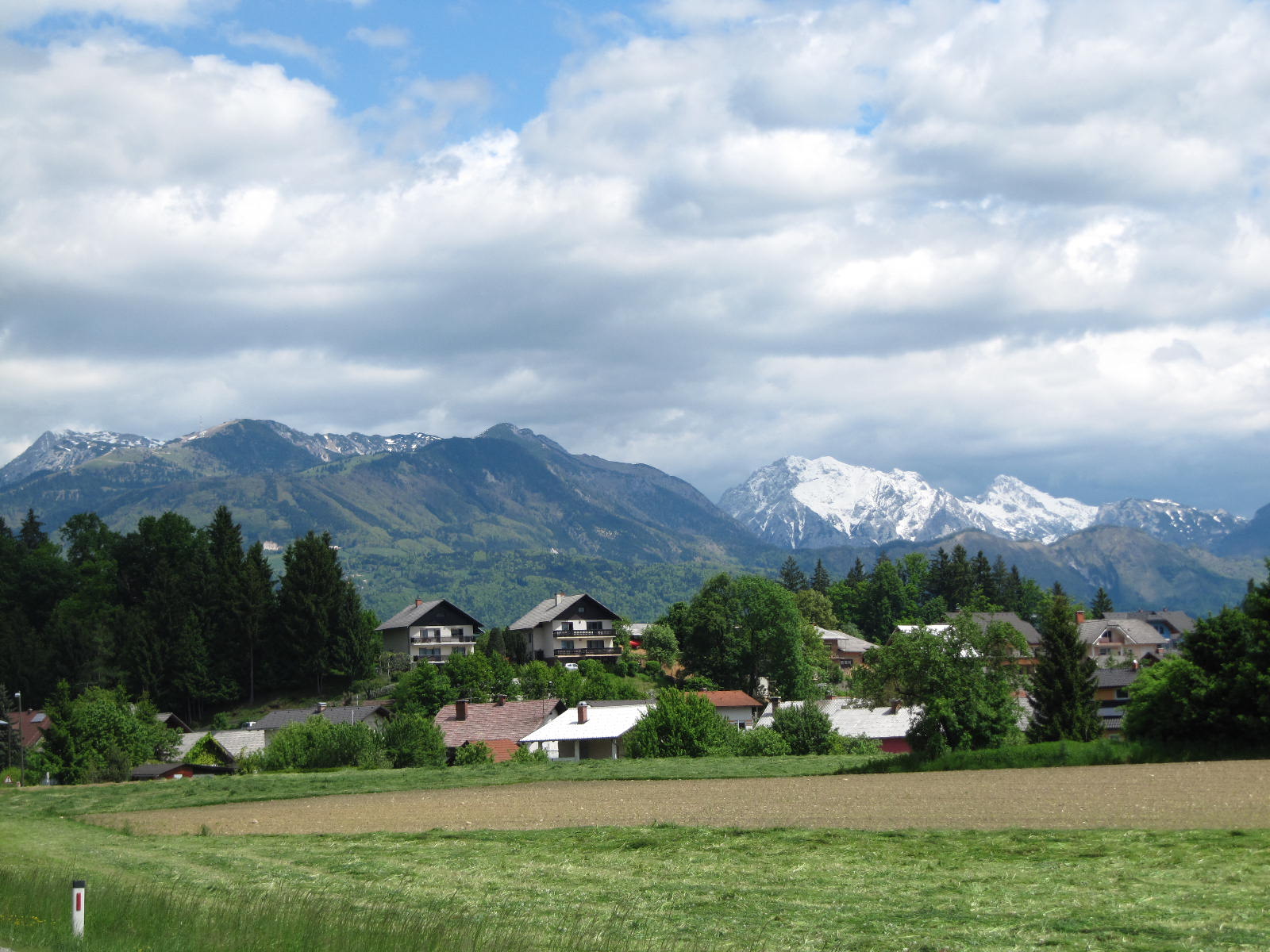
The scenery, breathtaking – lush green hills and forests, with snowcapped granite alps framing the background. I can’t imagine a more beautiful backdrop. Lake Bled is only 30 min. from Ljubljana, a clear blue lake resort town, with a medieval castle and a fairytale island. It is truly idyllic. This pretty much undiscovered part of the world is pristine and the people so friendly and relaxed. Our bed and breakfast, the Penzion Berc has been in the Berc family for 50 years. The hotel and B&B are run by 2 brothers. Luka, our host is a friendly guy, who we met at the front door, trying to calm his newborn twins who are crying in unison.

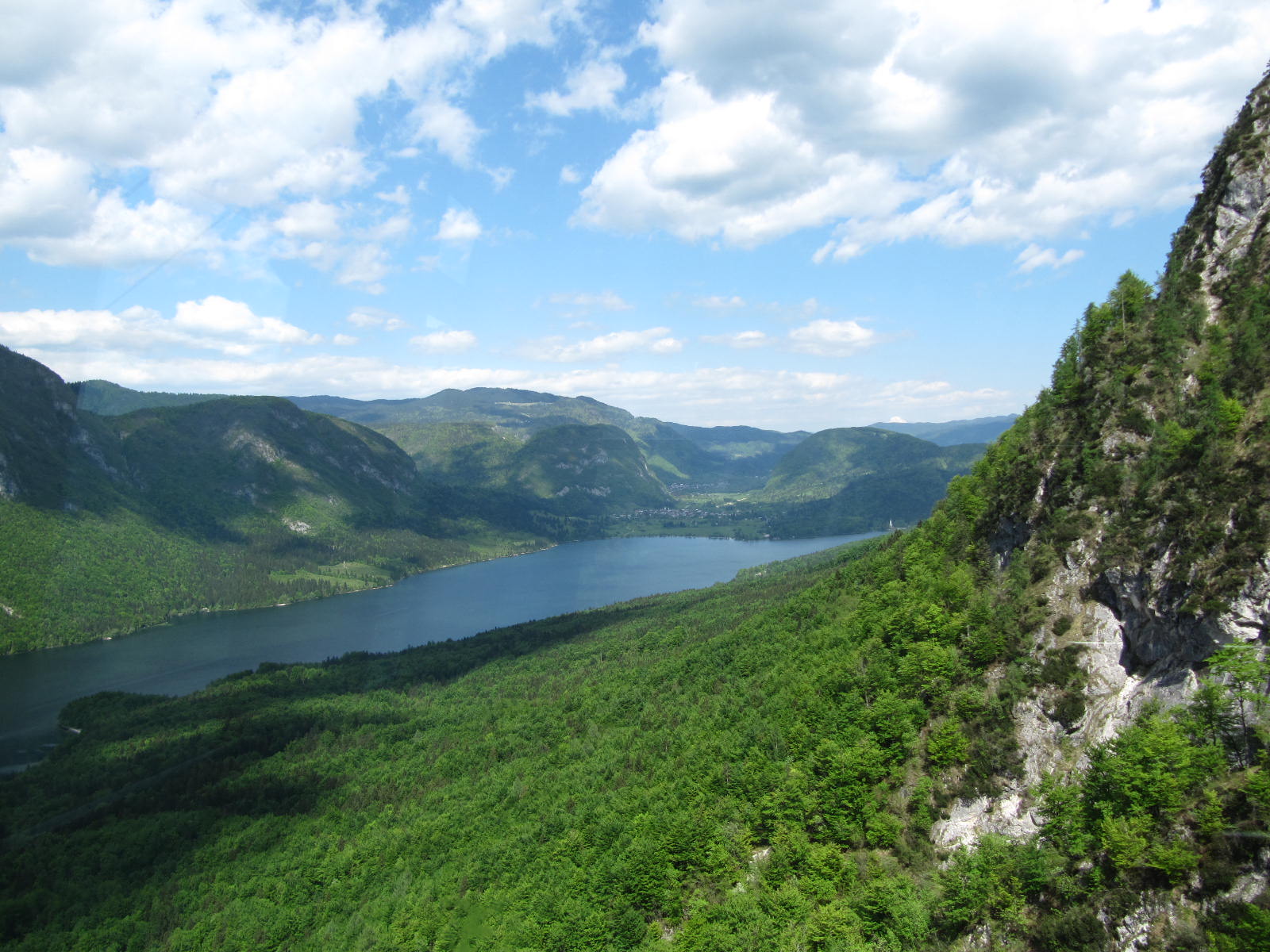
After settling in, we take a drive to Lake Bohinj, an alpine lake, and ride the cable car up Vogel Mountain, a ski area with a fantastic view of the Julian Alps. We then continue our adventure to Slap Savica, the waterfall at the end of the lake, reached by a hike up the trail and 553 stairs. Ray gets a chance to examine the river in preparation for his highly anticipated fishing trip with a guide tomorrow. I have high hopes that he would catch record numbers of trout, huge ones, so that he will be as interested in coming back to Slovenia as I am. Back at the hotel, I crash – Ray and Jen gp to the local pub, Gostilna Pri Planincu, for huge portions of food.

Austrian Scenery


We leave our hotel to catch the subway to our 8am train. We had bought rolls the night before but learn quickly that in Europe, one should never buy fresh bread the night before. We really do need to be more spontaneous, don’t we? The girl who was working the reception desk is supposed to be up at 7, to prepare breakfast and to give us rolls to go, but is still sleeping in the bedroom. A basket of bread, delivered for today’s hotel breakfast sits invitingly outside the main door and so we, feeling quite lucky, take our share of breakfast rolls, which are soft and fresh. Being at the train station is always a bit nervewrecking at first because we are afraid of missing our train, or being on the wrong side of the tracks, or getting into a car that will be taken off and left at another city. Imagine pulling into a station and then realizing the rest of the train has moved on and you are still sitting at this village! Trying to make sense of the foreign signs takes some thought and we learn from the map that cars 418, 419 and 420 go to Ljubljana while the others get left at villages along the way. Public transportation in Europe truly puts the US to shame. The trains are on time and clean, the subways run every 3-5 min. and connect you to any part of the city in less than 15 min. We climb onto the train and get desperately stuck in the aisle with a bunch of high school students trying to go the other direction with their large suitcases. All the cars have compartments for 6 and I am confused as to where our second class seats are. Turns out they are good in any compartment without reserved names on the doors. We share one with 2 young women. The girl sitting across from me has extremely long legs and is obviously happier when I get up to take pictures from the narrow hallway. The scenery along the 6 hour ride is breathtaking. Austria’s countryside is green and hilly, which changes to mountainous with lovely valleys and tiny towns. As we get in to Slovenia, we can see snow capped mountains in the distance. The weather is beginning to clear and some blue skies are peeking through.

We arrive in Ljubljana, the capital. The streets are wide, and the many pedestrian only walk ways and squares give it a wonderful feel of a walkable town. It appears to be a city in transformation as some courtyards and buildings are still “post Communist” gray and sterile, but other areas have been redone with fresh paint and new walkways. Along the new promenades, storefronts are all new with shops designed with tourists in mind, though the fashions are not quite up to European levels. Ray thought the main cobblestoned promenade had a Disneyland feel to it, void of cars and people, with empty outdoor cafes lining the sidewalk. It is still early in the year for most tourists and so the town is relatively quiet; the main activity in the Old Town is construction, and cranes are everywhere. We notice a large number of gelato stands, all selling the exact same flavors. We can imagine what the city will look like in 5 years. So to those who imagine a war torn city with land mines and bullet holed buildings, surprise, this city is as modern and vibrant as any other european city! I definitely think it is an up and coming place! Our hotel, the Hotel Emonec, is located just a short walk from the Old Town Square, the Mestni Trg. It is pretty basic, but very clean and quiet.

We take a walk up to the Ljubljana castle and climb the 92 steps to the tower where we are treated to a magnificent view of the entire city and surrounding hills and mountains. The red roofs mingled with new buildings creates an interesting combination. The biggest decision of the day is to choose a place for dinner. With all the pizzerias in town, we elect to try the Italian style wood fired pizza at Trta. There is a wide selection – the man next to me is eating one with a “sunny side up’ egg on top! The pizzas are thin, crispy and huge and we felt quite satiated. Walking back to the hotel along the riverfront, we take photos of the reflections in the water at Cobbler’s bridge. It has a slight feel of Florence but needs some strolling musicians and colored lights for additional ambience.

Wet, Wet, and More Wet


The rain just keeps falling and falling and the weather seems to be deteriorating. Today is cold, gusty and wet – a good day to sit by the fire and read a book – a bad day for sightseeing and walking around a city. The grayness of the morning is lightened for a moment as we walk by the “pay toilets” in the underground street crossing – the sounds of Mozart float out from the toilets and greet passersby. We get an early start on this sunday as we want to hear the Vienna Boys Choir at mass. The first 60 people in line can get standing room tickets in the back. Funny how people in line become friends – perfect strangers find connections to each other. 2 people in front of us are from Malaysia. They are tour hosts who do “backpacking” trips. Obviously their definition of backpacking is different from mine, as their tour guests include a group of 50-60 year old Malaysian women who do not look like they have any intention of sleeping on the ground in tents, much less carrying backpacks in the wilderness! The tour couple also look pretty dry and perky at 8am, certainly had not camped the night before. Turns out, they stay in hostels and hotels and the only resemblance to backpacking are the small backpacks they carry while sightseeing. The girl behind us was from Palatine Illinois, a college student studying in Vienna for a summer session. We manage to get in, packed like sardines, and craning our necks to see the mass. We find the boys’ voices to be truly amazing- so sweet and clear. After mass, they come to the front of the altar to sing one more song -they are quite cute and a lot younger than I had imagined.

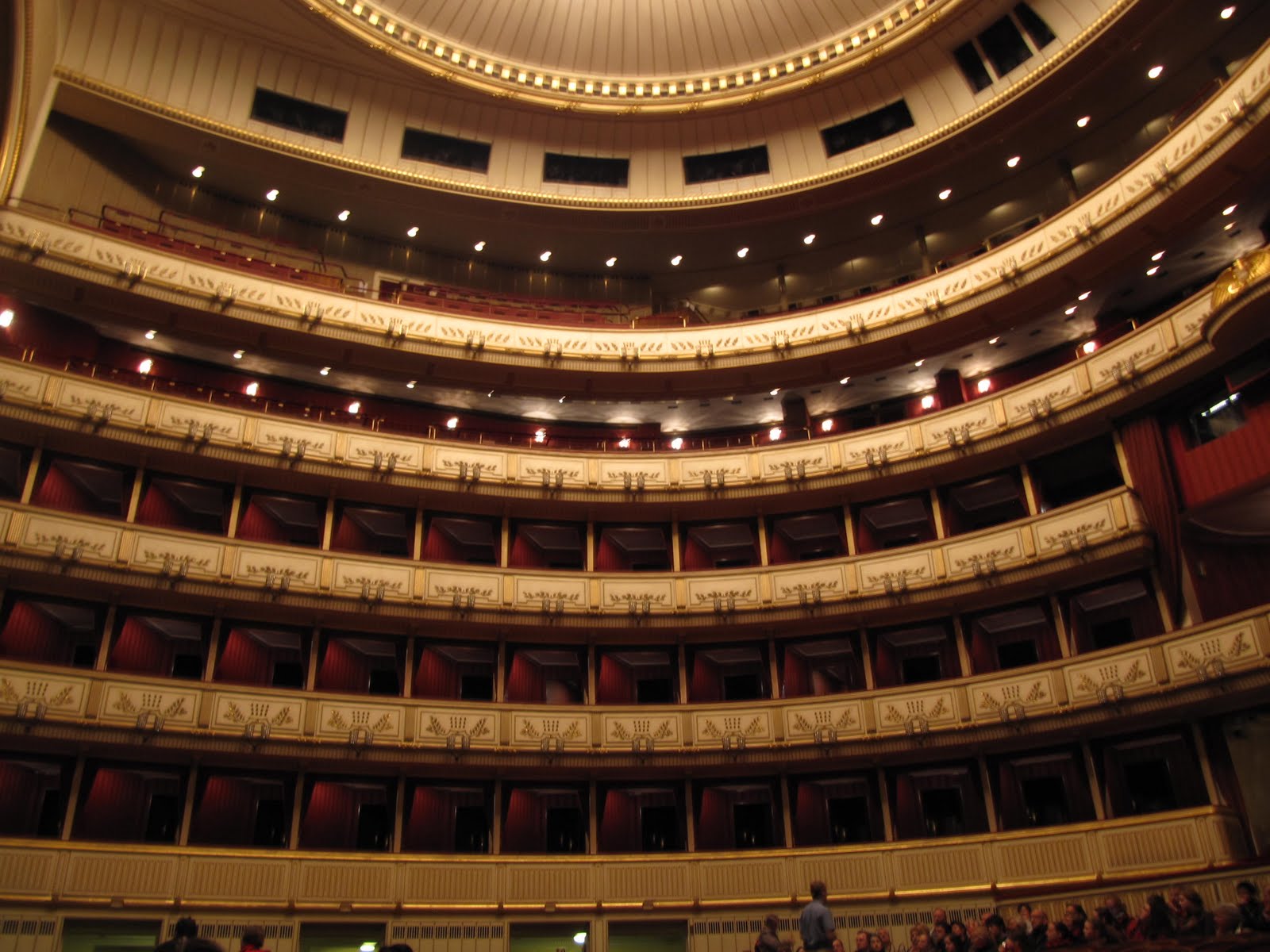
From there, we head to the Statsoper, the State Opera House for their 10:30am tour, one of the premier opera houses in the world, quite interesting and well worth the time. The tour guide tells us where the standing room area is, on the second level right in the middle, and tickets cost only 8 euro each. They alternate nights with different operas and as she is speaking, we can see them tearing down last night’s set from Carmen. There is a 600 member cast who are employees of the opera house and perform in the shows. It is a beautiful auditorium with excellent acoustics and I wished we could have seen an opera there. The Viennese opera ball is held in the same room, all seats are removed and a raised floor put in for this very special event. For 230 euro, you too can dance in the ball.

It is time to warm up and we stop for coffee, apfel struedel and the famous sacher torte at the very elegant Cafe Sacher, which makes us feel like we are high society. Our very critical review is that Sacher Torte is better at Cafe Sacher but apple struedel is the best at Demel. Back out into the wet weather we walk to Belvedere Palace, one of the most splendid pieces of Baroque architecture,which houses the Austrian Gallery of art, and features the work of Gustav Klimt’s The Kiss, Egon Schiele, and Oskar Kokoschka.

By then, Ray and I have had enough of this wet windy weather and elect to go back to the hotel. Jen braves the cold and walks to the art museum. Tonight, our last night in Vienna, a concert at Musikverein.

The Wiener Streich Quartet, a group of older gentlemen are simply superb, performing chamber music by Haydn, Mozart and Schubert. The audience is primarily older local residents, and everyone thoroughly enjoys the music. This is our last night in Vienna and we have high hopes that clear skies will follow.

Queuing for Wienerschnitzel


The day starts early as I venture out before 7 to photograph the streets before the city awakens. The quietness of the parks and alleys is wonderful at this time of day and it is only after taking the photography workshops at Yosemite that I have learned the best part of the day for taking photos is before 8am. Ray and I walk for miles toward the museum quarter and I spend a lot of time gazing at wrought iron balconies as they are so picturesque. On the way back, we happen to find ourselves in the middle of the Nascharkt along Wienzeile Street, the old open air market filled with food stalls, bakeries, and fruit and vegetable stands – just starting to open for a busy Saturday. The fresh fruit and vegetables are so brightly colored and so fresh, rolls at the bakery are soft and crusty. I see sauerkraut in wooden barrels and so many kinds of pickles. This is my favorite part of exploring a city and we buy fresh rolls to eat with our hotel breakfast. Later in the morning, we go back to gather a picnic lunch of bread, meat and cheese for our Shonbrunne Palace outing.

Our day is spent at Schonbrunn, the summer palace of the Habsburg family, a smaller scale Versailles and said to be one of the finest palaces in Europe with 1,441 rooms. Riding the subway out, we had a chance to see where local residents live. This is always one of my favorite part of traveling-venturing out to the nontourist neighborhoods. Unfortunately, the hotel receptionist was incorrect in telling us we did not need a reservation to visit and our tickets indicate a 3 hour wait until we can enter. After wandering through the gardens and having our picnic lunch on one of the park benches, we hike up to the Gloriette, a monument celebrating an Austrian military victory, high on the hill that overlooks Vienna, the palace and gardens. With more time to kill, we sit in the great hall and watch groups pass, trying to guess their nationality. Finally, at 3pm, we are permitted to enter. The palace, as expected was opulent and the audioguides provide a nice quick lesson in Austrian history. We learn that the interior was decorated by Maria Theresa, who had 11 children, and only one daughter, the her favorite was permitted to marry for love, the others all were married off to insure greater power for the Habsburg family.

Good Wienerschnitzel(breaded veal cutlet) is worth the wait and standing in line develops comaraderie among fellow travelers. For the second night in a row, we stand in line outside Figlmuller on Wollzeile St., a highly rated and very reasonably priced restaurant specializing in Wienerschnitzel. Last night, we stood in line for over an hour only to find that the line had hardly moved at all and even people with reservations were waiting for tables. “Come back before 6”, the waiter had advised and so we did, only to find another long line. Jen decides to go to their second location around the corner and her strategy is for us to be in line in both places. We meet 2 girls from Toronto in line and they tell us the wienerschnitzel is so good it is addictive-this was their 4th time there! A phone call from Jen makes us all realize that it is much faster getting a table over there. Our success in getting a table set off a chain of activity. Others join forces and begin working in groups to stand at both locations, pairing up with other strangers to maximize their chances of getting in. How funny is that! As we are seated at our table, we watch the remaining people in line come in and see their joy in being seated. Oh, was it worth the wait! The waiter brings out wafer thin pieces of lightly browned veal, larger than the plates they sit on, a full kilo per person, and hammered thin to be so tender. It is a dinner to remember! Our advice to others – go to the second location on Backerstrasse, you will get in less than half the amount of time.

In our quest for Wienerschnitzel, we missed getting standing room tickets for the opera Carmen but spend some time viewing it on an outdoor screen through a live feed. A group of die hard fans stand under umbrellas watching the opera on this cold, windy and wet night. Jen decides to join them later in the evening and meets a Korean student hitchhiking across Europe. Funny how the music that floats out of the halls at night creates the ambience that in our minds we imagine is Vienna!

Vienna


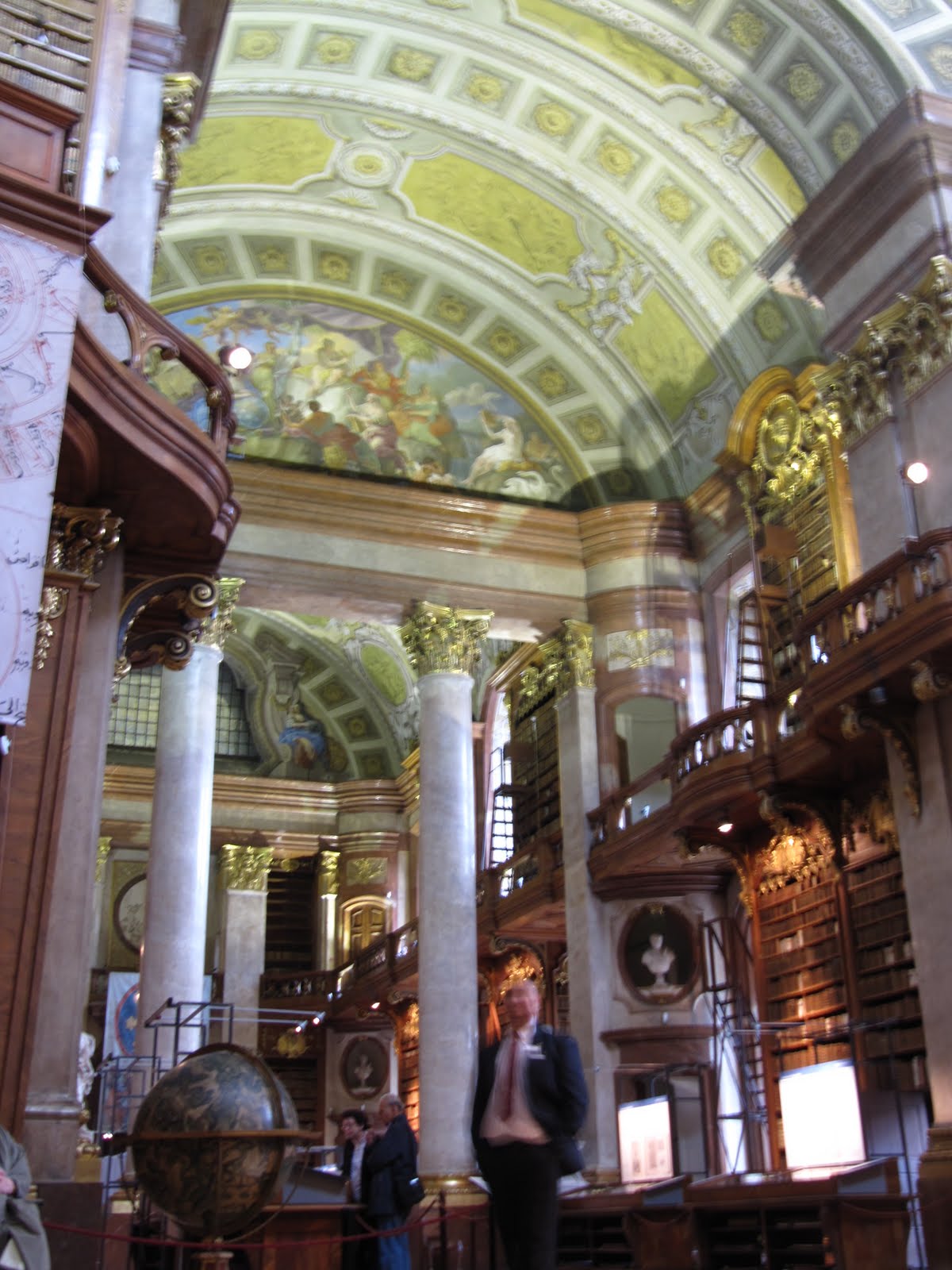
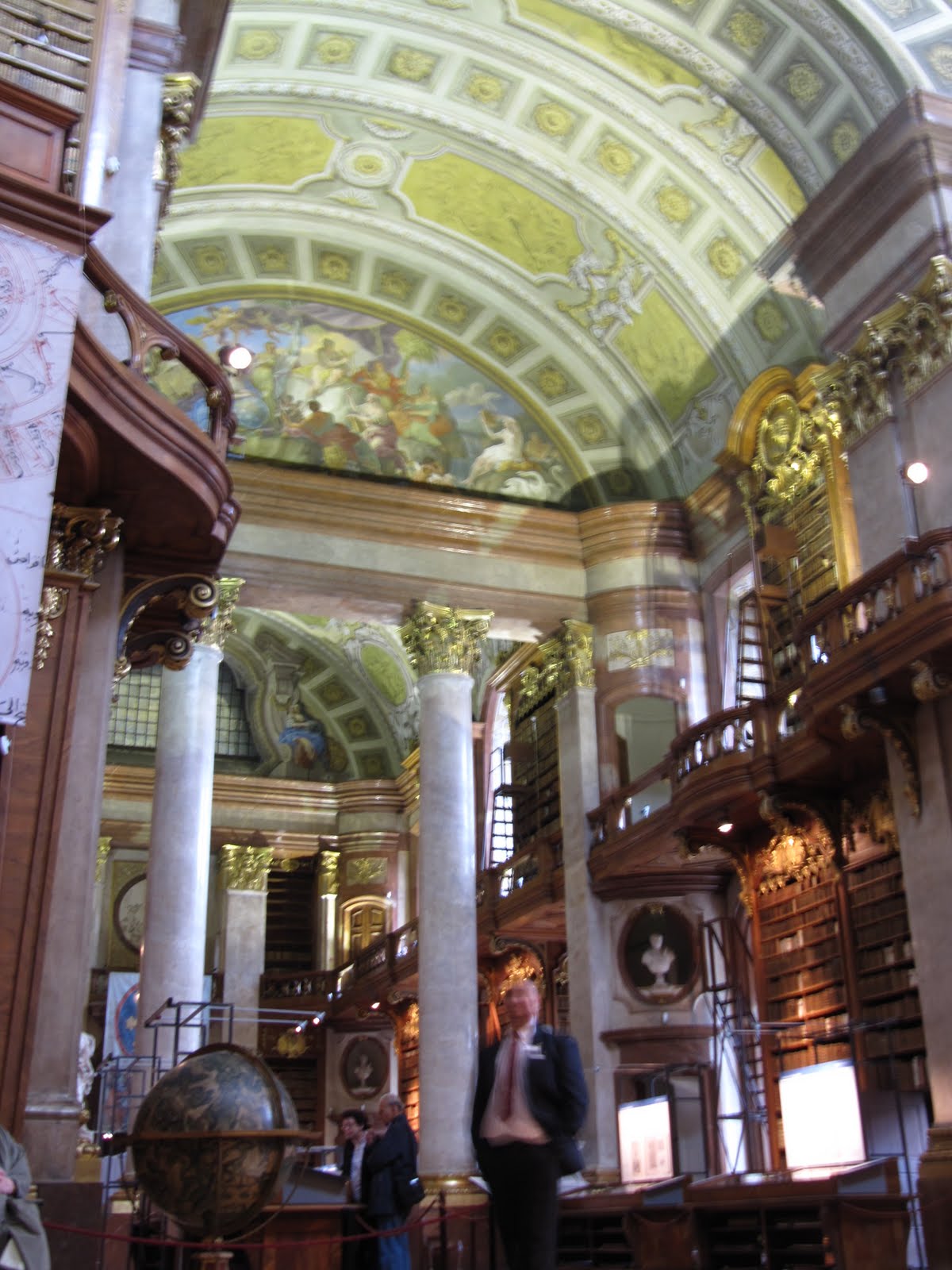
Our first day in Vienna starts gray and drizzly with a walk through the old town, city center. Us Californians are such puppies when it comes to weather and the rainy weather makes us feel a bit soggy. But there is something quite peaceful and beautiful in this musical city. It is definitely a city for walking and most of the historic sites are in close proximity to each other. In 1857, Emperor Franz Josef demolished the ancient wall surrounding the city to create a more cosmopolitan Ringstrasse, which encircles the heart of Vienna.Walking through the Hofburg Palace, the winter residence of the Habsburg ruling family until 1918, we follow others through a large gate and in to the back door of a room, and surprisingly find ourselves at the riding ring of the Spanish Riding School. The elegant Lipizzaners are in the midst of their morning workout to Baroque music in a chandeliered riding hall, and how graceful they are with their high stepping trots, dancing sideways and forwards almost like they are skipping. How in the world does one train a horse to prance like that, we wonder? We also wonder if the men on the horses are fulfilling a lifetime dream of riding them. Do they have women riders also? We skip the Imperial Apartments and go next door to the Treasury where we view diamond studded crowns, sceptors, robes, and other jewels owned by the Holy Roman Emperor. We then walk through the Baroque style Hofbibliotheque, the National Library, which holds one of the largest ancient collections of books.

What does Austria remind you of? Why pastries, of course. First on the agenda is to find Demel, at Kohlmarkt 14, the famous pastry shop offering a dazzling array of choices- apfel strudel,the paper thin layer of pastry wrapped around a high stack of filing of multiple layers of equally paper thin slices of apples and a light touch of sugar and spices, Sacher torte, a light chocolate cake topped with a thin layer of jam and chocolate frosting, and many other thinly layered cakes we can’t identify and can’t pronounce. Pastry shops sell only pastry so we then had to follow this up with coffee at Cafe Mozart at Albertinaplatz 2-another array of a dozen or more choices of expressos and other coffees. I could easily spend an entire afternoon, or many afternoons in this indulgence. After another little bit of walking to exercise off some calories, we stop for German bratwursts from a roadside stand and eat them sitting on the steps and watching people. Now thoroughly satiated, we continue on with our sightseeing.

For the remainder of the afternoon, we walk and walk and walk, through alleys, squares, stores and promenades. Schoenlaterngasse, “Street of the Beautiful Lanterns” was shorter than expected though cute with a wrought iron lantern. I must say that bed was a welcome sight.

Mother Nature and Ash in the Sky

I’ve been washing the skies for several weeks now, with an eye on the Icelandic volcano whose name we can’t pronounce but which holds such power over all of us travelers. Even up to today, it’s impending eruption has the potential to change the course of our vacation. I figure though, that there is no point in stressing about it as how can I argue with mother nature. I suppose that what will be will be and that it is completely out of my control. Fortunately today, the ash cloud has blown north and we are free to leave. The weather we leave behind is clear, dry, warm, and beautiful. The weather in Vienna that we are going to is wet, cold, and gray.

As we board the flight on Lufthansa, I am surprised at the changes to their seating since we flew with them a few years ago. My memories are of extra wide seats with thick navy blue cushions – these seats are extra narrow, with minimal armrests and no space to bend down and pick up anything on the ground. I can only imagine how someone bigger than I would feel like they have been put in a metal box overnight! My hand luggage, which was considered small a few years ago when I bought it, barely fits in the overhead compartment. I guess the airlines expect us to downsize both in body size and in belongings!

The flight is uneventful, which is good and we land in the early evening to rainy skies. Feeling adventurous and cheap, we opt to take public transportation to the hotel, which is the CAT subway with a transfer to a local bus. We follow the masses of people to the underground passageway and learn by copying, how to purchase and validate our tickets. Up and down stairs and through many halls- it is not very accessible, is it? It is no wonder that Europeans are so slim. Coming out of the station, we know it is a short walk to the Hotel Shermin, but in the dark are not quite sure which street to take, and I approach a group of teenage girls to ask directions. They mock my attempt to pronounce the street, shout and laugh in my face and send us in wrong direction, makes me realize how it feels to be bullied -how unkind young kids are! Finally, a decent young man directs us to the main road and we arrive at our hotel, the Hotel Pension Shermin well situated on Rilkeplatz just down the road from Karlsplatz and find Jen already in bed. The room is spacious for being so close to the city center. It is so nice to see her! She has spent the day walking the city and has gotten the lay of the land and what is what, has already had a wienerschnitzel dinner and is settled for the night. We look forward to what awaits us tomorrow and fall dead asleep very quickly.

Trees

There is such beauty in the tree filled forest and we love our tree lined streets and mature tree filled neighborhood. But trees drama filled our week and today when I look at the trees in our yard, they come with a price tag, and a mighty big one at that!

When we buy these cute little trees in 5 and 10 gallon black plastic pots, we don’t picture them as 20-30 ft. giants, dropping binfuls of leaves, piles of spikey things, or pods with seeds that explode all over the yard.
We plant them close together in a grouping that look so nice, and don’t foresee that they will grow up bumping into each other and jabbing each other like siblings sitting next to one another in the back of a car.

Did you know that a tree greater than 40 inches in diameter needs permission by way too many people to be cut down? Did you know that a 20-30 foot giant can cost several thousands of dollars to remove? I learned this week that removing a tree, can, like many other home improvements, lead to problems you could not even have imagined!
Our locust tree, with its bright golden autumn foliage has seen its last days. Half dead, with brittle branches, it stood waiting to be taken down.
The city however, has its own ideas. “Was an arborist consulted?” they asked. “How do you know it is dead?” “Can it be saved?” With these answers in hand, they were to meet as a staff group to assess this request and in 2 weeks a verdict would be handed down. Perhaps they should reconsider this process to be one in which a staff committee decides whether and where a tree should be planted.

What they failed to ask was, “Do you know what is under it?” “Did your pipes come before the tree, and if so why on earth would the previous owner plant a tree right on top of the gas and main water pipe?” If they had asked the right questions, they could have made my $40 permit worthwhile and have avoided a lot of unnecessary anguish.

Dear Mr. P, the previous owner who so lovingly designed the landscaping. What were you thinking? That tree roots could wind their way around the big pipe and feel secure? Perhaps that pipes would hold the tree up to be stabile? Maybe that gushing water in the pipes would hold good karma for a growing tree? Whatever the reason, it worked, because this tree grew to be a giant and under it still stood, the big white pvc pipe that carries water in to our house. And on the day of its death, the stump grinder took the remains of its stump and the great white pvc with it, sending a fountain of water high up in to the air to proclaim its removal. And thus the saga began…..

Plumber A, B, C , and PGE. Huge hole dug and big white pvc repaired. Other pipe unknown as to whether it carries gas or not – further investigation needed. Tree company disclaimer – not responsible for any lines under the ground. Cost – unknown. Moral of the story — don’t plant trees on pvc pipes and find out what lurks beneath those roots.

Beyond the Iconic Yosemite


They say you get inspiration from others and this weekend was particularly so. I was excited about the Yosemite photography workshop since last year it was one of the best weekends I had ever had. It seemed hard to top that but I was optimistic; at the least, Yosemite would be ablaze with color. We started our drive to the Sierras early in the afternoon and the skies were a bit ominous looking, but the forecast was for clear weather. I had been checking every day and on Tues. finally took the chance and cancelled my lodge room in favor of a campsite, saving a lot of money but thinking that I may regret this decision come midnight when our toes are freezing. We arrived after dark and in the brisk cold night air, set up our little backpacking tent among all the heated and lit RV’s. We must be a bit crazy sleeping out in the winter!

Entering the Girls Club was like an old reunion. It was so wonderful to see some of the same faces from last year; we had all left last year with a sense of comaraderie and excitement in becoming better photographers. I felt like an upperclassman in high school, a bit more confident this year and a little more well versed in the technicalities of photography. It kind of felt like the veil of uncertainty was becoming more and more transparent. After the short lecture, the announcement was to meet at 6:30am in the cafeteria for breakfast. Back at the campsite, we didn’t waste any time in making some simple sandwiches for tomorrow, getting our stuff together and running to hide in our down bags.

A bit after 7, I awoke to Ray saying my alarm hadn’t gone off. Darn!
Groaning about how early and how miserably cold it was, I quickly dressed and tried to put contacts in with frozen fingers and in the darkness of the bathroom which didn’t appear to have any lights. “Is this fun?” I asked myself. I have never gotten up this early at Yosemite and there was a peaceful stillness around. Driving past the meadow, we could see the mist lifting like fog on the ocean and granite peaks towered gray and cold. The park, void of visitors, felt like it belonged to us alone. 6:30 sharp and everyone was assembled, drinking coffee, eating oatmeal and looking out at the morning sky. Morning shooting would take place in the meadow where the mist was rising and everyone, adrenaline running was ready to go. I tried to remember the lessons I had learned previously, the first shots were discards, the second ones looked vaguely like the ones I shot last year. I was not impressed with myself. My fingers were numb, as were my feet and though the colors were spectacular, they didn’t translate as such in my camera. It was a welcome break to go back to the Girls Club to warm up.

If you only learn one thing in this class, it would be that the lighting at mid day is not good for photos. We learned about exposures and apertures and saw some beautiful images shot by the Yosemite photographers that we all aspire to become. The afternoon session was a bit more successful for me, as deep within the cobwebs of my brain, the
connections between exposure, aperture, and ISO started to come together and translate into what I was doing with my camera. This black box that I trust to capture all of the beautiful images I see with my eye, has so many buttons and knobs, many of which I still don’t have the vaguest notion of what they actually do.

Sat. morning, not any warmer, but with more time to get it together. The lights are fixed in the bathroom and I remember to put my gloves on as soon as I get up. It is going to be a better day. Again we meet for breakfast, and then head out to the meadow. “Look deep”, says Keith
I remember the previous nights talk on patterns, shapes, and colors. The field is brown, filled with spikey strawlike grasses that are covered with frost. The air is grey, moist, and mysterious. I begin to shoot and find a myriad of shapes and forms of all colors shimmering in the rising sun. Oooh, aah, nice, sigh. I think as I shoot, and the images on my screen are pleasing to the eye. I move to the river and see a world under the water and collages on the surface. I am so excited, I can’t stop. There is more, and more and more. Finally, I do a jog around the area to unstiffen my toes, and continue shooting. What a great morning it has been! In the afternoon, I see light of colors–gold, green and blues. Reflections in running water, ribbons of colors in slow motion, and the muted colors of dusk in the autumn. In the evening I enjoy the critique of my photos from the past year and I learn so much about how to improve upon them.

Sunday morning, a repeat of the previous, though today I am eager and anxious to get out there. We are now all comfortable with each other and it is fun to be a part of the group. Today we are out in the meadow and in a deep discussion with Mike, finally, finally understand the value of a histogram. Ah ha! So that is why my pictures are grainy. What a valuable lesson it was. Moving on to the woods and the reeds, I look for interesting subjects and into the water and ground for pictures that are unique and that convey a sense of emotion to me. Before you know it, the session comes to a close. I have enjoyed the friendships created and I have learned that photography is not just about a picture of what you see in front of you, but is an artform that conveys emotion, feeling, and an interpretation of what your eye sees. There is so much beauty around us and using this art form, I can translate it into something that is uniquely me. I thank my lucky stars for having found this opportunity with Keith and Mike, our instructors, Yosemite, the most beautiful studio in the world, and the warm and friendly group of people I met.

It Takes a Community


The entire Bay Area awakened to the rare sound of thunder and lightning, and it occurred to me that not much can stop the Aquathon from happening, but lightning can put the brakes on any swimming. As I drove down to SJSU at the crack of dawn, the skies were brightening and the clouds had a pinkish hue. My 7th time with the Aquathon and 4th time coordinating the event. It is funny how routine it has become yet, relief from sweating the details gives me more of an opportunity to reflect on the meaning of this event, and how far we have come in 4 years.

I was the first to arrive at the pool and the solitude, still waters and empty deck brought me a sense of peace and calmness. There was a familiarity to the place and I started to unload my car as people began to drift in. Soon the place would be bustling but for now, it was my world alone. The Balloon man was putting up the red and white balloon arch, which rocked back and forth in the mild breeze.

People were arriving and it felt to me a bit like a family holiday, with friends I hadn’t seen since last year, hugs and smiles, and a sense of camaraderie in getting together again for something important. I could feel the charge in the air and as the music started, a joyous feeling. It was time to start – Cole and his dad were in the water and ready to go. They made their way across the pool to the sounds of Celine Dion singing “The Power of a Dream”. I looked over at Wendy and she had tears in her eyes. Yes, indeed, it is the dreams we have for our children, no matter what the disability, that keeps parents going.

As I made my way around the pool, I saw Maritza with her mom; Maritza has cerebral palsy and her hair and nails are always perfectly done. Her hair was beautifully braided; she had been talking for weeks about her yellow swimsuit. Maritza was so excited that she had awakened every hour last night. Ali who is developmentally and physically disabled had a grin as wide as his face, getting into the pool, ready for his swim. I spotted the NVIDIA team and I was eager to see Martina’s baby; the last time I saw her, she was pregnant with him. Can it be possible that he is already 19 months old? Oracle’s swimmers, very serious, waved and gestured that they couldn’t talk until they were done racing. The music was playing and it sounded good. I had spent Wednesday evening pulling songs off my playlist, searching for the liveliest and most recent tunes, ones that had the right beat for swimming. There was a charge in the air, people were happy and having fun, and most of all, feeling good about why they were there.

The rest of the morning bustled with activity–laps and laps and laps being swum, gallons of juice and hundreds of bagels consumed, many photos taken, and medals given to proud youngsters. It all ran like clockwork, amazingly enough, and thanks to over 50 wonderful volunteers and as someone put it, our “small but mighty” staff team.

All the days and weeks of planning, and so quickly, the morning was over. Good byes were said, thank you hugs warmly given, and once again, the pool deck was quiet. The balloons had been taken down and popped, all the food was packed away, and the cars loaded up. We were left with wonderful memories and a warm feeling in our hearts. Another year, another aquathon.

Teeth are something that we don’t think about too much until they call attention to themselves in some distracting way. I was thoroughly enjoying a dinner of peking duck at Dynasty restaurant on Sunday. We were feeling very pleased that the 4 of us had an entire plate of duck for just us alone. In our childhood and in my children’s childhood, peking duck was something to be savored and rationed – one piece of meat and one piece of skin rolled up with hoisin sauce in one pancake, and there was never enough for thirds, maybe seconds if you were lucky. So here we were, giddy with delight, the skin was crisp, the buns warm and soft, and there was so much for all of us. I had consumed my third and was feeling satiated and very content. Suddenly, it felt like a bit of bone or something hard was stuck between my two molars and I couldn’t quite remove it with my tongue. Oh well, go home and get some dental floss. But hmm, after a while, it seemed there was a hole there–that was a bit odd. Oh my goodness, there was definitely a hole there.

Oh shoot, Dr. C, you were right. The hairline crack in my tooth that you warned me might fall apart, has fallen apart, and the $500 I didn’t want to spend until it got worse, probably now will cost me more. The “it got worse” time has now arrived, and I am sitting in a restaurant with a hole in my tooth, thinking that I have a tour of the agency to do at 11 and no time to go to the dentist. It means I have to get up at 7:30am when the office opens in order to get an appointment, and will they have to pull the tooth or what?

But you know what? It was my lucky day on monday because someone who was going to have a crown, cancelled their appointment and would I like that time slot? I felt like I should write this person a thank you note for deciding they shouldn’t have their crown done that day. How lucky can one get?!

I was reminded about the reason why I never get novacaine. The pain of the needle is worse than anything else that needs to be done. First, the needle is about a foot long with a huge handle at the top, big enough to inject an elephant! Then the needle goes in and the fluid comes out, more fluid than can fit in the crevasses of my jaw and feels like it is seeping up into my cheek and ear. He decides that one needleful is not enough and that I will require a second. I wince and squeal and my bottom is now up out of the chair, and he tells me I am a 2 on a scale of 10 in terms of tolerating this needle. He was not amused! He proceeds to start talking to me, asking me questions about how was my summer? “It was great until the needle went in.” I responded. They put a plastic glasses on me, “To keep the silver from flying at you.” Indeed, when he starts grinding on what was left of my tooth, pieces start flying all over the place and I am reminded of the stories my kids tell, when I insisted they get novacaine instead of anesthesia for their wisdom tooth extractions. “It sounded like a jackhammer and machine saw in my mouth,” they reported.

Now the big decision, porcelain or gold? Gold I am told will last forever. But vanity takes over and I have this horrifying picture myself, a wrinkled old lady with a mouthful of metal teeth. Yuck! Porcelain, I learn, comes with a choice of 10 shades, which the nurse and dentist carefully try to match with my other teeth. It is so much more elegant and dignified. I choose porcelain and picture myself the eternal youthful woman with gleaming white teeth. They finally settle on one, that they say is not too harsh, and matches the top and sides of the teeth I still have. Isn’t modern medicine remarkable?

It is not the next day, my tooth is fixed until the permanent crown arrives, and I have learned my lesson that waiting until it gets worse, doesn’t pay.

Destination


Jen was hoping we would wake up early and drive without stopping so she could make it to afternoon orientation. Alas, we all overslept, and didn’t wake up until 8:30 NC time. Calculations showed us arriving sometime around 5pm. We also had dinner arranged with Jim and Carol for a bbq dinner, so we tried hard to make good time. Could we get there in time with only bathroom breaks and drive-through meals, perhaps?

As we headed toward east Tennessee, the landscape changed and became hilly and lush. The Great Smoky Mts. was similarly mountainous, not jagged rocky peaks like the Sierras, but lush, green
heavily wooded mountains similar to other parts of the east coast. We stopped very little today and our behavior became similar to that of a runner about the finish the race, barreling down to the finish line. Bathroom breaks and short rests were all we had time for. We’d had enough jelly beans, doritos, melted and reformed chocolate, and hard gummy bears, and we were tired of sitting on our butts. No more Thomas Friedman on CD, thank you. We’d bonded enough and had no more to learn about each other. I was beginning to appreciate the flowers in the cupholder.

Though arriving at our destination meant that our journey was over and we would be delivering Jen to her apartment before leaving her behind. That thought was somewhat sad but the thought of getting out of the car was overpowering that feeling of sadness. What a feeling of empowerment it was to have made it across the country in a bit over 3 days! It made us feel like we could drive anywhere with minimal discomfort –Yellowstone, Washington, Las Vegas, Utah, Canada? What next?

Entering North Carolina and Raleigh, we ran in to some road construction. The gps took us directly to her apartment and I was surprised to see that it looked like the townhouses we used to rent for skiing at Tahoe. The buildings are grey, wood, 2 story, and nestled in the woods. I think I was expecting a concrete apartment house and this didn’t at all fit what I had imagined it would look like. We gasped when entering the place, as it was HUGE. 2 roomy bedrooms, a large living room, 2 baths, eating area, kitchen and large balcony with a bbq grill that looked down on the woods. Very different from California.

Jen’s things looked sparse in the room. Her clothes didn’t even halfway fill the 2 large closets, and her books looked lonely on the shelf. The bookcases in the living room were empty, as was most of the room. The vase of flowers in the cupholder looked homey on the kitchen table. We unloaded and quickly left to meet Jim and Carol; Jen went to her social event. We did finally get our bbq dinner and it sure did hit the spot.
It was fun to catch up and to realize that life takes us to places we never imagined we would be. Who woulda thought we would be in NC visiting our favorite neighbors?

We spent the evening watching Jen unpack her few boxes and I wondered how long it would be before her apartment was full, and if it did get filled, how she would move all of the stuff using her Prius. It would take a moving van to move if she filled this place. It also felt like the place needed some music, and the aroma of cooking to help fill the space. We were reluctant to leave so soon and I wished I could have stayed to help decorate the place with rugs and stuff. But there is something comforting in making the bed for your child and knowing that once the bed is made, you can leave, because they will be able to sleep at night. Having a made bed is very important, you know.

The next morning, Jen drove us to the airport and we flew out, to our chagrin, over the same route we had driven over the past few days. Little Rock down below….
It had been a good trip, good company, interesting sights, and in thinking back, it all went by so quickly. Amazing, isn’t it, that one can drive all the way across this great country in 3 days! It made the country feel not so big after all. We’re so close she can come back any time; all it takes it a few day to get here!

Halfway across the Country


Funny how we psychologically need milestones and markers to help us measure our progress. There is some comfort in seeing the signs that mark each state, as if we can mentally cross them off our list, or in our minds mark the line across the country with the state borders having been crossed.

Jen woke us up early, 7:45am Texas time. The further we travel east, the more behind we get in time. We have been driving until midnight CA time to rise on local time. Unfortunately the coffee at these motels is not worth drinking and the thought of getting back in to the car is not enough incentive for us to get up. Somewhat still groggy, we partake in our free breakfast of muffins, cereal and bananas. I managed to drop my muffin on the ground. Ok, Oklahoma, here we come. I slept through the Texas panhandle and woke up to Welcome to Oklahoma. It is very flat and so green, a warm 88 degrees and humid. We have hit the halfway mark and are looking forward to a bbq dinner in Little Rock, AK. We’ve spent a lot of time looking in my Southern Belly book, yelp, and the internet, checking out the best bbq restaurants. Did you know that there are 2 kinds of bbq sauce? Texas style is the traditional red sauce, but Eastern style is vinegar and mustard based. Our mouths were watering at the thought.

We saw a large wind turbine farm. I suppose the farmer is making so much money off his land from these turbines that he doesn’t need to farm it; sounds like a pretty good deal to me. So far, we have not interacted with any local people besides those that work at McDonalds or the night clerks in the motels, who have been from India. The cities look like any other American city. Though if you live in Oklahoma, you can have your own recognition sign if you are famous. We saw one for the former Miss America 1981 and one for some astronaut we had never heard of.

Our bbq dinner is waiting for us and we are anxious to get to Little Rock–pulled pork, ribs, beans anyone?
The gps has given us perfect directions and we make it there in good time. But oh no, why is it closed? Calling around, we find all of our choices closed. Turns out much of the city’s businesses are closed on sunday evenings. We are so disappointed and the hamburgers do NOT taste good tonight!

We cross in to Memphis and bed down for the night. We have now officially travelled half the distance. We are still speaking to each other and are beginning to see the light at the end of the tunnel.

Route 66 and Winslow, Arizona


It was a beautiful morning, blue skies and puffy white clouds. We left Barstow early and with lots of enthusiasm, driving through the red rock of Arizona and the high forested plains of Flagstaff. Ray was quite excited to see signs for Route 66, the Mother Road, which brought back memories of rock and roll and movies depicting travels along this famous road. Route 66 parallels I-40 for a bit, then meanders away from it, to join up again. Worn down shacks and rotting gas stations are the only indication of livelihoods lost with the construction of the Interstate. Now, cars whiz by the old towns and only a few stop to visit places like Winslow, Arizona. We pause for lunch at a small Mexican cafe that serves wonderful homemade tacos and enchiladas. Did you know there is a town named 2 Guns, where the Navajo and Apache fought each other? I’m sure this place was quite significant to their lives and yet, is merely a dot on the map to most travelers.

Driving through New Mexico, the scenery changes to colorful purplish blue skies and copper landscapes of mesas and buttes that show some incredibly beautiful cliff formations, especially as we get closer to Albuquerque. The city is nestled in a valley and reminds me of Las Vegas; the Rio Grande runs through the center of town. After our very enjoyable local eatery at lunch, we decide we should try hard to find local cuisine for the remainder of the trip.

Unfortunately, we were to realize at dinner time, that we are a McDonalds nation and there is not much else to be found along highways. Hard as we tried, we could not find anything ressembling local grub and at every corner were greeted by those golden arches. We ate a very disappointing meal of Big Macs and hamburgers.

It had been a long day and we were pleased to have gotten the last room at the Day’s Inn in Amarillo–who goes to Amarillo in August, go figure! Although we noticed that some one is taking care of Amarillo as we drove through a big construction zone on a 6 lane highway–could this have been stimulus money? Who goes to Amarillo that would warrant a 6 lane highway?

At the Day’s Inn, we and the desk clerk went through 3 key cards before determining none of them would work. He entered with the master and we flopped in to bed not even realizing we didn’t have a key to the room.
He could have been an axe murderer and that would have been the end of us.

Heading Out


We returned to the airport on the ‘wonderful’ airport shuttle, packed like sardines in to a van; wouldn’t you know it, the American family in the back seat decided to eat their lunch and the entire bus reeked of olives, garlic, and feta cheese. Tacky!!

Lovely traveling with Ray–we got to go in to the New Zealand Airlines lounge. They sure do it in style–food galore–fresh creamy soup, sandwiches, hot dogs, take out boxes of chinese, thai, indian foods, little desserts… We filled up on so much junk, and we still had our pastries that we bought in anticipation of a long airport wait without food. We were lucky to have bulk head seats with an empty aisle seat and I quickly took possession of it. The United flight was uneventful and an hour shorter than anticipated. We ate our food and theirs, watched parts of movies, and napped. Our arrival was announced and the pilot reported it was 90 degrees in SF. No….couldn’t be. We felt like we had left in the winter and returned in the summer.

Farewell to Oz


We returned to the airport on the ‘wonderful’ airport shuttle, packed like sardines in to a van; wouldn’t you know it, the American family in the back seat decided to eat their lunch and the entire bus reeked of olives, garlic, and feta cheese. Tacky!!

Lovely traveling with Ray–we got to go in to the New Zealand Airlines lounge. They sure do it in style–food galore–fresh creamy soup, sandwiches, hot dogs, take out boxes of chinese, thai, indian foods, little desserts… We filled up on so much junk, and we still had our pastries that we bought in anticipation of a long airport wait without food. We were lucky to have bulk head seats with an empty aisle seat and I quickly took possession of it. The United flight was uneventful and an hour shorter than anticipated. We ate our food and theirs, watched parts of movies, and napped. Our arrival was announced and the pilot reported it was 90 degrees in SF. No….couldn’t be. We felt like we had left in the winter and returned in the summer.

Bats and More Bats


So much to see and so little time! We didn’t linger over breakfast – Ray’s pancakes were a tad too dry, so tough you couldn’t cut them with a knife! When in doubt, stick with the standard 2 eggs and bacon. We had big plans for the day, starting by walking through the central part of the historic area toward the Sydney Tower, where a 360 degree view goes from coast to mts. and covers many bays. It was a bit drizzly, leaving raindrops on the windows, but still the view was spectacular. Further into the city, we crossed the footbridge across Darling Harbor. Not far from there was the big Sydney Fishmarket.

Now this was exciting. So much fresh fish and shellfish for sale, and even cooked seafood to go. We couldn’t get enough of the lobster, scallops on a half shell, battered fish, and the best fried squid I have ever had. It is pick what you want, and find a table to eat it. We took so many pictures of fish, it was ridiculous! Reminded me of the meat market in Athens. We practically rolled out of there and walked 5-6 miles back toward the B&B. Passing the cathedral, we ducked inside and were surprised to find that mass was being held, the glorious sounds of the choir and the huge organ echoed up through the tall ceiling, taking my breath away. Can you imagine going to mass every week in a place like this?

By now, the streets were deserted. The rains had also come but were intermittent. At one point, we took shelter under the eaves of a tv studio and watched as 2 anchorwomen were preparing to go on. They seemed to spent a lot of time sitting, fixing their hair and their collars. We talked about going back for more fish possibly tomorrow.

Towering Heights and Fresh Fruit


So much to see and so little time! We didn’t linger over breakfast – Ray’s pancakes were a tad too dry, so tough you couldn’t cut them with a knife! When in doubt, stick with the standard 2 eggs and bacon. We had big plans for the day, starting by walking through the central part of the historic area toward the Sydney Tower, where a 360 degree view goes from coast to mts. and covers many bays. It was a bit drizzly, leaving raindrops on the windows, but still the view was spectacular. Further into the city, we crossed the footbridge across Darling Harbor. Not far from there was the big Sydney Fishmarket.

Now this was exciting. So much fresh fish and shellfish for sale, and even cooked seafood to go. We couldn’t get enough of the lobster, scallops on a half shell, battered fish, and the best fried squid I have ever had. It is pick what you want, and find a table to eat it. We took so many pictures of fish, it was ridiculous! Reminded me of the meat market in Athens. We practically rolled out of there and walked 5-6 miles back toward the B&B. Passing the cathedral, we ducked inside and were surprised to find that mass was being held, the glorious sounds of the choir and the huge organ echoed up through the tall ceiling, taking my breath away. Can you imagine going to mass every week in a place like this?

By now, the streets were deserted. The rains had also come but were intermittent. At one point, we took shelter under the eaves of a tv studio and watched as 2 anchorwomen were preparing to go on. They seemed to spent a lot of time sitting, fixing their hair and their collars. We talked about going back for more fish possibly tomorrow.

Cockatoos


I am now an early rising photographer and look who came to pose for me! On my walk from the B&B to the lookout point of the Blue Mts., I met a local resident who pointed out the cawing birds in the trees. “Crows?” I thought. “No, Cockatoos”, she replied and I saw an entire flock of them on the grass–like overgrown cockatiels.

The viewpoint was quiet and peaceful. The masses of yesterdays tourists had been replaced by tripods and a few photographers, who looked like they knew more about what they were doing than me. All I cared about was the cockatoo. I got some decent shots before the sun washed out the mountains and it was time for coffee and breakfast. The hosts at Lureline House really do it right–Peter was a former manager of Sheraton and taught Hotel Management. He reminded me of a maitre d’ at a fine hotel. On the counter was fresh fruit, juices and cereals; cooked breakfast was made to order. My omelet was as good as the Awahnee and Ray’s pancakes were heavenly. This place is a keeper and I was sorry to have to leave.

We took a leisurely drive in to Sydney, returned the car and then went in search of Qantas’ lost and found to reclaim my phone. That is a story in itself–the “thunk” we had heard when landing in Cairns was not the luggage compartment below, but was, yes, my phone falling out of Ray’s pocket. I thought maybe I would get an iphone out of it, but they found it and me, thanks to my foresight in taping my contact info. on the back of it.

By then, we were anxious to get to the city since the book we were looking at yesterday showed so much to see in Sydney. Thus we were a bit annoyed to have to wait an hour for the shuttle bus, and then wound through some not so respectable neighborhoods while the bus driver dropped off his friend. Meanwhile, we heard our luggage knocking around in the little trailer he was towing. Obviously, Sydney’s airport transportation system needs some friendly competition. Finally, we arrived at the B&B On the Rocks and were greeted by Jeff and his fox terrier. It is an old historic house, more old than historic but clean and well situated. We strolled along the wharf–a pretty young contortionist was putting herself into a 16”x16” plexiglass box that stood 5 ft. above the ground. On the other side of the harbor was the famous Sydney Opera House, prettier in the evening sunset than in daylight, I thought.

Feeling adventurous, we decided to walk to Haymarket (Chinatown), about 3 miles away for seafood. The walk there and back was fun, the food was ok and quite expensive. Is this nightlife what we miss by not living in the city? The streets were full of young people, dressed up for a night on the town. “Mini skirts and tall spiked heels must be the fad, because they can’t all be hookers”, said Ray. How do they manage to walk so far like that? Music billowed out from the nightclubs, some of which had long lines waiting to get in. This must be Sydney at its best.

Blue Mountains


Our Easter special at the hotel comes with a huge breakfast buffet which we enjoy. We decide that we probably should not travel during Easter any more as all the school kids are out and families are everywhere. We can do without the wailing babies on the planes and the huge crowds. Who would have known that they take 2 weeks off during these holidays. We drive out toward the Blue Mts. and stop along the way to see the waterfalls and the sights. At Katoomba, we find the Lureline House B&B, which is simply beautiful. The room is so well appointed and there is a lovely breakfast room in front. This is what a B&B should be and we are so pleased to be here. After settling in, we take a long hike down to Leura Cascades and the Blue Mt. range. Great photo ops here and the scenery is splendid. I have some great photos of the layers of falls and the bubbling creek. We walk until dark and stop for pizza at an small local pizzeria. It is the perfect ending to a great day.

Departure from the Rainforest


We spent a lazy day in Cairns waiting for out flight to leave at 7pm. I was unsuccessful in getting us on an earlier flight and we had pretty much seen all there was to see here. At breakfast, we met a couple from Ohio whose daughter and son in law were from Durham, NC. Their daughter Julie was a fellow Trip Advisor-Fodorite and we had a lively conversations about traveling. The parents have been to 42 countries; we counted and discovered we have only been to 25! I got Julie’s email address and we will share travel info. They had been to Egypt last year and are going to Peru next month. Sharing stories was a lot of fun and the best part of about b&b’s. Not much to do, so we walked in the heat and humidity in to town. Pat warned us about the river where there are crocodiles and we were a bit hesitant to go there. She said it is not safe to walk or wade on the beach along the shores as there are jellyfish and box jellyfish can kill you. So we didn’t want to go there either! We ended up going to the tiny public library, where it was cool and dry, and safe from predators! What an odd selection of books they have, and a very limited selection consisting of 3 rows of fiction and 3 rows of nonfiction. I was astounded to see that in this sparce collection, they had very few books about the US and one of them was about the killing of Lacy Peterson! Ray and I poured over a thick book on Australia and planned out our visit to Sydney.

We then wandered out to a cafe for aussie meat pies and then back to the b&b to get a cab to the airport. Our flight was uneventful and after picking up a car, we found our airport hotel, and dropped off to sleep.

Great Barrier Reef


Today is the day! We are fortunate that the water is calm and the sun is shining. Pat helps us book a day on Ocean Spirit and we will be at Michaelmas Cay, a 2 hour cruise on a catamaran away. I am prepared with my dramamine. It is a beautiful boat and we meet a family from SJ. There are sure a lot of Californians out here on vacation! There is a youth group on board and they occupy pretty much the entire front deck out in the sun. By the end of the voyage, many of those kids will be bright red, some on one side of their body only! We are given directions as to the activities of the day; it is a bit confusing as there are a lot of choices and we try to maximize the amount of time snorkeling, not really interested in the submersible. At the last minute we thought we might try a scuba dive lesson but it is all filled up. We opt for a snorkel tour instead. I select a prescription mask as I did not wear my contacts. Finally we arrive. The cay is not big but the sand is white and the water bright blue. The reef consists of segments that are separated. We take our gear and get into the water buggy, which is anchored out at sea and brought over to the boat. Our tour is 6 people and a guide who shows us some fascinating facts about the corals and fish. We see a huge potato cod, which he said he has never seen there before. Giant clams have green irresescent edges and thing that look like big eyes inside. We are shown spaghetti coral and fire coral and get to hold a sea cucumber. it doesn’t look like the sea cucumbers we eat in chinese restaurants! There is a variety of brightly colored fish, and many parrotfish. Did you know that the sand on the beach is actually the poop of parrotfish?

Ray and I continue to snorkel and I find that it is not as scary or intimidating as I thought it would be, primarily because the sights are so fascinating, you forget where you are. The sea floor does not look that far down and the life jackets and fins keep you afloat quite well. The only problem I had was my mask getting water seepage in it which caused me to get anxious. I later figured out how to turn and lie on my back. The day made me want to learn to swim better so that I can enjoy such activities more. I think scuba diving might actually be easier because you don’t have to worry about the tube filling with water.
Back to the boat for a huge buffet lunch. We opted to not go on the submersible and went out snorkeling on our own in the afternoon. Ray saw a stingray and a lobster. It was such fun to be out there; it was an incredible day. We were all tired and sticky by departure time. Cake, coffee, then a glass of Australian wine left us all happy and relaxed. I sat on the side of the boat in the wind and just spaced out.

Back on land, we picked up sandwich fixings and took a cab back to the b&b. It was a relaxing ending to a lovely day.

Rainforest


Hot and humid! Pat at the B&B helps us book a train and skyrail ride up north in Kuranda, the site of the rainforests. At breakfast, we meet a mom and her 2 daughters from Bloomington Indiana. Her daughter is studying in Canberra for the semester. She tells us that her husband died of cancer last year; he had always wanted to travel to NZ and never made it. We chat about the midwest and NZ, where they will be going after Cairns. Breakfast is a choice of eggs and I try the kangaroo sausage, a very lean and meaty sausage that is quite tasty.

We take the train on a narrow gauge rail, going through the dense forest. Our seat mates is a family from Australia; the mother grew up in Milpitas, where she said her mom was afraid they would get beat up, and so they moved away from there. She said Milpitas has changed since then. In Kuranda, it begins to rain. We visit the small zoo where kangaroos, reptiles and koalas live. It is a fun place and we take lots of pictures of the cute animals. It never really clears up and we find ourselves walking through the market stalls and along the muddy river before taking the skyrail back. Rising high above the rainforest is a breathtaking sight with misty clouds floating rapidly across the skies. The tall trees, ferns and palms rise straight up forming a dense canopy below. Humid, humid, humid! We are happy to arrive back at the b&b and are quite ready for showers. The b&b is quite a ways outside of town so we wander down the street to a Thai place for dinner.

Ferry Crossing


Our ferry reservation is for 8am and we leave early to return our car and catch the shuttle bus to the ferry terminal. The sea is very calm this morning and though the boat is much smaller, the ride is so much more pleasant. Today is going to be a long travel day with “planes, ferries, and automobiles”. A taxi takes us to the Wellington airport where we board a Qantas flight for Sydney. We actually are served a meal and are given an ice cream bar later; later we are to learn that Qantas is losing buckets of money. My seat mate is a woman from Queenstown, going to Japan for her son’s wedding. She is a nurse in an assistive care facility and has sons in France and England also. We chat about traveling, kids, nonprofits, insurance, and everything under the sun. I learn a lot about life in NZ–they take care of their own as all care facilities provide the same level of care and there are quite good social services for those with no income. There are no homeless people, only those who chose to be so. She is amazed to learn that some in the US cannot afford health insurance.

We arrive in Sydney and it looks like it has been pouring outside. I hope it clears by the time we return. The next leg of the flight is to Cairns on Qantas, Boy, it is a long way from Wellington to Cairns! We get fed another meal and arrive at a small tropical airport–it is sure humid here! The taxi takes us to Lilybend B&B where we are greeted warmly and shown to a comfortable and air conditioned room in the plantation house with huge verandas. Lizards peek out at us from various places. It is 12 hours since we left Wellington. Again, we change our watches.

Running and Returning

I start the morning with a wonderful run on the country roads, going down a quiet orchard road until it hits the forest, then returning and running down the paved road past pastures and fields. The air is fresh and clean and there is very little traffic. I feel safe though perhaps naive, who knows? Running feels good and I cover 3 miles on rolling hills. Back to the room for fresh bread (I think the woman who runs the place needs to develop an alternate recipe for though the bread is good, it was better the first and second time. She has gone for Easter service and we pack up and leave, driving along the coast toward Picton. We stop for the scenery and photos. Ray buys mussels at the grocery store and we check in to the Beachcomber Inn.

Nelson lakes


This morning I rise early and go out with Ray to the river. Our first stop though is orchard down the road where bags of pears and apples are for sale. We choose a small bag of assorted fruit, and a very ripe honeydew melon. The mist is rising above the water and the riffles dazzle like diamonds in the bright dawn sunlight. I am eager to try my new skills and experiment with different shutter speeds on the river. Our next stop is Nelson Lakes, an alpine lake far in the forested wilderness. We take a steep trail that leads quickly high above the lake and the view is stupendous- the rich green agricultural valley sitting between the mountain ranges and the bright emerald lake below. We spend the rest of the day exploring the area’s rivers and winding roads. It is unbelievable how much untouched and pastureland there is, with fields of sheep. On some fields there are tall poles with wire strung across the top, which we later find out was for hops, which have just been harvested. The apple trees are all espaliered, some have sheets of netting over the entire orchard. Grapevines are also covered with netting. We are not sure what they are keeping out, since there is not much in NZ that one would consider pests.

Having given up on Motueka’s fine dining, we head for the local grocery store and buy Dory fish and vegetables, which I manage to cook in the microwave. Not much is open as we discover they celebrate Easter in a big way with Friday and Monday as holidays. Stores are actually fined if they open!!

Abel Tasman


Continental breakfast is provided and we enjoy some fresh homemade whole grain bread. i vow to go home and use my breadmaker for really healthy whole grain bread. Ray fishes early in the morning and then we set out for Abel Tasman National Park, in the far northwest corner of the south island. The easy dirt trail runs above the ocean, turquoise blue water and golden sandy beach coves. We walk under a canopy of tree ferns, palm trees, and dense underbrush, winding along coves. Paths run down to the beaches and we find a beautiful one for lunch. A kayak group is beached on the sand and the waters look inviting,
Our hike is a total of 10 miles and we feel refreshed and fit. It is Easter weekend and not much is open, so Ray fulfills his craving for KFC, after which he decides that was good enough for the next 5 years. I opt for a McDonald’s hamburger. Fine dining in Motueka indeed.

Ocean Crossing

The ferry is scheduled to depart at 10:30. It is huge but the ocean is “bouncy” as they say. The vehicle deck is below, and 2 floors of passenger decks are above. As we make our way out of the sheltered bay, I am thankful that I took my Dramamine. I choose to spend 2 of the 3 hour voyage on the side deck, despite the heavy wind and intermittent mist. I am out there with the smokers and some pale sea sick travelers. The rolling waves are like folds of heavy fabric, forming bunches and piles of foam; beautiful but foreboding. Ray looks at the lifeboats which have a capacity of 60 each and I think to myself that we wouldn’t even survive on a lifeboat in those waters! It reinforces the reason why I will never go on a cruise. Finally, back in the channel again, the waters are calm as we slide through the narrow passages of Marlborough Sound between islands and peninsulas with green grassy cliff coastlines that drop precipitously down to the turquoise and emerald water. It is very sparsely inhabited with only an occasional house on the hillside. Picton Harbor is a busy place and at the Europcar desk, we meet a young couple from Walnut Creek—they remind us of our younger days.

The seaside towns are tiny and Havelick is known as the green lipped mussel capital of the world! Our plate of mussels with a variety of toppings is fresh and delicious. They are meatier than manila clams or any of the mussels we get in CA. The chowder is soupy and I think I prefer Monterery Bay clam chowder. The coastside is breathtaking with all its inlets and cliffs of the peninsula across the water. Apparently the Queen Victoria trail runs up the peninsula, sometimes only wide enough for a walking path. We watch the sunset over the mountains which turns the puffy clouds pink and orange. Our most challenging task of the day is finding this b&b in the dark. They are a new b&b and have some things to modify—they have not begun to take credit cards and asked me to send a check written in NZ dollars only to find their bank would not take it. So armed with 450NZ dollars in cash, we attempt “Follow the road around the bend to the left past the 50mph sign, where you will see an orchard sign. At the big tree, turn at the lane and go until you see the gold mailbox on the right……” Ray is exasperated as we discover that in the dark, there are a lot of BIG trees along the road, and after the 50 mph sign, there is an 80 mph sign she didn’t mention. Does that mean we have gone too far? We stop again at the tavern and I get additional directions which turn out to be just as confusing. Back we go again to the tavern where Ray goes in for directions. Males should just get their own directions from other males!! He is happy because the male gave him directions to the # km, and he is impressed because the bridge is truly and exactly 2 km away! At the big tree, we turn down the lane and by now are convinced we are really in the middle of no where. The place is not a true b&b, but a well appointed cottage-like, apartment-like lodging in the middle of the forested countryside, only a few steps to several rivers and at the foothills of Abel Tasman. Tomorrow is forecasted to be beautiful and we are looking forward to a nice day of exploring and hiking.

Wellington

Today was a long driving day. These 2 lane winding roads force patience and reflection on the beauty of the countryside. Unfortunately, it was gale force winds, rain and threats of snowstorms on Tongariro which eliminated our plans for a long hike toward some of the crater peaks and volcanic lakes. Appears to be interesting terrain to hike and I mark it as “someplace to come back” and hike some day. We make our way down to Cuba street, a dingy part of the city, gray and old. Our hotel is in the heart of busy restaurants and cafes filled with very young people. Out in groups and couples, we are amazed at how clean cut and conservative the young people are, and that the next block has been designated an alcohol free zone. The room—much like a dungeon with its only window 8 ft. above ground is not a pleasant place to be. Fortunately, we are only sleeping here. At the local café, we chat with a young waiter who tells us how expensive internet is in NZ and only big places like Starbucks can afford wireless, “You must be from the US”, he states. The hotel charges by the gb of information transmitted and not by time.

Taupo


Ray had a very successful day fishing with his guide. It didn’t rain and the rivers were not washed out; the winds didn’t even pick up until late afternoon. 10 fish total and he was a happy camper. I followed the path alongside Lake Taupo for about 4 miles, walking a fast clip. It was a peaceful and beautiful parklike setting. Thought I had walked about half the lake only to find that I had only done a small bay of it, and barely out of the town of Taupo. In the afternoon, I meandered my way around the city centre and all of its shops. Found a butchery where I bought some lamb chops marinated in chili sauce and mint, which we cooked in the little kitchenette. Turned out to be one of our better meals.

Thermal Valley


We were up before sunrise–much earlier than I usually get up but the mist rising over the ocean and river in Whangamata presented some interesting photo ops. We wind our way down to Taupo on a 2 lane highway (4 lanes are nonexistent), and make a stop in Rotorua, a town of sulphur hot springs and thermal vents. First things first, and our Fodor guide took us to the city centre. Relish, a small cafe that serves a twice cooked, roasted then braised lamb shanks in gravy with shitake mushrooms over a bed of kamura mash. It was so delicious I was ready to lick the plate clean. Coffee choices – Long dark coffee (a bit diluted) vs short dark (expresso) vs American coffee vs white (full of evaporated milk). The waitress was incredulous that Ray could eat a full order of 2 huge shanks and kept looking at him and laughing, and wondering where he was putting it all. I told her he hadn’t eaten in days! At the Watupoa Thermal Area, hot springs of various colors delighted this photographer. There are beautiful turquoise and copper colored pools and waterfalls of bright lime green deposits. We were practically chased out of the place at 5pm as I was definitely not ready to leave. Ray is excited about meeting the fly fishing guide tomorrow and being locked in at the thermal park overnight would be a definite disappointment! Oh no, rain is forecasted for tomorrow–he better not get rained out!

Coromandel Peninsula


Today is the end of daylight savings time in NZ and we awoke early, early. The breakfast room at the Chalet Chevron looks over the Auckland harbor in the distance and we chatted with the other guests. A Brit told us about the terrible economic condition in England where young people had purchased homes at overinflated prices and were now in trouble; sound familiar? A woman from Scotland told us about the festivals in the southwestern villages throughout August that features Scottish Highland dances; this sounds like a great place to visit. Another family from France had 3 very well behaved young children and I was impressed. The homemade yogurt with fresh boysenberries is wonderful and I am inspired to make my own. It is creamy, not sour and has no sugar-so much better than Dannon. There is a variety of packaged loaves of whole grain seeded breads, some of which I would love to bring home.

We are off to the Coromandel Peninsula, east of Auckland. Jutting out into the ocean, this area is heavily forested with ferns, and a variety of trees. It is a bit jungle-like and we set out on a hike along the river. A bit leery, I slowly, without looking down, crossed a suspension bridge hanging over the river with a wire mesh and steel bar open floor that is no more than 6″ wide. The rocks were a bit slippery but we walked over an hour over steep terrain.

The 2 lane road to Whangamata, our final destination along the coast, winds treacherously and I think kiwis have no fear, as they drive way to fast. I’m clutching my seat most of the way and breathe a sigh of relief upon arriving. I give a lot of credit to Ray’s driving. Not much is open at this hour in this tiny harbor town but we stop at the local fish and chips place and dine on fried snapper and grilled tahiyaki and kamura (sweet potato) fries wrapped in newsprint and newspaper–so fresh and juicy. It is a “takeaway” place but the owner clears a corner for us to eat there. My cheap hotel reservation was hostel like; our bare room consisted of a queen size bed and a chair, with shared bath down the hall and shared kitchen downstairs. All for US$29 a night! Spartan but immaculate.

Retraining the Brain

It takes 2 to retrain the brain. One to make the motor acts of driving, the other to loudly announce every right and left turn, and visibly gesture which lane to point the car, and which way the driver should turn his head. This works quite well and we managed to get out of Auckland and up the coast with relatively little distress to either party. The only minor slip up occurred when the shouting and pointing person zoned out for a few seconds. This cute little Nissan took us up the “Northland” toward Whangmea. Quirky weather they have up north–clear sunny skies with intermittent mists and showers that last no more than a minute, a bit like the misters that come on in Safeway when you are about to reach for the broccoli. It must be what keeps the grass so green and the ferns growing among the pampas grass, which line the hillsides. Ray was a bit anxiety ridden in trying to find a store that sold fishing licenses, when we realized that tomorrow is Sunday and the stores would be closed. Wouldn’t you know it- you don’t need a license to fish in the ocean therefore they are hard to find up here, and geez, we would happen to pick the wrong stores, provoking even greater anxiety, only to find the 3rd store out of 3 sold them! I did buy a smoked mullet which we ate with our fingers in the car, in the parking lot of the fishing store. Yum. Toll road up the Northland without tollbooths; what a concept. You buy toll passes at the “petrol station” or at a roadside machine ahead of time or call the toll free number to give them a credit card number. You have 3 days to pay. Cameras are mounted above the road and if you don’t pay, you are fined!

After last night’s lavish dinner, we opted for simple tonight. Checking out the local Safeway-like grocery store, we were so excited about the quality and prices of produce, we ended up with a huge bag of fruit. We didn’t find oversized fruit like in the US, but normal sized apples and pears, not unlike the organic produce we are used to. The prices,oh so cheap. Apples for NZZ$1.50/lb, equivalent to around $1 a pound. Can you believe they have 5 varieties of wheet bix? 5 grain, barley, etc.! I am amazed at the healthy choices in food. There are a lot fewer choices here-one variety of paper towels, 3 types of mustard and not an entire shelf-ful. We decided on fresh bread, deli meats, and local mussels garlic or bbq sauced (which were delicious, by the way).

The Land Down Under


Blue skies, clean air, and very handsome young men. Air New Zealand’s service to Auckland is quite a step up from United. Cute young male flight attendants treat you so kindly with big friendly smiles, the food is actually quite good, and they offer an amazing selection of movies on personal screens. We landed before 6am, an hour that rarely finds me up–still dark and cold, but as the morning wore on, the skies were a beautiful blue, the air crisp and clean. Matter of fact, this whole place feels clean and healthful. As I strolled through a small food store, I saw a myriad of muesli, whole grain breads, and nuts/seeds in the snack section. Not much in the way of junk food. People look healthier – slim and fit. The fruits and vegetables taste naturally sweet and fresh, Furthermore, it feels like there is just less waste overall. People eat less, consume less, throw away less, and are in general more frugal; I like it. Definitely much less of a wasteful way of life. We took a ferry ride over to Davenport, and spent time browsing through several small used book store. This is surely an independent used book store lovers’ dream-the musty smell of old paper, rickety old shelves with books of every genre lining floor to ceiling, and long, white bearded bespectalcled men manning the counter. We must have walked at least 5-6 miles around the city centre and ended with dinner at Cibos, delicious and fresh grouper over a bed of risotto. Yum!

Not a Care in the World

Ah, to be a dog with not a care in the world except whether…
— you really want to go outside because your paws will get wet
— your treat is where you left it before you got distracted by the bird flying around the room, and if the bird is going to eat it before you do
— you can sneak out and grab some toilet paper before someone notices
— you can hide so mom doesn’t grab you to give you a bath

I have been tuning out the news on TV, ignoring the economic predictions, and shoving stock reports in a drawer without looking at them. Ignorance is truly bliss and by living in denial, I am so much happier! I am so happy not to know that the greedy have taken hard working people’s savings, we will not have enough water this summer, and charitable giving is down by 25%. What I do know is that there is great work being done in the community, Obama is now in office, and I can still fit in to my clothes.

Have you ever analyzed every penny of your expenses for the year? We discovered that we buy too much food–which must mean we eat too much, because we throw very little of it away. This was quite a surprise to us since in the past year, we have made a concerted effort to eat healthfully, filling our plates with lots of veggies. I always knew that fresh food is more expensive than processed, and I wonder how much it would have cost us to eat packaged foods all year. If we spend half as much as we did last year on food, maybe I will weigh half as much! Therefore, in 2009, I am going to try to reduce our food bill by 50% and still eat healthily—stay tuned for the conclusion at the end of 2009.

Friending and Twittering

I joined the social networking revolution last year by opening a Facebook account and thanks to my dear, thoughtful daughter, did not remain friendless. Isn’t it sad to click on a name and read, “Linda has no friends” 🙁 For the past year, I’ve been a bad friend and have not responded to gifts of flowers, ice cream, and other nice gestures. Nor have I reciprocated by writing on people’s walls or telling them what I was doing at some random point in time. I had gotten several messages from Melody, a friend of Jen and had often wondered who this nice person was that was sending me little notes. At Jen’s dance competition last month, Melody’s name was announced on the floor and it was an AHA moment–that is who Melody is! The big break came this weekend when I discovered that my high school graduating class in Illinois has gotten on to Facebook and I have connected with half a dozen classmates that I have neither seen nor heard from in 35 years. One classmate has worked at Stanford for 20 yrs. It is simply the wildest thing to see their photos and read their messages. Comparing their photos to our high school yearbook is a rude awakening that people change a lot between age 17 and 53!

Last night, I took another plunge and set up a Twitter account. Now this is a concept that I cannot grasp. I immediately got a message that Leah F. was following me. Now why in heavens name, would this person Leah want to know what I am doing and why would she want to be bothered by my tweets all day? Who is this Leah person? Does she have her account set up so that she follows any new person that joins? Does it make her feel liked to be tweeted by everyone on Twitter??? Now that the account is opened, I am not sure what to do with it; I guess I will have to wait for my dear thoughtful daughter to set me up with some tweets.

Homeward Bound

Alas, our vacation had come to an end and it was time to head home. We shared a very early morning shuttle van with several young men and women from the UK. It was funny to hear them talking about their escapades and adventures in Turkey. We quickly forgot about any misgivings we had about flying Turkish Airways back to JFK, as they were very customer service focused and served two delicious Turkish meals en route. We had ample leg space and even footrests at each seat. Our connection at JFK was on time and several movies later, we were back in SF with a head full of memories, hearts full of love for the Turkish and Greek people, and thousands of photos in our cameras. The cultures we had experienced had enriched our understanding of people on the other side of the world, of countries we read about in magazines and newspapers, and of news stories that often do not do them justice. We appreciated the fact that we have had the opportunity to visit these beautiful countries.

Bazaar Fun


Windy, windy and cold, and tomorrow it is supposed to rain. I think it is time to go home! We had a lazy morning, chatting with the other guests in the breakfast room then heading out to the Bosphorus. We walked across the bridge at the south end of the river, watching the many men with their surf rods, trying their luck at fishing; lots of lacy jellyfish were skimming the surface of the water. The lower level of the bridge was lined with restaurants and we stopped for fresh sea bream, which was quite good. By then it was too late to go to the Topkapi Palace so we opted to wander through the spice market again. I bargained for and bought a few Turkish plates.

We went back to Majoob, the Chinese speaking spice salesman who greeted us heartily, and gave us a good price on pepper, cinnamon and other spices. You see, speaking Chinese does bring in extra business! In walked another American he recognized from 2 years ago and we had a nice chat about travels in Greece, Turkey and China. This guy was in Greece, learning the language and finding his roots; he was originally from South Carolina. Majoob was such a congenial guy and was in the process of negotiating a price for 250 kg of Turkish Delight candy with a large Chinese tour group. He loves speaking the language and is quite good; he is also a great salesman. The shopkeepers in the bazaar are entertaining and eager to make a sale. We have a good time interacting and joking with them-what a fun experience.

We spent the rest of the evening stuffing our things into the little bit of luggage we had brought. We had purchased only some food items, spices and a couple of plates but since we had come with full roll-ons and had only one empty duffle bag – finding space was a challenge. Besides the ongoing problem of having to check in all jars of liquids but packing them to avoid breakage. Breaking a jar of olive tapenade in your clothes would not have been good! I was pleased that I had read 2 of the 3 books I had brought, and did not have to take home the 4 magazines in my bag.
I have so many issues of the Economist stacked up at home, I take them with me, and leave them at airports and hotels, hopefully to enlighten others who might happen to pick one up.

Toward evening, we walked the streets of Istanbul and ended up at a small Turkish restaurant that was below ground. We were attracted by the woman standing in front, making flat bread. Helping her was a young girl from NY, whose boyfriend managed the place. It was her second visit to Greece. The restaurant’s specialty was chicken cooked inside a sealed pottery crock, which the waiter cracks open at the table. We watched with this process at the table next to us. The bread was fabulous and our lamb dishes perfect. It was a nice way to end our stay in Istanbul.

Running Around Istanbul


We just got back to the hotel after our little adventure in Istanbul. After spending the day in Ephesus, we flew back to Istanbul, arriving at 9pm. Our hotel owner had clearly drawn a diagram for us indicating the route we should follow from the airport to metro to tram, but when we asked for directions at the airport, we were told there was no metro, only a shuttle bus. This seemed very odd to us and we were really irritated and puzzled. The guard at the bus stop told us we needed to go to 4.Levant and take the metro to Taksin, but according to the map, that was all the way up north—how could this possibly be? Finally, after a lot of questions, one girl on the bus pointed out to us where we were on the map. Turns out we were not at the regular airport; I had booked our return ticket into the local domestic airport on the other side of town, on the Asian side of Istanbul! In order to get back, we had to ride the bus up north and across the Bosphorus, then transfer to the metro. It ended up being quite an adventure of bus to metro to funicular to tram and then a walk back, taking over an hour. Riding the metro and tram so late at night were mostly men, and we felt very much like locals. It was unbelievably safe, and all along the way, workers went out of their way to help us. Our little adventure on the bus went through the very modern Istanbul, financial district and across the Bosphorus. We saw beautiful high rise office buildings in blue and green neon lights, and the brightly lit buildings along the river at night. The bridge that spans the Bosphorus was glittering in blue lights. It was a breathtaking scene—a silver lining to my little error.

We had had an interesting day walking around the ruins of Ephesus, the former capital of Roman Asia Minor and site of one of the grandest reconstructed ancient sites in the world. Over 250,000 people lived in this city during this time. The reconstructed Library of Celsus is a two story high marble building that stands grandly at the end of the site. What a great undertaking it was over a period of 10 years to excavate and piece together this edifice. The size of this city is impressive with columns lining the marble streets, many of which are still standing. The Romans constructed an elaborate system of concrete pipes to bring water down from the mountains. This was a vibrant city until the land began to silt over increasing the distance to the harbor. As we walked down the streets, you could almost hear the sounds of this Roman city come to life.

Our guide took us to the city of Selcuk, the second city of the Romans, after Ephesus became less desirable. We visited St. John’s Basilica, a ruin of the basilica where he was buried. The size of the building is astounding and it made us wonder how the ancient Romans transported the columns and rocks over such large distances to construct such elaborate buildings. We stopped for a simple but delicious lunch of kabobs and dolmas (artichokes and peppers stuffed with rice). Our guide was a gentle 75 year old man who clearly was not happy about the increase of the extremists in Turkey. Despite his long career as an engineer and in the army, he was still working because the government pension is quite small. He had us a bit worried with his driving and we had a few close calls and swerves as he tried to answer his cell phone while driving. My heart stopped a few times when he was climbing down over the tall Roman blocks and the multitude of steps in the old Roman theatres. I took his business card but Ray said he definitely wouldn’t want him driving our kids around!

Propositioned


So much to see, and so little time to see it. First on the agenda was the Blue Mosque, a very serene place with red carpeted floors and stained glass windows. Visitors are required to remove their shoes and women must cover their heads. People who come to pray must wash at the faucets outside. Down the street is the Haghia Sophia, one of the world’s most magnificent architectural achievements. This Byzantine church was converted to a mosque in 15th century by the Ottomans. Here I was propositioned by a young security guard. I was taking photos and he attempted to engage me in conversation about my photos. He told me the mosque would be closing at 5, and asked if I had any plans. He then proceeded to invite me to have kebabs with him but I told him my husband was “over there”, to which he apologized. Don’t know what his intentions were, but I was flattered, just the same!

The Basilica cistern is a vast underground vault that held water for the great palace. The roof is held up by over 336 columns that run at angles to each other. This amazing structure is still intact. We walked along the walkways and Ray was in awe at the number of fish in the water.

Next stop was the Grand Bazaar, a labyrinth of streets all in one building, consisting of thousands of shops selling all sorts of goods-leather, clothing, ceramics and of course, carpets. This place was similar to Silk Alley in Beijing but on a much larger scale, and bargaining is essential. I was thinking of buying a set of 6 dessert plates but each stall had one sample of each design/color so in order to buy a set, I would have had to go to 6 stores and negotiate a price in each; this seemed like an awful lot of work and way too much trouble. The salespeople are friendly and entertaining, calling to you, saying “Ni hao” and “Konichiwa”, and “Where are you from?” We also walked through the spice market where we spent time talking to a young Turkish salesman who spoke excellent Chinese. He was a very likable guy, very proud of the fact that he is the only sales person in the Bazaar who can speak Chinese. He apparently does a booming business to Chinese tour groups! We bought a supply of spices and a variety of teas from him.

The hotel owner recommended an Ottoman Restaurant at the northwestern part of the city. It took a while to get there and was an upscale place with a few guests dining there. We especially enjoyed the appetizers-variations of dolmas and other Turkish delights. The main course, on the other head, was rather plain. What an interesting and busy day it had been.

Big Blocks


This was our last day in Greece and we had plans to drive to Mycenae and on to Athens to return our car before our flight to Istanbul in the evening. We had a leisurely breakfast and set out. The drive to Mycenae was a familiar one by now, having made it several times already. Mycenae is the site of a fortified palace, one of the earliest examples of citadel architecture. Mycenean refers to the late Bronze Age, 1700-1100BC. The cyclopean walls were made of enormous blocks of rock—how in the world did they manage to cut, move, and stack them? The front gate, called Lion’s Gate has a sculpture of 2 lions facing each other. At the end of the palace is a secret staircase leading to a tunnel system of water pipes that ran through the walls. This provided water to the palace in the event of attack.

We then walked to the Treasury of Atteus, a magnificent tholos, one of the few 2 chambered tombs. It has 33 rows of stones ending in a domed top. The doorway has a 30 ft. long stone rests at the top of the door, weighing 264,000 lbs. It is unknown how they managed to hoist the rock up so high. Above the door was a triangular opening—-the sides of the triangle diverted pressure to the ends of the long piece of rock, versus having rock sitting directly on the cross beam. Their engineering and architectural prowess was admirable to say the least.

It did not take us long to reach Athens and to return our car. We flew Turkish Air to Istanbul, arriving early in the evening. The Ada Istanbul is s a small hotel in the Sultanahmet district, owned by an older couple whose son lives in SF. We were given a basement room but the lack of windows was a bit claustrophobic and we requested a room on the upper level.

Ah, Turkey has no church bells but at 5am, you can hear the call to prayer broadcast by megaphones across the city. It is followed by the voices of people praying. Muslims pray 5 times a day, but the early morning one definitely wakes you up. During the day, it is a memorable sound to hear this call amid the sounds of the city.

800 Steps


Today was a day of relaxation. Ray started with a long run along the wharf; I chose to sleep in then went for a 3 mile walk by the water. The hotel served a breakfast of rolls and Greek yogurt, thicker than American yogurt, and usually eaten with honey. The city had emptied out after the weekend and was quiet. We took a walk to the Palamidi, a huge Venetian citadel built in the 1800’s, and constructed to withstand all artillery. It consists of a wall enclosing 7 forts. Up 800 steps, the view from the top was again spectacular as were the lines and arches of the walls themselves. Purple wildflowers hung off of the craggy walls. At the top, I had a nice conversation with a middle aged man who was a bellman in Cooperstown, NY, the baseball capital of the US, traveling around Europe for the first time, staying in 10E a night hostels and riding around on a railpass. He had never traveled to Europe before this and was enjoying himself so much and realizing how much most Americans miss by not taking the opportunity to travel. Talking to him made me realize how much of Europe we have seen. The weather was warm and somewhat humid, leaving us quite sticky after our walk.

Gelato was next on the agenda; the best gelato in Greece, I believe. I think we should just skip meals and eat gelato instead. My tiramasu and mango combination was the best I have tasted in a long time, and we went back for gelato a second time in the evening. We sat at the wharfside and watched people walk by. Ever notice how many tall men are married to short women?

Are You Open or Not?

Greek museums and sites seem to operate on their own mysterious schedule. Ignore those guidebooks and the opening hours. What is supposed to be open until 7pm, and keeping summer hours, are actually not and no one seems to know why or when they will stay open late. On our drive down to Nafplio, we stopped in Mycenae, only to discover that the site closed at 3. However they told me that Ancient Corinth would be open until 7. We took a drive out there only to discover that wrong…they closed at 3 just like everyone else. Since we were already there, we decided to check out Acrocorinth, above the main city of Ancient Corinth, high up on the hill, a fortress that was refortified by every occupying power of Greece. It has Turkish, Frankish and Byzantine influences. Although we couldn’t go into the fortress, there was a sweeping view of Greece from the top.

We then headed down to Nafplio, the first capital of Greece in 1829. The medieval old town area is dense but quite charming with cafes lining the wharf. It was packed full of people and cars. We found our hotel, the Hotel Leto at the end of an alley and were impressed by the skill of the local residents in getting in and out of their very narrow winding driveways and parking spaces. This was clearly a town designed before the days of cars. The hotel is clean and lovely. I mentioned to the owner that Greek people are so friendly, and he laughed and said, “No, not always!” Perhaps they are like Chinese, friendly to tourists and not to their own! We ventured out for a seafood dinner along the wharf, though we found a Fodor’s recommendation Arapaka, quite expensive and only so-so. We ordered grilled cod and stuffed squid. Prices are based by the kg, and an average serving is 900gm for most fish like grouper, at 60E per kg. Smaller fish like cod run 40E for a kg and a serving is around 600 gm. With the exchange rate at 1.58, dinner was not cheap! Walking back to the hotel, we got great shots of the fortress bathed in lights.

Musings

I am convinced that the Greeks are going to die of lung cancer which will eradicate their civilization. Men, young and old smoke like chimneys. Young women and kids as young as 15-16 gather in groups and smoke. I noticed that young woman are quite beautiful, but they age quickly and that middle aged women look quite old and wrinkly. There does not appear to be any government movement to educate the populace about the dangers of smoking, rather you see posters of glamorous women in cigarette ads lining the bus stops. Tobacco is a major product in Greece and the income it produces most likely outweighs the motivation for them to regulate smoking. Smoking is permitted in any public building, restaurants etc. There is no escaping the smoke. In coffee stands, men and women have their cigarette and their cup of coffee. In the outdoor restaurant at dinnertime, every girl at a table for 8 ended the meal with a cigarette.

We also noticed that very few young people have earbuds on while riding the metro, or walking on the street. It is still rather difficult to find wireless connections in the cities, and technology certainly does not dominate life as it does in Silicon Valley.

We have found the Greeks to be extremely friendly people. Outside of Athens and Santorini, it is common to find people that do not speak any English. Yet they are helpful and eager to provide information as best they can.

Athens is a very polluted city but has its own type of charm. I can imagine how unpleasant it must be in the heat of the summer when tourists flock to the city in droves and the air is brown muck. Spring is definitely a more preferable season to visit and the weather is similar to that of the Bay Area.

We have tried all the main Greek specialties-stuffed grape leaves, moussaka, greek salad, souvlaki, grilled meats, meatballs, gyros, lamb etc. Greek food has left us with mixed feelings. We had a great dinner at a Crete restaurant but disappointing lunch at two homestyle Greek restaurants. I think we need to pay more to get a decent meal and that homestyle food is not necessarily the tastiest, but finding a reasonably priced good Greek restaurant seems to be a challenge. We followed Fodor’s recommendations as we usually do and have struck out twice. Baklava is very, very sweet , though they have many varieties here. Souvlaki is ok, though can be somewhat dry. Perhaps the seafood on the island and coastal regions will be good. It seems that the Greeks eat salads but not very many vegetables. Dinners are usually served with potato, often French fries, but not fresh vegetables. We question the so called healthy Mediterranean diet. Is it just the olive oil that makes their diet healthy? There is no shortage of fast food and the under 40 crowd appears to be somewhat heavy. Perhaps their diet too has changed, and that coupled with the lack of exercise and smoking seems to be a recipe for disaster.

Small Town Warmth


There is a sense of calm and peacefulness in these little villages, far from the distractions of internet and world politics. Up here, little seems to matter and life appears to be simple. What is it like to live your life running a small café in these mountain areas, when a quarter of the year is spent with no guests? At the head of the path lives a family with 3 children; they have a small flock of sheep and an assortment of chickens and goats. Children like kids anywhere were playing happily, chatting while they rode their bikes in circles on the patch of concrete in front of their home. “Who do they pretend to be?” I wondered. The father, who we had seen sitting on the front patio of the restaurant for 2 days now, was engaged in a loud argument with a woman, we assumed was the wife. We would not survive such an existence for more than a few weeks, would we? The woman who runs one of the two village restaurants told us her mother was from this village, and her father from Macedonia. She has been here for 4 years with her husband, who works as the cook. In his black plastic frame glasses and tshirt that read “Facebook Addict”, he looked like a software engineer from Silicon Valley. Do people here aspire to be somewhere else, or something else?

We took a 3 mile hike along the Vikos Gorge, the turquoise river ran below the trail and in some spots we could see spring water bubbling out from under the rocky cliffs. Wildflowers were blooming everywhere and the cliffsides were green with spring grass. The sun was warm and the air humid; after about an hour we decided we needed to head back and proceeded onward driving back down the coast. First, though, we took a short drive to the Albanian border. Many police cars and vans were patrolling the highway and we reached the agricultural and passport control area within 20 minutes. Not knowing anything about Albania, we didn’t dare to venture across.

The remainder of the afternoon was spent driving south along the coastal area and through many small towns. This part of the country is agricultural and not very wealthy. They reminded us of small towns in China with run down buildings and machinery sitting in the driveways. We stopped at a roadside stand to buy fresh oranges which were hanging in bags from the stalls. The owner refused to give me a price per kg, indicating that my 5E was fine. He gave me no change and I began to think I had gotten cheated but there was not much I could do about it. It was worth it though as the oranges were sun ripened, and when peeled, the sweet juices ran down our hands. Our second stop was for strawberries. Again, the woman refused to give me a price per basket and indicated my 5E was fine; I really should have stopped showing 5 dollar bills! This time I refused, fool me once shame on me, fool me twice, shame on you! I continued to ask for a price or change. Along came a group of older Greek men, checking the quality of the berries. I stood there intending to see what they would pay but the woman keep shooing me off. She tried to give me 1E and clearly wanted me to leave. This made me more suspicious until I finally gave her back her berries and asked for my money back, refusing to be her victim! So much for roadside stands.

We crossed the suspension bridge across the Gulf of Corinth and entered the town of Patras, a port city that was bustling with young people. We did not have a reservation and were again worried about not finding a place, given our prior experience. We drove around town, and saw a hotel sign. How fortunate we were to find a decent hotel room in the central part of the town at a reasonable price. It was a block from a promenade where hundreds of young people were sitting at outside cafes drinking; the bars were booming with music. So this is what young people do at night! They drink but don’t eat; the restaurants are frequented by older adults. We managed to find a small Italian restaurant and enjoyed a wonderful meal of braised lamb and tiramisu.

God’s Country


There is a part of Greece that few Americans venture to. It has some of the most spectacular scenery in Europe, according to the guidebook, and a rustic charm that exists only in small villages, away from the tour buses and cruise ship vacationers, and with not a gift shop in sight. It is an area where few speak English but with local people so warm and friendly that it draws you to stay a while. The region of Zagoria in central Greece, is located just 30km east of the Albanian border and contains the Vikos National Park. The Vikos Gorge cuts through limestone cliffs, rising vertically 2,000 ft. Nestled in the valleys and along the way up the mountain roads are many small villages, with stone buildings and bright orange clay or gray slate roofs. Skinny cattle and groups of sheep can be seen meandering their way along the quiet roads, led by shepherds, some of whom spend summer high in the mountains and winters in town. We found the village of Aristi, just 30 min. north of Ioannina. The town had a sleepy feel to it; the local taverna owner told us that next Wed., before the Orthodox Easter would bring 10 days of tourists and all their hotel rooms were fully booked for then. Feb. through now is their slow season but autumn, with its vivid colors, is the most beautiful time in this area. Winter brings rock climbers, summer the rafters. She was curious as to how we had found our way up here as, “most Americans”, she told us, “go to Mykonos and Santorini but don’t come this far north”. We had suspected that but also thought it a shame, as this is some of the most beautiful country in the world. Having seen some of the most spectacular mountain ranges of the Alps, Sierras, Pyrenees, and Himalayas, we found this area to be among the most beautiful in the world.

How did we find this place, you ask? Coming out of Ioannina earlier in the day and heading north, we had made a short stop in Asfaka for coffee. We had been driving for over 2 hours on switchbacks that wound up and down the mountain, sharing the road with trucks and wild Greek drivers who had no fear of passing a caravan of cars on a two lane road. Their custom is to drive a bit on the shoulder, leaving a midroad section for passing, but pray that no one is passing from the opposite direction. We were headed for the national park, which in the guidebook looked inviting, but we were were clueless as to where to find hiking trails and whether there was any lodging in the mountain area. No one at the roadside café spoke English, but the owner of the 2 room hotel sitting out in front knew more English words than anyone else and was delegated to the job of answering my questions. I’m sure we were an amusing scene-me deep in conversational English, he in Greek, though neither of us understood each other; we might as well have kept our mouths shut! Pantomine, drawing numbers in the air, one word at a time, by intonation, we somehow had a conversation. We learned that Vikos gorge was up the road, you can pay for lodging, people go up to hike, and that we should come back and stay at his hotel! A smile, a nod, a few laughs, and pats on the back, and we had made a connection.

An hour later, in Aristi, we were checking out a small hotel owned by an elderly Greek couple, but who were no where to be found. A very helpful and quite handsome young Greek construction worker with a beautiful smile told us to go in and take a look at the room. He also couldn’t find the owners, but as we were waiting, he gestured that the couple was coming down the path, returning from their evening walk. It was 40E, a good price. Aphrodite and her husband, a typical Greek couple straight out of the movies, very cheerily greeted us. The rooms had not yet been prepped for the tourist season and they busily turned on heat, hot water and electricity. I helped Aphrodite make up the bed and we unloaded our luggage before driving to Vikos along a narrow and very scenic 3 km road to the head of the Vikos Gorge hike. Vikos is an even smaller town of less than 10 shepherding families. The path runs behind their homes and we saw sheep and chickens in the back yards. The view down the gorge and across the valley was really God’s country-layers of mountain chains fading into the distance, craggy limestone rising up to the clouds, and the bright green of spring grass as a background for the blooming purple plum trees put us in touch with the heavens.

It was an end to an interesting day. Early in the morning we had entered the town of Meteora in search of video tapes and batteries. First things first, we found a tiny local bakery where an elderly woman was gently placing dozens of loaves of bread at a time onto a baking sheet, with many dozens of freshly baked loaves standing in baskets by the door. We went back 3 times in a period of 15 min. for more fresh bread, breadsticks, and muffins. Oh, so yummy-fresh from the oven, the bread was crusty on the outside and soft as velvet inside! On the street, we saw groups of young girls swinging baskets decorated with flowers, frequenting the shops for sweets, Easter eggs, and treats. It is the week before Easter and this Greek tradition finds children singing their Easter song for treats, not unlike trick or treating. Meteora has a cluster of limestone rocky protrusions, approximately 1,500 ft. high, upon which ancient monks had built their monasteries. With no roads leading to the peaks, they had used ropes and pulleys to haul their supplies and building materials up. Seeing the buildings constructed into the rocky protuberances made us realize what a great feat this was. The neighboring area has clusters of villages nestled in the mountains and hills. Our drive throughout the day took us through this mountainous region winding along mountain passes, and finally ending up in Aristi. It was truly a backroads experience and one that is seen by few American tourists!

Ni Hao!


I believe that we are quite an oddity in Greece, especially to the hoards of Greek schoolchildren who we have seen at various tourist places this week. “Ni hao”, they say, “Welcome to Greece!” “Are Greek children learning to speak Chinese?” we wondered. Early in the morning, we left the Holiday Inn Attica by shuttle bus back to the airport for our rental car. Economy Car Rental-their shuttle should have been at the parking lot, but was not. 2 phone calls and 30 min later, we were chastised by the owner for coming in earlier than our reservation time and expecting the shuttle to be there to pick us up. He turned out to be a friendly guy, and gave us advice on which highways to take as we headed north. In our little Fiat, we ventured onto the highway toward Delphi. We quickly learned that the roads in Greece are not well marked, and often do not appear as on the map. You have to match the city names with the highway signs to determine which direction to go, and this is sometimes challenging as the city names are long and not always Roman alphabetic. We made it to Delphi, but learned that the guidebooks often do not correctly reflect the closing times of museums. The Delphi museum was to close at 2:45, for what reason, we were not able to determine. Fortnately, the museum was not as big as we had expected it to be and we had adequate time to explore and see the displays. The bronze statue of the charioteer and chariot are beautiful. According to legend, Zeus released 2 eagles and the spot where their paths crossed, at Delphi, was determined to be the center of the earth. The dwelling spot for Apollo was the site where ancient Greeks traveled to in order to determine the course of their public and private lives. The Sanctuary of Apollo with its temple, and the Tholos were incredibly elaborate structures, as depicted in the museum. It was hard to believe that the ancient Greeks traveled so far to this area for direction regarding their destiny; it is not an easy place to reach running through mountain passes and valleys.

While in Santorini, we had cancelled our hotel reservations for 3 nights in the Delphi area, in order to give ourselves the flexibility to explore the mountains. It was fortunate we had done that because we found that Delphi is a very small town with not much to hold our interest for more than a day. However, we were hotel-less and somewhat anxious about finding something. The last time we went reservation-less was 30 years ago in DC, where we ended up driving 30 miles outside of the city before we could find a room. Leaving Delphi, we drove north and by evening had reached Trikala, a moderately large city in central Greece. To our surprise and dismay, the city center was packed with cars and people, and several hotels were full—who stays in Trikala, we wonder?
Apparently, it was the week before the Greek Orthodox Easter, schools were out, and many local tourists were in the area. We finally found a simple hotel, reeking of stale cigarette smoke, but were so thankful to find a room that it didn’t matter.

We went out for a late dinner and decided to go where business was brisk; there were not a lot of options in the area. It was a fast food place filled with young people enjoying gyros. A young man who spoke some English offered to place our order for us; we decided to have gyros with “everything on it” and oh it was so delicious! We watched with great interest as they used a slicer and a dustpan, shaving mounds of lamb off the tall roasting leg. This was stuffed inside a fluffy pita bread and smothered with sour cream, onions, and French fries. Again, we were a curiosity among the young people, but smiled at each of them and got lots of smiles and nods in return. The manager or owner seemed pleased that foreigners had come to eat at his shop.

Windy Aegean


“The sun is rising and the colors are beautiful!” said Ray with enthusiasm at 7am. We bounced out of the room, cameras in hand and ran off in different directions to capture the soft colored shadows of the early morning light. I walked the path and went down steps in various directions, seeking the perfect photo. Along the way, I encountered the garbage collector with his donkey, traversing the narrow steps and paths. Workers were coming in to town, and everywhere there were signs of preparation for the tourist season-lots of painting and construction in progress. Gift shops were preparing to open but the town was peaceful in its awakening. I could smell the aroma of fresh bread from the bakery across the way, and my dog buddies greeted me happily and followed me in my quest. 2 hours later, I returned, and we sat on the balcony happily munching on freshly made pastries. The wind had died down a bit and the sky was bluer than it had been the previous day. We were sad to be leaving this beautiful place. Our flight was not until 6pm, and we had plans to drive south through Fira and to visit the smaller towns and possibly the archeological site of Thera. However, the Aegean was bringing in strong winds and it certainly was not the day to be climbing a caldera. Once in Fira, we discovered it was way too touristy for us—alley upon alley of gift shops, hotels and restaurants, and tourists by the busloads; we couldn’t wait to leave. Lunch there was also disappointing as the moussaka was certainly not up to par and we were not happy to learn that bread placed on your table comes with a charge if you eat it. We were thankful that we had chosen to stay in Oia, for what a completely different experience Santorini would have been otherwise! We drove through a few of the picturesque medieval towns and returned our car to the airport for our flight to Athens.

The clear skies gave us a view of the multitude of islands, large and small, popping up in the blue waters. The flight was uneventful and we were on our way to the Holiday Inn, not quite an airport hotel but the closest hotel to the airport. We took full advantage of the amenities-worked out in the fitness room, used the business center to check email, did some laundry, and got cleaned up.

Sunburn and Great Vistas


Strong winds rattled the shutters and whistled between the buildings during the night. It is no wonder that people built cave houses; their homes would have gotten blown away otherwise. Early morning was breathtaking as I headed out with my camera and Ray went for a long jog. The paths were empty, the air cool and moist. I really enjoyed the morning calm and the sun rising over the hill. I was greeted by 3 dogs who quickly became my loyal buddies for the morning, running ahead of me on the path, resting on the ground when I stopped, and coming up for scratches and belly rubs. I shot pictures of the sun’s glow on the white buildings, the sun shining through the church steeple, the bright blue domes contrasting with the white walls, and the islands in the distance.

After our morning outing, we stopped for Turkish coffee and then headed out for our long hike toward Fira. The walk took us along the upper edge of the caldera through meadows of wild daisies, up hilly passes overlooking the sea below, and views of the village of Imerovigli in the distance. It was a warm day, quite windy in spots, and somewhat overcast, though we later realized the sun was quite strong on our bare skin. We stopped in the village of Imerovigli, which was busy in preparations for the summer season; everybody was painting and building but not much was open. We managed to find a small store, bought fresh bread, salami and cheese and had lunch in the square. It was a delicious lunch; the bread crusty and soft. The walk was a total of 10 miles and we were both sunburned when we returned and ready to sit and lounge. We had dinner at a local restaurant; according to Rena, all of them are good! I had a superb moussaka. We joined the crowds trying to view the so called “famous” sunset; the skies turned a glowing pink but the angle of the sun shone on the backside of the buildings and did not cast their glow on the picturesque side of the village. It had been a perfect day, relaxing and peaceful. What a wonderful place Santorini is.

Island Calm


We felt quite comfortable taking the Metro and made our way to the airport. Surprisingly, partway there, the train stopped and the lights went out. One woman gestured to us to get off; apparently we needed to change trains midway but this was not shown on the train schedule. It was interesting to be on the train with all the local residents on their way to work. The crowds thinned out as we got closer to the airport. I’ve noticed that the young Greek girls are quite beautiful. We arrived early at the airport – the place was full of travelers and their cigarettes. It is hard to escape the smoky air of Greece. Our flight to Santorini was short and the Santorini airport is about the size of the one in Champaign-Urbana-one runway and a simple terminal. Our rental car was ready for us and we took the somewhat stressful short drive to Oia. The roads are narrow, drivers aggressive, and take to passing anytime and anywhere. Sharing the road with trucks and huge tour buses mades it a real challenge. Driving through Fira is not for the faint of heart.

We had a difficult time finding the hotel, driving up and down the street several times. I ended up getting out and walking, finding that Delfini Villas is actually not on the street, but in the village along its walking path. The village is breathtakingly beautiful, the white buildings hug the sides of the cliffs and are contrasted by bright blue, burnt orange, yellow and other tropical colors. The stone and marble walking path run the length of the village. There was a distinct charm to the place and it being out of season, was quiet and relaxing. Our room was tiny but the balcony overlooked the caldera and the sea below. I think it was the most beautiful place we have ever stayed. We meandered through the village taking pictures; the painted staircases lead to alleys which take you to different villas, homes, views of the village and the sea below. In the evening, we made our way down the rocky steps to the harbor below where the Taverna Katina had just opened for the season. The waiter introduced us to eggplant salad, a cold dish of soft white eggplant, onions, vinegar and olive oil. He also recommended tomato fritters-a fried cake of chopped tomatoes. We selected a few small fresh mullets which they cooked for us on the grill. It was a perfect ending to a beautiful day. Oia is famous for its sunsets, but alas, today was heavily overcast.

Smoking Like Chimneys

We started the morning at our now favorite coffee shop and were now beginning to wonder if lack of running and too many baked goods were going to take their toll on our waistlines. Our first stop was the National History Museum, with artifacts from Greece’s war days. Next, back to the National Arch. Museum to finish our visit there. I spend most of my time in the bronze and sculpture exhibits. Feeling satisfied, we stopped for a quick lunch of Greek pizza and paninis at a Greek fast food chain which was quite good, and made plans to take a long afternoon walk through parts of Athens we had not yet seen. We were ambitious today and decided to head for Lycovittos Hill. There is something about us and hills, isn’t there? It rises up 910 ft. above Athens, a 45 min. climb. From the top, you can see all of Athens and at dusk, the lights coming on from below. There are great shots of the Acropolis and the densely populated city. Unfortunately, Athens is often shrouded in smog and we wondered if it is ever gets sunny here. We climbed down in the dark, and went in search of dinner, a bit wary after our strike outs in previous days. As we walked, we ended up in a trendy part of town, where young professionals were dining at outdoor cafes. We stopped at a restaurant serving food from Crete, and ordered chicken breast and a large salad. Turned out to be a delicious meal with great ambience. The young people around us seemed to be enjoying their evening with friends, smoking, dining and chatting. There didn’t seem to be any escape from cigarette smoke; young teens and young adults puff away nonstop in all public buildings and restaurants.

Closing Already?


We awakened, well rested and ready for adventure. We chose to have breakfast at the hotel, which was typical European-ham, boiled eggs and breads, then set out to see the Acropolis, which we could see immediately upon exiting the hotel. The streets were crowded with people walking to work and traffic was heavy on the narrow cobblestone streets. The neighborhood reminded me of China, small old shops lining the sidewalks selling household goods, sundries, and shoes. On the street corners, older men were selling oval shaped sesame breads that were stacked several feet high. There was a distinct smell of a busy city. Along the way we stopped to see the Roman Agora and then made our way through a fruit market and gift stalls, up the hill to the Acropolis. It is really an incredible contrast in time, these enormous ruins sitting on a flat rock high above the busy city of Athens. As you walk up the path, one of the first stops looks down into the theatre of Herodes Atticus. At Beule gate, there are throngs of tourists and school groups making their way up. We seemed to have reached this place at prime tourist hour.

The new entrance to the Acropolis is the Propylaia with its majestic columns. As you make your way in through the gate, the path opens out into a large flat area and the splendor of the Parthenon greets you and literally takes your breath away. It is surrounded on almost 3 sides by scaffolding as they continue to renovate the building. I think it is probably a lifetime job for some of the men. There are stacks of marble and columns waiting to be retrofitted and you can see where the old joins the new on the structures already completed. I was amazed at the size of the building for pictures cannot do it justice. It leaves you in awe and lets your imagination run wild in picturing what it must have looked like in its full glory. The path runs around the building; it is not possible to enter into it, or to see into it and being there makes you long to go inside. The Acropolis museum is now closed and its collection has been moved to the National Arch. Museum in Athens. We took our time, leisurely walking the grounds, soaking in the atmosphere and the grandeur of the place.

Walking back down the path, we went into the Ancient Agora, a marketplace that was the political heart of ancient Athens. The rebuilt Stoa is the most complete building, and there are some statues on display; I loved the colonnades and the great hall and took many pictures of them. From there, we walked up to Areopagos Hill, a stony hill, which looks across to the Acropolis.

Lunch is a guidebook recommendation-in a small residential square-I had stuffed grape leaves and Ray had lamb; we also tried their fava beans in tomato sauce. It was ok but expensive-the stuffing in my grape leaf reminded me of Heidi’s food, lamb and rice! We walked around the city and the traffic and pollution reminded me of cities in China.

After a short break at the hotel, we set out for a walk around around the city at sunset and took night shots of the Acropolis, all lit up. We decided to forego a fancy dinner and tried some local spinach pie, Greek pizza, and gelato.

Ruins


We awakened, well rested and ready for adventure. We chose to have breakfast at the hotel, which was typical European-ham, boiled eggs and breads, then set out to see the Acropolis, which we could see immediately upon exiting the hotel. The streets were crowded with people walking to work and traffic was heavy on the narrow cobblestone streets. The neighborhood reminded me of China, small old shops lining the sidewalks selling household goods, sundries, and shoes. On the street corners, older men were selling oval shaped sesame breads that were stacked several feet high. There was a distinct smell of a busy city. Along the way we stopped to see the Roman Agora and then made our way through a fruit market and gift stalls, up the hill to the Acropolis. It is really an incredible contrast in time, these enormous ruins sitting on a flat rock high above the busy city of Athens. As you walk up the path, one of the first stops looks down into the theatre of Herodes Atticus. At Beule gate, there are throngs of tourists and school groups making their way up. We seemed to have reached this place at prime tourist hour.

The new entrance to the Acropolis is the Propylaia with its majestic columns. As you make your way in through the gate, the path opens out into a large flat area and the splendor of the Parthenon greets you and literally takes your breath away. It is surrounded on almost 3 sides by scaffolding as they continue to renovate the building. I think it is probably a lifetime job for some of the men. There are stacks of marble and columns waiting to be retrofitted and you can see where the old joins the new on the structures already completed. I was amazed at the size of the building for pictures cannot do it justice. It leaves you in awe and lets your imagination run wild in picturing what it must have looked like in its full glory. The path runs around the building; it is not possible to enter into it, or to see into it and being there makes you long to go inside. The Acropolis museum is now closed and its collection has been moved to the National Arch. Museum in Athens. We took our time, leisurely walking the grounds, soaking in the atmosphere and the grandeur of the place.

Walking back down the path, we went into the Ancient Agora, a marketplace that was the political heart of ancient Athens. The rebuilt Stoa is the most complete building, and there are some statues on display; I loved the colonnades and the great hall and took many pictures of them. From there, we walked up to Areopagos Hill, a stony hill, which looks across to the Acropolis.

Lunch is a guidebook recommendation-in a small residential square-I had stuffed grape leaves and Ray had lamb; we also tried their fava beans in tomato sauce. It was ok but expensive-the stuffing in my grape leaf reminded me of Heidi’s food, lamb and rice! We walked around the city and the traffic and pollution reminded me of cities in China.

After a short break at the hotel, we set out for a walk around around the city at sunset and took night shots of the Acropolis, all lit up. We decided to forego a fancy dinner and tried some local spinach pie, Greek pizza, and gelato.

The Road to Greece


This was not good news to wake up to. American Airlines had grounded 500 planes in order to inspect them for potential electrical problems. Our first leg was on American, followed by 2 other connections at JFK and London Heathrow with very short layovers. Would we be sitting at JFK unable to get a connection? How well will they treat people flying on mileage seats? These nagging worries accompanied us on our train ride up to SFO. We breathed a huge sigh of relief to find our flight was still scheduled to depart on time. With only one carryon each, we also avoided the risk of lost baggage.

I am convinced that American Airlines serves you only enough food to keep its customers from fainting due to hunger while flying over the Atlantic, and certainly won’t win any awards for culinary excellence. After arriving in Heathrow, we got our first exposure to the now famous Terminal 5 and had to walk miles to make our connection. This new terminal has just opened and there obviously are still a few kinks they need to iron out. Some signs would help, but a people mover would be an improvement! Miraculously, every connection on this flight out was on time, which was unbelievable to us. We had exit row seats on all our flights, conditions were excellent, and we were comfortable and happy. 20 hours from the time we left home, we arrived in Athens. It was only late afternoon on Thursday, and feeling adventurous, we decided to take the metro for 6E each versus a cab for 30E. The metro runs from the airport and stopped just a block from our hotel. The Hotel Acropole was old and situated among hardware stores, like the online reviews indicated. The room was spartan, but clean and you couldn’t ask for a better location, in the Monastiraki district, in south Athens. I couldn’t believe we were actually in Greece! I followed my usual routine, got right into bed and slept like a log until morning.

Powerless

You can wash your hair, but you can’t dry it. You can’t read past 4pm. The garage door is in a closed state. The ice cream in your freezer is gradually melting. The house gets gradually colder, reaching 56 degrees at night. I put a sweater on Heidi and we light our gas fireplace and put the birdcage next to it. The parakeet hangs on for dear life, onto the side of the cage facing the fire, warming his belly. It is day one without power. I come in to the house after work and it is dark. With the aid of a flashlight, we manage to cook on the campstove. I feel half blind and consequently like half a brain is functioning. The storm outside is fierce, with strong winds
and rain. I can only begin to imagine what it is like in the mountains of Santa Cruz. We are thankful for 4 walls and a roof, even if it is cold.
Day 2. I find many chores to occupy my day. How productive one can be without computer and internet. I frame several photos that have been sitting around for a few years, thoroughly clean the house, put away all the Christmas decorations, and handwrite thank you notes. As night falls, we try to plan an evening away from home. Jen and I talk about going to the movies.
At the theatre, we luxuriate under the bright lights. Driving back, we notice that all the other streets have power. I look at the homes with their Christmas lights on, thinking how we don’t even have power to light a lamp! The house is dark and oh, so cold. I knit a scarf by firelight. Time to get under the covers and stay warm!
Day 3. Ray talks to John, our neighbor behind us, who cannot believe we don’t have power. He throws an extension cord over the fence and we are so grateful to be able to plug in the freezer, charge our cell phones, and dry our hair. On my morning jog, I am overjoyed to see the blue PG&E truck parked on the corner. I go up to him with a big grin on my face, welcoming him, telling him how happy I am that he is here to give us lights. “Lights, what lights?” he says. “I’m the gas man!” The PG&E automated line, stopped giving a time of day for the next info. report, saying instead that they did not know when they would have info. I spent the day in the stores. What a luxury to be able to plug in one lamp at nightfall. I discover that the gas stove does indeed work-and we don’t need the campstove after all. I cook a wonderful dinner and we play scrabble by candlelight. When was the last time YOU played Scrabble? Our street is dark and I wonder where our neighbors are.
Day 4. We talk to PG&E at 8:30 and they have no idea when power will be restored. I go out for my run, and lo and behold, a convoy of trucks is coming around the corner. I learn that they are a contract company from Riverside, who came up before the storms and have been working 32 hrs. on and 8 off. Power is restored a couple of hours later.

Warm and Fuzzy

As I sit at my keyboard, it is almost midnight, and Christmas is ending. Birds sit on either side of me, in separate cages, one old one new. On my right is Pepper, an impulse acquisition I made this summer on a day Ray was in China. I bought her, and the following day almost took her back to the store, thinking I could never give her enough time to keep her from getting lonely. The really friendly Asian boy whose family owned the bird store looked at me and said, “It’s only a bird. I don’t think anyone expects you to quit your job to take care of it!” Pepper has endeared herself to us-Heidi included and has been a joy. On my left is the new bird I purchased yesterday for my Dad. He is a yellow canary that sings so beautifully; his trill brightens up the room. I half expected to be driving back to the bird store again tomorrow to return him, not quite knowing what my parent’s reaction might be. But to my surprise, my Dad was simply delighted! I am hopeful that he will enjoy its company and that it will give him much joy.
I think this bird reflects all the joy I have experienced this holiday season. Seems like a flurry of activity leading up to it-there never seemed to be enough time and it seems crazy that there are all these “must do’s” that we put upon ourselves. I found myself at OSH tying a Christmas tree to the top of my car a few weeks ago; it was too difficult to get everyone together to do it, and this one was such a good price! The tree got decorated, the garland hung, the Christmas photo printed, the Christmas letter written-funny enough to pass the Chin editors, cookies baked and sent out, gifts sent, gifts purchased and wrapped, and the house cleaned. Now, the kitchen is clean, stomachs are full, the house is still, and I feel all warm and fuzzy inside.
We had our 8th annual Mother-daughter/son tea on sunday. What a joy it was to see these beautiful young adults, full of dreams and working to make it on their own. I am so proud to know each and every one of them. Their smiles and hugs meant so much to me; it seems like yesterday that they were huddled in the basement eating chocolate chip cookies and playing pool.
Yesterday, we celebrated Julia’s birthday and enjoyed a wonderful meal with Julia’s grandparents, listening to incredible stories of their adventures backpacking in the Russian wilderness, 40- 50 years ago. They spoke of Oleg, a wiry man, carrying a pack over 100 lbs. holding implements they would need chop logs to build a 3 man raft to carry them down river. Robert and Julia made lamb and her grandparents brought borscht. It is a life I could not even begin to imagine-the stories of relatives who endured Siberian winters, lives of those who had so little. Who are we to ever complain-how rich our lives are in comparison.
I went to midnight mass-to give thanks for what God has given me, a life as full as one could possibly wish for.
We took a long walk as a family, then Julia and I continued on for another few miles. It was a beautiful sunny day, slightly cool, the leaves red and gold. So many cooks today that I didn’t have to do much! I sat at the end of the table and looked at this amazing family of mine, young and old. We missed Calvin and Michael, who were sick and couldn’t come, but I love to see the interactions between the cousins, the difference in age slowly melting as they get older. As I had mentioned previously, food seems to be a focal point of our gatherings, as it was tonight. There is something really important about being around a table of those that love you, and care about you. I captured the moment on camera and it sits clearly in my mind tonight.

Watching for Clouds

Breakfast at the Cricketwood Inn is made to order and there is no shortage of food, from eggs and bacon to cinnamon roles and creme brulee french toast. We practically roll out of there, convinced we won’t need to eat for days. The drive through the Sisters Wilderness area is strikingly beautiful and we head for Black Butte, to hike and work off our breakfast. The trailhead is at 4,900 ft. and rises quickly to 6,400 ft. in less than an hour. As we climb, we can see four main mountain peaks across the valley, white from the recent snowfall and mystically moving in and out of view from the passing clouds. At the higher elevations, the trees around us are shrouded in snow, providing a sharp contrast to the golden and crimson autumn leaves. Off in the distance, the landscape is white, with branches sparkling in the occasional sunshine. It is a beautiful sight and we consider ourselves fortunate that the recent cold snap and snowstorm has left this landscape for us; I suppose the cold weather was worth it after all. After our hike, we stop alongside the Metolius River, where Ray tries his hand at fly fishing while I take a pleasant walk on the river trail. The days are getting shorter and we reluctantly leave the area, on our way toward the coast. The weather becomes quite wet as we move through the mountain passes, past Eugene and into Florence, a small coastal town.

We arrive at the Edwin K Bed and Breakfast around 10pm. The innkeeper lets us in, tells us to be quiet, and turns out all the lights downstairs. I suppose that is a hint that we should go upstairs to bed. The notebook in the room has a list of many rules and we feel as if we have entered a boarding school. Lights out at 10, breakfast at 9am sharp, don’t use the white towels to remove make-up, don’t use the colored towels if you have bleach-like facial cleanser, no eating in the rooms, ……… Sigh!
However, in the morning, we come down to an elegantly set table, and are treated to a 5 course breakfast, all homemade. The innkeeper is a friendly fellow, quite a chef, and with service to match. He describes the 6 pots of homemade jams and salsas, and begins with strawberry and yogurt compote. He then serves each of us a plate of spinach souffle on a bed of ham with raspberry sauce, accompanied by yummy potatoes. This is followed by fresh fruit, fresh baked nut breads, and warm scones. While we eat, he entertains us with stories about Florence and the b&b. We learn that it was an original Sears Craftsmen house built in 1914. Sears had 4 models in their catalogue and were delivered with all the pieces-beams, beveled leaded glass windows, nails etc. Sears would send someone to put it all together. This original house was 1500 sq. ft.
Florence is a charming historic town on the wharf with the best ice cream parlor in Oregon. We walk the old downtown area then leave to travel south down the coast to Gold Beach.

Gold Beach feels like home as we have been there so often. Tomorrow, we will test our luck with Greg and hopefully bring home some salmon for the year. At 8am, it is windy and cold as we get on to the boat. Greg takes his boat out and we ride up and down the mouth of the river, waiting for a bite. 2 hours later, we are still riding up and down, no bite yet, and I am frozen. We take a bathroom break and I get a cup of tea, shivering in the cold. It would be a miserable day if we didn’t get a single bite. I lose on off the line, Ray catches a wild silver which he cannot keep. He loses on off the line. We eat lunch, still no fish. We pass the same boats over and over again as we all cruise back and forth, up and down that section of the river.
On one boat, a boy sleeps for more than 4hrs. We see others catching big ones, little ones, not our luck. Finally, a fish on.
It is my line and I fight to keep it on-pull up, reel down as fast as I can, pull up….. All of a sudden, the line goes loose-did I lose it? Reel, reel, reel, says Greg, and I follow his instructions. Whew, it is still there. wow, it is a big one, more than 20 pounds. What a moment-the adrenaline flows! I don’t think I have ever caught one this big.

Back to our seats and we go back and forth again, but we have a story to tell the others who pass. Greg’s line dips down and he hands it to me. One more big fish-its a hatchery silver and we can keep it. 2 in the cooler now. Toward afternoon, Greg hands Ray his line and Ray brings in a monster of a fish- somewhere around 35 pounds of Chinook Salmon. Lots of pictures and so much excitement. It is time to call it a day. We take the fish up to the dock and Greg cleans them for us. He gives me the recipe for caviar and we pack up to leave for home. It has been a wonderful and productive day of fishing. “Greg always comes through for us”, we say.

We begin our long drive and stop to sleep at Richardson State Park among the redwoods. In the morning we head for home.
It is time for a fish feast and a caviar making session. Robert, Julia and Jen join Ma and Pa as we prepare our feast of fish head soup and fresh salmon. We eat plenty of toasted baguettes with caviar. I like Greg’s recipe the best-with a hint of sake, soy and mirin. the rest of the evening is spent fileting and vacuuming packing fish–it is like a cannery. Our annual Oregon trek has given us a freezer full of salmon, enough to last us the year!

Summer to Winter

We leave on a beautiful Saturday afternoon, full of adventure and excitement. Like usual, it takes us a long time to leave the house, making multiple trips back inside for items forgotten. After our usual long distance trip meal of In ‘n Out Burger, we spend the night at Castle Crags State Park campground not far from Dunsmuir. It is dark, and we eat our chicken, then unsuccessfully try to light a fire. I think we needed some scouting skills as we tried the fire starter, then the gas stove, failing miserably at getting a flame. Finally we manage a meager fire over which I roast a few marshmallows before it dies.

The following day, Sunday, we take a long walk along the Upper Sacramento River where Ray had fished unsuccessfully with Jim, in the middle of summer. He tries his hand again. The area is very pretty, with craggy granite on the mountian tops; the area is popular with rock climbers. I think it would be a great place to backpack in the spring since rattlesnakes come out in the hot summer months. We stop at the Pizza Factory in Dunsmuir, Ray’s favorite local place for Italian meatball sandwiches. Northward into Oregon, we stop and kayak on the canoe trail of the Klamath Lakes region, a wildlife refuge. (We thought of you, Gay-you would have loved it!) It is windy but beautiful, the glassy narrow channel edged by tall reeds, autumn colored brown and rust. We see herons, cranes, and many species of ducks, although need Gay to help us identify the many waterfowl on the banks. A single white crane staying just far enough ahead of us, swooping and landing, giving me lots of chances to take his picture. There is a definite feel of impending winter, as gray clouds roll in and a chill fills the late afternoon breeze. We can imagine birds and ducks flying off to warmer places.

As we roll in to Klamath Falls, it begins to shower and we quickly decide that the rain would make camping rather unpleasant, and begin to think about being wimpy and finding a motel room. A few calls alert us to the fact that motels in the area are rather aggressive in bringing down their rates, Quality Inn, in particular drops their rate from $94 to $71 in a matter of seconds. It feels good to take a hot shower and sleep in a warm bed!

Monday, we wake up to blue skies and puffy white clouds. Quality Inn has a wonderful waffle maker with fresh batter! Such a luxury. We feel like two young adults in our pre-kid years, driving north with no set schedule, watching the weather reports and traveling to avoid the rain showers. Could it be that 25 years have passed in between those times, our younger years? Arriving at Collier State Park, we find a beautiful campsite nestled in the pines. The campground is quiet, with only retired couples in their big RV’s. Ray and I walk the trail along the Williamson River, he fishes, I go into the outdoor logging museum which is filled with old log cabins, and enormous machinery. It is such an interesting place-I see wagon wheels that are 8 feet in diameter and logging machines sitting on railroad tracks. Ray finds a “hole” and catches multiple large trout, which he can’t keep but enjoys the thrill. I walk along the trail and around the river loop. The area is beautiful, surrounded by tall, white trunks of aspens and the deep rust colored grasses. It is a photographer’s paradise. As evening approaches, the cool breezes start up again, and oh, it is chilly. We quickly eat our spaghetti, then try to light a fire again. This cigarette lighter we have just purchased must have been made in China! It certainly was not designed to light anything. We manage to get an acceptable fire lit and sit close, trying to warm ourselves. The Highlander feels warm and cozy compared to the below 40 degree temperature of the out of doors.

Ray spends much of Tuesday morning fishing-it is cold! We take the kayak out to a nearby lake and paddle out for several hours, the water is calm, the sky is blue and the autumn colors make a beautiful scene. On the way back, the winds pick up, oooh, the chilly fall air again. We go back to the campground and Ray goes back to his now favorite river and I walk out on the trail. The early evening sun is gorgeous and I regret not bringing the camera, so I walk back to get it, and continue on the trail. By then the light is dimming but I get some fabuous shots of the aspens and look forward to seeing them on the computer. It is very, very cold eating dinner when it is barely 40 degrees. We forego the fire and hide away in the car.

Early in the morning we awaken to the sound of raindrops. The showers clear into a blue sky, and everything shimmers in the sunlight. It was apparently quite cold last night-we must have been crazy to stay out there. Every other camper is inside a trailer. I discover that Dawn dishwashing detergent should definitely not be frozen. After spending time along the river, we drive north into the Deschutes National Forest. The road passes a large burned area with acres of gray and black trunks standing like ghosts in an empty forest. The blue lake in the background creates an eery scene. We stop at an osprey nesting ground, but alas, the ospreys and cormorants have left for the summer, migrating to the warmer waters of Mexico. There are several lakes along the scenic byway and we stop at each of them, with plans to kayak them in the future. Oregon’s forests range from sparse pines in sandy soil, to lava beds and dense pine forests. From the lookout, we can see heavily forested valleys and mountains below. The road goes up to 6,000 feet and the showers turn in to snow flurries. As we reach the summit, the trees are covered with snow and there is a blanket of white on the ground. Winter has arrived! We are happy not to be camping up here. In the distance is Bend.

Bend is a charming city, along the Deschutes River. Cricketwood Bed and Breakfast is on the outskirts of Bend, a quiet place with a cozy atmosphere and plenty of snacks to keep Ray happy. Our room is the Enchanged Forest-in the bathroom is a large old clawfooted tub. The background is a painted jungle with apes hanging from the trees. The bed is hidden by a grayish green sheer curtain, decorated to resemble a tropical jungle, I assume. Jungle like plants hang from the ceiling and sit on planter stands. The manager shows us all the tricks of the room and gives us a large breakfast menu to put our selections. It is an interesting process. We go in to town to a “award winning” bbq joint, apparently Oprah’s favorite-though I can’t imagine why Oprah would have any reason to be in Bend. The waitress says it is not a franchise, and there is only one Baldy’s, right here in Bend. Now why in the world would Oprah come out here for bbq is beside me. It is absolutely delicious though and Ray orders a full slab, to take half back for tomorrow’s lunch. I think we will have to find an alternative for lunch as he leaves not a crumb. The onion rings are the best ever. Big flat sheets of sweet onions with a light crispy covering. We are ready to come back just for ribs and onion rings! Back at the B&B, Ray indulges in not one, but 2 chocolate ice cream sandwiches, then settles in by playing their acoustic guitar. It is late, and I have been at this computer for an hour now. One of the other guests has walked past me a dozen times already-she seems to be a busy one! We’re hoping for clear weather tomorrow. If not, we’ll follow whichever road takes us to sunshine!

The Unwritten Blog

I have neglected this blog for nearly 4 months. That isn’t to say I haven’t had adventures, experiences, or thoughts to share.
For some reason, the longer I leave the page blank, the harder it is to begin again – there is so much to say, where do I even begin? The present-it’s fall and the air smells like eucalyptus and halloween. Remember walking around the block trick or treating? It smelled like eucalyptus. I see pumpkins on people’s front yards and Christmas cards at Costco. Do you feel like someone is rushing you through life? My little nephew is an articulate 6 year old. When did he become so mature and wise?
We celebrate many birthdays and eat way too many moon cakes-it is hard to stay slim. I colored my hair for the first time and it made me feel like my mom. It is September and my kids aren’t starting a new school year.

The recent-CAR’s Aquathon is over and I feel a sense of great accomplishment and huge success. I also feel a sense of relief tht it is over for another year. More on that later.

The summer-wow, I don’t think we have ever had a summer where we hiked so much and scaled so many peaks. We did 4 backpacking trips, one as a couple and 3 with various combinations of young adult children. I don’t think I have ever been in such good shape; never been able to hike a steady incline for hours without huffing and puffing. We’ve seen the backcountry of Desolation Wilderness and Yosemite, away from any hint of other humans, and seen alpine sights that took my breath away.

Even better, we were able to share those with Robert and Julia, Jen and Ravi. i consider myself quite blessed to be able to spend weekends in the wilderness with them. Getting to know them as adults had been one of my greatest joys this summer. When did they become so articulate, confident and wise? So sensitive, caring and loving individuals. We spent hours trudging up dusty trails single file, not speaking, just watching the dust billow up from the pairs of feet in front of us, lost in our own thoughts. Hours in deep conversations sharing childhood memories, feelings and worries. Sitting on rocks eating tortellini or freahly caught trout, instant oatmeal, or pancakes that ressemble mush because we forgot to bring oil. Looking at shooting stars, purple sunsets, or glowing full moons. We skipped down trails dodging rocks and trying to save our knees, and relished in drippy hamburgers on the way home. I look at leftover bags of my homemade trail mix and I remember us unloading our shoulders of our packs, and each picking out the pieces that were our favorites-raisins, m&m’s, nuts. I can see the beautiful clear lake as if it was this morning, watching the thin ribbon of filtered water flow into my water pack as I pumped. The bear canister sits on the floor-so many times we stuffed and stuffed the last envelope of oatmeal into it-Julia was a pro at that. leave it to Robert to bring exotic food that tasted especially good after a full day’s hike-rum cake, sausages, cheese. And Jen, well, her spirit brightens the day and there can’t be a more amenable soul than Ravi.
Ray took the prize for the heaviest and biggest pack, but also for the most prepared, whether it be technology or band-aids!
We had no bear adventure to report, just adventures forging rivers, and crashing through forests as we made our own trails.
But now the days are getting shorter. Camping means going to bed before 8pm. The recent rains were supposed to put snow on the mountains. Alas, summer is over.

The Past and the Future

This trip to Yunnan Province has been different from the other dozen or so trips we have made within China. I think the rural and remote nature of the area has been a striking difference to the other major cities. It has not been an easy trip, as the physical demands of the heat, humidity, sanitation and transportation have been challenging. Yet, I have learned so much about the minority groups that make up this area, and their way of life which stresses living in harmony with nature.

Being in these remote areas makes me think about the people that make up our world-their challenges, their aspirations, their hardships. As we travel, we encounter lifestyles and behaviors that are quite foreign and different from our own. Yet we share common hopes – to raise our children, saving our money so they will have the best education and a good quality of life. It makes you realize that it is a common thread that permeates much of the world, but the challenges people face in other countries are so much greater than our own. I think the challenges these people face as commoners is so great, as is the competition for survival and success. There are simply so many people competing for so little resources, that the sense of friendliness, customer service, and kindness that we see in our society is sometimes difficult to find among the masses. I see glimmers of change in the major cities, especially among the educated population.

Beyond the food, the scenery, and the museums, what is special, is the perspective we gain about people. I think that is what I take with me when I leave. Experiencing the world and its people makes me better understand why people see the world the way they do, and why they behave as they do. It is not possible to expect people in other countries to accept western doctrines and policies as their own.

What I find most heartwarming is the effort that Robert, Jen and Julia put in to trying to communicate in Chinese. It is empowering, especially for Jennifer, whose boldness has visibly developed in these past 2 weeks. There is an underlying strength that has appeared and that I hope will continue to be nurtured.

China changes each time we come here. A lot of the old gets torn down and much of the new looks the same. People in the cities are becoming more and more westernized and it is getting harder and harder to tell the difference between native and overseas Chinese when in China. The most colorful part of China still exists in its rural villages – the minority women in their traditional costumes chanting folk songs, and the rural farmers with baskets on their backs climbing the tiered rice paddies – I know in the passing decades, these too will be gone.

Trains and Hangzhou

We spent our final day in China, traveling by train to Hangzhou to visit West Lake and to enjoy a meal at a famous restaurant by the lake. Ray’s office had purchased one way tickets for us, and we were instructed to purchase the return tickets when we arrived at the Hangzhou station. It apparently is not possible to purchase the return portion at your point of origin. We chose to take the late morning train, even though we were told the morning train is cleaner and faster.
Less clean and less fast it was – a bit warm, somewhat dingy, and a little rickety.
We arrived in Hangzhou to 90% humidity and temperatures in the high 80’s. The sky was quite hazy and the moisture in the air looked like it was raining. The 5 of us negotiated our way down the wrong hallway, looking for the ticket office. Railroad personnel hastily pointed in the direction we needed to be, not wanting to be bothered to help. It reminded me of being at the train station 12 years ago, looking for our train and no employees or travelers would take the time to help us. Here we were, 12 years later, and people were still behaving in the same rude manner. We found our way to the main ticket hall where thousands of people were standing in lines, in front of 20 some ticket windows. Some had agents there, others not. It was packed and hot, not a pleasant place at all. We stood in the shortest line. I asked someone which was the right place to buy “soft seat tickets” and he said, “anywhere in this room”. I tried to ask a girl why this line was the shortest and she said, “I don’t know.” Turns out some of the windows were closed for lunch and the hours of operation were posted on big boards above them. I then walked to the schedule boards to try and figure out what the return times were. I asked 5 people to explain the boards, some ignored me, one told me to ask at the window, and one told me to read the board! At this point, Robert and Julia discovered a small room off in the corner where people were better dressed and looked like they had more money. Thank goodness, it was the higher priced first class ticket office. The travelers were so much kinder and more helpful. By then, we had figured out how to read the schedule, had found our train time and the transaction went smoothly. I sometimes wonder if I would have gotten better treatment had I been a blond, instead of being just a regular Chinese person. Perhaps, this goes along with Mazlov’s hierarchy of needs, and since ones basic needs need to be fulfilled before one can be generous in spirit, these common Chinese had not reached a level where they could be helpful to others. It puzzles me!

We spent much of the day in a very interesting silk museum, located in Hangzhou because it is historically considered the main site of silk manufacturing. In one room was an enormous loom that was used to demonstrate the art of weaving silk. Ray spent a lot of time trying ot figure out this loom, which consisted of many ropes and bundles of thread, the pattern of which was controlled by a man sitting at the very top, about 12 feet high. The colors and weaving was done by the woman seated in front of the loom. Looking in the mirror below her work, you could see the face of the fabric, a beautiful design of dragons and flowers. They say that the loom and process was developed by a Frenchman named Jacquard and follows patterns of light and dark, the forerunner to the earliest computers. We learned about the silkworm and the process of degumming the cocoon and removing the threads of silk. The large map on the wall indicated the 3 earliest silk trade routes-the northern route through Shandung, the more commonly remembered one from X’ian to the middle east, and the maritime one.

Leaving the museum, we walked to West Lake. I felt so sticky, I was ready to peel my clothes off, and regretted wearing waterproof pants and hiking boots. I was all prepared for rains, but it didn’t rain and I was hot! As we walked around the lake, we were harassed by a driver trying to get us to ride in his private car. He followed us down the path until Jen turned around and yelled at him in Chinese. Hurray Jen! He was so taken aback and muttered, “so fierce.” We laughed so hard at his reaction and Jen’s boldness!

We had dinner as planned at Louwailou, a restaurant that is over 200 years old. Their specialty is beggar’s chicken, cooked in an oven for 5-6 hours, wrapped in lotus leaves, plastic wrap, more lotus leaves, and finally encased in mud. It is broken open with a mallet and the layers are cut open to reveal a tender and flavorful chicken.

Lijiang and Tiger Leaping Gorge


Lijiang is about as close to the western border of China as we will probably ever venture. Flying in, we were treated to a scene of bright green mountain chains with small villages hidden among the canyons. Lijiang sits in a valley surrounded by mountains. The area is inhabited by 22 minority groups, of which about 60% represent the Naxi clan, a traditionally matrilineal society. We arrive on a beautiful day with blue skies and white puffy clouds. Given the expectation that this is monsoon season, we decide to see as many sites as we can in the afternoon. The hotel arranges a driver for us, who is prepared to take us to Jade Snow Mountain, the top of which reaches 13,000 feet. We make a stop for snacks and another for canisters of oxygen, which he advises us to take. Remembering how we felt in Lhasa, we don’t argue. He will drive us to the park where we will ride a cable car up to the peak and then walk the remainder of the way. The drive up is beautiful and we pass small villages and green fields. As in all places of China, there are crowds of people, and after purchasing tickets, we wait for our bus number to be called. The bus takes us to the cable car, where another long line awaits, not unlike the queues at Disneyland. We wind our way around and around, watching the tv sets showing a music video of Prince. A video of the tourist site would have been more appropriate, we thought. The cable cars which seat 6 takes you up the mountain through a beautiful valley. At the top, a walkway consisting of wooden paths and stairs leads up to the peak. This is where the oxygen comes in handy. It begins to rain, hail then pour. It is around 20 degrees and downright miserable. We are shrouded in clouds and I begin to wonder if this climb is worth it, and twice almost turn back. We can see dirty glaciers along the side but not much else. After about 30 min. we reach the top. Lo and behold, the skies clear and the clouds drift by. The view of the valleys and mountains below is spectacular. We are standing at an elevation higher than we have ever been before and what a feeling that is!

Tiger Leaping Gorge
The following day, we venture out to Tiger Leaping Gorge, a river gorge that sits between the back of Jade Snow Mountain and Habba Mountain. It is a 2 hour drive on a winding narrow road. I try to convince the driver that perhaps we could go to the section of the gorge that backpackers frequent; the area that is a “rite of passage” for packers, but he is not convinced. He tells me the road to that section is closed due to an avalanche 40 days ago. I have read of a different section accessible by ferry and he proceeds to tell me that people die each year attempting to hike the gorge. He says he is responsible for our safety and we shouldn’t think about it. I tell him we are strong and hearty hikers, and he thinks I am nuts. So we end up walking the tourist trail out to the gorge. Workers are stationed along the path with megaphones, and they yell to you if you don’t stay close to the edge of the cliff. If you don’t mind their commands, their megaphones begin to play Jingle Bells!

It is an hour walk and the weather is quite warm. We reach the viewing platforms and look at the roaring brown waves below, which look like foaming cappuccino. It is not quite the scene that I had pictured, but is quite incredible all the same. I still wonder about the trail we did not take and wish we could have at least explored it up close to see what it was like. Though given the canyon was not as wooded as I had imagined it would be, I am sure it would have been a dusty and hot hike.

This trip has been much harder to navigate as the rural character of the area and the lack of ready transportation aside from a leased car, has made it challenging to be independent. Lijiang has no train or subway system. I would have liked to have hiked the green hillsides or walked along the farmlands, but to do so could have been unsafe and quite cumbersome. We made a last tour stop at a protected wildlife refuge along a lake. The lake is low this time of year and becomes a vast grassland. In the distant water, we can see hundreds of fishing nets in the process of being repaired. This lake fills up between Dec. and April, and migrating wildlife flock to the area. Our local guide, a young Naxi girl tells us about the area, and shows us the minority homes that have been constructed on the property to illustrate the differing cultures. Their water comes from the snow melt of Jade Snow Mountain and she tells us that recent winters have seen the water level rise approximtely 2-3 meters over the past 5 years. It occurs to us that we were seeing the effects of global warming in action. They were in the process of rebuilding in order to raise the height of all of their buildings. We tell her about global warming which she finds quite fascinating, and thanks us for educating her. After arriving home, we search the internet and indeed find articles discussing the issue of melting glaciers on Jade Snow Mountain.

Our last day in Lijiang was spent in the old town. Black Dragon Pool, where all spectacular photos of Jade Snow Mountain are taken, is currently a dry pond due to the drought. The drought has kept the weather good for us, but has left rivers and lakes dry and brown.

The old town area is a restored village built on many levels with canals running along the streets. It is charming, especially at night when the music from the bars flow out and the costumed waiters and waitresses dance to their local folk music. Like all “restored” ancient Chinese towns, it is lined with souvenir shops. We contribute our share to the local economy and then find a restaurant for a Yunnan dinner. In the evening, we attend a Naxi orchestral concert performed by local artists, the majority of whom are in their 70’s and 80’s. The ancient instruments are fascinating to see and hear. During the cultural revolution, the musicians buried their instruments to keep them safe. Being part of this show made me feel a part of the local culture and fortunate to be able to experience this as a local Chinese tourist would. This was the perfect ending to a very educational trip in the west.

Local Color

It is the children in the villages we pass that are the most interesting to watch. Children can occupy their time no matter where they live and how little they have. I saw a little boy around 3 years old, squatting happily on the sidewalk with a pile of dusty dirt in front of him, using his finger to make a road. Children in these rural villages would be astounded at the piles of toys that our children in the US have at their disposal. These family’s lives are so spartan and without any western toys. Passing through one village, the driver told us it was market day, and farmers were making their way to the lively street market to sell their crops and animals. There were no stalls, just cloth and plastic on the ground, piled with vegetables and fruit. We saw family after family, riding standing up in the backs of old rickety trucks, dressed up and going to market. The children had huge smiles on their faces and you could only imagine what a big weekly event it was. In the afternoon, we again saw these trucks, the backs piled high with baskets of fresh vegetables and fruit.

We were told that beginning this year, China now provides a free education to all children from kindergarten to grade 9. The standards and quality of education varies tremendously from school to school, and if parents want their child to attend a school outside of their neighborhood, they must pay tuition. High school and college admissions is highly competitive. Our driver told us that in the past few years, China has tried to push hard for students to attend college. Many students work extremely hard to get in to colleges with the expectation that an education is the ticket to a better quality of life. Unfortunately, high numbers of students are graduating to find that there are not enough jobs to accommodate all of them. Disappointment, depression and other mental health issues are on the rise. China is finding itself with too many educated and unemployed young people.

We have also learned that in the rural areas, China provides a set amount of land per family member to use in growing crops. The family can choose to plant the land and sell the crops for income, or lease the land and go into the city to work.
The government does not charge the family for use of the land. When one becomes elderly, they will depend on their child to support them. If they have no children, they are eligible for a small government stipend.

We were also told that the real estate market is booming and many people from all walks of life are investing in apartments and making a profit from them. New houses are being built in the outlying areas for residential and holiday use. This is leading to an increase in the purchase of cars, which have dropped considerably in price to make them affordable to ordinary citizens.

Chinglish

I have told Jen that China needs a nationwide editor for English; it would be a lifetime job to edit all the signs, tourist markers, and tour books etc. Signs such as, “When 200 feet and notice rock falling, please run around cliff.” “Blind person manssage.” “Kunming machine photo splendid company.” In our hotel room, Robert and Jen tried to read the pictorial book, which was was basically a stringing together of English words that in combination had no meaning whatsoever. The further back in the book you went, the worse it was. Most people in China still do not have a conversational level of English. Their mandate for all cabdrivers in Beijing to be able to speak the language by 2008 will be a challenge to overcome. We read a story about one driver who has hundreds of common phrases translated phonemically into equivalent Chinese words. He can prattle off these phrases with ease, but has no comprehension of them at all. Ray’s company driver in Shanghai has acquired quite a vocabulary of English swear words from TV and movies that he proudly spouts, to which Ray has told him he needs to be careful what he is saying!

Trying Not to Be a Tourist

Kunming and Guilin are cities where tourism is their major source of income. It is not surprising then that so many people are trying to make a dollar off of us, the tourists. We go into an electronics store to buy a video camera tape. They don’t carry that brand but one of the salesboys says he can get one in 10 min. He then runs to some other store, returns with a tape, which he sells to us without a receipt and most certainly has made a small profit from us. All transactions are negotiable, whether for service or product, and without taking the time to negotiate, one can expect to pay several times more than what the expected cost should be. At some point during our stay though, the whole process feels tiring and you begin to think that the twenty cents or ten dollars is not worth the effort. You can easily spend 15 min haggling over 20rmb which amounts to $3! Although it really represents the principle of the matter, the $1 gained means more to the vendor than it does to us.

There is also the constant question posed to us as to where we are from. It is
a mystery to many people as they say my Chinese is very “standard”. I suppose it means textbook like, as I do not speak with any local slang or local dialectical accent. But I am accompanied by what obviously is my family, half of whom speak Chinese but not well, and my husband, not at all. We are hesitant to say we are from the US for obvious reasons of getting cheated. Therefore, we have given a variety of responses consisting of, “Where do you think I am from?” “What, you don’t think I am Chinese!” “Perhaps I am from Korea.” “I flew over from Hong Kong.” “I live outside of this country.” “My mom is from northern China.” They are even more puzzled when they see Ray, as he looks Chinese, acts Chinese but doesn’t speak any Chinese. Most of the time, they think he is from Singapore. On one taxi ride, I said we had come over from Hong Kong and he proceeded to ask me about the political situation in HK, how the poor are now being treated, and whether the stories he had seen on tv were true! I think I blew my cover on that one.

The biggest source of embarrassment is in a restaurant, when the menu has no pictures. All of us study the menu in great detail, trying to combine our character recognition. Unfortunately, all 4 of us recognize the same basic characters (cow, chicken, egg, mushroom, vegetable, soup etc.) which doesn’t help much in deciphering the complex naming of Chinese dishes. We’ve done ok in some places, but in others have ended up with surprise plates of food. Waitresses often balk at having to describe all the vegetable dishes they have, especially when they have already told us to read the menu. I have devised a question system by which I ask specifically what ingredients are in the dish and how it is prepared. This makes me appear less stupid and more of a culinary expert. By asking whether it is braised, fried or steamed, and whether it is spicy, or what part of the animal it contains, I can usually gain enough information to figure out what the dish is. We also ask what the specialties of the region are and since we are from out of the area, this is a question that is better received.

We have found the food in western China to be quite greasy and the cooking to be less refined than in Beijing or Shanghai. We also found prices to be quite high compared to the larger cities. Yunnan specialties include Yunnan ham, steampot chicken, rice noodles, and babba, a fried pancake. We are not really sure where the fish comes from but suspect is is mostly river fish. I have given up worrying about what could possibly be in the food-toxic or whatever. I read on a listserve about rural farmers injecting red sugar water into watermelons to make them red and juicy. Only problem is, they were using nontreated water. It is just too much to worry about and I think I accept our fate regarding whatever we eat. Although we do try to eat in large restaurants that seem to have a large number of clientele. Walking down the street, I saw a dishwashing basin outside a food stall with the foulest looking water you could imagine!! However, there seem to be a fair number of very healthy looking elderly women and long bearded men in these towns and villages, so it can’t be all that bad!

Another of our greatest challenges in traveling in China is operating in a cash society. Our credit cards are basically unusable except in large department stores. We have found no restaurants on this trip that would take a credit card.
I was savvy enough this time to bring only American Express travelers checks as most hotels and banks will not recognize Citibank’s checks. We can only exchange $200 US a day and bills have to be clean, unmarked and in good condition. We have only seen one ATM that had the Mastercard, Cirrus logo on it. When shopping in Chinese department stores, each section is a separate vendor, so items have to be paid for individually. This results in your US credit card being rejected after 3 or 4 purchases. We seem to be constantly exchanging money and the trick is to finish your trip before running out of cash!! On this trip, restaurant prices seemed to be much higher, perhaps because we were in tourist areas, and our cash ran out quickly each day. Also, we were told that admission prices to local sites were scheduled to increase on July 1, some double the old rate. We tried to see as many as we could on June 30!

People in the US always ask about the toilet facilities in China. I am always tempted to take pictures of them as we have encountered just about every size, shape and condition. When you have to go, you have to go and I could write a book about washrooms in China. Squat toilets that flush are the norm in this area and I find it interesting that usually the upright toilet stall is left empty, the Chinese prefer to use the squat toilets, finding them more sanitary. Today at the beautiful new Shanghai train station where the interior glistens with glass and shiny metal, I walked in to the restroom and was hit by a strong odor. I reached for toilet paper in the wall holder which was empty. (one holder hangs at the entrance to the washrooms and you have to remember to get your paper before entering the stall, or you will be in trouble). As there were two women cleaning the washroom, I asked one of them if they had any paper. Her response was, “If there is paper it will be in the holder.” When I asked if she could fill it, she replied, “We will fill it when we are ready to fill it.” At one stop, our driver stopped at a “free toilet” which turned out to be at the very back of a long, long gift shop. This was a row of tiled shoulder height stalls with no doors. They resembled tiled troughs and I think were the worst we encountered. At one of the restaurants, Ray noticed that the water from the sink drained directly on to the floor, and in order to reach the sink in this little triangular room, you had to lean over the squat toilet. We all plan to claim that we have been running around the rural areas so that airport security will irradiate our shoes! Basically, if you plan to travel to China, don’t expect too much, you won’t be disappointed or surprised!!

Shoes and Dogs that Cross Streets

Shopping in Kunming was an eye opening experience. We spent much of the day walking around the city, going into department stores. Prices were surprisingly high and we saw very little that we felt was a worthwhile purchase. Toward the end of the day, we stopped in to Parksons, what used to be my favorite store in Shanghai. Wandering through the shoe section, we saw a huge selection of women’s shoes, not unlike a large Macy’s. Jen found something she liked, only $25US and needed a smaller size. The salesgirl had her try on a smaller size in a different color and said they would get the correct color for her. 30 min. later, it still hadn’t arrived at which point, she revealed that it had to be picked up from the stockplace down the road by a man who had to ride a bike there. Unfortunately, the man in charge of the stock had gone to dinner and it was closed. He had to wait until the man returned before he could bring it back. Jen found another pair of shoes. Again, it had to be picked up. Did we want the man to wait for the other pair, before riding his bike to stockplace #2 for the second pair? We decided no as it would have taken another 30 min. We sent him to place #2 for the second pair instead. It makes you appreciate western inventory procedures and the ease by which we are able to obtain our goods! I told Jen she shouldn’t try on any more shoes!

Street crossing in any city of China always means putting your life at risk. Early on, when we would visit, I would make sure to spot an elderly woman and walk close to her. There is safety in numbers and I figured I was safer in her shadow. One time in Beijing, the elderly woman actually grabbed me by the elbow and pulled me out of the way of an oncoming car! Now, my skills are a bit more refined and I am able to meander my way across the constantly moving traffic. It is not unlike crossing a stream by stepping on rocks, however the rocks are also moving. In Kunming, I found it particularly amazing to watch a small dog on a walk with his owner. She was pushing a stroller and the dog was off leash, as all dogs in China are. The dog walked a few paces ahead and would stop regularly to wait for the owner. When they reached the busy intersection, the dog crossed with all of the people, meandering among the people and the cars, just as the pedestrians did; it was a very interesting process. I immediately thought of Heidi, who has no sense of moving traffic, much less the skills to cross the street on her own. Having crossed streets in China, I always chuckle to myself when we talk about jaywalking across Charleston Ave. at work, where one car comes every couple of seconds!

It is amazing that I am willing to put the safety and well being of my family in the hands of a Naxi driver on a winding road full of old overpacked pick up trucks and buses. Obviously, driving in the middle of your own lane is a foreign concept; driving in the middle of the road is much more efficient, for one can see both oncoming traffic and whatever is in front of the truck in front of you! Honk your horn, and pass regardless of blind curves. If you pass quickly, you can usually dodge the oncoming car before it reaches your front bumper. Watch out for chickens crossing the road, farmers herding their cows down the street, people darting out, rocks sitting in the road, and the inevitable loads of whatever might fall off the trucks in front of you. We’ve ridden in cabs where drivers answer cell phones, eat, drink, pick at their teeth with a toothpick etc, but never miss a bit. I’ll bet they are great at video games!

Kunming


We arrive midday in Kunming and the little bit of coolness and less humidity feels really good. We wander around the bird and fish market, which turns out has neither many birds nor any flowers. The stalls of souvenirs are somewhat interesting. We go to a tea shop and learn about Pu-er tea which this area is famous for. Pu-er is said to have many health benefits and there is young pu-er and older pu-er. The older tea has less caffeine, is aged longer and the longer it ages, the better it becomes. It should be stored where it can air. We also take a walk to a Muslim temple. The older part of Kunming is being destroyed and there is not much history to see. The newer city has been built around the the older area and resembles most any other city in China. We discovered that Fodors in China is not much use as far as restaurant recommendations are concerned. The highly rated restaurant did not answer their phone and none of the cab drivers had ever heard of it. The cab driver ended up taking us to a street that was a “restaurant row”. We settled on a typical Yunnan place with low tables and Kindergarten size chairs. Food selection photos and ingredients were up at the front and Robert, the adventurous eater convinced me to order fried grubs among other local dishes. They came on a plate, heaped high with crispy larva skins, looking very much like larva! I ate them with lots of beer.

Getting to the Stone Forest was a mystery, since all the guide books had suggested taking the express train or bus. The hotel said there had not been a train for 2 years. Some boys in a local electronics store had told me to take the local bus but we could not figure out how and when they ran. We ended up reserving a minivan and driver to take us out there. It turned out to be a good choice since it was a long ride and we would have had trouble finding our way to the park. The stone forest was not as immense as I had imagined it would be, but quite an interesting sight all the same. There are paths that run in the forest and the maze of trails among the tall spires takes you up and down narrow staircases, fissures and caverns. We spend the next 3 hours winding our way around them. We do quite well until the very last 30 min. when we get hopelessly lost and keep coming back to the same signs no matter which way we go. After about 4 tries to get out, we finally run into an elderly worker who directs us to a dirt path that takes us immediately to the main road. What an adventure that was.

Our hotel recommends a very nice restaurant in a very old building that reminds us of mansions in the movies, with a wide courtyard and main gate. We have a terrific dinner and especially enjoy the assorted wild mushrooms. Walking back to the hotel, we detour through the large park and lake. It is full of local character- at one pagoda, a group of people are “jamming”, playing an assortment of Chinese instruments. Further down the path, a small crowd is watching a woman singing Chinese opera while a man is dancing. A bit farther, a large group of people, young and old, are learning to do a line dance. The place is alive with ordinary people living a normal evening in Kunming and it is touching. I feel very much a part of the place, fully immersed in the hustle and bustle of life, and the calmness of the evening.

Guilin and karsts


Is it possible to have 94% humidity and not be raining? In Guilin, it is. One of the warmest days of the year, so far, we are told. I am beginning to realize that finding the hotels and destination cities was straightforward, finding a way to get to the sights can be challenging. I have signed us up for the bus ride to the pier, where we will board a boat on a day cruise along the Li River.

It turns out the bus ride includes a local tour guide, trouble is, she only speaks Chinese. My translation capabilities……leaves a bit to be desired. Between my vocabulary and assistance from Robert, Jen, and Julia, we manage to figure out instructions and some basic introductory information, but have virtually no idea what she is rambling on about. Funny how language you don’t understand sounds like squawking. We’re taken on a traditional “gift shop” visit and encouraged to buy pearls. It is a busload of Chinese from various regions of the country. Our Li River boat has 2 seating levels and an upper deck. The view is spectacular from the top, but the air is also hot and muggy. Inside the air conditioned cabin, groups of Chinese people eat, drink tea, chit chat and sleep. About 20 minutes into the ride, the scenery changes and we see magnificent karst formations of many shapes and sizes. Boats pass on the river and we are served a simple lunch of rice, vegetables and a hot dog! I take way too many photos. Our day tour continues to a Buddhist temple of unknown name and history, to a huge banyan tree, and lastly, a ride on a bamboo raft. We float along, with the young girl encouraging us to sing folk songs with her. The small area on the river is full of tourist boats, and the banks are piled high with bamboo rafts. Part of this “tourist experience” is watching an elderly man with his 4 cormorants, whose necks are tied with a small string. They repeatedly dive into the water, coming up with a fish in their mouth. The man removes the fish, tosses it back in the river, and encourages his birds to go back in. We watch this process over and over.

I discover that Guilin sees too many tourists, and each and every person tries to make a buck off of you. We walk into the lobby after breakfast and are quite simply stalked by the wife of our taxi driver from the day before. She is determined to take us on a tour today and sits in the lobby, waiting for us to come back down. Her price is right, however, and I agree to have her take us to Longsheng, the terraced rice paddies that are so often photographed. It is a 2 hour ride to this area, and we debate for a long time whether we want to attempt this trip, or to spend our time walking around the city of Guilin. We decide to go. About an hour in to the drive, the skies turn gray, it begins to sprinkle, then the skies open up to torrential rains. Meanwhile, our driver is causing me to have hysterics in the front seat, as she passes truck after truck on the 2 lane winding road. The technique here is to honk, drive for as long as you need to in the oncoming lane and hope that no one is coming! In addition, they are reluctant to use headlights because they are “saving power”, and this driver has her own ideas about how to, or how not to adjust the temperature inside the car. Temperature control, in her mind is AC on or AC off. I am ready to turn around and head back, after all, the skies are gray and as we climb higher up the mountain, we are shrouded in fog. I am not sure what we will see from the top, and walking around the area in the pouring rain does not sound like fun. From the window, I can see some small terraces, which don’t look too impressive. Everyone else though, thinks we should take the chance and go up. I think it will be a waste of time.

After a nervewrecking 2 hour ride, we reach the parking lot of this scenic area. I could not believe my eyes- the clouds miraculously break up to reveal blue skies, the misty clouds float by and the air is crystal clear. The fields below are a bright jade green in the emerging sunlight. The contours of the terraced fields form unusual shapes and designs. It is a scene I cannot describe in words. The terraces rise thousands of feet in elevation and run for acres and acres. Rice plants are emerging from the murky waters and farmers with big straw hats tend the fields, some of which are only a couple of feet in depth. Paths run up and down the mountain and also crisscross the fields. We walk for hours, in awe as the sunlight reflects on the rice paddies, creating a rainbow of colors. We stroll through the small mountain village where women come up to us asking if we would like to see them comb their hair. In this minority group, women only cut their hair once in their lifetime, and their hair is longer than they are tall. They roll and wrap their long hair under a colorful turban. It is said that their glistening black hair is washed in water that has been used to wash rice. The small mountain village sits on a cliffside with a creek running through it. Wooden houses are constructed on stilts. Men carry loads on bamboo poles balanced on their shoulders. We feel very much like we have been transported back in time. In this remote and somewhat isolated village,
life is simple. The nearest town can only be reached by walking, yet these residents have seen tourists from all over the world who come to get a glimpse of their rice paddies. How fortunate we were to have been able to experience it.

Our driver takes us back to town and drops us off at a restaurant that she recommended. In all the years of travels, this was one time I felt really scammed, and didn’t realize it until much later. We sat down to order and decided on a few dishes that seemed pretty simple. The waiter tells us that one of us must go with him to pick out the fish and the duck; obviously that was me. The little room off of the front door had some fish tanks and cages. He told me the prices of the fish ranging from $12-$30/kg and tried to get me to take the dead fish, telling me that type of fish normally swims upside down like that! I picked one of the cheapest ones, and then it was time to pick a duck. I told him to take a smaller one, so he grabs one, weights it and takes it to its death chamber. At this point, I am not eager to eat any duck that I have selected to end its life! After I go back to our table, it occurs to me that they probably take the animals back to their tank and cages. The duck they bring out is mostly bones. Both dishes turn out to be outrageously expensive.

Bell Ringing


There’s nothing like a bell ringing week to start a vacation. Obtaining grants feels to me a bit like winning a gambling bet, not that I have done much gambling beyond quarter slot machines, but I imagine that winning at the races or even super lotto gives one the same kind of “high”. The week started with $60,000 on Monday, ending with a total of $135,500 for the month, not a bad way to walk out the door for a 2 week break!

We’ve been planning this trip for many months and I can’t believe that we leave tomorrow. The weather site forecasts rain for the next 2 weeks in every city we will be visiting. I have told everyone to bring water shoes, water repellent clothing, umbrellas and rain jackets. Lovely… at least we will all be together, lots of bonding, though with that kind of weather, we may be totally fed up with each other by the end of the 2 weeks. I can just imagine us trudging through mud and
wetness on Chinese trails and river cruises. Not only that – it will be extremely humid and warm, as the western region of China, Yunnan Province is somewhat tropical. Fortunately, clothing for hot weather doesn’t take up much room, and my suitcase is half empty. I make up the space by throwing in my hiking boots.

There’s an excitement in the air. Julia’s mom takes us to the Caltrain station bright and early, sending us off with lots of hugs and kisses, and we arrive at SFO with plenty of time to spare. Ray has gotten some of us access to the Red Carpet Club and was able to upgrade the two of us to business class. We agree that one could easily get used to traveling this way, free cookies and all, and spent considerable time calculating how many trips he needs in order to take to retain his 1K status this year.

The liquid and gel in zip loc bags seems to be a constantly changing source of confusion for everyone. Does anyone actually remember what the mnemonic 3+1+1 actually stands for? Is a 120ml bottle actually a greater threat than a 100ml bottle? Who came up with these numbers anyway? So now, shoes are ok, bottles are not. I set off the metal detector and the only thing metallic on me are in my teeth!

The flight is uneventful and as we enter the jetway in Hong Kong, the heavy air hits us like a wall. The new airport is off on Lantau Island, quite a distance from Hong Kong proper. No longer do planes fly in to Kai Tok, between apartment buildings with a clear view of people’s television sets through their living room windows. We ride the tram, the express train, and finally a taxi to get to our hotel in what seems like a very long time. Sleep is the order of the day and I am grateful it is night time.

Hong Kong island is even more beautiful than I remember from our last visit 30 years ago. The sky is clear and blue, and the harbor sparkles. We walk through Hong Kong park and ride the Peak Tram to the top for a wonderful view of the city and outlying islands. This city certainly has glamour and I am in awe of its architecture. Much of the building is close to the harbor area and the backside of the island is pretty much undeveloped. Kowloon, across the harbor extends north up to the border of China. New Territories on the norther edge used to be wilderness but now is contiguous with the rest of Kowloon. Upon the recommendation of a local acquaintance, we find Maxim’s for dimsum. We savor every morsel and try plates we have never seen before. Good food, a view of the harbor, and togetherness, leaves me feeling very, very content, totally blessed, and not wishing for anything more.

We decide to make a trek to Lantau Island in order to see a large sitting bronze Buddha on the mountaintop. First, my favorite of rides, a ferry trip across the harbor, which brings back vivid memories from childhood. I venture down to the empty lower deck and let the breeze blow through my hair while I watch the waves swirl around the side of the boat. The ride was sure short-Ray says the harbor is shrinking from all the development that has taken place on landfill. The heavy gangplank gets lowered and we follow the mass of people up the ramp and exit toward a very old bus station. We are a bit puzzled but finally find the right bus to the middle of the island. Before we go off, I check on the time for the last bus, which is 7:30. We wander up to the park and find out…..What….. the road to Buddha is closed? Celebrating the 10th anniversary of the return of HK to China? There was a large public event planned that evening and we were out of luck. We decide to take a short walk in the area and made our way back to the bus station, only to be told that the last bus left 10 min. ago and there were no more buses to the ferry! How could that be, I argued, it is only 6:30??. Well, quite simply, the manager at the station was wrong, the bus was gone, and we were stuck. Out of the corner of my eye, I see a taxi, the only remaining one, and we grab it, reluctantly agreeing to the fare. An hour later, we were aboard the ferry again.

This $2 ferry ride was worth every penny. The sky was darkening and Hong Kong’s skyline is magnificent from a boat. To the left was the newly built bridge to Lantau Island, and to the right we passed Aberdeen, the fishing village. Beyond that was the harbor and the sparkling city lights of Kowloon and Hong Kong. This has got to be the most beautiful ocean front in the world; the view was breathtaking. We ended the evening with a nice meal at Pacific Place and fell into bed.

Ray and I quite simply operate on different time zones. I never appreciate being awakened at 5:30am to the sound of running water and the rustling of objects in his suitcase; you would think by now, after 28 years, I would be used to it. By the time the rest of us get up at 8:30, Ray has already checked his email, walked around the city, and gotten coffee at McDonalds. Eager to finally start the day, he wastes no time in showing us where the bakery Maxim’s is located. What a wonderful way to have breakfast-we select an assortment of cakes, breads and tarts, and take them back to the room to feast on. Forget the diet, I tell myself and it doesn’t take much convincing. We head over to the Star Ferry and across to Kowloon, spending the morning
at the Museum of History learning about Hong Kong’s past. The girls choose to forego lunch in favor of the art museum and I accompany Ray and Robert to one of the best eel dishes I have ever had. So ends our short trip to Hong Kong.

Winding Down

We spent a lazy morning at the cottage doing not much of anything which felt really good. Why is that so hard to do at home? Late in the morning, we tore ourselves away from Hana to make the winding trip back to civilization, but not before stopping to buy one last tree ripened papaya and some apple bananas. I am in love with these fragrant little bananas bursting with flavor. Back along the “road to Hana” where we encountered quite a bit of traffic going the other way, somewhat treacherous since much of the road and bridges are one lane only. Maui proper was just as crowded with a chain of traffic going toward Lahaina, on the western shore. I have to admit, the beaches are pretty, but you have to be willing to share them with hoards of people. We drove a bit north and spent some time walking around a mall, where to my surprise, we ran right into David Soo and his wife. David also grew up in Urbana and his mom was a good friend of my mom. I wouldn’t have recognized him, but apparently he recognized us from our Christmas photos! It is always so amazing to run into people in places like this, what are the chances??

Ray is getting ready for his big fishing expedition tomorrow. We have had our fill of mahi mahi for lunches and dinners but it would be nice for him to actually catch one. The charters here do not give you your catch, providing you with only a filet, or selling the fish back to you. Somehow this just doesn’t seem right, does it?

It has been a wonderful trip, full of many new adventures and sights. It appears many people come to Maui and see only the resorts and walk only the streets of gift shops and malls. This is quite a shame as the island has so much more to offer in terms of nature and geology. Every corner of the island has its own distinctive flora, weather and ecosystem. It is a fascinating place to explore.

Tomorrow, we head back home. It will be a long trip since we leave from Maui and have a long layover in Kona, before arriving in LA and then on to SF.
Aloha!

Heavenly Hana

We got our share of exercise today. We each did our morning run-Hana is not flat and so it was quite a work out going up and down the hills, but so heavenly running along the beach with the salty cool wind blowing. The streets have very little traffic and most people are quite friendly. Hawaiians, though, are not tiny people by any means, and the women especially can be big and “mean”. It was a lazy Sunday that we spent walking to various beaches and watching the surf. Ray watched with envy as one local boy caught 8 fish from the top of the cliff, reeling them in every 10-15 minutes.
We drove further out of Hana toward the southern end of the island and hiked up to Waimoku Falls, a good 4 hour round trip that took us through a magnificent bamboo forest, past layers of pools, through streams and across bridges high above waterfalls. The bamboo forest stretched for about a half mile, the stems rising 30-50 feet into the air. It was so dense, that the wind made a rattling sound as the bamboo knocked against one another. The trail was muddy and full of tree roots and rocks. I was amazed to see so many people hiking it in flip flops! The end of the trail led to a spectacular waterfall, falling a thousand feet straight down the side of a cliff. It was a hike worth doing! We felt rejuvenated and well exercised! It feels like such a healthy lifestyle-lots of activity, sunshine, clean air, fresh fish and fruit.

Escape to Hana

We stocked up on some supplies-fresh pineapple, bananas and other groceries and headed out of town to Hana. The road to Hana is a narrow two lane winding road that is full of majestic pull-outs-waterfalls, pools, overlooks and fruit stands. Driving down this road, we had the feeling of escaping to somewhere truly special and secluded. Most people take this road down and back in the same day but to spend a few days down there is a treat. The weather changed from sunshine to mist to downpour as this part of the island is the wettest, with 300 inches of rain a year. It is very much a rainforest with tropical plants and birds. We stopped at several parks, walked along the coast viewing blowholes and sea arches-the crashing waves throwing their spray high up into the air. From our vantage point, we could see many fountains of spray shooting upward, and foamy waves hitting the cliffs. At the end of the day, we arrived in Hana, a lovely small village with no more than 2 general stores and one restaurant that is open only some of the time. Our cottage is a short walk to a secluded beach, sitting next to a koi pond. It is peaceful and quiet. This is the Maui that I had imagined!

Maui

Early in the morning, we arrived at Kona Airport, only to stand in line for a long, long time. I have to keep reminding myself that Hawaiian time means to relax and forget about being in a hurry. Here, everything is laid back-even the animals-dogs lay in the middle of the road and even cattle lay lazily on the ground! The lobster delivery man had to wait almost 30 min. for his boxes to get checked in; no wonder lobsters are so expensive. Isn’t it amazing at how much stuff people take on trips? The people in front of us had so many bags they had to keep counting and counting them, and figuring out among the 4 of them, who was going to carry what. It is a very short and beautiful flight to Maui.

We headed for the bed and breakfast, an old plantation house filled with antiques and set in the middle of fruit trees and tropical plants. She made a mistake on our reservation and only had a room for us tonight. But after driving around Maui, sitting in a long chain of traffic that wound up the west coast, we decided this part of the island has way too many tourists and resorts for our taste. We decided that we would spend another night in Hana instead. We spent the afternoon on the beach, did some snorkeling, had a fabulous fresh mahi mahi sandwich and retired for the evening.

Adventures


It was a typical Hawaiian morning, misty and warm turning into blue skies and sunshine. The Big Island seems to have many microclimates, with unpredictable weather, as clouds blow in and out. As we drove across the northern part of the island back to Wai’po Valley, the weather changed from showers, to sunshine, to gusty winds. We were totally energized for this hike, especially the down and up hill climbs in and out of the valley. The valley is along the coast, one of many that line the northern cliffs of the island. It is a narrow cut in the land, lush and tropical. From the top of the cliff at the overlook, we could see the winding river as it flowed into the ocean. One enters the valley via a one mile hike down a very steep one lane road. At the bottom, we walked toward the back of the valley, an immense bowl with 2waterfalls dropping straight down the side of the cliff. Backtracking we walked toward the ocean through a magnificent tropical forest. Bright orange blossoms dotted the tops of trees, 20-30 feet above the ground. The sound of birds was everywhere. The river entered the ocean atop black sand and met the crashing tides head on, swirling foam in many directions. It was quite windy and the dampness of salt lingered on our skin. What a beautiful way to start the day. Our return was the workout we had been anticipating, a mile climb up a very, very steep road. It made Mission Peak seem easy. We climbed steadily, stopping only briefly to allow passing cars to go by, a good excuse to catch our breath. Reaching the top, we felt a great — our workout accomplished.

The afternoon was spent driving down the Kohala or west coast to Kohona Bay where we spotted a large green turtle along the shore. This part of the island is very dry, rollling hils that show a combination of lava and yellow grassland, intermingled with bright bouganvilla gardens of resorts.

Our excitement built as it was to time for our big adventure up Mauna Kea, the highest observatory in the world. We decided to drive up before dusk to familiarize ourselves with the road, which we had read and heard was somewhat treacherous. The drive up took about an hour on a narrow, and not so well paved road that climbed upward through mist, fog and sometimes clear skies. Past the 8,000 ft. level, suddenly the skies were blue and the air crystal clear. The road climbed steeply now. We were above the clouds and found a place where we spent a considerable amount of time watching a magnificent sunset and amber hills surroundedd by blue and pink clouds. It was surreal. Along with a large group of visitiors, we waited for darkness at the Visitor’s Center. Several telescopes were set up with astronomers there as guides. This was an amazing experience–seeing Saturn, about the size of a pea but with its rings a slight orange hue is unforgettable. It was a new moon and through the telescopes, we could see the gray surface and its craters so clearly. Another was set up to see Venus, and the last 2 stars in our galaxy and 2 galaxies out of ours. It was quite a thrill! What sights we had seen this week-the birth of new lands, stars millions of years old, lush rainforests, and the bluest of ocean waters!
We have met friendly and warm Hawaiians and experienced a life so different from our own.
It is hard to believe we have only been on this island since Sunday; tomorrow we leave for Maui.

Fresh Fish

What a very pleasant morning it was, fresh baked nut bread and a view of the lush forest. We left the town of Volcano, made a stop at the orchid nursery, sending several plants back to CA. We headed toward Hilo and spent some time in the town, stopping for a quick meal of fresh ahi tuna at a local hang-out. Fresh fish is definitely the meal of choice here, and so inexpensive! Following the coastal highway, we stopped at several places to see waterfalls and the coast line, and for a Hawaiian smoothie made from fresh bananas, papaya, guava and juices. We ended at the lookout to the Wai’po Valley, too late to hike down but with plans to do so in the morning. Another wonderful B&B cottage-spacious and clean in the town of Waimea where we stopped at the local grocery store for fresh ahi tuna and cooked it ourselves in the kitchen. This place is high up on the hill and the wind is gusting outside. Is the entire island windy all of the time??
The observatory at Maunea Kea beckons-are we brave enough to drive the narrow road up there to see the heavens?

Craters


Today we awoke to rain. We spent some time at the Visitors center talking to the ranger who was originally from Los Altos Hills! We drove around the rim of the crater, and then met a group at the parking lot to hear his ranger talk which led us on a walk into an old lava tube. It was very much like a cave tunnel, damp and very dark. We spent the rest of the day driving the rim and looking at craters. We walked down onto the crater floor, which was immense and quite a thrill, seeing the many steam vents giving off plumes of steam. Ended the day with pizza at a local restaurant. This B&B was in the middle of a rain forest and very secluded. I am amazed that the places are all so new, large and very nice. Hawaii is truly laid back-even the dogs are laid back-sleeping in the middle of the roads with not a care in the world.

Young and Adventurous (Foolish?)


We awoke to sunshine and a beautiful view of the ocean. The grounds are immaculate and very beautiful. It is so much more pleasant staying in a small town versus a busy resort teaming with tourists and traffic. I went for a run along the local road, which turned out to be somewhat treacherous. Not wanting to become road kill, I truncated the run. Breakfast was simple wheat breads and a bowl of local fruit-papayas, bananas, strawberries and melon. But eating it on the lanai was a perfect start to our vacation. The owners have run this place for 6 years, and are just now starting to ramp up their business by using the web. She is from BC and he from Collinsville, IL. Their stories about building up customer traffic were interesting. We exchanged horror stories about experiences with b&b’s. We learned about Kona coffee and this area which has many coffee plantations. She told us that cheaper packages of Kona coffee are usually only 10% Kona coffee and you have to be careful to read the label. Good Kona coffee is 100% and runs around $18/pound. She buys her coffee from a local woman at the garden store. We did a short tour at the Bayview Coffee Co., a small place with one young man who roasts the beans by hand using a single roaster. An elderly Japanese man was waiting for his own beans to be roasted. He grows his own on the east side of the island and comes over twice a year to have 50 pounds roasted. After tasting their coffee, we decided we liked the one from the B&B, and went to the garden center to buy our supply. You would never have thought to go there for coffee, as the elderly Japanese woman driving a forklift runs this little place selling fertilizer, seeds, and other garden materials.

We were sorry to leave this lovely side of the island.

We wound our way to the southern tip of the island, where the Polynesians first landed. The winds in this area are incredibly gusty. Several groups of men were fishing from the cliff, high above a very rough ocean. Boat hoists sat on the cliffs where in the past, Hawaiians lowered their canoes to the water. The area is always windy and they say that currents can take boats out to “Antarctica”. It is a very dangerous area. We were surprised to see two people swimming toward shore.

It apparently is a very rich fishing area, and the men talked about catching mahi mahi, ahi and marlin. Ray was curious about how they bring their fish in from so high up and they showed us their metal hook and tube set up for pulling their line up to the top of the cliff.

We stopped at the Black Sand Beach, with its glistening black grains of sand. Too windy to stay, we continued on. We stopped at the local sweet bread bakery for Hawaiian bread. Around 4, we arrived the Volcano National Park. The ranger was just starting her talk outside on the patio. She talked about the current lava conditions and recommended a lava walk in the evening. If you walk out at 5, you can get out onto the lava fields by dark and see the glowing lava flows, but you have to walk back in the dark. If you are more adventurous, you can walk out even further about 3 miles and see the lava flow as it hits the ocean waves. Cool, we thought! We’ll go check in and come back at 5.
We should do it tonight since the weather was so clear, and it rains about 80% of the time in this area. How impetuous we were! Didn’t even give much thought to preparation. This is so unlike us!

We checked in, a bit impatient as the lady wanted to give us a full property tour. Grabbing extra flashlights, some bread and water, we went back to the park. We started on the trail around 5, and started walking with a large crowd of people, which thinned as time went on. It was not an easy walk as the lava fields are bumpy and undulated. Midway through, we ended up in an area where the ground was very warm with steam coming out of vents in ground. Everyone got really excited. It was crispy where we walked, as the silica crackled under our feet. We were careful not to fall and very careful not to step into crevices where you could easily turn your ankle.

As it got darker, the lava field looked metallic in the setting sunlight, with ribbons and bulbous shapes on the ground. Darkness set in and we found ourselves next to a 2 foot high lava mound, with red glowing lava slowing oozing out. It was mesmerizing until we suddenly remembered that we had farther to go, and we set off again. Off in the distance, we could see plumes of steam rising up, marking where we were heading. It looked so far away. We had forgotten to check our batteries in our headlamps and the b&b flashlights and so were cautious about using too much of our lights. Several a half couples and groups turned back, as returning hikers said it was still pretty far, and we had been walking almost 2 hours by then. One young couple said it had taken them a total of 5 hours. There were no more reflectors on the trail and we passed the last of the beacons (wooden horses with reflectors and lights on them). We were surprised that the beacons were placed so far apart, and were trying to remember their placement so we could locate them on the way back. Soon only a few couples remained. A large group of guys in army fatigues ran by us up the trail. We continued on, wondering if perhaps we should also turn back, as it seemed beyond the point that was deemed safe. The roped areas along the shoreline, keeping people from “benches that could fall off into the ocean” had ended. But people returning said it was incredible to see and it wasn’t too much further. We trudged on. The army guys were returning and encouraged us to go further, pointing out where the view was the best. After another half an hour, we got to the edge of the cliff and looking out on to the ocean, we could see hot lava flowing down into the crashing waves, creating plumes of fire and bright red clouds of foam and steam. It was such an unbelievable sight!

We were witnessing the birth of land and it was so spectacular. Further away in the distance, we could see what looked like waterfalls of fire flowing into the sea. Ray took video and I tried without success to take photos, but it was dark as can be and the movements of the lava and waves so violent. We watched for a very long time, listening to the crashing of the waves and the sizzling of the lava.

It was time to head back. Energized by the experience, we started out over the
mounds, and undulated ground. At first we walked hand in hand, later splitting up. We were worried that our headlamps and flashlights might run out, so we used them sparingly. It would be a long walk back. We walked and walked for an hour, not seeing any beacon. We found ourselves repeatedly coming to the ropes by the shore and knew that we were zigzagging along the fields, how quickly and easily one can become disoriented in the blackness. The stars in the black sky sparkled like diamonds but they were little help in guiding us along. Tripping and sliding on the silica covered ground, and avoiding the crevices, we trudged on for hours. Toward hour 3, we became worried that we had veered to far off track. To our right and in the distance, we could see ribbons of lava with their speckles of red from the “windows” of the lava tubes, reflecting out their glowing lava. There were 2 or 3 large sections of such ribbons.

By then, we were flailing, our legs were so tired, we were on autopilot. We had to remind ourselves to stop every so often, look up and try to find the beacon. Finally, beacon #5, how happy were to see it, but there were 4 more and each one was just as difficult to find, we would see one and as we walked down a slope, it would disappear from view. Sometimes we could see multiple lights in different directions, and couldn’t figure out which one was closer. After 3 hours, we were comforted by the presence of young groups of people setting out on short hikes. This meant we were getting somewhat closer. It was around 10pm by then. How wonderful it was to see the reflectors on the trail again, and finally, the paved road. We were exhausted by then, had eaten all our bread and drank all our water. We had made it safely back. In retrospect, it seemed that the area we were standing on, probably was a dangerous area, as it could have been a bench, and broken off into the ocean. I think we were the oldest couple on the trail, maybe the older ones thought better of the risk! Lots of danger, much adventure and some great memories.

Up Up and Away


How lovely it is to travel with Ray! Not only is he an amusing companion, he can get us upgraded to First Class! Though domestic first class is certainly not as
cushy as international, it sure beats sitting in between 2 large guys hanging over the armrests onto your lap. Although with free food, It’s hard to stay on a diet-I prepared a lite veggie lunch only to be offered a frittata with potato cakes. My cubed kohlrabi and container of cucumbers, peppers and shredded carrots will have to wait until tomorrow.

It was a smooth flight, clear and beautiful. Kona airport resembles a public park, the departure/arrival lounge is all open air with benches around large containers of tree. They obviously have no issues concerning airport security here.

After getting our rental car, we drove down the Kona coast, not pausing to stop in Kona-Kahulia as it just appeared much to touristy. Checking out the coast, we made several stops along the shore where kayakers were coming in, and watched a beautiful sunset at Honaunau. The orange glow of the sky with the swaying coconut trees in the background was quite a sight. Following our trusty Fodor’s guide we found a very plain family style cafe in the town of Captain Cook serving very fresh mahi mahi and ono, fresh and sweet. Most of the customers were local people, Hawaiians mostly. It was a slice of local Hawaii and quite pleasant and very inexpensive. Our b&b is simply charming. The room has a beautiful lanai and glass sliding doors that look down onto the pool, patio, lush gardens and the ocean in the distance. We are staying in bed and breakfasts this entire trip and booking them over the internet, I could only hope that the customer ratings were accurate. This one was a winner!

Kicking the Sugar Habit

24 hour fitness started the year with a $55 special – lose 5 pounds in 5 weeks. The personal trainer said most people have dropped out after realizing that they had actually had to exercise and change their diet to make it happen. Most did not lose more than 1-2 pounds which they immediately put back on. March finds the gym much emptier, which is great for the rest of us. I was at Borders yesterday and gasped at the 2 full bookcases full of diet, nutrition and weight loss books. I skimmed through a few which left my mind whirling-what to believe? … eat carbs, eliminate carbs, eat meat, no meat. Reading some would have you running to the top of a mountain and jumping off-for some would have you believe there is nothing good in any of the foods we eat-chemicals, antibiotics, additives, sugar, preservatives-oh my! The only solution is to grow it all yourself and raise your animals too.

I have developed tremendous sympathy for all of the overweight people in America, as in the past month, I have come to realize that losing weight is harder than just about anything you will attempt to do-harder than learning to ride a bicycle, learning to drive, learning to knit! It is about on par with learning to play piano and learning a foreigh language—it takes more dedication, will power, and motivation than the average person can remain committed to. Far from being a 1-2 week commitment, weight loss requires a total change in lifestyle for a long, long time. Worse thing is, most people don’t event realize what is making them fat. The culprit–our American diet. Our portions are gigantic, our boxed and bottled foods full of sugar, and our favorite foods high in fat.

At a recent dinner party, the conversation turned to the morbid subject of aging and nursing homes. The comment was made that at a recent visit to a retirement home, they were shocked to find an absence of males. Where were the men, they said? I was shocked to realize that we, as wonderful nurturing wives, are causing the demise of our wonderful husbands with the foods we put on the table each day. Sexist as it may sound, it is we that buy the groceries, prepare their favorite meals, and smile with happiness as they enjoy dinner each day, and the lovely baked goods for dessert.

About a month ago, I realized that my so called diet was not working-the love handles were as solidly implanted as cast iron.
What could be wrong-I no longer ate fatty foods or bakery sweets and other than working, I was exercising. The scale refused to budge. I decided to take drastic means to jump start my body and went back on the South Beach Diet. I couldnt’ stand to do phase 1 for more than 5 days-deprivation is mentally painful! Most importantly, what it did was to force me to read labels and shocks you into realizing what terrible things we Americans consume. The Costco diet is killing most Americans. There is virtually nothing good that comes out of a bottle, jar or box. The sugar content of most processed foods is so high that it is near to impossible to maintain a healthy weight. Most troubling is that our nation’s children are being raised on a sugar high. It is no wonder that so many have health and behavioral issues.

I have since moved on to a modified phase 2 of this diet. Paying attention to the glycemic load of foods is a good guide ot healthy eating:
http://www.50plus.org/Libraryitems/2_5_glycemicload.html
www.health.harvard.edu/newsweek/Glycemic_index_and_glycemic_load_for_100_foods.htm
If you really want to get into it, here is a list of 750 common foods. http://www.ajcn.org/cgi/content/full/76/1/5/T1
A glycemic load of 1-10 is low, 11-19 medium and over 20 is high. it is important to look at the fat content of prepared foods in addition to the glycemic load and eat in moderation. Basically, natural foods (not processed) are much lower in GI and GL.

We feel detoxed-after a month without added sugars, we’ve lost our cravings for sweets. I’ve lost 4 pounds and Ray, the bugger has lost 10. Our diet consists of all fresh and natural foods-lean meat, fish, tons of fresh vegetables, whole grain breads, brown rice, nuts, low fat cheese, skim milk, and fresh fruit. With all the vegetables and whole grains, I have found that I don’t require as much food. I am strict about a “fist size” portion of meats and no limit on veggies. Interestingly enough, I realized that I am cooking chinese food every night. As the weeks go on, I am developing new dishes to cook and it no longer feels like diet foods. I have developed a version of squash soup and spinach soup made totally without cream. I take about 6 fistfuls of spinach, or a squash, boil it lightly in just enough water to keep it from drying out. Puree the spinach or squash in its own water and return to the pan. Add chicken broth to thin it and add lots of chopped garlic, dill, parsley and curry powder. It is a delicious superfood!
Recipe 2-shell large shrimp and mix with curry paste, a bit of chutney, green onions, garlic and a little bit of oil. Pan fry until browned. Brown onions in the pan and return shrimp to the pan, mix.
Recipe 3- Sugar pods or pea pods are wonderful sauteed with garlic. Put in a hot pan with a bit of oil, sautee and add a few tablespoons of water, Keep sauteeing until bright green and crispy.

The second part of this weight loss plan is exercise. Heidi is getting to be in good shape as we run 3 miles a day together in the morning, or do fitness walks after work using downtown as a track.

Bad part of this plan is that it is hard to have a social life. What does one eat when invited to someone’s home? I like the ideas given to me of a “binge meal” once a week, being really low cal and healthy the rest of the day to make up for it. You learn not to waste those calories! I won’t eat a pizza unless it is a really good pizza!

In conclusion, I am still convinced that losing weight is almost impossible for many people. I look in the shopping carts of others at Costco-the huge boxes of prepared foods, big jugs of juice, and the other day-the biggest round chocolate cake I have ever seen! The foods we think are healthy are really not-have you ever read the glycemic content of granola, or sweetened whole grain cereal? How about salad dressing, Ragu spaghetti sauce, or a plain bagel? It appears that the US needs to make a concerted effort to educate our citizens because the current trend is not a pretty one.

Maps on Condoms

The city of New York is attempting to battle a growing problem of AIDS and HIV.
What better way to combat this problem than to distribute free condoms. And to make them attractive for
the regular New Yorker to carry in their pockets, they will print subway maps on them! Is this just too clever, or what?
The logic being, of course, that large numbers of visitors to New York use subways. They can’t negotiate the complex subway system without a map, and being too cheap to buy a map, they will gravitate to free ones. Never mind that they are printed on a condom package, after all, it is small, fits easily into a pocket or purse, and can be hidden in the palm of your hand for easy reference! Picture me, a bonafide tourist, on my way to Manhattan, determined to take public transportation over an expensive cab ride. After all, who wants to sit in traffic. The subways are safe, clean and convenient. “Oh darn, I left my map on the kitchen table. I can’t remember which subway to take and where to get off.” Slightly panicked, I check the station diagram and try to memorize the stops along this line. And then, lo and behold, I spot a bowl of free maps! What a lifesaver! I’ll take a couple. As I board the subway, I check my map, nestled in the palm of my hand. Another tourist asks me for directions; I give one to him. It’s much better than a regular map, being so compact, no one can tell I am a tourist. I get off at my stop, pocket my map and go about my evening. I now unconsciously am prepared for a night in my hotel room with a beautiful lady or gorgeous young man. It’s a stroke of genius, wouldn’t you say?

The Energy Czar

The PG&E bill arrived yesterday, and so ended my warm evenings cuddled in a reading chair with a good book. We have morphed into energy czars overnight, glaring at those who dare to leave any unattended lights on. Heidi, sporting a new haircut, stays curled on her pillow with all of her extremities hidden underneath herself. It is a miserly existence and the inside temperature is often colder than outside, 54 degrees at night, 61 degrees in the day. My next door neighbor proudly announced to me that the temperature in his house when he got up, was a brisk 40 degrees! Is this what we have to look forward to when we are 70? How did we get to this point? 80 years from the days of Laua Ingles Wilder, and we are wearing long underwear and jackets in the house! Everyday, the newspaper talks of global warming-sure doesn’t feel any warmer to me!

This weekend, we will check our energy usage with a device my brother has. It will tell us what monsters are consuming our power. We will change our lightbulbs, unplug appliances, and close bedrooms off. We’ll find our heavy sweaters and our woolen socks. Nothing will escape the grips of the energy czars.

Junk

Junk seems to come into this house at a significantly faster rate than I am able to get rid of it. I think it is because there are 4 people bringing it in, and only 1 person taking it out. This imbalance creates a situation where every available space is seen as potential “storage” for goods that may be put to good use someday….. Now, this past summer, I actually felt I had a good handle on our junk, doing a major purge of our closets and basement, ridding us of all property that had been unused for 5 years. Two weeks ago, I got rid of the last stack of curtain rods and mini blinds from windows that had been replaced a decade ago. It took me an entire day to find a place to take them, load them up, and drop them off. What a great feeling it was to see empty space in the garage. I put the bright red particle board toy bins out by the street with a “free” sign on them. Lo and behold, the next day, they had found a new home. Feeling even more optimistic, I set out other items, among them, a red plastic framed poster of children that read, “children love the world, children love eachother”. This had hung in Jen’s room since she was a baby, a symbol of the goodness in the world, I suppose, that moms want their kids to grow up with. The next day, to my delight, it was gone! Walking by, I saw visions of maybe a teacher from the school hanging it in the classroom, or maybe our neighbor hanging it in their child’s bedroom. I knew it had found a good home where it would continue to spread love and joy. Yesterday, Ray came into the house chuckling. He had traded cars with Jen, and in the back seat was the childhood poster! It reminded me of when she was 4 and I had set Ray’s old office chair by the street for pick-up. Watching through the window, I could see Jen pushing it up the driveway and hiding it in the garage.

I look at the pile of redwood beams in the basement, stacked below boxes of leftover hardwood flooring. There is a roll of old kitchen vinyl flooring sitting next to our plastic sled and metal saucer. Behind that is a roll of tar paper and a large box of internet cable, all waiting to be used someday….

This week, we acquired 4 file cabinets, 2 bookcases, 2 desks, a fax machine, and a microwave, all from Ray’s office. Do we really need them? Not really, but the kids might someday……Ray brought in office goods, Jen brought in CD’s from a neighbor’s garage sale, Robert brought in auto cleaning supplies, and me– well, I am slowly moving stuff out, trying to at least create equilibrium.